 Add to Chrome
 Add to Firefox
 Add to Edge
GEAR: Granularity-Adaptive Advantage Reweighting for LLM Agents via Self-Distillation
May 14, 2026
Reinforcement learning has become a widely used post-training approach for LLM agents, where training commonly relies on outcome-level rewards that provide only coarse supervision. While finer-grained credit assignment is promising for effective policy updates, obtaining reliable local credit and assigning it to the right parts of the long-horizon trajectory remains an open challenge. In this paper, we propose Granularity-adaptivE Advantage Reweighting (GEAR), an adaptive-granularity credit assignment framework that reshapes the trajectory-level GRPO advantage using token- and segment-level signals derived from self-distillation. GEAR compares an on-policy student with a ground-truth-conditioned teacher to obtain a reference-guided divergence signal for identifying adaptive segment boundaries and modulating local advantage weights. This divergence often spikes at the onset of a semantic deviation, while later tokens in the same autoregressive continuation may return to low divergence. GEAR therefore treats such spikes as anchors for adaptive credit regions: where the student remains aligned with the teacher, token-level resolution is preserved; where it departs, GEAR groups the corresponding continuation into an adaptive segment and uses the divergence at the departure point to modulate the segment' s advantage. Experiments across eight mathematical reasoning and agentic tool-use benchmarks with Qwen3 4B and 8B models show that GEAR consistently outperforms standard GRPO, self-distillation-only baselines, and token- or turn-level credit-assignment methods. The gains are especially strong on benchmarks with lower GRPO baseline accuracy, reaching up to around 20\% over GRPO, suggesting that the proposed adaptive reweighting scheme is especially useful in more challenging long-horizon settings.

CCD-Level and Load-Aware Thread Orchestration for In-Memory Vector ANNS on Multi-Core CPUs
May 11, 2026Vector approximate nearest neighbor search (ANNS) underpins search engines, recommendation systems, and advertising services. Recent advances in ANNS indexes make CPU a cost-effective choice for serving million-scale, in-memory vector search, yet per-core throughput remains constrained by memory access latency of vector reading and the compute intensity of distance evaluations in production deployments. With the growing scale of the business and advances in hardware, modern CCD-based multi-core CPUs have been widely deployed for high throughput in our services. However, we find that simply increasing core counts does not yield optimal performance scaling. To improve the efficiency of more cores from the CCD-based architecture, we analyze the distributions of real-world requests in our production environments. We observe high access locality in vector search in our online services and low cache utilization, resulting from overlooking the multi-chiplet nature of CCD based CPUs. Hence, we propose a workload- and hardware-aware thread orchestration framework at CCD-level that (i) provides a uniform interface for both inter-query parallel HNSW search and intra-query parallel IVF search, (ii) achieves cache-friendly and workload-adaptive mapping of task dispatching, and (iii) employs CCD-aware task stealing to address load imbalance. Applied to real production workloads from search, recommendation, and advertising services of Xiaohongshu (RedNote), our approach delivers up to 3.7x higher throughput and 30-90% reductions in P50 and P999 latency. In detail, compared with the original framework, the cache-miss ratio decreases by 6-30%, and the total CPU stall is reduced by 20-80%.
2D or 3D: Who Governs Salience in VLA Models? -- Tri-Stage Token Pruning Framework with Modality Salience Awareness
Apr 10, 2026Vision-Language-Action (VLA) models have emerged as the mainstream of embodied intelligence. Recent VLA models have expanded their input modalities from 2D-only to 2D+3D paradigms, forming multi-visual-modal VLA (MVLA) models. Despite achieving improved spatial perception, MVLA faces a greater acceleration demand due to the increased number of input tokens caused by modal expansion. Token pruning is an effective optimization methods tailored to MVLA models. However, existing token pruning schemes are designed for 2D-only VLA models, ignoring 2D/3D modality salience differences. In this paper, we follow the application process of multi-modal data in MVLA models and develop a tri-stage analysis to capture the discrepancy and dynamics of 2D/3D modality salience. Based on these, we propose a corresponding tri-stage token pruning framework for MVLA models to achieve optimal 2D/3D token selection and efficient pruning. Experiments show that our framework achieves up to a 2.55x inference speedup with minimal accuracy loss, while only costing 5.8% overhead. Our Code is coming soon.
SIT-Graph: State Integrated Tool Graph for Multi-Turn Agents
Dec 08, 2025Despite impressive advances in agent systems, multi-turn tool-use scenarios remain challenging. It is mainly because intent is clarified progressively and the environment evolves with each tool call. While reusing past experience is natural, current LLM agents either treat entire trajectories or pre-defined subtasks as indivisible units, or solely exploit tool-to-tool dependencies, hindering adaptation as states and information evolve across turns. In this paper, we propose a State Integrated Tool Graph (SIT-Graph), which enhances multi-turn tool use by exploiting partially overlapping experience. Inspired by human decision-making that integrates episodic and procedural memory, SIT-Graph captures both compact state representations (episodic-like fragments) and tool-to-tool dependencies (procedural-like routines) from historical trajectories. Specifically, we first build a tool graph from accumulated tool-use sequences, and then augment each edge with a compact state summary of the dialog and tool history that may shape the next action. At inference time, SIT-Graph enables a human-like balance between episodic recall and procedural execution: when the next decision requires recalling prior context, the agent retrieves the state summaries stored on relevant edges and uses them to guide its next action; when the step is routine, it follows high-confidence tool dependencies without explicit recall. Experiments across multiple stateful multi-turn tool-use benchmarks show that SIT-Graph consistently outperforms strong memory- and graph-based baselines, delivering more robust tool selection and more effective experience transfer.
Scaling Environments for LLM Agents in the Era of Learning from Interaction: A Survey
Nov 12, 2025LLM-based agents can autonomously accomplish complex tasks across various domains. However, to further cultivate capabilities such as adaptive behavior and long-term decision-making, training on static datasets built from human-level knowledge is insufficient. These datasets are costly to construct and lack both dynamism and realism. A growing consensus is that agents should instead interact directly with environments and learn from experience through reinforcement learning. We formalize this iterative process as the Generation-Execution-Feedback (GEF) loop, where environments generate tasks to challenge agents, return observations in response to agents' actions during task execution, and provide evaluative feedback on rollouts for subsequent learning. Under this paradigm, environments function as indispensable producers of experiential data, highlighting the need to scale them toward greater complexity, realism, and interactivity. In this survey, we systematically review representative methods for environment scaling from a pioneering environment-centric perspective and organize them along the stages of the GEF loop, namely task generation, task execution, and feedback. We further analyze benchmarks, implementation strategies, and applications, consolidating fragmented advances and outlining future research directions for agent intelligence.
CantoASR: Prosody-Aware ASR-LALM Collaboration for Low-Resource Cantonese
Nov 06, 2025Automatic speech recognition (ASR) is critical for language accessibility, yet low-resource Cantonese remains challenging due to limited annotated data, six lexical tones, tone sandhi, and accent variation. Existing ASR models, such as Whisper, often suffer from high word error rates. Large audio-language models (LALMs), in contrast, can leverage broader contextual reasoning but still require explicit tonal and prosodic acoustic cues. We introduce CantoASR, a collaborative ASR-LALM error correction framework that integrates forced alignment for acoustic feature extraction, a LoRA-finetuned Whisper for improved tone discrimination, and an instruction-tuned Qwen-Audio for prosody-aware correction. Evaluations on spontaneous Cantonese data show substantial CER gains over Whisper-Large-V3. These findings suggest that integrating acoustic cues with LALM reasoning provides a scalable strategy for low-resource tonal and dialectal ASR.
CultureCLIP: Empowering CLIP with Cultural Awareness through Synthetic Images and Contextualized Captions
Jul 08, 2025Pretrained vision-language models (VLMs) such as CLIP excel in multimodal understanding but struggle with contextually relevant fine-grained visual features, making it difficult to distinguish visually similar yet culturally distinct concepts. This limitation stems from the scarcity of high-quality culture-specific datasets, the lack of integrated contextual knowledge, and the absence of hard negatives highlighting subtle distinctions. To address these challenges, we first design a data curation pipeline that leverages open-sourced VLMs and text-to-image diffusion models to construct CulTwin, a synthetic cultural dataset. This dataset consists of paired concept-caption-image triplets, where concepts visually resemble each other but represent different cultural contexts. Then, we fine-tune CLIP on CulTwin to create CultureCLIP, which aligns cultural concepts with contextually enhanced captions and synthetic images through customized contrastive learning, enabling finer cultural differentiation while preserving generalization capabilities. Experiments on culturally relevant benchmarks show that CultureCLIP outperforms the base CLIP, achieving up to a notable 5.49% improvement in fine-grained concept recognition on certain tasks, while preserving CLIP's original generalization ability, validating the effectiveness of our data synthesis and VLM backbone training paradigm in capturing subtle cultural distinctions.
MMBoundary: Advancing MLLM Knowledge Boundary Awareness through Reasoning Step Confidence Calibration
May 29, 2025In recent years, multimodal large language models (MLLMs) have made significant progress but continue to face inherent challenges in multimodal reasoning, which requires multi-level (e.g., perception, reasoning) and multi-granular (e.g., multi-step reasoning chain) advanced inferencing. Prior work on estimating model confidence tends to focus on the overall response for training and calibration, but fails to assess confidence in each reasoning step, leading to undesirable hallucination snowballing. In this work, we present MMBoundary, a novel framework that advances the knowledge boundary awareness of MLLMs through reasoning step confidence calibration. To achieve this, we propose to incorporate complementary textual and cross-modal self-rewarding signals to estimate confidence at each step of the MLLM reasoning process. In addition to supervised fine-tuning MLLM on this set of self-rewarded confidence estimation signal for initial confidence expression warm-up, we introduce a reinforcement learning stage with multiple reward functions for further aligning model knowledge and calibrating confidence at each reasoning step, enhancing reasoning chain self-correction. Empirical results show that MMBoundary significantly outperforms existing methods across diverse domain datasets and metrics, achieving an average of 7.5% reduction in multimodal confidence calibration errors and up to 8.3% improvement in task performance.
Vision-Language Models Are Not Pragmatically Competent in Referring Expression Generation
Apr 22, 2025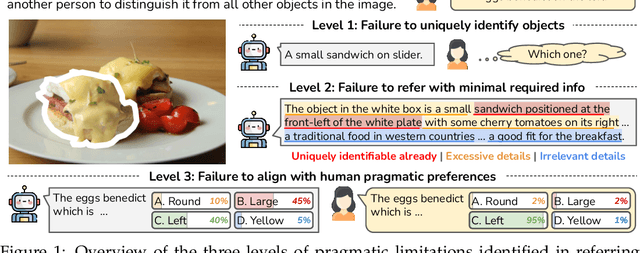
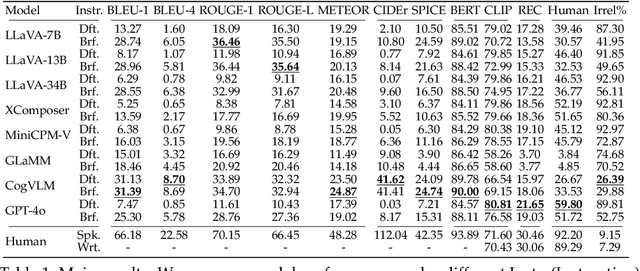
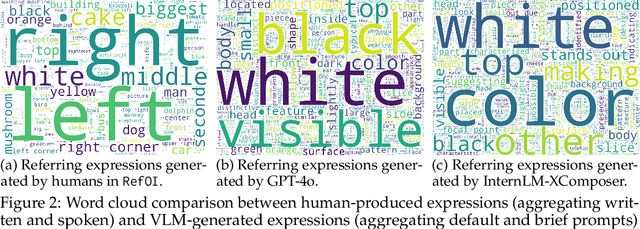
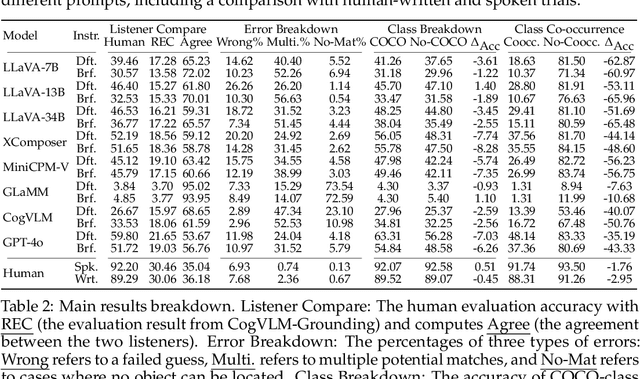
Referring Expression Generation (REG) is a core task for evaluating the pragmatic competence of vision-language systems, requiring not only accurate semantic grounding but also adherence to principles of cooperative communication (Grice, 1975). However, current evaluations of vision-language models (VLMs) often overlook the pragmatic dimension, reducing REG to a region-based captioning task and neglecting Gricean maxims. In this work, we revisit REG from a pragmatic perspective, introducing a new dataset (RefOI) of 1.5k images annotated with both written and spoken referring expressions. Through a systematic evaluation of state-of-the-art VLMs, we identify three key failures of pragmatic competence: (1) failure to uniquely identify the referent, (2) inclusion of excessive or irrelevant information, and (3) misalignment with human pragmatic preference, such as the underuse of minimal spatial cues. We also show that standard automatic evaluations fail to capture these pragmatic violations, reinforcing superficial cues rather than genuine referential success. Our findings call for a renewed focus on pragmatically informed models and evaluation frameworks that align with real human communication.
pTSE: A Multi-model Ensemble Method for Probabilistic Time Series Forecasting
May 16, 2023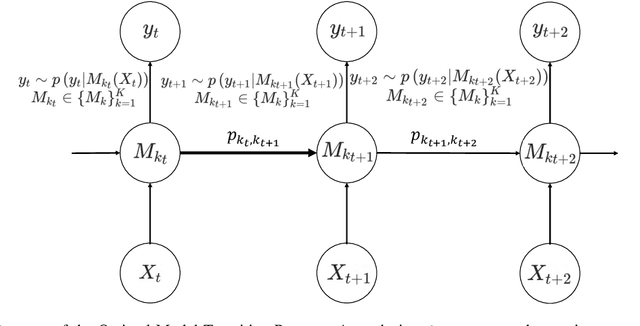
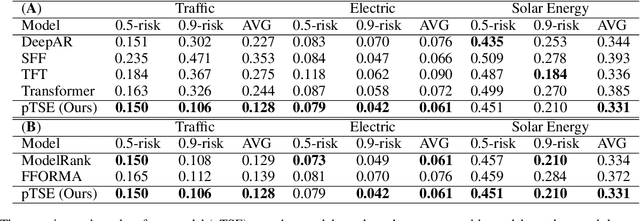
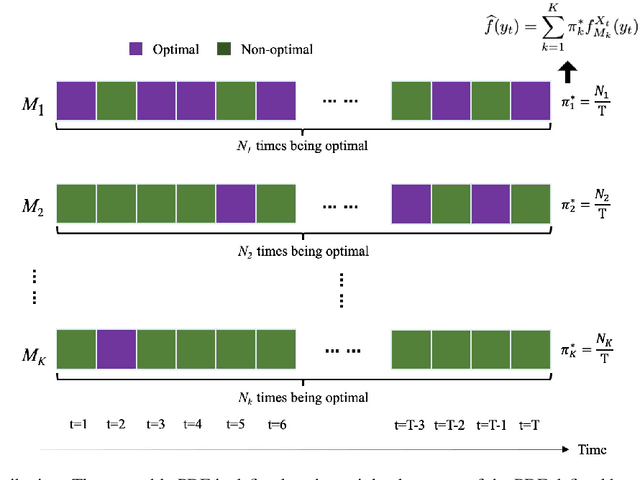
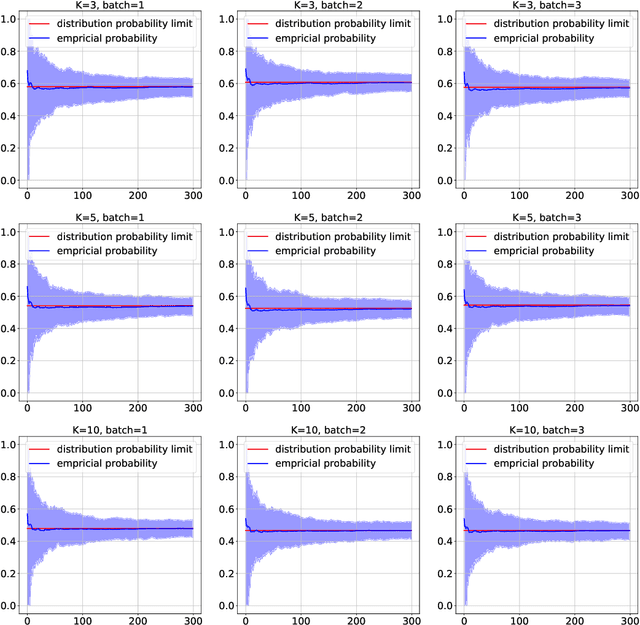
Various probabilistic time series forecasting models have sprung up and shown remarkably good performance. However, the choice of model highly relies on the characteristics of the input time series and the fixed distribution that the model is based on. Due to the fact that the probability distributions cannot be averaged over different models straightforwardly, the current time series model ensemble methods cannot be directly applied to improve the robustness and accuracy of forecasting. To address this issue, we propose pTSE, a multi-model distribution ensemble method for probabilistic forecasting based on Hidden Markov Model (HMM). pTSE only takes off-the-shelf outputs from member models without requiring further information about each model. Besides, we provide a complete theoretical analysis of pTSE to prove that the empirical distribution of time series subject to an HMM will converge to the stationary distribution almost surely. Experiments on benchmarks show the superiority of pTSE overall member models and competitive ensemble methods.