 Add to Chrome
 Add to Firefox
 Add to Edge
Close the Loop: Synthesizing Infinite Tool-Use Data via Multi-Agent Role-Playing
Dec 29, 2025
Enabling Large Language Models (LLMs) to reliably invoke external tools remains a critical bottleneck for autonomous agents. Existing approaches suffer from three fundamental challenges: expensive human annotation for high-quality trajectories, poor generalization to unseen tools, and quality ceilings inherent in single-model synthesis that perpetuate biases and coverage gaps. We introduce InfTool, a fully autonomous framework that breaks these barriers through self-evolving multi-agent synthesis. Given only raw API specifications, InfTool orchestrates three collaborative agents (User Simulator, Tool-Calling Assistant, and MCP Server) to generate diverse, verified trajectories spanning single-turn calls to complex multi-step workflows. The framework establishes a closed loop: synthesized data trains the model via Group Relative Policy Optimization (GRPO) with gated rewards, the improved model generates higher-quality data targeting capability gaps, and this cycle iterates without human intervention. Experiments on the Berkeley Function-Calling Leaderboard (BFCL) demonstrate that InfTool transforms a base 32B model from 19.8% to 70.9% accuracy (+258%), surpassing models 10x larger and rivaling Claude-Opus, and entirely from synthetic data without human annotation.

Autoregressive Flow Matching for Motion Prediction
Dec 27, 2025Motion prediction has been studied in different contexts with models trained on narrow distributions and applied to downstream tasks in human motion prediction and robotics. Simultaneously, recent efforts in scaling video prediction have demonstrated impressive visual realism, yet they struggle to accurately model complex motions despite massive scale. Inspired by the scaling of video generation, we develop autoregressive flow matching (ARFM), a new method for probabilistic modeling of sequential continuous data and train it on diverse video datasets to generate future point track locations over long horizons. To evaluate our model, we develop benchmarks for evaluating the ability of motion prediction models to predict human and robot motion. Our model is able to predict complex motions, and we demonstrate that conditioning robot action prediction and human motion prediction on predicted future tracks can significantly improve downstream task performance. Code and models publicly available at: https://github.com/Johnathan-Xie/arfm-motion-prediction.
A Tool Bottleneck Framework for Clinically-Informed and Interpretable Medical Image Understanding
Dec 24, 2025Recent tool-use frameworks powered by vision-language models (VLMs) improve image understanding by grounding model predictions with specialized tools. Broadly, these frameworks leverage VLMs and a pre-specified toolbox to decompose the prediction task into multiple tool calls (often deep learning models) which are composed to make a prediction. The dominant approach to composing tools is using text, via function calls embedded in VLM-generated code or natural language. However, these methods often perform poorly on medical image understanding, where salient information is encoded as spatially-localized features that are difficult to compose or fuse via text alone. To address this, we propose a tool-use framework for medical image understanding called the Tool Bottleneck Framework (TBF), which composes VLM-selected tools using a learned Tool Bottleneck Model (TBM). For a given image and task, TBF leverages an off-the-shelf medical VLM to select tools from a toolbox that each extract clinically-relevant features. Instead of text-based composition, these tools are composed by the TBM, which computes and fuses the tool outputs using a neural network before outputting the final prediction. We propose a simple and effective strategy for TBMs to make predictions with any arbitrary VLM tool selection. Overall, our framework not only improves tool-use in medical imaging contexts, but also yields more interpretable, clinically-grounded predictors. We evaluate TBF on tasks in histopathology and dermatology and find that these advantages enable our framework to perform on par with or better than deep learning-based classifiers, VLMs, and state-of-the-art tool-use frameworks, with particular gains in data-limited regimes. Our code is available at https://github.com/christinaliu2020/tool-bottleneck-framework.
UCoder: Unsupervised Code Generation by Internal Probing of Large Language Models
Dec 19, 2025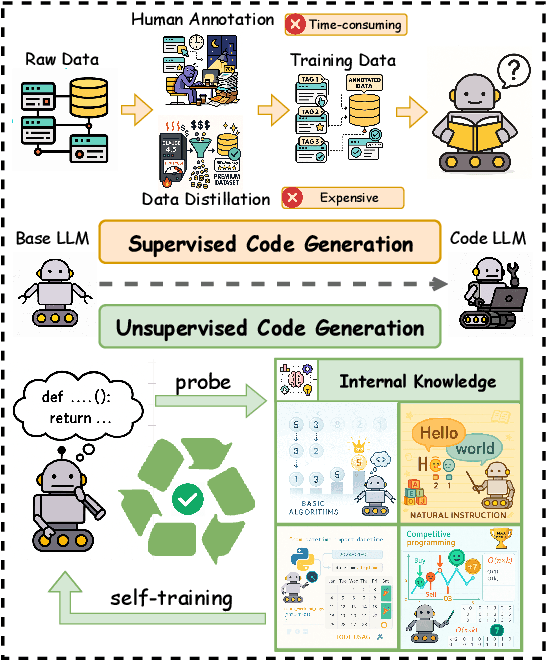
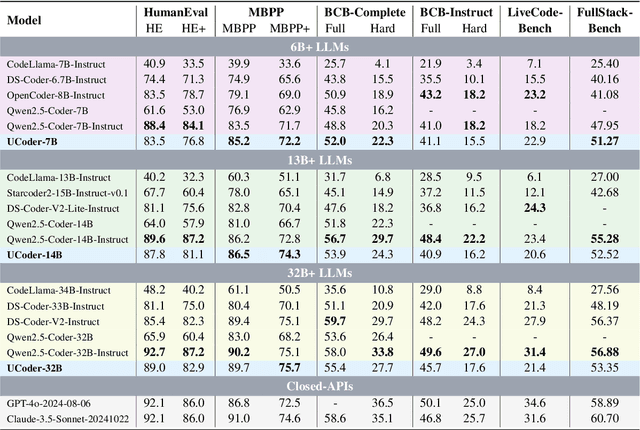
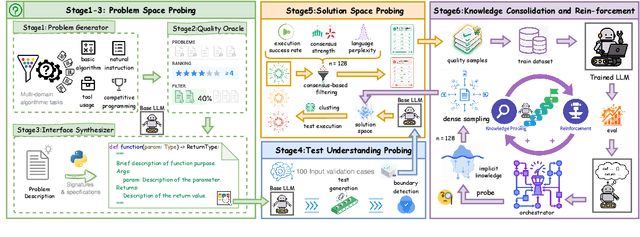
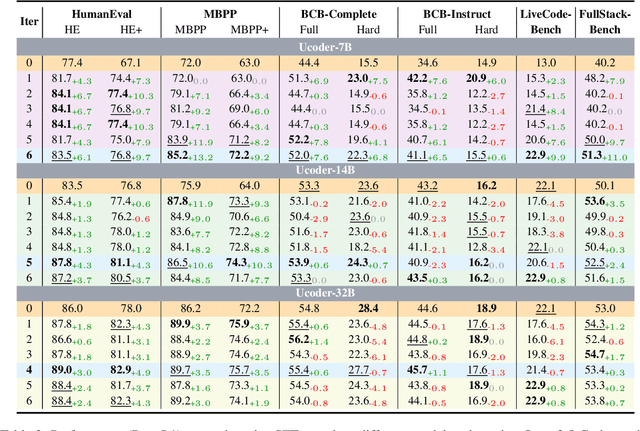
Large language models (LLMs) have demonstrated remarkable capabilities in code generation tasks. However, their effectiveness heavily relies on supervised training with extensive labeled (e.g., question-answering pairs) or unlabeled datasets (e.g., code snippets), which are often expensive and difficult to obtain at scale. To address this limitation, this paper introduces a method IPC, an unsupervised framework that leverages Internal Probing of LLMs for Code generation without any external corpus, even unlabeled code snippets. We introduce the problem space probing, test understanding probing, solution space probing, and knowledge consolidation and reinforcement to probe the internal knowledge and confidence patterns existing in LLMs. Further, IPC identifies reliable code candidates through self-consistency mechanisms and representation-based quality estimation to train UCoder (coder with unsupervised learning). We validate the proposed approach across multiple code benchmarks, demonstrating that unsupervised methods can achieve competitive performance compared to supervised approaches while significantly reducing the dependency on labeled data and computational resources. Analytic experiments reveal that internal model states contain rich signals about code quality and correctness, and that properly harnessing these signals enables effective unsupervised learning for code generation tasks, opening new directions for training code LLMs in resource-constrained scenarios.
VLIC: Vision-Language Models As Perceptual Judges for Human-Aligned Image Compression
Dec 17, 2025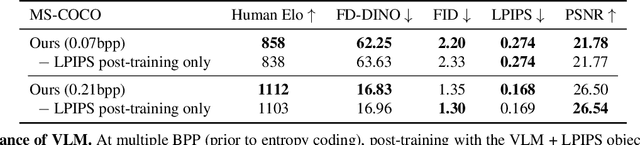
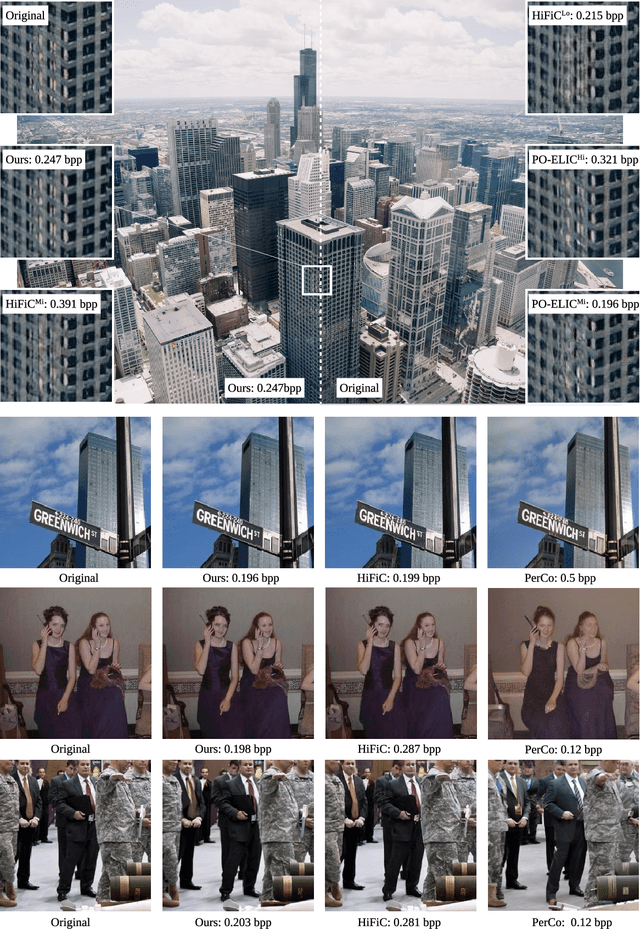
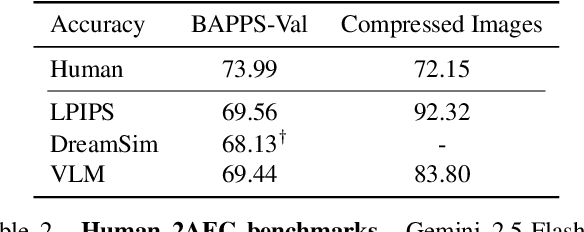
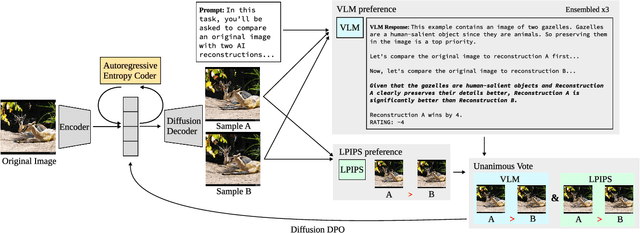
Evaluations of image compression performance which include human preferences have generally found that naive distortion functions such as MSE are insufficiently aligned to human perception. In order to align compression models to human perception, prior work has employed differentiable perceptual losses consisting of neural networks calibrated on large-scale datasets of human psycho-visual judgments. We show that, surprisingly, state-of-the-art vision-language models (VLMs) can replicate binary human two-alternative forced choice (2AFC) judgments zero-shot when asked to reason about the differences between pairs of images. Motivated to exploit the powerful zero-shot visual reasoning capabilities of VLMs, we propose Vision-Language Models for Image Compression (VLIC), a diffusion-based image compression system designed to be post-trained with binary VLM judgments. VLIC leverages existing techniques for diffusion model post-training with preferences, rather than distilling the VLM judgments into a separate perceptual loss network. We show that calibrating this system on VLM judgments produces competitive or state-of-the-art performance on human-aligned visual compression depending on the dataset, according to perceptual metrics and large-scale user studies. We additionally conduct an extensive analysis of the VLM-based reward design and training procedure and share important insights. More visuals are available at https://kylesargent.github.io/vlic
ART: Articulated Reconstruction Transformer
Dec 16, 2025We introduce ART, Articulated Reconstruction Transformer -- a category-agnostic, feed-forward model that reconstructs complete 3D articulated objects from only sparse, multi-state RGB images. Previous methods for articulated object reconstruction either rely on slow optimization with fragile cross-state correspondences or use feed-forward models limited to specific object categories. In contrast, ART treats articulated objects as assemblies of rigid parts, formulating reconstruction as part-based prediction. Our newly designed transformer architecture maps sparse image inputs to a set of learnable part slots, from which ART jointly decodes unified representations for individual parts, including their 3D geometry, texture, and explicit articulation parameters. The resulting reconstructions are physically interpretable and readily exportable for simulation. Trained on a large-scale, diverse dataset with per-part supervision, and evaluated across diverse benchmarks, ART achieves significant improvements over existing baselines and establishes a new state of the art for articulated object reconstruction from image inputs.
WonderZoom: Multi-Scale 3D World Generation
Dec 09, 2025We present WonderZoom, a novel approach to generating 3D scenes with contents across multiple spatial scales from a single image. Existing 3D world generation models remain limited to single-scale synthesis and cannot produce coherent scene contents at varying granularities. The fundamental challenge is the lack of a scale-aware 3D representation capable of generating and rendering content with largely different spatial sizes. WonderZoom addresses this through two key innovations: (1) scale-adaptive Gaussian surfels for generating and real-time rendering of multi-scale 3D scenes, and (2) a progressive detail synthesizer that iteratively generates finer-scale 3D contents. Our approach enables users to "zoom into" a 3D region and auto-regressively synthesize previously non-existent fine details from landscapes to microscopic features. Experiments demonstrate that WonderZoom significantly outperforms state-of-the-art video and 3D models in both quality and alignment, enabling multi-scale 3D world creation from a single image. We show video results and an interactive viewer of generated multi-scale 3D worlds in https://wonderzoom.github.io/
10 Open Challenges Steering the Future of Vision-Language-Action Models
Nov 08, 2025Due to their ability of follow natural language instructions, vision-language-action (VLA) models are increasingly prevalent in the embodied AI arena, following the widespread success of their precursors -- LLMs and VLMs. In this paper, we discuss 10 principal milestones in the ongoing development of VLA models -- multimodality, reasoning, data, evaluation, cross-robot action generalization, efficiency, whole-body coordination, safety, agents, and coordination with humans. Furthermore, we discuss the emerging trends of using spatial understanding, modeling world dynamics, post training, and data synthesis -- all aiming to reach these milestones. Through these discussions, we hope to bring attention to the research avenues that may accelerate the development of VLA models into wider acceptability.
Rotate Both Ways: Time-and-Order RoPE for Generative Recommendation
Oct 23, 2025Generative recommenders, typically transformer-based autoregressive models, predict the next item or action from a user's interaction history. Their effectiveness depends on how the model represents where an interaction event occurs in the sequence (discrete index) and when it occurred in wall-clock time. Prevailing approaches inject time via learned embeddings or relative attention biases. In this paper, we argue that RoPE-based approaches, if designed properly, can be a stronger alternative for jointly modeling temporal and sequential information in user behavior sequences. While vanilla RoPE in LLMs considers only token order, generative recommendation requires incorporating both event time and token index. To address this, we propose Time-and-Order RoPE (TO-RoPE), a family of rotary position embedding designs that treat index and time as angle sources shaping the query-key geometry directly. We present three instantiations: early fusion, split-by-dim, and split-by-head. Extensive experiments on both publicly available datasets and a proprietary industrial dataset show that TO-RoPE variants consistently improve accuracy over existing methods for encoding time and index. These results position rotary embeddings as a simple, principled, and deployment-friendly foundation for generative recommendation.
Coupled Diffusion Sampling for Training-Free Multi-View Image Editing
Oct 16, 2025We present an inference-time diffusion sampling method to perform multi-view consistent image editing using pre-trained 2D image editing models. These models can independently produce high-quality edits for each image in a set of multi-view images of a 3D scene or object, but they do not maintain consistency across views. Existing approaches typically address this by optimizing over explicit 3D representations, but they suffer from a lengthy optimization process and instability under sparse view settings. We propose an implicit 3D regularization approach by constraining the generated 2D image sequences to adhere to a pre-trained multi-view image distribution. This is achieved through coupled diffusion sampling, a simple diffusion sampling technique that concurrently samples two trajectories from both a multi-view image distribution and a 2D edited image distribution, using a coupling term to enforce the multi-view consistency among the generated images. We validate the effectiveness and generality of this framework on three distinct multi-view image editing tasks, demonstrating its applicability across various model architectures and highlighting its potential as a general solution for multi-view consistent editing.