 Add to Chrome
 Add to Firefox
 Add to Edge
HistoGPA: A Context-Conditioned Gene-Prior Attention Framework for Histology-Based Spatial Gene Expression Prediction
Jul 27, 2026
Predicting spatial gene expression from routine hematoxylin and eosin (H&E) images provides a practical complement to experimental spatial transcriptomics. Existing approaches focus on local or multi-scale visual features and often treat pretrained gene representations as fixed priors, although the interpretation of local morphology and the relevance of gene priors depend on tissue context. We propose HistoGPA, a context-conditioned gene-prior attention framework that uses a shared slide-level representation in two parallel pathways: one modulates local morphological features, whereas the other conditions pretrained gene embeddings and retrieves gene-prior information through cross-attention. This design enables each spatial location to retrieve context-adapted gene-prior information using its local morphology, position, and slide context. Across ten cancer types in HEST-1k, HistoGPA achieves the highest macro-averaged gene-wise Pearson correlation coefficient among the compared methods under the same evaluation protocol for both the top-50 and top-1,500 highly variable gene sets. Additional analyses show that HistoGPA better recovers the spatial expression patterns of cancer-associated genes and yields greater agreement between clusters derived independently from predicted and ground-truth expression profiles. Together, these findings motivate a context-dependent view of histology-to-expression prediction, in which local morphological representations and gene priors are jointly adapted to the broader tissue context.

Thinking in Video: Can Video Generators Really Reason About the Real World?
Jul 20, 2026Recent advances in world models and video generation have given rise to an emerging reasoning paradigm that leverages video generative models to simulate, predict, and reason about real-world dynamics. We redefine this paradigm as Thinking in Video, where video is not merely an output artifact but a medium for constructing, extending, and verifying causal thought. However, this promise remains unverified: convincing rollouts may reflect memorized appearances rather than causal understanding, while existing metrics separate perceptual fidelity from semantic logic. To evaluate whether video generators support such reasoning, we introduce the Causal-Generative Dual-Judge (CGDJ), auditing World Model Consistency from two perspectives. Explicit Causal Perception tests whether a generator reads a video scenario as a reasoning problem through spatio-temporal flattened visual question answering, while Implicit Generative Perception-Prediction Gap evaluates whether it renders the causal consequence as a consistent future video. Applying CGDJ to representative open- and closed-source generators reveals a clear Perception-Prediction Gap: open-source models produce plausible dynamics despite near-zero explicit causal perception, whereas advanced closed-source systems show stronger but still limited alignment between reasoning and generation. Further analysis exposes audio-visual misalignment, where models verbalize correct causal logic more reliably than they render it, challenging the "world simulator" narrative.
FedACT: Federated Adaptive Coordinate Trust Modulation for Robust Transformer Training under Data Heterogeneity
Jul 04, 2026Federated Transformer training increasingly relies on local AdamW, whose adaptive updates can provide much stronger local progress than SGD-based training. However, under heterogeneous client data, even globally corrected AdamW updates may remain highly uneven in coordinate-wise reliability. We refer to this phenomenon as coordinate trust mismatch. Existing federated adaptive optimizers mainly address mismatch at the client-update or communication-round level, but still apply the corrected adaptive direction densely and uniformly across coordinates. In this paper, we propose FedACT, a global-aware coordinate trust modulation method for federated AdamW training. FedACT first forms a globally corrected adaptive direction and then reallocates update magnitudes according to a coordinate-wise trust score, assigning larger steps to coordinates jointly supported by local gradients and global correction, while preserving smaller non-zero updates on the remaining coordinates. Extensive experiments on federated vision Transformers, CNNs, LLM pre-training, and LLM fine-tuning show that FedACT consistently improves over strong federated adaptive baselines, with the largest gains on Transformer models under stronger data heterogeneity. Mechanism analyses further show that FedACT improves cross-client direction consistency, suggesting that coordinate-level trust allocation effectively complements round-level global-local correction. Code will be released.
From Chatbot to Digital Colleague: The Paradigm Shift Toward Persistent Autonomous AI
Jun 12, 2026Large Language Models (LLMs) are undergoing a fundamental transformation from conversational generators into integrated AI systems capable of reasoning, action, memory, and self-improvement. We conceptualize this transition as a shift from Chatbot to Digital Colleague: from conversational answers to persistent work. We organize this transition along two tightly coupled dimensions. First, at the cognitive core level, LLMs are advancing from Chatbot-era "fast thinking" systems driven by next-token prediction toward Thinking LLMs that leverage inference-time computation, Chain-of-Thought reasoning, reflection, process supervision, and reinforcement learning to support more deliberate and reliable cognition. Second, at the tool-augmented task execution level, LLMs are progressing from tool-calling Agents that invoke external resources in an ad hoc manner toward OpenClaw-style workstation systems (OpenClaw) equipped with persistent Workspaces, skills, verification loops, and governance. The "Workspace + Skill" paradigm makes episodic tool use colleague-like via state persistence, reusable procedures, task closure, and experience reuse. We examine data construction shifts from instruction-response pairs to State-Action-Observation trajectories and evaluation from static benchmarks to sandboxed, auditable, self-evolving AI ecosystems.
Microwave Linear Analog Computer (MiLAC)-Aided MIMO Radar Sensing: Transmit Beamforming Design and DoA Estimation
May 20, 2026Multiple-input multiple-output (MIMO) radar has waveform diversity and large spatial degrees of freedom (DoFs), making it attractive for high-resolution sensing. Scaling MIMO radar to massive arrays can further improve sensing performance, but it also increases hardware cost, power consumption, and digital processing complexity. The microwave linear analog computer (MiLAC) can tackle these challenges by moving linear operations from the digital domain to the analog domain. MiLAC has shown promising benefits for communications in recent studies and this paper identifies its potential for radar sensing. Specifically, we consider both MiLAC-aided transmit beamforming and receiver-side two-dimensional discrete Fourier transform (2D-DFT)-based direction-of-arrival (DoA) estimation. For transmit beamforming, we formulate a weighted Cramer Rao bound (CRB) minimization problem under lossless and reciprocal MiLAC constraints and propose a penalty dual decomposition (PDD)-based iterative algorithm to address the non-convex problem. We further prove that MiLAC-aided and fully-digital beamforming achieve the same CRB. For receiver processing, we show that the 2D DFT can be implemented by a lossless reciprocal MiLAC, which enables analog-domain DoA estimation without digital optimization. Numerical results confirm the theoretical finding and show that the MiLAC-aided approach achieves the same CRB and DoA estimation performance as the fully-digital benchmark. Meanwhile, hardware cost and power consumption are reduced because only low-resolution DACs are required at the transmitter, while RF chains and ADCs are eliminated at the receiver. Moreover, performing the 2D DFT in the analog domain eliminates all digital DFT operations for DoA estimation.
OpenRoboCare: A Multimodal Multi-Task Expert Demonstration Dataset for Robot Caregiving
Nov 17, 2025We present OpenRoboCare, a multimodal dataset for robot caregiving, capturing expert occupational therapist demonstrations of Activities of Daily Living (ADLs). Caregiving tasks involve complex physical human-robot interactions, requiring precise perception under occlusions, safe physical contact, and long-horizon planning. While recent advances in robot learning from demonstrations have shown promise, there is a lack of a large-scale, diverse, and expert-driven dataset that captures real-world caregiving routines. To address this gap, we collect data from 21 occupational therapists performing 15 ADL tasks on two manikins. The dataset spans five modalities: RGB-D video, pose tracking, eye-gaze tracking, task and action annotations, and tactile sensing, providing rich multimodal insights into caregiver movement, attention, force application, and task execution strategies. We further analyze expert caregiving principles and strategies, offering insights to improve robot efficiency and task feasibility. Additionally, our evaluations demonstrate that OpenRoboCare presents challenges for state-of-the-art robot perception and human activity recognition methods, both critical for developing safe and adaptive assistive robots, highlighting the value of our contribution. See our website for additional visualizations: https://emprise.cs.cornell.edu/robo-care/.
FEAST: A Flexible Mealtime-Assistance System Towards In-the-Wild Personalization
Jun 17, 2025Physical caregiving robots hold promise for improving the quality of life of millions worldwide who require assistance with feeding. However, in-home meal assistance remains challenging due to the diversity of activities (e.g., eating, drinking, mouth wiping), contexts (e.g., socializing, watching TV), food items, and user preferences that arise during deployment. In this work, we propose FEAST, a flexible mealtime-assistance system that can be personalized in-the-wild to meet the unique needs of individual care recipients. Developed in collaboration with two community researchers and informed by a formative study with a diverse group of care recipients, our system is guided by three key tenets for in-the-wild personalization: adaptability, transparency, and safety. FEAST embodies these principles through: (i) modular hardware that enables switching between assisted feeding, drinking, and mouth-wiping, (ii) diverse interaction methods, including a web interface, head gestures, and physical buttons, to accommodate diverse functional abilities and preferences, and (iii) parameterized behavior trees that can be safely and transparently adapted using a large language model. We evaluate our system based on the personalization requirements identified in our formative study, demonstrating that FEAST offers a wide range of transparent and safe adaptations and outperforms a state-of-the-art baseline limited to fixed customizations. To demonstrate real-world applicability, we conduct an in-home user study with two care recipients (who are community researchers), feeding them three meals each across three diverse scenarios. We further assess FEAST's ecological validity by evaluating with an Occupational Therapist previously unfamiliar with the system. In all cases, users successfully personalize FEAST to meet their individual needs and preferences. Website: https://emprise.cs.cornell.edu/feast
Coloring Between the Lines: Personalization in the Null Space of Planning Constraints
May 21, 2025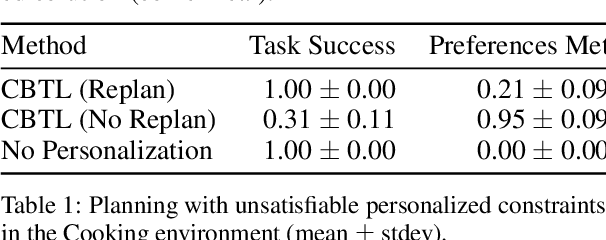
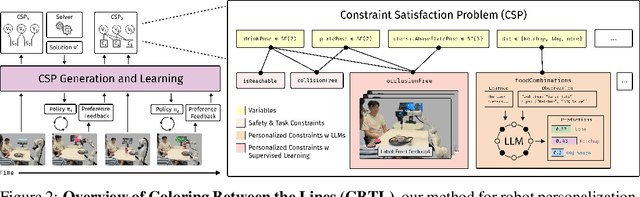
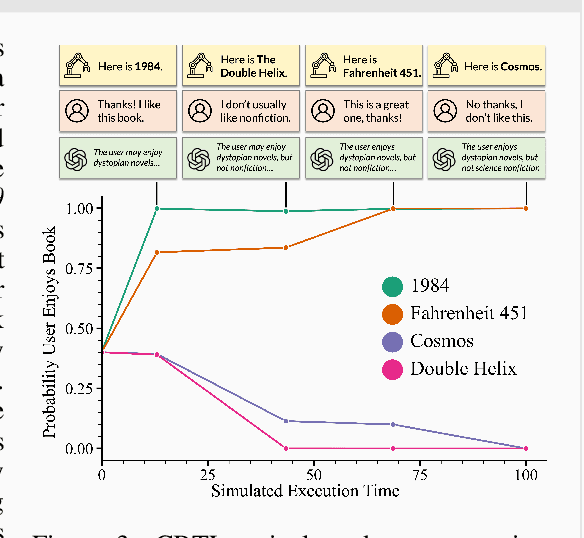
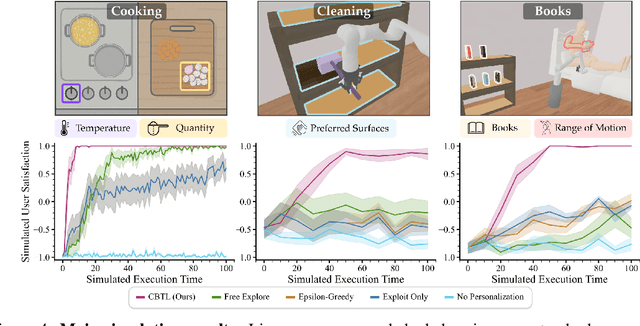
Generalist robots must personalize in-the-wild to meet the diverse needs and preferences of long-term users. How can we enable flexible personalization without sacrificing safety or competency? This paper proposes Coloring Between the Lines (CBTL), a method for personalization that exploits the null space of constraint satisfaction problems (CSPs) used in robot planning. CBTL begins with a CSP generator that ensures safe and competent behavior, then incrementally personalizes behavior by learning parameterized constraints from online interaction. By quantifying uncertainty and leveraging the compositionality of planning constraints, CBTL achieves sample-efficient adaptation without environment resets. We evaluate CBTL in (1) three diverse simulation environments; (2) a web-based user study; and (3) a real-robot assisted feeding system, finding that CBTL consistently achieves more effective personalization with fewer interactions than baselines. Our results demonstrate that CBTL provides a unified and practical approach for continual, flexible, active, and safe robot personalization. Website: https://emprise.cs.cornell.edu/cbtl/
GRACE: Generalizing Robot-Assisted Caregiving with User Functionality Embeddings
Jan 29, 2025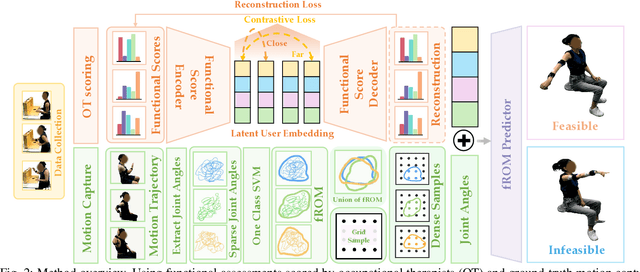
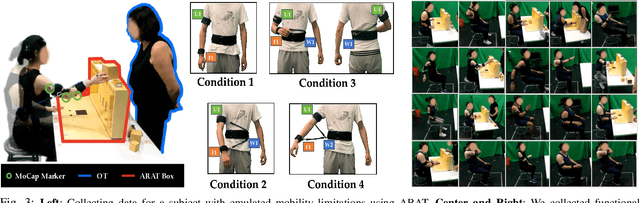
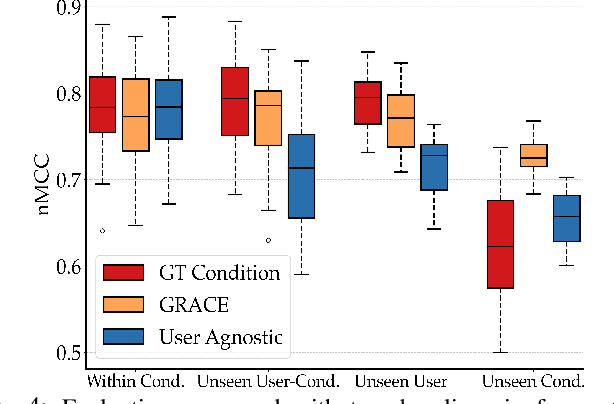
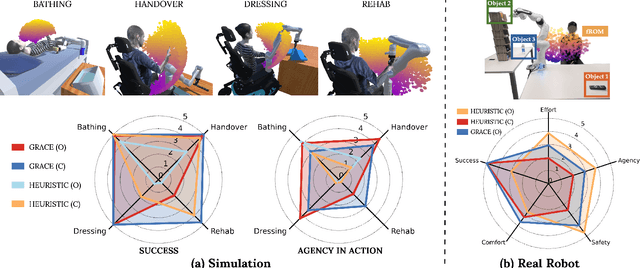
Robot caregiving should be personalized to meet the diverse needs of care recipients -- assisting with tasks as needed, while taking user agency in action into account. In physical tasks such as handover, bathing, dressing, and rehabilitation, a key aspect of this diversity is the functional range of motion (fROM), which can vary significantly between individuals. In this work, we learn to predict personalized fROM as a way to generalize robot decision-making in a wide range of caregiving tasks. We propose a novel data-driven method for predicting personalized fROM using functional assessment scores from occupational therapy. We develop a neural model that learns to embed functional assessment scores into a latent representation of the user's physical function. The model is trained using motion capture data collected from users with emulated mobility limitations. After training, the model predicts personalized fROM for new users without motion capture. Through simulated experiments and a real-robot user study, we show that the personalized fROM predictions from our model enable the robot to provide personalized and effective assistance while improving the user's agency in action. See our website for more visualizations: https://emprise.cs.cornell.edu/grace/.
Non-reciprocal Beyond Diagonal RIS: Sum-Rate Maximization in Full-Duplex Communications
Dec 07, 2024


Reconfigurable intelligent surface (RIS) has been envisioned as a key technology in future wireless communication networks to enable smart radio environment. To further enhance the passive beamforming capability of RIS, beyond diagonal (BD)-RIS has been proposed considering reconfigurable interconnections among different RIS elements. BD-RIS has a unique feature that cannot be enabled by conventional diagonal RIS; it can be realized by non-reciprocal circuits and thus enables an asymmetric scattering matrix. This feature provides the capability to break the wireless channel reciprocity, and has the potential to benefit full-duplex (FD) systems. In this paper, we model the BD RIS-assisted FD systems, where the impact of BD-RIS non-reciprocity and that of structural scattering, which refers to the specular reflection generated by RIS when the RIS is turned OFF, are explicitly captured. To assess the benefits of non-reciprocal BD-RIS, we optimise the scattering matrix, precoder and combiner to maximize the DL and UL sum-rates in the FD system. To tackle this optimization problem, we propose an iterative algorithm based on block coordination descent (BCD) and penalty dual decomposition (PDD). Numerical results demonstrate surprising benefits of non-reciprocal BD-RIS that it can achieve much higher DL and UL sum-rates in the FD scenario than reciprocal BD-RIS and conventional diagonal RIS.