 Add to Chrome
 Add to Firefox
 Add to Edge
AnyLift: Scaling Motion Reconstruction from Internet Videos via 2D Diffusion
Apr 20, 2026
Reconstructing 3D human motion and human-object interactions (HOI) from Internet videos is a fundamental step toward building large-scale datasets of human behavior. Existing methods struggle to recover globally consistent 3D motion under dynamic cameras, especially for motion types underrepresented in current motion-capture datasets, and face additional difficulty recovering coherent human-object interactions in 3D. We introduce a two-stage framework leveraging 2D diffusion that reconstructs 3D human motion and HOI from Internet videos. In the first stage, we synthesize multi-view 2D motion data for each domain, leveraging 2D keypoints extracted from Internet videos to incorporate human motions that rarely appear in existing MoCap datasets. In the second stage, a camera-conditioned multi-view 2D motion diffusion model is trained on the domain-specific synthetic data to recover 3D human motion and 3D HOI in the world space. We demonstrate the effectiveness of our method on Internet videos featuring challenging motions such as gymnastics, as well as in-the-wild HOI videos, and show that it outperforms prior work in producing realistic human motion and human-object interaction.

IMPASTO: Integrating Model-Based Planning with Learned Dynamics Models for Robotic Oil Painting Reproduction
Mar 31, 2026Robotic reproduction of oil paintings using soft brushes and pigments requires force-sensitive control of deformable tools, prediction of brushstroke effects, and multi-step stroke planning, often without human step-by-step demonstrations or faithful simulators. Given only a sequence of target oil painting images, can a robot infer and execute the stroke trajectories, forces, and colors needed to reproduce it? We present IMPASTO, a robotic oil-painting system that integrates learned pixel dynamics models with model-based planning. The dynamics models predict canvas updates from image observations and parameterized stroke actions; a receding-horizon model predictive control optimizer then plans trajectories and forces, while a force-sensitive controller executes strokes on a 7-DoF robot arm. IMPASTO integrates low-level force control, learned dynamics models, and high-level closed-loop planning, learns solely from robot self-play, and approximates human artists' single-stroke datasets and multi-stroke artworks, outperforming baselines in reproduction accuracy. Project website: https://impasto-robopainting.github.io/
Physion-Eval: Evaluating Physical Realism in Generated Video via Human Reasoning
Mar 20, 2026Video generation models are increasingly used as world simulators for storytelling, simulation, and embodied AI. As these models advance, a key question arises: do generated videos obey the physical laws of the real world? Existing evaluations largely rely on automated metrics or coarse human judgments such as preferences or rubric-based checks. While useful for assessing perceptual quality, these methods provide limited insight into when and why generated dynamics violate real-world physical constraints. We introduce Physion-Eval, a large-scale benchmark of expert human reasoning for diagnosing physical realism failures in videos generated by five state-of-the-art models across egocentric and exocentric views, containing 10,990 expert reasoning traces spanning 22 fine-grained physical categories. Each generated video is derived from a corresponding real-world reference video depicting a clear physical process, and annotated with temporally localized glitches, structured failure categories, and natural-language explanations of the violated physical behavior. Using this dataset, we reveal a striking limitation of current video generation models: in physics-critical scenarios, 83.3% of exocentric and 93.5% of egocentric generated videos exhibit at least one human-identifiable physical glitch. We hope Physion-Eval will set a new standard for physical realism evaluation and guide the development of physics-grounded video generation. The benchmark is publicly available at https://huggingface.co/datasets/PhysionLabs/Physion-Eval.
RealWonder: Real-Time Physical Action-Conditioned Video Generation
Mar 05, 2026Current video generation models cannot simulate physical consequences of 3D actions like forces and robotic manipulations, as they lack structural understanding of how actions affect 3D scenes. We present RealWonder, the first real-time system for action-conditioned video generation from a single image. Our key insight is using physics simulation as an intermediate bridge: instead of directly encoding continuous actions, we translate them through physics simulation into visual representations (optical flow and RGB) that video models can process. RealWonder integrates three components: 3D reconstruction from single images, physics simulation, and a distilled video generator requiring only 4 diffusion steps. Our system achieves 13.2 FPS at 480x832 resolution, enabling interactive exploration of forces, robot actions, and camera controls on rigid objects, deformable bodies, fluids, and granular materials. We envision RealWonder opens new opportunities to apply video models in immersive experiences, AR/VR, and robot learning. Our code and model weights are publicly available in our project website: https://liuwei283.github.io/RealWonder/
SurfPhase: 3D Interfacial Dynamics in Two-Phase Flows from Sparse Videos
Feb 11, 2026Interfacial dynamics in two-phase flows govern momentum, heat, and mass transfer, yet remain difficult to measure experimentally. Classical techniques face intrinsic limitations near moving interfaces, while existing neural rendering methods target single-phase flows with diffuse boundaries and cannot handle sharp, deformable liquid-vapor interfaces. We propose SurfPhase, a novel model for reconstructing 3D interfacial dynamics from sparse camera views. Our approach integrates dynamic Gaussian surfels with a signed distance function formulation for geometric consistency, and leverages a video diffusion model to synthesize novel-view videos to refine reconstruction from sparse observations. We evaluate on a new dataset of high-speed pool boiling videos, demonstrating high-quality view synthesis and velocity estimation from only two camera views. Project website: https://yuegao.me/SurfPhase.
PerpetualWonder: Long-Horizon Action-Conditioned 4D Scene Generation
Feb 04, 2026We introduce PerpetualWonder, a hybrid generative simulator that enables long-horizon, action-conditioned 4D scene generation from a single image. Current works fail at this task because their physical state is decoupled from their visual representation, which prevents generative refinements to update the underlying physics for subsequent interactions. PerpetualWonder solves this by introducing the first true closed-loop system. It features a novel unified representation that creates a bidirectional link between the physical state and visual primitives, allowing generative refinements to correct both the dynamics and appearance. It also introduces a robust update mechanism that gathers supervision from multiple viewpoints to resolve optimization ambiguity. Experiments demonstrate that from a single image, PerpetualWonder can successfully simulate complex, multi-step interactions from long-horizon actions, maintaining physical plausibility and visual consistency.
WonderZoom: Multi-Scale 3D World Generation
Dec 09, 2025We present WonderZoom, a novel approach to generating 3D scenes with contents across multiple spatial scales from a single image. Existing 3D world generation models remain limited to single-scale synthesis and cannot produce coherent scene contents at varying granularities. The fundamental challenge is the lack of a scale-aware 3D representation capable of generating and rendering content with largely different spatial sizes. WonderZoom addresses this through two key innovations: (1) scale-adaptive Gaussian surfels for generating and real-time rendering of multi-scale 3D scenes, and (2) a progressive detail synthesizer that iteratively generates finer-scale 3D contents. Our approach enables users to "zoom into" a 3D region and auto-regressively synthesize previously non-existent fine details from landscapes to microscopic features. Experiments demonstrate that WonderZoom significantly outperforms state-of-the-art video and 3D models in both quality and alignment, enabling multi-scale 3D world creation from a single image. We show video results and an interactive viewer of generated multi-scale 3D worlds in https://wonderzoom.github.io/
WonderPlay: Dynamic 3D Scene Generation from a Single Image and Actions
May 23, 2025WonderPlay is a novel framework integrating physics simulation with video generation for generating action-conditioned dynamic 3D scenes from a single image. While prior works are restricted to rigid body or simple elastic dynamics, WonderPlay features a hybrid generative simulator to synthesize a wide range of 3D dynamics. The hybrid generative simulator first uses a physics solver to simulate coarse 3D dynamics, which subsequently conditions a video generator to produce a video with finer, more realistic motion. The generated video is then used to update the simulated dynamic 3D scene, closing the loop between the physics solver and the video generator. This approach enables intuitive user control to be combined with the accurate dynamics of physics-based simulators and the expressivity of diffusion-based video generators. Experimental results demonstrate that WonderPlay enables users to interact with various scenes of diverse content, including cloth, sand, snow, liquid, smoke, elastic, and rigid bodies -- all using a single image input. Code will be made public. Project website: https://kyleleey.github.io/WonderPlay/
Digital Twin Catalog: A Large-Scale Photorealistic 3D Object Digital Twin Dataset
Apr 11, 2025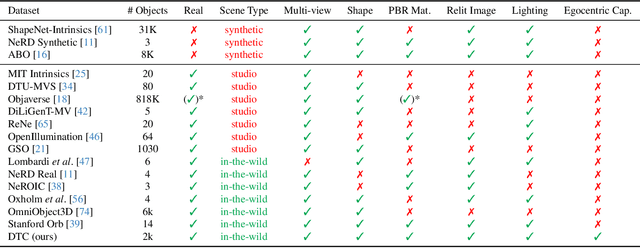
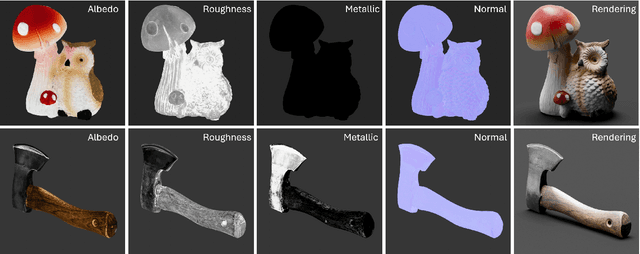

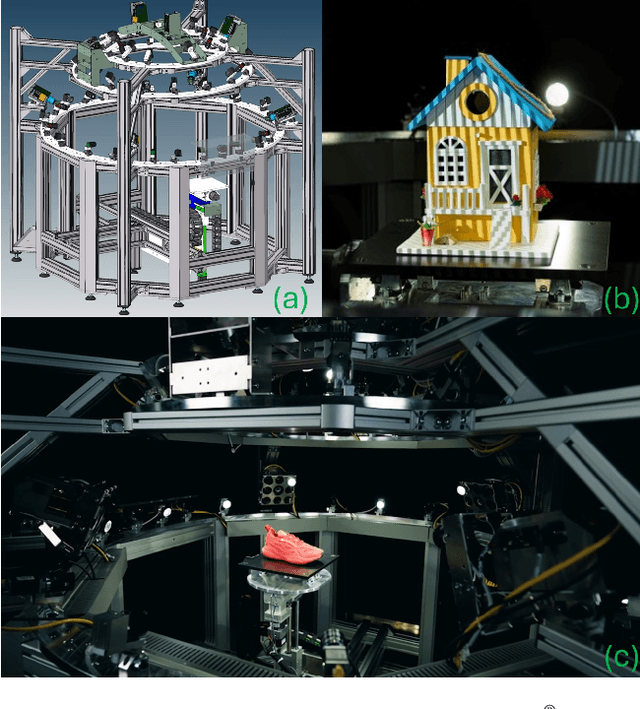
We introduce Digital Twin Catalog (DTC), a new large-scale photorealistic 3D object digital twin dataset. A digital twin of a 3D object is a highly detailed, virtually indistinguishable representation of a physical object, accurately capturing its shape, appearance, physical properties, and other attributes. Recent advances in neural-based 3D reconstruction and inverse rendering have significantly improved the quality of 3D object reconstruction. Despite these advancements, there remains a lack of a large-scale, digital twin quality real-world dataset and benchmark that can quantitatively assess and compare the performance of different reconstruction methods, as well as improve reconstruction quality through training or fine-tuning. Moreover, to democratize 3D digital twin creation, it is essential to integrate creation techniques with next-generation egocentric computing platforms, such as AR glasses. Currently, there is no dataset available to evaluate 3D object reconstruction using egocentric captured images. To address these gaps, the DTC dataset features 2,000 scanned digital twin-quality 3D objects, along with image sequences captured under different lighting conditions using DSLR cameras and egocentric AR glasses. This dataset establishes the first comprehensive real-world evaluation benchmark for 3D digital twin creation tasks, offering a robust foundation for comparing and improving existing reconstruction methods. The DTC dataset is already released at https://www.projectaria.com/datasets/dtc/ and we will also make the baseline evaluations open-source.
WorldScore: A Unified Evaluation Benchmark for World Generation
Apr 01, 2025We introduce the WorldScore benchmark, the first unified benchmark for world generation. We decompose world generation into a sequence of next-scene generation tasks with explicit camera trajectory-based layout specifications, enabling unified evaluation of diverse approaches from 3D and 4D scene generation to video generation models. The WorldScore benchmark encompasses a curated dataset of 3,000 test examples that span diverse worlds: static and dynamic, indoor and outdoor, photorealistic and stylized. The WorldScore metrics evaluate generated worlds through three key aspects: controllability, quality, and dynamics. Through extensive evaluation of 19 representative models, including both open-source and closed-source ones, we reveal key insights and challenges for each category of models. Our dataset, evaluation code, and leaderboard can be found at https://haoyi-duan.github.io/WorldScore/