 Add to Chrome
 Add to Firefox
 Add to Edge
Next-Scale Autoregressive Models for Text-to-Motion Generation
Apr 04, 2026
Autoregressive (AR) models offer stable and efficient training, but standard next-token prediction is not well aligned with the temporal structure required for text-conditioned motion generation. We introduce MoScale, a next-scale AR framework that generates motion hierarchically from coarse to fine temporal resolutions. By providing global semantics at the coarsest scale and refining them progressively, MoScale establishes a causal hierarchy better suited for long-range motion structure. To improve robustness under limited text-motion data, we further incorporate cross-scale hierarchical refinement for improving per-scale initial predictions and in-scale temporal refinement for selective bidirectional re-prediction. MoScale achieves SOTA text-to-motion performance with high training efficiency, scales effectively with model size, and generalizes zero-shot to diverse motion generation and editing tasks.

OmniGuide: Universal Guidance Fields for Enhancing Generalist Robot Policies
Mar 09, 2026Vision-language-action(VLA) models have shown great promise as generalist policies for a large range of relatively simple tasks. However, they demonstrate limited performance on more complex tasks, such as those requiring complex spatial or semantic understanding, manipulation in clutter, or precise manipulation. We propose OMNIGUIDE, a flexible framework that improves VLA performance on such tasks by leveraging arbitrary sources of guidance, such as 3D foundation models, semantic-reasoning VLMs, and human pose models. We show how many kinds of guidance can be naturally expressed as differentiable energy functions with task-specific attractors and repellers located in 3D space, that influence the sampling of VLA actions. In this way, OMNIGUIDE enables guidance sources with complementary task-relevant strengths to improve a VLA model's performance on challenging tasks. Extensive experiments in both simulation and real-world environments, across diverse sources of guidance, demonstrate that OMNIGUIDE enhances the performance of state-of-the-art generalist policies (e.g., $π_{0.5}$, GR00T N1.6) significantly across success and safety rates. Critically, our unified framework matches or surpasses the performance of prior methods designed to incorporate specific sources of guidance into VLA policies. Project Page: $\href{https://omniguide.github.io/}{this \; url}$
tttLRM: Test-Time Training for Long Context and Autoregressive 3D Reconstruction
Feb 23, 2026We propose tttLRM, a novel large 3D reconstruction model that leverages a Test-Time Training (TTT) layer to enable long-context, autoregressive 3D reconstruction with linear computational complexity, further scaling the model's capability. Our framework efficiently compresses multiple image observations into the fast weights of the TTT layer, forming an implicit 3D representation in the latent space that can be decoded into various explicit formats, such as Gaussian Splats (GS) for downstream applications. The online learning variant of our model supports progressive 3D reconstruction and refinement from streaming observations. We demonstrate that pretraining on novel view synthesis tasks effectively transfers to explicit 3D modeling, resulting in improved reconstruction quality and faster convergence. Extensive experiments show that our method achieves superior performance in feedforward 3D Gaussian reconstruction compared to state-of-the-art approaches on both objects and scenes.
Zero-shot Reconstruction of In-Scene Object Manipulation from Video
Dec 22, 2025


We build the first system to address the problem of reconstructing in-scene object manipulation from a monocular RGB video. It is challenging due to ill-posed scene reconstruction, ambiguous hand-object depth, and the need for physically plausible interactions. Existing methods operate in hand centric coordinates and ignore the scene, hindering metric accuracy and practical use. In our method, we first use data-driven foundation models to initialize the core components, including the object mesh and poses, the scene point cloud, and the hand poses. We then apply a two-stage optimization that recovers a complete hand-object motion from grasping to interaction, which remains consistent with the scene information observed in the input video.
DIMO: Diverse 3D Motion Generation for Arbitrary Objects
Nov 10, 2025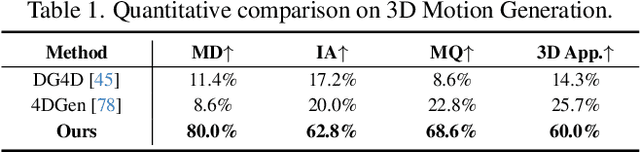
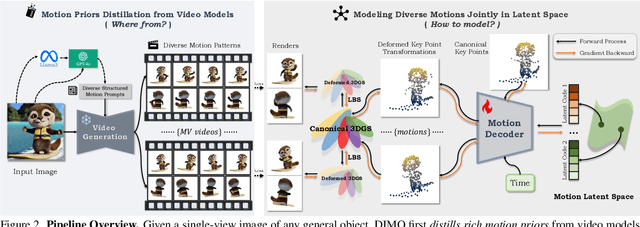
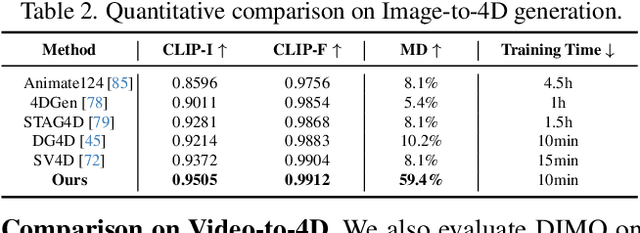
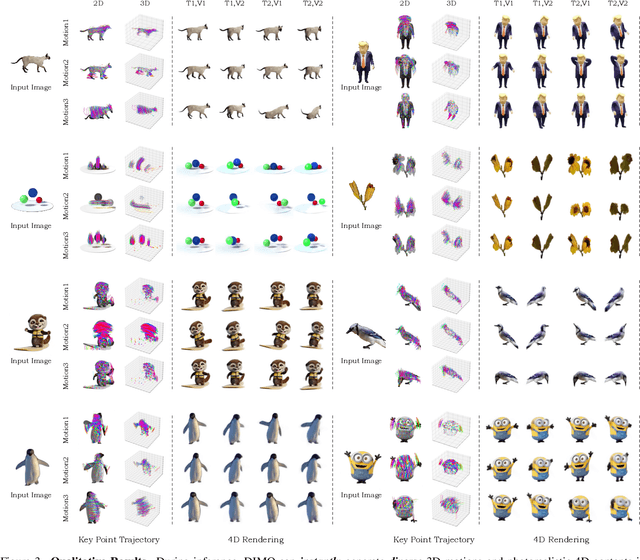
We present DIMO, a generative approach capable of generating diverse 3D motions for arbitrary objects from a single image. The core idea of our work is to leverage the rich priors in well-trained video models to extract the common motion patterns and then embed them into a shared low-dimensional latent space. Specifically, we first generate multiple videos of the same object with diverse motions. We then embed each motion into a latent vector and train a shared motion decoder to learn the distribution of motions represented by a structured and compact motion representation, i.e., neural key point trajectories. The canonical 3D Gaussians are then driven by these key points and fused to model the geometry and appearance. During inference time with learned latent space, we can instantly sample diverse 3D motions in a single-forward pass and support several interesting applications including 3D motion interpolation and language-guided motion generation. Our project page is available at https://linzhanm.github.io/dimo.
FormCoach: Lift Smarter, Not Harder
Aug 10, 2025Good form is the difference between strength and strain, yet for the fast-growing community of at-home fitness enthusiasts, expert feedback is often out of reach. FormCoach transforms a simple camera into an always-on, interactive AI training partner, capable of spotting subtle form errors and delivering tailored corrections in real time, leveraging vision-language models (VLMs). We showcase this capability through a web interface and benchmark state-of-the-art VLMs on a dataset of 1,700 expert-annotated user-reference video pairs spanning 22 strength and mobility exercises. To accelerate research in AI-driven coaching, we release both the dataset and an automated, rubric-based evaluation pipeline, enabling standardized comparison across models. Our benchmarks reveal substantial gaps compared to human-level coaching, underscoring both the challenges and opportunities in integrating nuanced, context-aware movement analysis into interactive AI systems. By framing form correction as a collaborative and creative process between humans and machines, FormCoach opens a new frontier in embodied AI.
StereoDiff: Stereo-Diffusion Synergy for Video Depth Estimation
Jun 25, 2025


Recent video depth estimation methods achieve great performance by following the paradigm of image depth estimation, i.e., typically fine-tuning pre-trained video diffusion models with massive data. However, we argue that video depth estimation is not a naive extension of image depth estimation. The temporal consistency requirements for dynamic and static regions in videos are fundamentally different. Consistent video depth in static regions, typically backgrounds, can be more effectively achieved via stereo matching across all frames, which provides much stronger global 3D cues. While the consistency for dynamic regions still should be learned from large-scale video depth data to ensure smooth transitions, due to the violation of triangulation constraints. Based on these insights, we introduce StereoDiff, a two-stage video depth estimator that synergizes stereo matching for mainly the static areas with video depth diffusion for maintaining consistent depth transitions in dynamic areas. We mathematically demonstrate how stereo matching and video depth diffusion offer complementary strengths through frequency domain analysis, highlighting the effectiveness of their synergy in capturing the advantages of both. Experimental results on zero-shot, real-world, dynamic video depth benchmarks, both indoor and outdoor, demonstrate StereoDiff's SoTA performance, showcasing its superior consistency and accuracy in video depth estimation.
Vid2Sim: Generalizable, Video-based Reconstruction of Appearance, Geometry and Physics for Mesh-free Simulation
Jun 06, 2025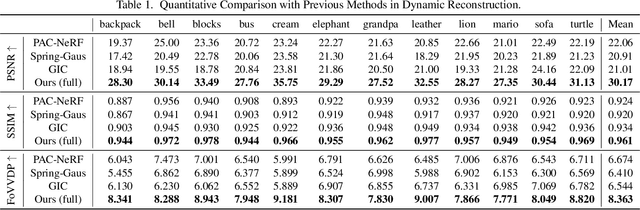
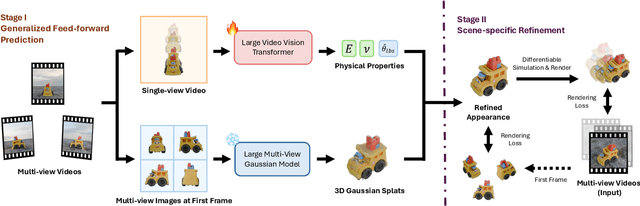
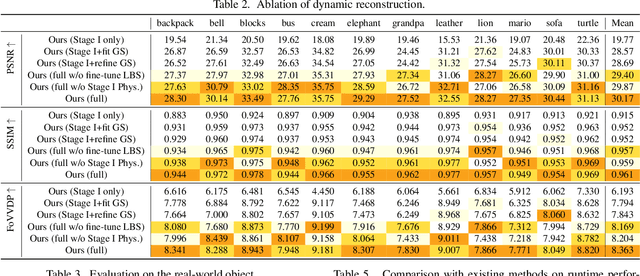
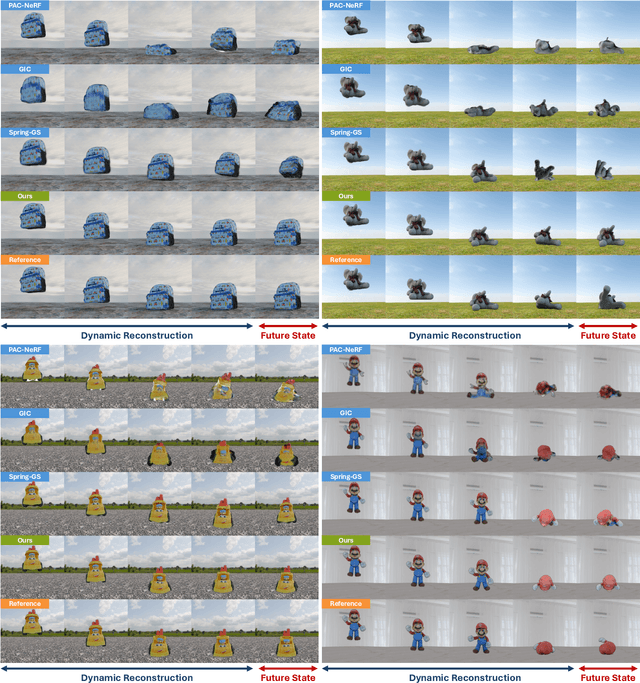
Faithfully reconstructing textured shapes and physical properties from videos presents an intriguing yet challenging problem. Significant efforts have been dedicated to advancing such a system identification problem in this area. Previous methods often rely on heavy optimization pipelines with a differentiable simulator and renderer to estimate physical parameters. However, these approaches frequently necessitate extensive hyperparameter tuning for each scene and involve a costly optimization process, which limits both their practicality and generalizability. In this work, we propose a novel framework, Vid2Sim, a generalizable video-based approach for recovering geometry and physical properties through a mesh-free reduced simulation based on Linear Blend Skinning (LBS), offering high computational efficiency and versatile representation capability. Specifically, Vid2Sim first reconstructs the observed configuration of the physical system from video using a feed-forward neural network trained to capture physical world knowledge. A lightweight optimization pipeline then refines the estimated appearance, geometry, and physical properties to closely align with video observations within just a few minutes. Additionally, after the reconstruction, Vid2Sim enables high-quality, mesh-free simulation with high efficiency. Extensive experiments demonstrate that our method achieves superior accuracy and efficiency in reconstructing geometry and physical properties from video data.
Ego4o: Egocentric Human Motion Capture and Understanding from Multi-Modal Input
Apr 11, 2025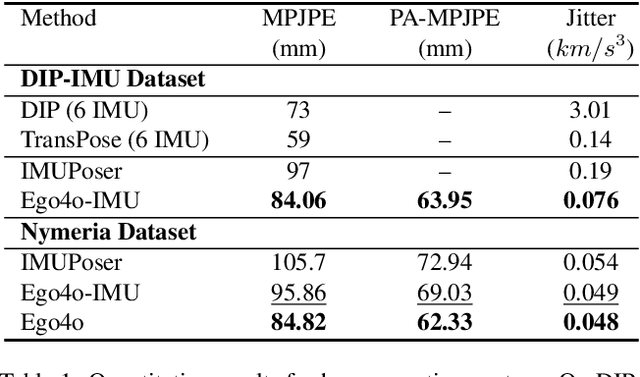
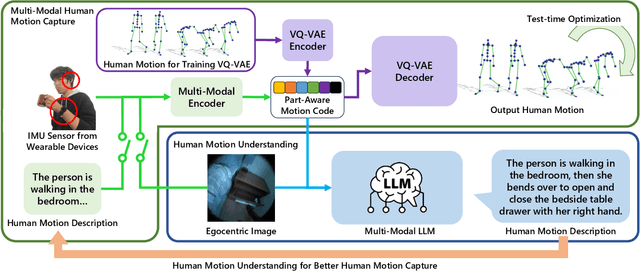
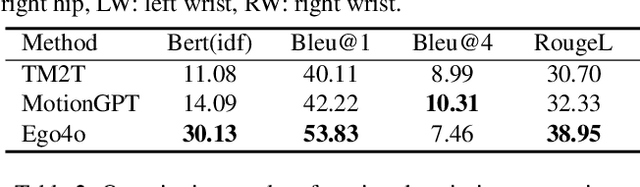
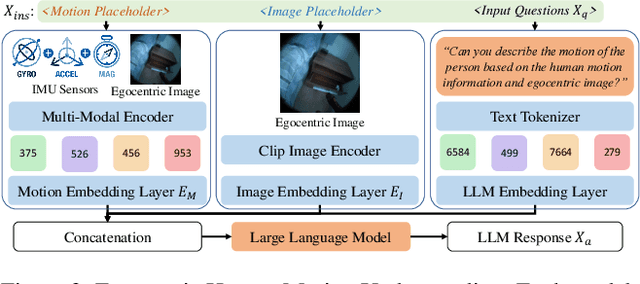
This work focuses on tracking and understanding human motion using consumer wearable devices, such as VR/AR headsets, smart glasses, cellphones, and smartwatches. These devices provide diverse, multi-modal sensor inputs, including egocentric images, and 1-3 sparse IMU sensors in varied combinations. Motion descriptions can also accompany these signals. The diverse input modalities and their intermittent availability pose challenges for consistent motion capture and understanding. In this work, we present Ego4o (o for omni), a new framework for simultaneous human motion capture and understanding from multi-modal egocentric inputs. This method maintains performance with partial inputs while achieving better results when multiple modalities are combined. First, the IMU sensor inputs, the optional egocentric image, and text description of human motion are encoded into the latent space of a motion VQ-VAE. Next, the latent vectors are sent to the VQ-VAE decoder and optimized to track human motion. When motion descriptions are unavailable, the latent vectors can be input into a multi-modal LLM to generate human motion descriptions, which can further enhance motion capture accuracy. Quantitative and qualitative evaluations demonstrate the effectiveness of our method in predicting accurate human motion and high-quality motion descriptions.
CBIL: Collective Behavior Imitation Learning for Fish from Real Videos
Mar 31, 2025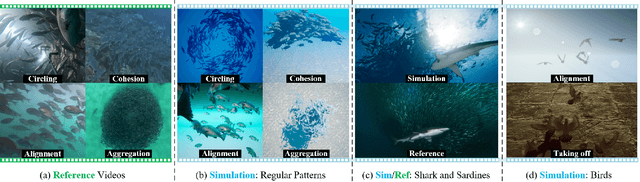
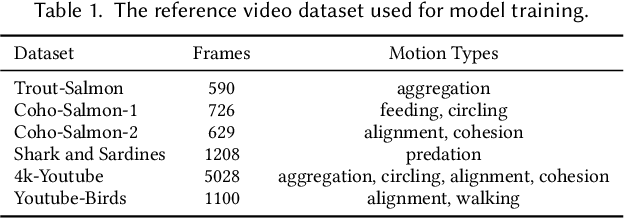
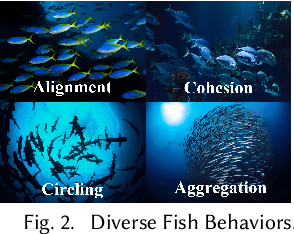
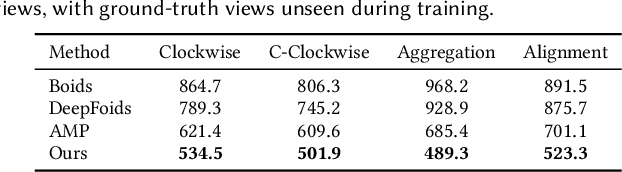
Reproducing realistic collective behaviors presents a captivating yet formidable challenge. Traditional rule-based methods rely on hand-crafted principles, limiting motion diversity and realism in generated collective behaviors. Recent imitation learning methods learn from data but often require ground truth motion trajectories and struggle with authenticity, especially in high-density groups with erratic movements. In this paper, we present a scalable approach, Collective Behavior Imitation Learning (CBIL), for learning fish schooling behavior directly from videos, without relying on captured motion trajectories. Our method first leverages Video Representation Learning, where a Masked Video AutoEncoder (MVAE) extracts implicit states from video inputs in a self-supervised manner. The MVAE effectively maps 2D observations to implicit states that are compact and expressive for following the imitation learning stage. Then, we propose a novel adversarial imitation learning method to effectively capture complex movements of the schools of fish, allowing for efficient imitation of the distribution for motion patterns measured in the latent space. It also incorporates bio-inspired rewards alongside priors to regularize and stabilize training. Once trained, CBIL can be used for various animation tasks with the learned collective motion priors. We further show its effectiveness across different species. Finally, we demonstrate the application of our system in detecting abnormal fish behavior from in-the-wild videos.