 Add to Chrome
 Add to Firefox
 Add to Edge
Hermite-NGP: Gradient-Augmented Hash Encoding for Learning PDEs
May 23, 2026
We propose Hermite-NGP, a gradient-augmented multi-resolution hash encoding designed to enable fast and accurate computation of spatial derivatives for neural PDE solvers. Unlike existing NGP-based approaches that rely on automatic differentiation or finite differences and suffer from instability or high cost, Hermite-NGP explicitly stores function values and mixed partial derivatives at hash grid vertices, allowing fully analytic evaluation of gradients, Jacobians, and Hessians via Hermite interpolation. This design preserves the efficiency and spatial adaptivity of NGP while supporting analytic differential operators up to second order. We further introduce a multi-resolution curriculum training strategy analogous to multigrid V-cycles to enable coarse-to-fine optimization. Across a range of 2D and 3D PDE benchmarks, Hermite-NGP achieves up to approximately 20 times lower error than prior neural PDE methods, and reduces wall-clock convergence time by 2 to 10 times compared to other solvers, with per-epoch training times as low as 3.5 ms for models with up to 17M parameters.

A Few-Step Generative Model on Cumulative Flow Maps
May 05, 2026We propose a unified, few-step generative modeling framework based on \emph{cumulative flow maps} for long-range transport in probability space, inspired by flow-map techniques for physical transport and dynamics. At its core is a cumulative-flow abstraction that connects local, instantaneous updates with finite-time transport, enabling generative models to reason about global state transitions. This perspective yields a unified few-step framework built on cumulative transport and \revise{cumulative} parameterization that applies broadly to existing diffusion- and flow-based models without being tied to a specific prediction \revise{instantiation}. Our formulation supports few-step and even one-step generation while preserving synthesis quality, requiring only minimal changes to time embeddings and training objectives, and no increase in model capacity. We demonstrate its effectiveness across diverse tasks, including image generation, geometric distribution modeling, joint prediction, and SDF generation, with reduced inference cost.
Generative Modeling with Orbit-Space Particle Flow Matching
May 04, 2026We present Orbit-Space Geometric Probability Paths (OGPP), a particle-native flow-matching framework for generative modeling of particle systems. OGPP is motivated by two insights: (i) particles are defined up to permutation symmetries, so anonymous indexing inflates per-index target variance and yields curved, hard-to-learn flows; and (ii) particles live in physical space, so the flow terminal velocity has physical meaning and can encode geometric attributes, e.g., surface normals. OGPP instantiates three key components: (1) orbit-space canonicalization of the probability-path terminal endpoint, (2) particle index embeddings for role specialization, and (3) geometric probability paths with arc-length-aware terminal velocities that generate normals as a byproduct of the flow. We evaluate OGPP on minimal-surface benchmarks, where it reduces metric error by up to two orders of magnitude in a single inference step; on ShapeNet, where it matches the state of the art with 5x fewer steps and reaches airplane EMD comparable to DiT-3D with 26x fewer parameters and 5x fewer steps; and on single-shape encoding, where it produces normals and reconstructions competitive with 6D generators while operating entirely in 3D.
Free-Range Gaussians: Non-Grid-Aligned Generative 3D Gaussian Reconstruction
Apr 06, 2026We present Free-Range Gaussians, a multi-view reconstruction method that predicts non-pixel, non-voxel-aligned 3D Gaussians from as few as four images. This is done through flow matching over Gaussian parameters. Our generative formulation of reconstruction allows the model to be supervised with non-grid-aligned 3D data, and enables it to synthesize plausible content in unobserved regions. Thus, it improves on prior methods that produce highly redundant grid-aligned Gaussians, and suffer from holes or blurry conditional means in unobserved regions. To handle the number of Gaussians needed for high-quality results, we introduce a hierarchical patching scheme to group spatially related Gaussians into joint transformer tokens, halving the sequence length while preserving structure. We further propose a timestep-weighted rendering loss during training, and photometric gradient guidance and classifier-free guidance at inference to improve fidelity. Experiments on Objaverse and Google Scanned Objects show consistent improvements over pixel and voxel-aligned methods while using significantly fewer Gaussians, with large gains when input views leave parts of the object unobserved.
A Self-Rotating Tri-Rotor UAV for Field of View Expansion and Autonomous Flight
Mar 30, 2026Unmanned Aerial Vehicles (UAVs) perception relies on onboard sensors like cameras and LiDAR, which are limited by the narrow field of view (FoV). We present Self-Perception INertial Navigation Enabled Rotorcraft (SPINNER), a self-rotating tri-rotor UAV for the FoV expansion and autonomous flight. Without adding extra sensors or energy consumption, SPINNER significantly expands the FoV of onboard camera and LiDAR sensors through continuous spin motion, thereby enhancing environmental perception efficiency. SPINNER achieves full 3-dimensional position and roll--pitch attitude control using only three brushless motors, while adjusting the rotation speed via anti-torque plates design. To address the strong coupling, severe nonlinearity, and complex disturbances induced by spinning flight, we develop a disturbance compensation control framework that combines nonlinear model predictive control (MPC) with incremental nonlinear dynamic inversion. Experimental results demonstrate that SPINNER maintains robust flight under wind disturbances up to 4.8 \,m/s and achieves high-precision trajectory tracking at a maximum speed of 2.0\,m/s. Moreover, tests in parking garages and forests show that the rotational perception mechanism substantially improves FoV coverage and enhances perception capability of SPINNER.
A Long-Short Flow-Map Perspective for Drifting Models
Feb 24, 2026This paper provides a reinterpretation of the Drifting Model~\cite{deng2026generative} through a semigroup-consistent long-short flow-map factorization. We show that a global transport process can be decomposed into a long-horizon flow map followed by a short-time terminal flow map admitting a closed-form optimal velocity representation, and that taking the terminal interval length to zero recovers exactly the drifting field together with a conservative impulse term required for flow-map consistency. Based on this perspective, we propose a new likelihood learning formulation that aligns the long-short flow-map decomposition with density evolution under transport. We validate the framework through both theoretical analysis and empirical evaluations on benchmark tests, and further provide a theoretical interpretation of the feature-space optimization while highlighting several open problems for future study.
SurfPhase: 3D Interfacial Dynamics in Two-Phase Flows from Sparse Videos
Feb 11, 2026Interfacial dynamics in two-phase flows govern momentum, heat, and mass transfer, yet remain difficult to measure experimentally. Classical techniques face intrinsic limitations near moving interfaces, while existing neural rendering methods target single-phase flows with diffuse boundaries and cannot handle sharp, deformable liquid-vapor interfaces. We propose SurfPhase, a novel model for reconstructing 3D interfacial dynamics from sparse camera views. Our approach integrates dynamic Gaussian surfels with a signed distance function formulation for geometric consistency, and leverages a video diffusion model to synthesize novel-view videos to refine reconstruction from sparse observations. We evaluate on a new dataset of high-speed pool boiling videos, demonstrating high-quality view synthesis and velocity estimation from only two camera views. Project website: https://yuegao.me/SurfPhase.
Trajectory Consistency for One-Step Generation on Euler Mean Flows
Jan 31, 2026We propose \emph{Euler Mean Flows (EMF)}, a flow-based generative framework for one-step and few-step generation that enforces long-range trajectory consistency with minimal sampling cost. The key idea of EMF is to replace the trajectory consistency constraint, which is difficult to supervise and optimize over long time scales, with a principled linear surrogate that enables direct data supervision for long-horizon flow-map compositions. We derive this approximation from the semigroup formulation of flow-based models and show that, under mild regularity assumptions, it faithfully approximates the original consistency objective while being substantially easier to optimize. This formulation leads to a unified, JVP-free training framework that supports both $u$-prediction and $x_1$-prediction variants, avoiding explicit Jacobian computations and significantly reducing memory and computational overhead. Experiments on image synthesis, particle-based geometry generation, and functional generation demonstrate improved optimization stability and sample quality under fixed sampling budgets, together with approximately $50\%$ reductions in training time and memory consumption compared to existing one-step methods for image generation.
Functional Mean Flow in Hilbert Space
Nov 17, 2025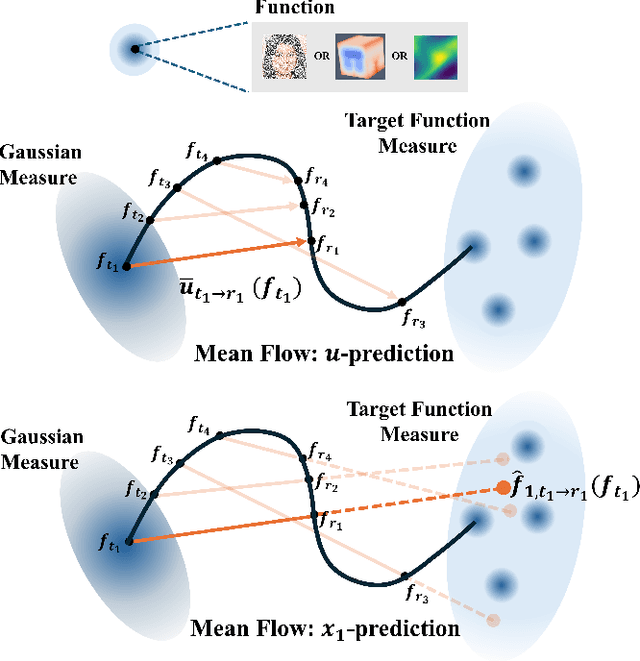
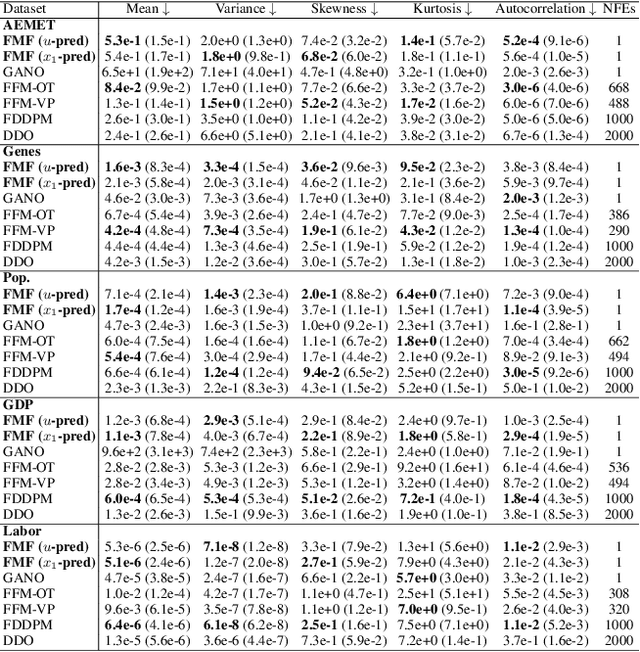

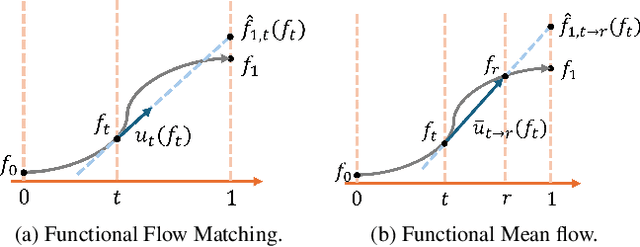
We present Functional Mean Flow (FMF) as a one-step generative model defined in infinite-dimensional Hilbert space. FMF extends the one-step Mean Flow framework to functional domains by providing a theoretical formulation for Functional Flow Matching and a practical implementation for efficient training and sampling. We also introduce an $x_1$-prediction variant that improves stability over the original $u$-prediction form. The resulting framework is a practical one-step Flow Matching method applicable to a wide range of functional data generation tasks such as time series, images, PDEs, and 3D geometry.
FluidNexus: 3D Fluid Reconstruction and Prediction from a Single Video
Mar 06, 2025We study reconstructing and predicting 3D fluid appearance and velocity from a single video. Current methods require multi-view videos for fluid reconstruction. We present FluidNexus, a novel framework that bridges video generation and physics simulation to tackle this task. Our key insight is to synthesize multiple novel-view videos as references for reconstruction. FluidNexus consists of two key components: (1) a novel-view video synthesizer that combines frame-wise view synthesis with video diffusion refinement for generating realistic videos, and (2) a physics-integrated particle representation coupling differentiable simulation and rendering to simultaneously facilitate 3D fluid reconstruction and prediction. To evaluate our approach, we collect two new real-world fluid datasets featuring textured backgrounds and object interactions. Our method enables dynamic novel view synthesis, future prediction, and interaction simulation from a single fluid video. Project website: https://yuegao.me/FluidNexus.