 Add to Chrome
 Add to Firefox
 Add to Edge
APIVOT: Adaptive Planning with Interleaved Vision-Language Thoughts
Jul 09, 2026
Long-horizon robot planning requires jointly reasoning over semantic task structure and geometric feasibility. To successfully execute a task, a robot must decompose goals, select task-relevant objects, and sequence actions, while ensuring that plans satisfy spatial constraints such as limited free space and object collisions. In this work, we propose APIVOT, a VLM-based planner that adaptively interleaves language and visual thoughts for long-horizon planning. APIVOT learns to leverage language for semantic reasoning, while using visual thoughts as imagined future states for internal verification of geometric feasibility. On long-horizon kitchen tasks, APIVOT outperforms general-purpose VLMs and prior planning frameworks, achieving the largest gains in spatially constrained settings. We find that APIVOT learns meaningful modality selection behavior, demonstrating that adaptive interleaving of vision-language thoughts improves both planning success and reasoning efficiency.

ExpRL: Exploratory RL for LLM Mid-Training
Jun 15, 2026Sparse reward reinforcement learning (RL) has become a standard tool for improving LLM reasoning, but its success depends critically on the coverage present in the base model. In practice, models are often primed for RL through \emph{mid-training} on curated reasoning traces that teach useful primitive skills such as decomposition, verification, or self-correction. Although effective, this strategy requires manually specifying what the model should learn, and it remains unclear whether such primitive coverage is enough for much harder problems, which require combining these skills into broader solution strategies. We study a more automated approach: \emph{RL-based mid-training} using large corpora of human-written question-answer data. Rather than treating reference solutions as targets to imitate, our method, ExpRL, uses them as \emph{reward scaffolds}: references are hidden from the policy and used only to construct problem-specific grading rubrics for judging on-policy reasoning traces. The policy samples from the original problem prompt, while an LLM judge compares the sampled reasoning trace against the reference solution and assigns outcome-level or process-level dense rewards. This lets ExpRL reinforce partial progress, useful intermediate reductions, and productive reasoning behaviors that sparse final-answer rewards often fail to upweight. On challenging math reasoning tasks, ExpRL yields stronger RL priming than SFT, sparse-reward GRPO, and self-distillation, and provides a better initialization for subsequent sparse-reward RL. Additional mixed-domain experiments further suggest that ExpRL can extend beyond the original math-only setting.
A Model of Multi-turn Human Persuadability Using Probabilistic Belief Tracing
Jun 03, 2026Large language models can shift human beliefs across high-stakes domains, but most persuasion studies rely on pre/post belief change. These endpoint measures identify whether persuasion occurred, yet miss where and how beliefs moved within a dialogue. We present PERSUASIONTRACE, a framework for studying persuasion in human-LLM interaction. Built on a web-based experimental platform, PERSUASIONTRACE contributes a tool for multi-turn persuasion studies and a process-level evaluation protocol: it records multi-turn belief reports from human or simulated targets of persuasion, annotates persuader turns with rhetorical dimensions (logos/pathos/ethos), and evaluates simulators by fidelity to real human belief dynamics. Using this framework, we find that human targets group into two clusters of multi-turn belief updates and exhibit susceptibility to rhetorical strategies, and that LLMs are persuasive across generic and personalized topics, text and audio modalities, and multi-turn interactions. Prior work has chiefly used vanilla-prompted LLMs to simulate human targets, but we show that these simulators fail to replicate human belief dynamics. We introduce a Bayesian-network simulated target that maintains an explicit latent belief state over time so each persuader message yields cognitively realistic belief updates. In human-likeness evaluation, our Bayesian target scores near a human reference (81 vs 80), while baseline LLM targets score substantially lower (64). PERSUASIONTRACE reframes persuasion evaluation from endpoint movement alone to process fidelity, providing a stronger basis for scientific analysis and safer optimization of persuasive systems.
The Dynamics of Delusion: Modeling Bidirectional False Belief Amplification in Human-Chatbot Dialogue
Apr 28, 2026There is growing concern that AI chatbots might fuel delusional beliefs in users. Some have suggested that humans and chatbots mutually reinforce false beliefs over time, but quantitative evidence is lacking. Using a unique dataset of chat logs from individuals who exhibited delusional thinking, we developed a latent state model that captures accumulating and decaying influences between humans and chatbots. We find that a bidirectional influence model substantially outperforms a unidirectional alternative where humans are the primary driver of delusion. We find that humans exert strong but short-lived influence on chatbots, whereas chatbots exert longer-lasting influence on humans. Moreover, chatbots exert strong, stable self-influence over their own future outputs that tends to perpetuate delusions over long stretches of conversation. In fact, this chatbot self-influence constituted the dominant pathway when considering accumulated influence over time. Overall, these results indicate that humans tend to drive sharp, immediate increases in delusion, whereas chatbots sustain and propagate these effects over longer timescales. Together, these findings provide the first quantitative evidence that human-chatbot interactions can form feedback loops of delusion, decomposable into distinct pathways with dissociable temporal dynamics. By doing so, they can inform the development of safer AI systems.
Data-efficient pre-training by scaling synthetic megadocs
Mar 19, 2026Synthetic data augmentation has emerged as a promising solution when pre-training is constrained by data rather than compute. We study how to design synthetic data algorithms that achieve better loss scaling: not only lowering loss at finite compute but especially as compute approaches infinity. We first show that pre-training on web data mixed with synthetically generated rephrases improves i.i.d. validation loss on the web data, despite the synthetic data coming from an entirely different distribution. With optimal mixing and epoching, loss and benchmark accuracy improve without overfitting as the number of synthetic generations grows, plateauing near $1.48\times$ data efficiency at 32 rephrases per document. We find even better loss scaling under a new perspective: synthetic generations from the same document can form a single substantially longer megadocument instead of many short documents. We show two ways to construct megadocs: stitching synthetic rephrases from the same web document or stretching a document by inserting rationales. Both methods improve i.i.d. loss, downstream benchmarks, and especially long-context loss relative to simple rephrasing, increasing data efficiency from $1.48\times$ to $1.80\times$ at $32$ generations per document. Importantly, the improvement of megadocs over simple rephrasing widens as more synthetic data is generated. Our results show how to design synthetic data algorithms that benefit more from increasing compute when data-constrained.
Characterizing Delusional Spirals through Human-LLM Chat Logs
Mar 17, 2026As large language models (LLMs) have proliferated, disturbing anecdotal reports of negative psychological effects, such as delusions, self-harm, and ``AI psychosis,'' have emerged in global media and legal discourse. However, it remains unclear how users and chatbots interact over the course of lengthy delusional ``spirals,'' limiting our ability to understand and mitigate the harm. In our work, we analyze logs of conversations with LLM chatbots from 19 users who report having experienced psychological harms from chatbot use. Many of our participants come from a support group for such chatbot users. We also include chat logs from participants covered by media outlets in widely-distributed stories about chatbot-reinforced delusions. In contrast to prior work that speculates on potential AI harms to mental health, to our knowledge we present the first in-depth study of such high-profile and veridically harmful cases. We develop an inventory of 28 codes and apply it to the $391,562$ messages in the logs. Codes include whether a user demonstrates delusional thinking (15.5% of user messages), a user expresses suicidal thoughts (69 validated user messages), or a chatbot misrepresents itself as sentient (21.2% of chatbot messages). We analyze the co-occurrence of message codes. We find, for example, that messages that declare romantic interest and messages where the chatbot describes itself as sentient occur much more often in longer conversations, suggesting that these topics could promote or result from user over-engagement and that safeguards in these areas may degrade in multi-turn settings. We conclude with concrete recommendations for how policymakers, LLM chatbot developers, and users can use our inventory and conversation analysis tool to understand and mitigate harm from LLM chatbots. Warning: This paper discusses self-harm, trauma, and violence.
Large Language Models Persuade Without Planning Theory of Mind
Feb 19, 2026A growing body of work attempts to evaluate the theory of mind (ToM) abilities of humans and large language models (LLMs) using static, non-interactive question-and-answer benchmarks. However, theoretical work in the field suggests that first-personal interaction is a crucial part of ToM and that such predictive, spectatorial tasks may fail to evaluate it. We address this gap with a novel ToM task that requires an agent to persuade a target to choose one of three policy proposals by strategically revealing information. Success depends on a persuader's sensitivity to a given target's knowledge states (what the target knows about the policies) and motivational states (how much the target values different outcomes). We varied whether these states were Revealed to persuaders or Hidden, in which case persuaders had to inquire about or infer them. In Experiment 1, participants persuaded a bot programmed to make only rational inferences. LLMs excelled in the Revealed condition but performed below chance in the Hidden condition, suggesting difficulty with the multi-step planning required to elicit and use mental state information. Humans performed moderately well in both conditions, indicating an ability to engage such planning. In Experiment 2, where a human target role-played the bot, and in Experiment 3, where we measured whether human targets' real beliefs changed, LLMs outperformed human persuaders across all conditions. These results suggest that effective persuasion can occur without explicit ToM reasoning (e.g., through rhetorical strategies) and that LLMs excel at this form of persuasion. Overall, our results caution against attributing human-like ToM to LLMs while highlighting LLMs' potential to influence people's beliefs and behavior.
Neural Nonmyopic Bayesian Optimization in Dynamic Cost Settings
Jan 10, 2026Bayesian optimization (BO) is a common framework for optimizing black-box functions, yet most existing methods assume static query costs and rely on myopic acquisition strategies. We introduce LookaHES, a nonmyopic BO framework designed for dynamic, history-dependent cost environments, where evaluation costs vary with prior actions, such as travel distance in spatial tasks or edit distance in sequence design. LookaHES combines a multi-step variant of $H$-Entropy Search with pathwise sampling and neural policy optimization, enabling long-horizon planning beyond twenty steps without the exponential complexity of existing nonmyopic methods. The key innovation is the integration of neural policies, including large language models, to effectively navigate structured, combinatorial action spaces such as protein sequences. These policies amortize lookahead planning and can be integrated with domain-specific constraints during rollout. Empirically, LookaHES outperforms strong myopic and nonmyopic baselines across nine synthetic benchmarks from two to eight dimensions and two real-world tasks: geospatial optimization using NASA night-light imagery and protein sequence design with constrained token-level edits. In short, LookaHES provides a general, scalable, and cost-aware solution for robust long-horizon optimization in complex decision spaces, which makes it a useful tool for researchers in machine learning, statistics, and applied domains. Our implementation is available at https://github.com/sangttruong/nonmyopia.
3D-Generalist: Self-Improving Vision-Language-Action Models for Crafting 3D Worlds
Jul 09, 2025Despite large-scale pretraining endowing models with language and vision reasoning capabilities, improving their spatial reasoning capability remains challenging due to the lack of data grounded in the 3D world. While it is possible for humans to manually create immersive and interactive worlds through 3D graphics, as seen in applications such as VR, gaming, and robotics, this process remains highly labor-intensive. In this paper, we propose a scalable method for generating high-quality 3D environments that can serve as training data for foundation models. We recast 3D environment building as a sequential decision-making problem, employing Vision-Language-Models (VLMs) as policies that output actions to jointly craft a 3D environment's layout, materials, lighting, and assets. Our proposed framework, 3D-Generalist, trains VLMs to generate more prompt-aligned 3D environments via self-improvement fine-tuning. We demonstrate the effectiveness of 3D-Generalist and the proposed training strategy in generating simulation-ready 3D environments. Furthermore, we demonstrate its quality and scalability in synthetic data generation by pretraining a vision foundation model on the generated data. After fine-tuning the pre-trained model on downstream tasks, we show that it surpasses models pre-trained on meticulously human-crafted synthetic data and approaches results achieved with real data orders of magnitude larger.
CogGen: A Learner-Centered Generative AI Architecture for Intelligent Tutoring with Programming Video
Jun 25, 2025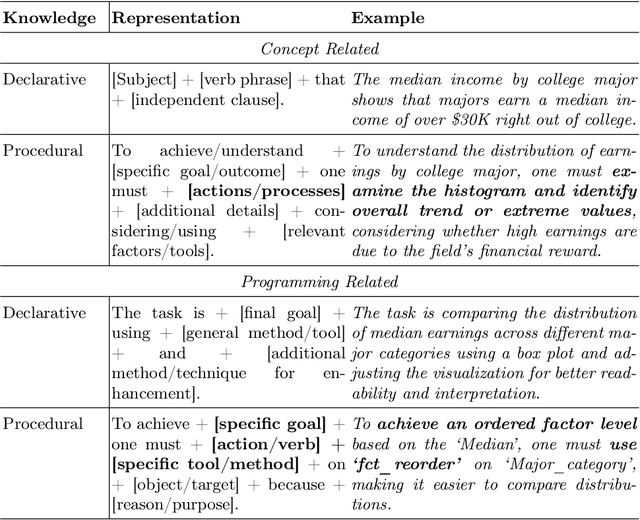
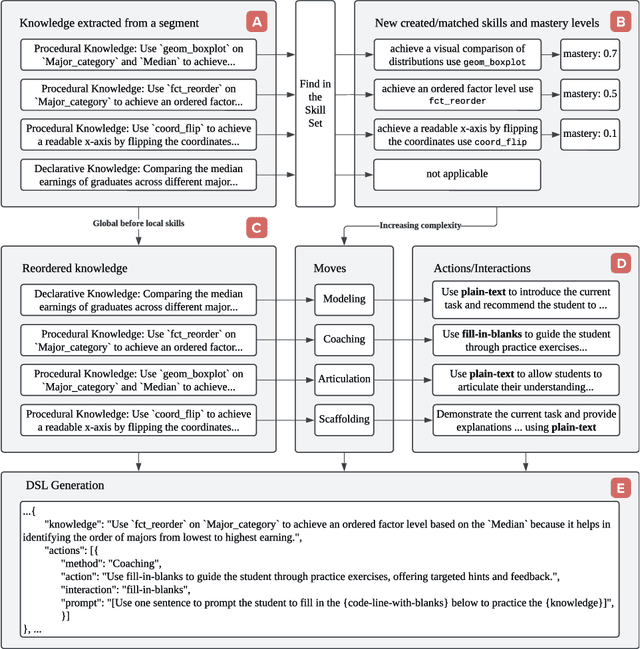
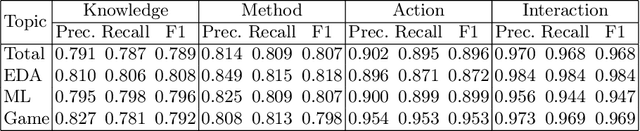
We introduce CogGen, a learner-centered AI architecture that transforms programming videos into interactive, adaptive learning experiences by integrating student modeling with generative AI tutoring based on the Cognitive Apprenticeship framework. The architecture consists of three components: (1) video segmentation by learning goals, (2) a conversational tutoring engine applying Cognitive Apprenticeship strategies, and (3) a student model using Bayesian Knowledge Tracing to adapt instruction. Our technical evaluation demonstrates effective video segmentation accuracy and strong pedagogical alignment across knowledge, method, action, and interaction layers. Ablation studies confirm the necessity of each component in generating effective guidance. This work advances AI-powered tutoring by bridging structured student modeling with interactive AI conversations, offering a scalable approach to enhancing video-based programming education.