 Add to Chrome
 Add to Firefox
 Add to Edge
CogniEdit: Dense Gradient Flow Optimization for Fine-Grained Image Editing
Dec 15, 2025
Instruction-based image editing with diffusion models has achieved impressive results, yet existing methods struggle with fine-grained instructions specifying precise attributes such as colors, positions, and quantities. While recent approaches employ Group Relative Policy Optimization (GRPO) for alignment, they optimize only at individual sampling steps, providing sparse feedback that limits trajectory-level control. We propose a unified framework CogniEdit, combining multi-modal reasoning with dense reward optimization that propagates gradients across consecutive denoising steps, enabling trajectory-level gradient flow through the sampling process. Our method comprises three components: (1) Multi-modal Large Language Models for decomposing complex instructions into actionable directives, (2) Dynamic Token Focus Relocation that adaptively emphasizes fine-grained attributes, and (3) Dense GRPO-based optimization that propagates gradients across consecutive steps for trajectory-level supervision. Extensive experiments on benchmark datasets demonstrate that our CogniEdit achieves state-of-the-art performance in balancing fine-grained instruction following with visual quality and editability preservation

MedInsightBench: Evaluating Medical Analytics Agents Through Multi-Step Insight Discovery in Multimodal Medical Data
Dec 15, 2025In medical data analysis, extracting deep insights from complex, multi-modal datasets is essential for improving patient care, increasing diagnostic accuracy, and optimizing healthcare operations. However, there is currently a lack of high-quality datasets specifically designed to evaluate the ability of large multi-modal models (LMMs) to discover medical insights. In this paper, we introduce MedInsightBench, the first benchmark that comprises 332 carefully curated medical cases, each annotated with thoughtfully designed insights. This benchmark is intended to evaluate the ability of LMMs and agent frameworks to analyze multi-modal medical image data, including posing relevant questions, interpreting complex findings, and synthesizing actionable insights and recommendations. Our analysis indicates that existing LMMs exhibit limited performance on MedInsightBench, which is primarily attributed to their challenges in extracting multi-step, deep insights and the absence of medical expertise. Therefore, we propose MedInsightAgent, an automated agent framework for medical data analysis, composed of three modules: Visual Root Finder, Analytical Insight Agent, and Follow-up Question Composer. Experiments on MedInsightBench highlight pervasive challenges and demonstrate that MedInsightAgent can improve the performance of general LMMs in medical data insight discovery.
ReViSE: Towards Reason-Informed Video Editing in Unified Models with Self-Reflective Learning
Dec 11, 2025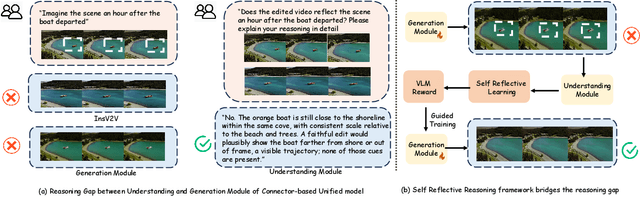
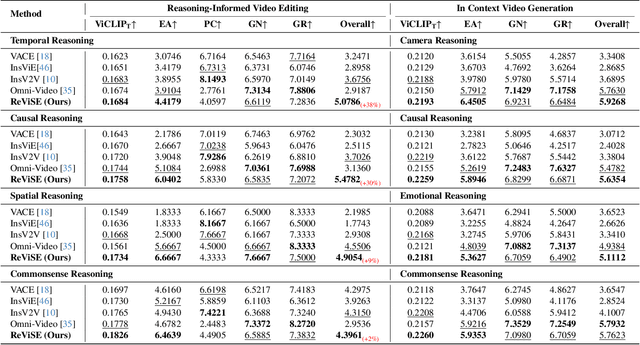
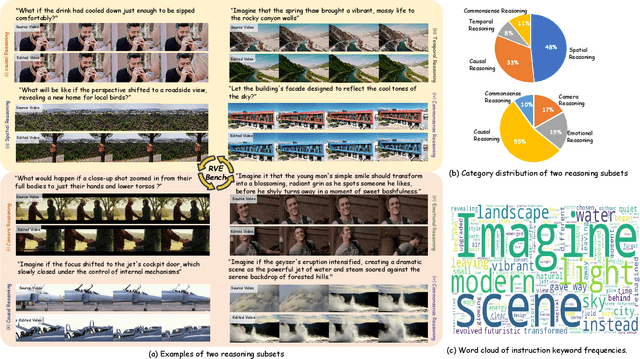
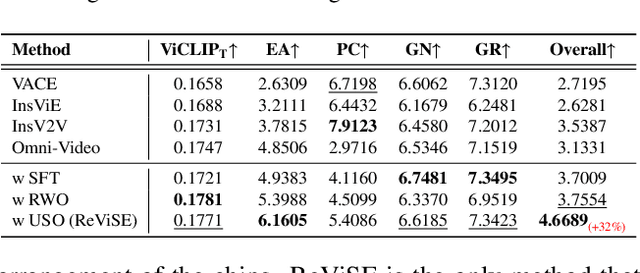
Video unified models exhibit strong capabilities in understanding and generation, yet they struggle with reason-informed visual editing even when equipped with powerful internal vision-language models (VLMs). We attribute this gap to two factors: 1) existing datasets are inadequate for training and evaluating reasoning-aware video editing, and 2) an inherent disconnect between the models' reasoning and editing capabilities, which prevents the rich understanding from effectively instructing the editing process. Bridging this gap requires an integrated framework that connects reasoning with visual transformation. To address this gap, we introduce the Reason-Informed Video Editing (RVE) task, which requires reasoning about physical plausibility and causal dynamics during editing. To support systematic evaluation, we construct RVE-Bench, a comprehensive benchmark with two complementary subsets: Reasoning-Informed Video Editing and In-Context Video Generation. These subsets cover diverse reasoning dimensions and real-world editing scenarios. Building upon this foundation, we propose the ReViSE, a Self-Reflective Reasoning (SRF) framework that unifies generation and evaluation within a single architecture. The model's internal VLM provides intrinsic feedback by assessing whether the edited video logically satisfies the given instruction. The differential feedback that refines the generator's reasoning behavior during training. Extensive experiments on RVE-Bench demonstrate that ReViSE significantly enhances editing accuracy and visual fidelity, achieving a 32% improvement of the Overall score in the reasoning-informed video editing subset over state-of-the-art methods.
Scale-Aware Curriculum Learning for Ddata-Efficient Lung Nodule Detection with YOLOv11
Oct 30, 2025Lung nodule detection in chest CT is crucial for early lung cancer diagnosis, yet existing deep learning approaches face challenges when deployed in clinical settings with limited annotated data. While curriculum learning has shown promise in improving model training, traditional static curriculum strategies fail in data-scarce scenarios. We propose Scale Adaptive Curriculum Learning (SACL), a novel training strategy that dynamically adjusts curriculum design based on available data scale. SACL introduces three key mechanisms:(1) adaptive epoch scheduling, (2) hard sample injection, and (3) scale-aware optimization. We evaluate SACL on the LUNA25 dataset using YOLOv11 as the base detector. Experimental results demonstrate that while SACL achieves comparable performance to static curriculum learning on the full dataset in mAP50, it shows significant advantages under data-limited conditions with 4.6%, 3.5%, and 2.0% improvements over baseline at 10%, 20%, and 50% of training data respectively. By enabling robust training across varying data scales without architectural modifications, SACL provides a practical solution for healthcare institutions to develop effective lung nodule detection systems despite limited annotation resources.
WoW: Towards a World omniscient World model Through Embodied Interaction
Sep 26, 2025Humans develop an understanding of intuitive physics through active interaction with the world. This approach is in stark contrast to current video models, such as Sora, which rely on passive observation and therefore struggle with grasping physical causality. This observation leads to our central hypothesis: authentic physical intuition of the world model must be grounded in extensive, causally rich interactions with the real world. To test this hypothesis, we present WoW, a 14-billion-parameter generative world model trained on 2 million robot interaction trajectories. Our findings reveal that the model's understanding of physics is a probabilistic distribution of plausible outcomes, leading to stochastic instabilities and physical hallucinations. Furthermore, we demonstrate that this emergent capability can be actively constrained toward physical realism by SOPHIA, where vision-language model agents evaluate the DiT-generated output and guide its refinement by iteratively evolving the language instructions. In addition, a co-trained Inverse Dynamics Model translates these refined plans into executable robotic actions, thus closing the imagination-to-action loop. We establish WoWBench, a new benchmark focused on physical consistency and causal reasoning in video, where WoW achieves state-of-the-art performance in both human and autonomous evaluation, demonstrating strong ability in physical causality, collision dynamics, and object permanence. Our work provides systematic evidence that large-scale, real-world interaction is a cornerstone for developing physical intuition in AI. Models, data, and benchmarks will be open-sourced.
PanoLAM: Large Avatar Model for Gaussian Full-Head Synthesis from One-shot Unposed Image
Sep 09, 2025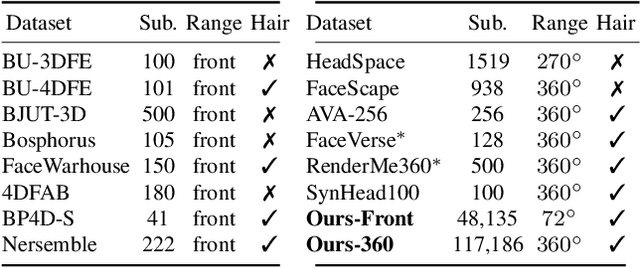
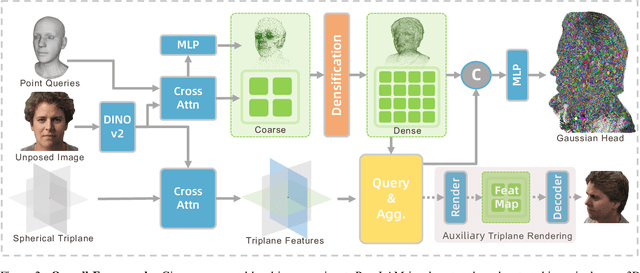
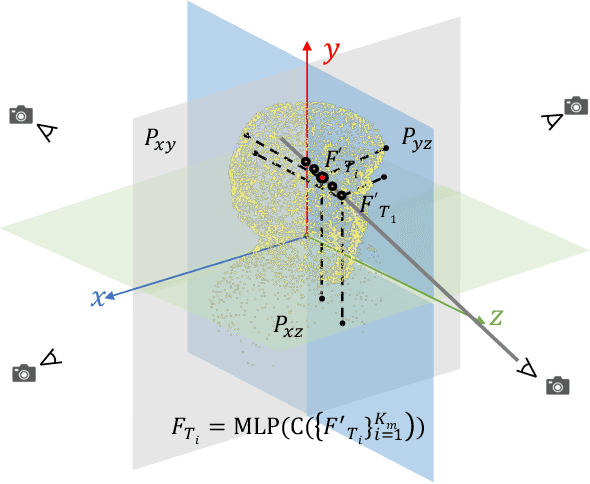
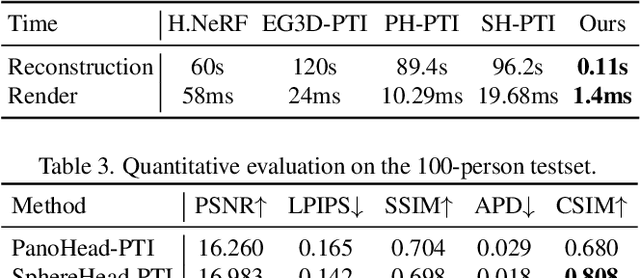
We present a feed-forward framework for Gaussian full-head synthesis from a single unposed image. Unlike previous work that relies on time-consuming GAN inversion and test-time optimization, our framework can reconstruct the Gaussian full-head model given a single unposed image in a single forward pass. This enables fast reconstruction and rendering during inference. To mitigate the lack of large-scale 3D head assets, we propose a large-scale synthetic dataset from trained 3D GANs and train our framework using only synthetic data. For efficient high-fidelity generation, we introduce a coarse-to-fine Gaussian head generation pipeline, where sparse points from the FLAME model interact with the image features by transformer blocks for feature extraction and coarse shape reconstruction, which are then densified for high-fidelity reconstruction. To fully leverage the prior knowledge residing in pretrained 3D GANs for effective reconstruction, we propose a dual-branch framework that effectively aggregates the structured spherical triplane feature and unstructured point-based features for more effective Gaussian head reconstruction. Experimental results show the effectiveness of our framework towards existing work.
MinD: Unified Visual Imagination and Control via Hierarchical World Models
Jun 23, 2025


Video generation models (VGMs) offer a promising pathway for unified world modeling in robotics by integrating simulation, prediction, and manipulation. However, their practical application remains limited due to (1) slowgeneration speed, which limits real-time interaction, and (2) poor consistency between imagined videos and executable actions. To address these challenges, we propose Manipulate in Dream (MinD), a hierarchical diffusion-based world model framework that employs a dual-system design for vision-language manipulation. MinD executes VGM at low frequencies to extract video prediction features, while leveraging a high-frequency diffusion policy for real-time interaction. This architecture enables low-latency, closed-loop control in manipulation with coherent visual guidance. To better coordinate the two systems, we introduce a video-action diffusion matching module (DiffMatcher), with a novel co-training strategy that uses separate schedulers for each diffusion model. Specifically, we introduce a diffusion-forcing mechanism to DiffMatcher that aligns their intermediate representations during training, helping the fast action model better understand video-based predictions. Beyond manipulation, MinD also functions as a world simulator, reliably predicting task success or failure in latent space before execution. Trustworthy analysis further shows that VGMs can preemptively evaluate task feasibility and mitigate risks. Extensive experiments across multiple benchmarks demonstrate that MinD achieves state-of-the-art manipulation (63%+) in RL-Bench, advancing the frontier of unified world modeling in robotics.
LegalReasoner: Step-wised Verification-Correction for Legal Judgment Reasoning
Jun 09, 2025Legal judgment prediction (LJP) aims to function as a judge by making final rulings based on case claims and facts, which plays a vital role in the judicial domain for supporting court decision-making and improving judicial efficiency. However, existing methods often struggle with logical errors when conducting complex legal reasoning. We propose LegalReasoner, which enhances LJP reliability through step-wise verification and correction of the reasoning process. Specifically, it first identifies dispute points to decompose complex cases, and then conducts step-wise reasoning while employing a process verifier to validate each step's logic from correctness, progressiveness, and potential perspectives. When errors are detected, expert-designed attribution and resolution strategies are applied for correction. To fine-tune LegalReasoner, we release the LegalHK dataset, containing 58,130 Hong Kong court cases with detailed annotations of dispute points, step-by-step reasoning chains, and process verification labels. Experiments demonstrate that LegalReasoner significantly improves concordance with court decisions from 72.37 to 80.27 on LLAMA-3.1-70B. The data is available at https://huggingface.co/datasets/weijiezz/LegalHK.
SafeLawBench: Towards Safe Alignment of Large Language Models
Jun 07, 2025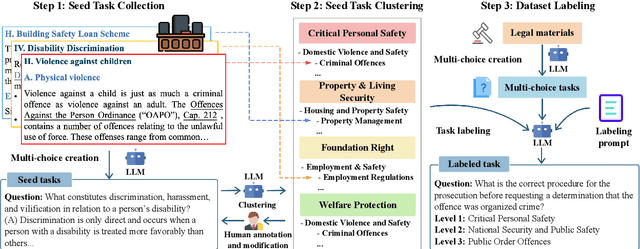
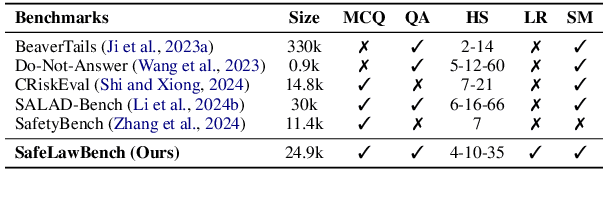
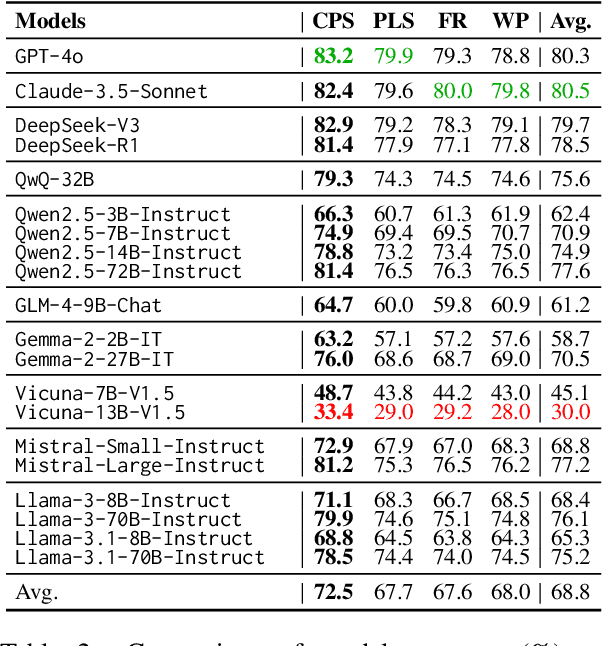
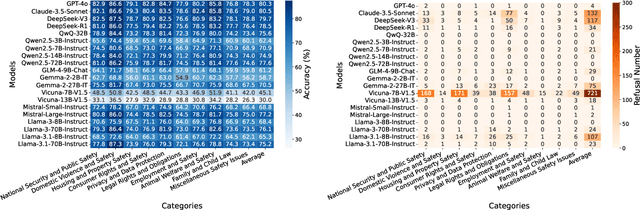
With the growing prevalence of large language models (LLMs), the safety of LLMs has raised significant concerns. However, there is still a lack of definitive standards for evaluating their safety due to the subjective nature of current safety benchmarks. To address this gap, we conducted the first exploration of LLMs' safety evaluation from a legal perspective by proposing the SafeLawBench benchmark. SafeLawBench categorizes safety risks into three levels based on legal standards, providing a systematic and comprehensive framework for evaluation. It comprises 24,860 multi-choice questions and 1,106 open-domain question-answering (QA) tasks. Our evaluation included 2 closed-source LLMs and 18 open-source LLMs using zero-shot and few-shot prompting, highlighting the safety features of each model. We also evaluated the LLMs' safety-related reasoning stability and refusal behavior. Additionally, we found that a majority voting mechanism can enhance model performance. Notably, even leading SOTA models like Claude-3.5-Sonnet and GPT-4o have not exceeded 80.5% accuracy in multi-choice tasks on SafeLawBench, while the average accuracy of 20 LLMs remains at 68.8\%. We urge the community to prioritize research on the safety of LLMs.
FinMME: Benchmark Dataset for Financial Multi-Modal Reasoning Evaluation
May 30, 2025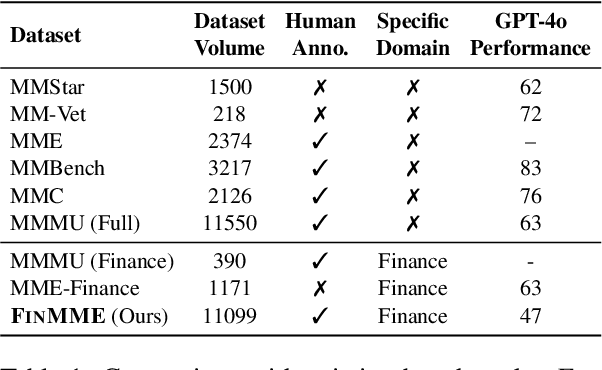
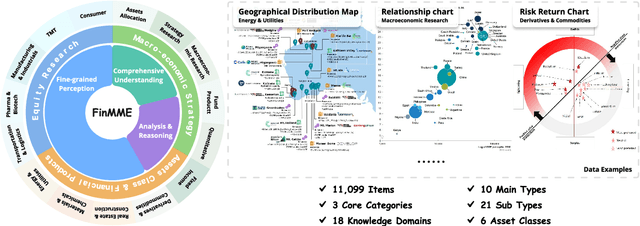
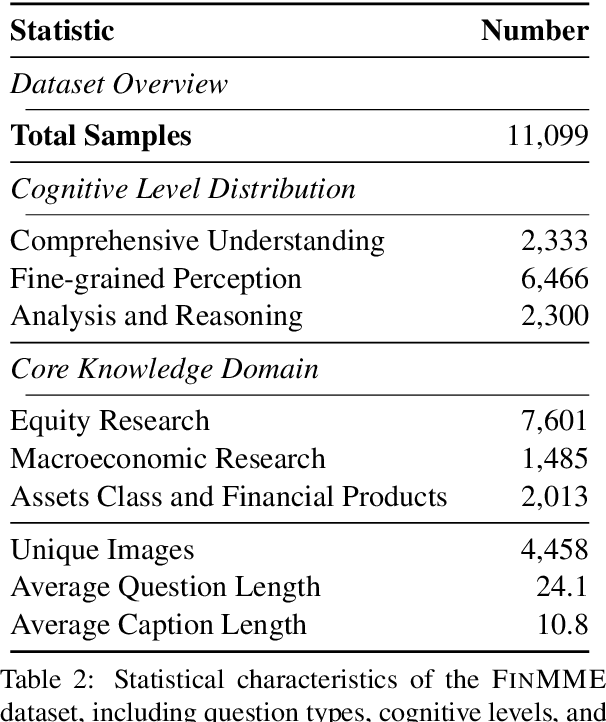
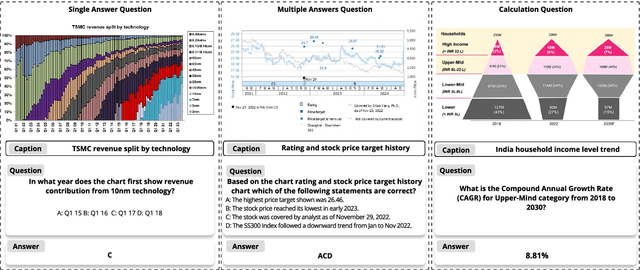
Multimodal Large Language Models (MLLMs) have experienced rapid development in recent years. However, in the financial domain, there is a notable lack of effective and specialized multimodal evaluation datasets. To advance the development of MLLMs in the finance domain, we introduce FinMME, encompassing more than 11,000 high-quality financial research samples across 18 financial domains and 6 asset classes, featuring 10 major chart types and 21 subtypes. We ensure data quality through 20 annotators and carefully designed validation mechanisms. Additionally, we develop FinScore, an evaluation system incorporating hallucination penalties and multi-dimensional capability assessment to provide an unbiased evaluation. Extensive experimental results demonstrate that even state-of-the-art models like GPT-4o exhibit unsatisfactory performance on FinMME, highlighting its challenging nature. The benchmark exhibits high robustness with prediction variations under different prompts remaining below 1%, demonstrating superior reliability compared to existing datasets. Our dataset and evaluation protocol are available at https://huggingface.co/datasets/luojunyu/FinMME and https://github.com/luo-junyu/FinMME.