 Add to Chrome
 Add to Firefox
 Add to Edge
Data Pyramid for Embodied Manipulation
Jul 27, 2026
Multimodal foundation models learned to see and to speak by consuming the whole internet. Embodied agents admit no such shortcut, since they require data that couple observations with physical states and actions. These signals can be provided, to varying degrees, by multiple data sources. In this work, we organize the embodied data ecosystem as a "pyramid" spanning five complementary sources: real-robot data, UMI-style data, egocentric and exocentric data, simulation data, and general vision-language data. We organize the pyramid around the tension between scalability and robot alignment, and further characterize each source in terms of data quality, diversity, reusability, and physical fidelity. We then analyze recent embodied foundation models through the lens of their data recipes, examining how different sources are selected, aligned, and mixed during pretraining. For embodied brain models, vision-language-action models, and world-action models alike, we relate data composition to capabilities in perception, reasoning, planning, action generation, and world prediction. We close by discussing six open challenges: building large-scale tactile datasets, collecting failure and recovery data, developing scalable data-collection pipelines, aligning actions across embodiments, leveraging egocentric data for dexterous manipulation, and designing principled data recipes for robot learning. We hope this work paves the foundation for the design of next-generation embodied systems.

Glob3R: Global Structure-from-Motion with 3D Foundation Models
Jul 10, 2026Recent 3D geometric foundation models, such as VGGT, provide robust feed-forward 3D reconstruction by directly predicting camera poses and 3D scene points from input images. However, their results remain inaccurate, and scaling them to long sequences or large unordered image sets typically requires chunk-wise processing, which can introduce drift and inconsistency. We present Glob3R, a global SfM-style reconstruction built on 3D foundation models. Our key idea is to explicitly optimize feed-forward geometric predictions. To this end, we augment a frozen Pi3X backbone with a lightweight dense matching head that predicts image warps between selected reference frames and neighboring views. These dense warps are converted into sparse but reliable multi-view feature tracks, which provide correspondence constraints for global optimization. We further introduce a keyframe-based sliding-window association strategy that propagates tracks and relative poses across overlapping windows, enabling scalable reconstruction. Finally, we perform global motion averaging and bundle adjustment to refine camera poses, reduce scale inconsistencies, and recover dense scene geometry. Extensive experiments on indoor, outdoor, large-scale driving, and unordered SfM benchmarks demonstrate that Glob3R achieves robust and accurate reconstruction. It consistently improves over feed-forward foundation-model baselines and recent scalable reconstruction methods, while being more robust than classical SfM pipelines. The refined poses also lead to higher-quality neural rendering, validating the benefit of combining foundation-model priors with global geometric optimization. Project page: https://junyuandeng.github.io/Glob3r
UniTacVLA: Unified Tactile Understanding and Prediction in Vision Language Action Models
Jun 30, 2026Vision-language-action (VLA) models have achieved strong performance in many robotic manipulation tasks, yet remain limited in contact-rich dexterous manipulation. To overcome this limitation, recent vision-tactile-language-action (VTLA) methods incorporate tactile sensing into VLA models to provide direct contact information. However, they typically treat tactile signals as passive auxiliary inputs, making it difficult to model tactile semantics and future physical interactions. To this end, we propose a unified tactile learning framework for contact-rich manipulation that models tactile signals as dynamic interaction cues for both contact understanding and prediction. Specifically, we construct a unified tactile latent space and jointly model current tactile states and future contact changes through tactile chain-of-thought reasoning and coarse-to-fine future tactile prediction, thereby forming a state-aware and dynamics-aware tactile prior. Based on this prior, we introduce a tactile-action mixed controller that combines real-time and predicted tactile feedback to refine low-frequency action chunks with high-frequency corrections. Real-world experiments on four categories of contact-rich tasks, including adjustment, insertion, wiping, and assembly, under both clean and externally perturbed settings, show that our method improves success rate, manipulation accuracy, and contact robustness over existing methods, demonstrating its effectiveness in dexterous physical interaction.
TouchThinker: Scaling Tactile Commonsense Reasoning to the Open World with Large-scale Data and Action-aware Representation
Jun 10, 2026Touch is a key modality for embodied agents to understand the physical world. Although recent work has incorporated tactile signals into language systems for tactile commonsense reasoning, scaling such systems to realistic open-world settings remains challenging due to two key bottlenecks: (1) current tactile reasoning datasets remain limited in format and scale, providing insufficient supervision for reasoning from tactile observations to physical commonsense and hindering the learning of transferable tactile commonsense; (2) Tactile signals are inherently redundant and action-specific, yet existing methods often overlook these properties, resulting in inefficient representations with limited semantic expressiveness. To address these limitations, we propose TouchThinker, a tactile-language framework that scales tactile commonsense reasoning to the open world from both data and representation perspectives. First, we construct TouchThinker-1M, a million-scale, multi-source tactile reasoning dataset covering \textbf{415} objects, \textbf{8} scenarios, and \textbf{7} sensor types, providing a solid data foundation for open-world generalization. We further introduce TouchThinker-Bench, an open-world benchmark with more realistic and diverse tasks. Then, we propose action-aware modeling mechanism to improve tactile representation efficiency and enable efficient reasoning. Experimental results demonstrate that TouchThinker achieves competitive performance against state-of-the-art models across multiple datasets. Our code and dataset will be made available at: https://github.com/lvkailin0118/TouchThinker.
3DThinkVLA: Endowing Vision-Language-Action Models with Latent 3D Priors via 3D-Thinking-Guided Co-training
Jun 03, 2026We propose a 3D-thinking-guided co-training framework that enables vision-language-action (VLA) models to perform 3D spatial reasoning implicitly during action prediction. Our core insight is that 3D geometry perception and 3D spatial reasoning are distinct capabilities that can be disentangled and injected at different feature hierarchies. During training, three tightly coupled components work in concert primarily within the latent space: (1) To gain geometric priors, a latent 3D geometry perception module aligns intermediate visual features with a 3D foundation model, acquiring low-level geometric cues without architectural modifications to the VLM backbone. (2) Complementing this, an online 3D reasoning distillation module mitigates the prompt-induced reasoning gap via a shared reasoning anchor token. During 3D VLM co-training, this anchor is emitted as the first output token to robustly encode spatial priors. During VLA training, it serves as an input token inserted between the task and action instructions, transferring high-level spatial thinking from explicit teacher reasoning prompts to student action prompts without chain-of-thought text generation. (3) These disentangled geometric and reasoning features are then united by a spatially augmented action integration, which jointly injects them into the action-query tokens as hierarchical spatial conditions to prevent action shortcuts. At deployment, our method retains only its lightweight adapters to perform implicit 3D reasoning, discarding the 3D foundation model and the teacher branch used for supervision. Consequently, it operates purely on 2D images without 3D sensors, external models, or explicit text generation while preventing catastrophic forgetting of the pretrained VLM, achieving state-of-the-art performance on LIBERO, LIBERO-PLUS, SimplerEnv, and real-world manipulation tasks.
Touch-R1: Reinforcing Touch Reasoning in MLLMs
May 26, 2026While rule-based reinforcement learning has recently catalyzed explicit reasoning in multimodal models, tactile reasoning remains largely underexplored. Existing tactile-language models primarily rely on supervised or contrastive objectives, which limits their capacity to ground predictions in physical evidence or rectify misleading visual priors. Tactile reasoning introduces two modality-specific challenges: the ordinal nature of physical attributes (e.g., hardness, roughness) and the cross-sensor distribution shifts inherent in optical tactile hardware. In this work, we introduce TouchReason-1M, a large-scale multimodal dataset comprising over 1M synchronized tactile pairs across four distinct sensors, and TouchReason-Bench, a rigorous framework for evaluating tactile perception and visual-tactile conflict resolution. Building upon these, we propose Touch-R1, a tactile reasoning MLLM based on Qwen2.5-VL-7B. Touch-R1 is trained via a tactile-grounded GRPO objective that combines ordinal-aware accuracy, cross-sensor physical consistency, structured-format control, and an input-side tactile grounding objective. Specifically, the tactile-use reward assigns credit only when authentic tactile inputs yield superior correctness relative to counterfactual controls where the tactile stream is removed, shuffled, or noise-masked. On TouchReason-Bench, Touch-R1-7B outperforms Octopi-13B by 18.4\% and GPT-4o by 24.7\% on average. Its structured reasoning traces reveal emergent behaviors of probing, comparison, and revision, demonstrating that R1-style reasoning can be effectively grounded in physical contact.
FocusVLA: Focused Visual Utilization for Vision-Language-Action Models
Mar 30, 2026Vision-Language-Action (VLA) models improve action generation by conditioning policies on rich vision-language information. However, current auto-regressive policies are constrained by three bottlenecks: (1) architectural bias drives models to overlook visual details, (2) an excessive number of visual tokens makes attention difficult to focus on the correct regions, and (3) task-irrelevant visual information introduces substantial noise - together severely impairing the quality of action. In this paper, we investigate how to effectively utilize different visual representations for action generation. To this end, we first empirically validate the above issues and show that VLA performance is primarily limited by how visual information is utilized, rather than by the quality of visual representations. Based on these insights, we introduce FocusVLA, a novel paradigm that directs the model's attention to task-relevant visual regions to effectively bridge vision to action. Specifically, we first propose Modality Cascaded Attention to eliminate shortcut pathways, thereby compelling VLA models to rely on task-relevant visual details for action generation. Furthermore, we propose Focus Attention, which dynamically selects task-relevant visual patches to control information quantity while explicitly modulating their influence to suppress task-irrelevant noise. Extensive experiments on both simulated and real-world robotic benchmarks demonstrate that FocusVLA not only effectively leverages visual details to perform dexterous manipulations, but also substantially improves performance and accelerates convergence across a variety of tasks.
ViSA: 3D-Aware Video Shading for Real-Time Upper-Body Avatar Creation
Dec 09, 2025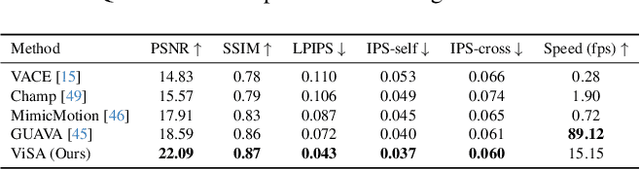
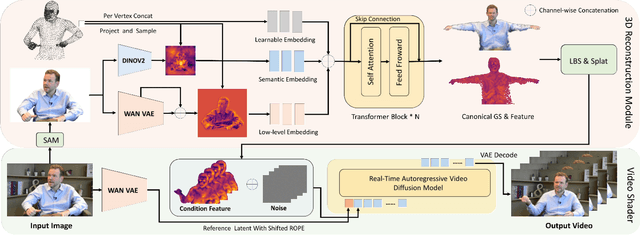
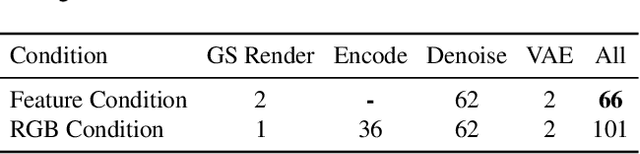
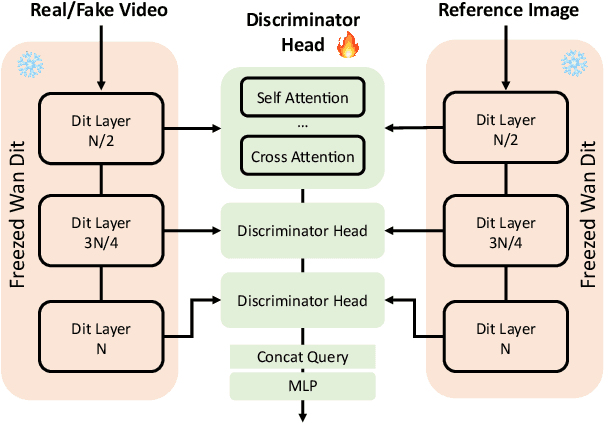
Generating high-fidelity upper-body 3D avatars from one-shot input image remains a significant challenge. Current 3D avatar generation methods, which rely on large reconstruction models, are fast and capable of producing stable body structures, but they often suffer from artifacts such as blurry textures and stiff, unnatural motion. In contrast, generative video models show promising performance by synthesizing photorealistic and dynamic results, but they frequently struggle with unstable behavior, including body structural errors and identity drift. To address these limitations, we propose a novel approach that combines the strengths of both paradigms. Our framework employs a 3D reconstruction model to provide robust structural and appearance priors, which in turn guides a real-time autoregressive video diffusion model for rendering. This process enables the model to synthesize high-frequency, photorealistic details and fluid dynamics in real time, effectively reducing texture blur and motion stiffness while preventing the structural inconsistencies common in video generation methods. By uniting the geometric stability of 3D reconstruction with the generative capabilities of video models, our method produces high-fidelity digital avatars with realistic appearance and dynamic, temporally coherent motion. Experiments demonstrate that our approach significantly reduces artifacts and achieves substantial improvements in visual quality over leading methods, providing a robust and efficient solution for real-time applications such as gaming and virtual reality. Project page: https://lhyfst.github.io/visa
OmniMotion: Multimodal Motion Generation with Continuous Masked Autoregression
Oct 16, 2025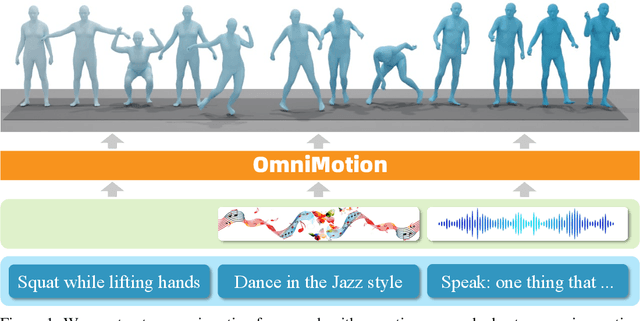
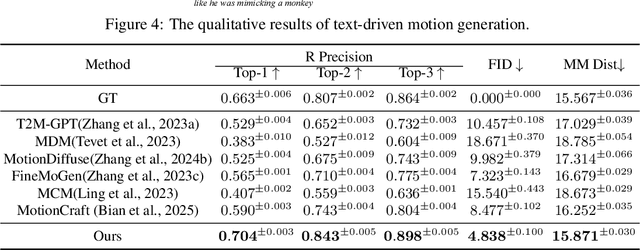
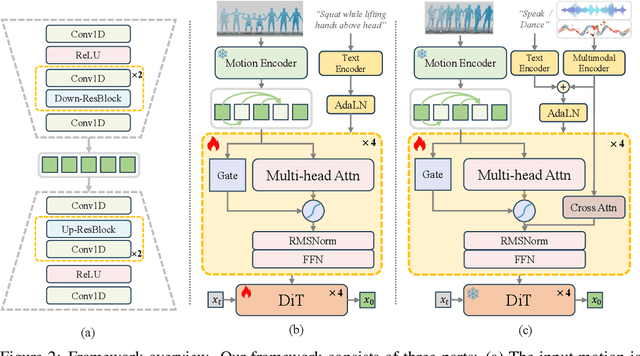
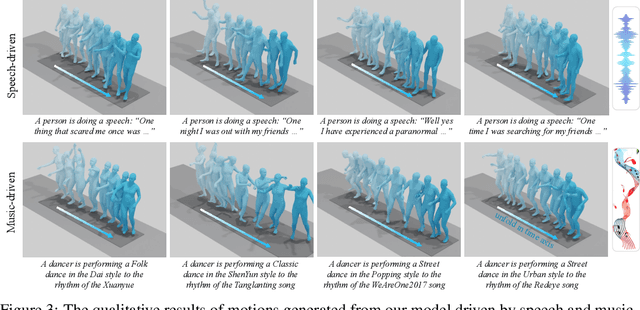
Whole-body multi-modal human motion generation poses two primary challenges: creating an effective motion generation mechanism and integrating various modalities, such as text, speech, and music, into a cohesive framework. Unlike previous methods that usually employ discrete masked modeling or autoregressive modeling, we develop a continuous masked autoregressive motion transformer, where a causal attention is performed considering the sequential nature within the human motion. Within this transformer, we introduce a gated linear attention and an RMSNorm module, which drive the transformer to pay attention to the key actions and suppress the instability caused by either the abnormal movements or the heterogeneous distributions within multi-modalities. To further enhance both the motion generation and the multimodal generalization, we employ the DiT structure to diffuse the conditions from the transformer towards the targets. To fuse different modalities, AdaLN and cross-attention are leveraged to inject the text, speech, and music signals. Experimental results demonstrate that our framework outperforms previous methods across all modalities, including text-to-motion, speech-to-gesture, and music-to-dance. The code of our method will be made public.
PanoLAM: Large Avatar Model for Gaussian Full-Head Synthesis from One-shot Unposed Image
Sep 09, 2025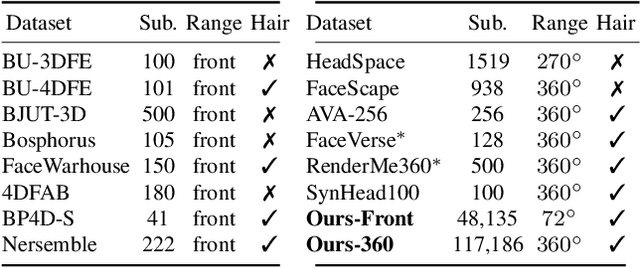
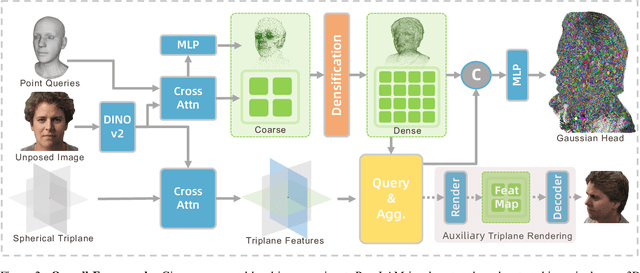
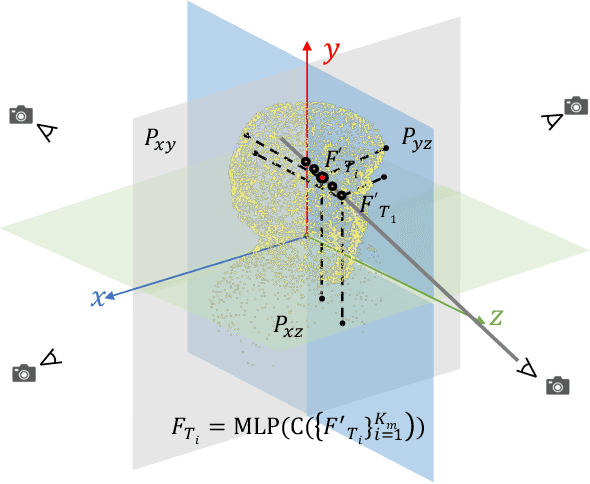
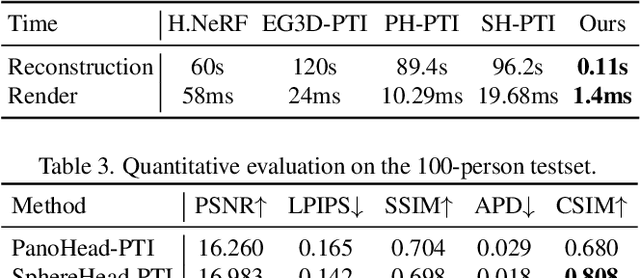
We present a feed-forward framework for Gaussian full-head synthesis from a single unposed image. Unlike previous work that relies on time-consuming GAN inversion and test-time optimization, our framework can reconstruct the Gaussian full-head model given a single unposed image in a single forward pass. This enables fast reconstruction and rendering during inference. To mitigate the lack of large-scale 3D head assets, we propose a large-scale synthetic dataset from trained 3D GANs and train our framework using only synthetic data. For efficient high-fidelity generation, we introduce a coarse-to-fine Gaussian head generation pipeline, where sparse points from the FLAME model interact with the image features by transformer blocks for feature extraction and coarse shape reconstruction, which are then densified for high-fidelity reconstruction. To fully leverage the prior knowledge residing in pretrained 3D GANs for effective reconstruction, we propose a dual-branch framework that effectively aggregates the structured spherical triplane feature and unstructured point-based features for more effective Gaussian head reconstruction. Experimental results show the effectiveness of our framework towards existing work.