 Add to Chrome
 Add to Firefox
 Add to Edge
SkillProx: Self-Evolving Agent Skills via Proximal Textual Gradient Descent
Aug 07, 2026
LLM agents increasingly adapt to recurring tasks by accumulating procedural knowledge in skills. These skills are lightweight, reusable textual artifacts that are loaded into the agent's context without weight updates. Recent methods refine skills through iterative task execution, failure diagnosis, and trajectory-guided text-space updates. However, existing frameworks lack explicit diagnosis--outcome feedback and treat deletion as a generic edit operation rather than a dedicated mechanism for consolidating accumulated knowledge. We introduce SkillProx, a proximal-gradient-inspired forward--backward framework that couples closed-loop diagnostic evolution with utility-aware proximal refinement. Motivated by a composite objective balancing task loss and skill complexity, the forward stage re-executes diagnosis-driven edits on the same task batch, rolls back regressions, and feeds measured outcomes into subsequent diagnoses. The backward stage decomposes the resulting skill into auditable knowledge units, estimates their contributions using a frozen leave-one-out utility audit, and applies validation-gated consolidation, demotion, or removal. Experiments on in-distribution and out-of-distribution benchmarks across multiple backbone LLMs show that SkillProx improves average accuracy by 3.0 percentage points over the strongest gradient-based baseline. Component ablations demonstrate the complementary effects of closed-loop diagnosis and proximal refinement.

Pushing the Boundaries of Natural Reasoning: Interleaved Bonus from Formal-Logic Verification
Jan 30, 2026Large Language Models (LLMs) show remarkable capabilities, yet their stochastic next-token prediction creates logical inconsistencies and reward hacking that formal symbolic systems avoid. To bridge this gap, we introduce a formal logic verification-guided framework that dynamically interleaves formal symbolic verification with the natural language generation process, providing real-time feedback to detect and rectify errors as they occur. Distinguished from previous neuro-symbolic methods limited by passive post-hoc validation, our approach actively penalizes intermediate fallacies during the reasoning chain. We operationalize this framework via a novel two-stage training pipeline that synergizes formal logic verification-guided supervised fine-tuning and policy optimization. Extensive evaluation on six benchmarks spanning mathematical, logical, and general reasoning demonstrates that our 7B and 14B models outperform state-of-the-art baselines by average margins of 10.4% and 14.2%, respectively. These results validate that formal verification can serve as a scalable mechanism to significantly push the performance boundaries of advanced LLM reasoning.
LRAS: Advanced Legal Reasoning with Agentic Search
Jan 12, 2026While Large Reasoning Models (LRMs) have demonstrated exceptional logical capabilities in mathematical domains, their application to the legal field remains hindered by the strict requirements for procedural rigor and adherence to legal logic. Existing legal LLMs, which rely on "closed-loop reasoning" derived solely from internal parametric knowledge, frequently suffer from lack of self-awareness regarding their knowledge boundaries, leading to confident yet incorrect conclusions. To address this challenge, we present Legal Reasoning with Agentic Search (LRAS), the first framework designed to transition legal LLMs from static and parametric "closed-loop thinking" to dynamic and interactive "Active Inquiry". By integrating Introspective Imitation Learning and Difficulty-aware Reinforcement Learning, LRAS enables LRMs to identify knowledge boundaries and handle legal reasoning complexity. Empirical results demonstrate that LRAS outperforms state-of-the-art baselines by 8.2-32\%, with the most substantial gains observed in tasks requiring deep reasoning with reliable knowledge. We will release our data and models for further exploration soon.
MedInsightBench: Evaluating Medical Analytics Agents Through Multi-Step Insight Discovery in Multimodal Medical Data
Dec 15, 2025In medical data analysis, extracting deep insights from complex, multi-modal datasets is essential for improving patient care, increasing diagnostic accuracy, and optimizing healthcare operations. However, there is currently a lack of high-quality datasets specifically designed to evaluate the ability of large multi-modal models (LMMs) to discover medical insights. In this paper, we introduce MedInsightBench, the first benchmark that comprises 332 carefully curated medical cases, each annotated with thoughtfully designed insights. This benchmark is intended to evaluate the ability of LMMs and agent frameworks to analyze multi-modal medical image data, including posing relevant questions, interpreting complex findings, and synthesizing actionable insights and recommendations. Our analysis indicates that existing LMMs exhibit limited performance on MedInsightBench, which is primarily attributed to their challenges in extracting multi-step, deep insights and the absence of medical expertise. Therefore, we propose MedInsightAgent, an automated agent framework for medical data analysis, composed of three modules: Visual Root Finder, Analytical Insight Agent, and Follow-up Question Composer. Experiments on MedInsightBench highlight pervasive challenges and demonstrate that MedInsightAgent can improve the performance of general LMMs in medical data insight discovery.
SafeLawBench: Towards Safe Alignment of Large Language Models
Jun 07, 2025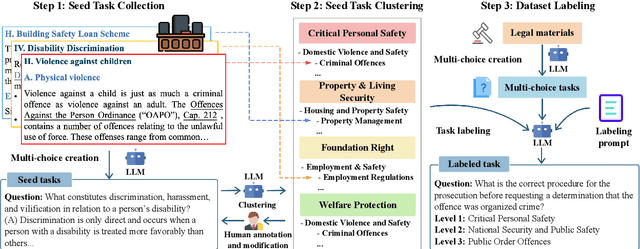
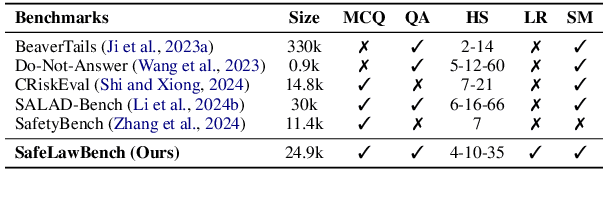
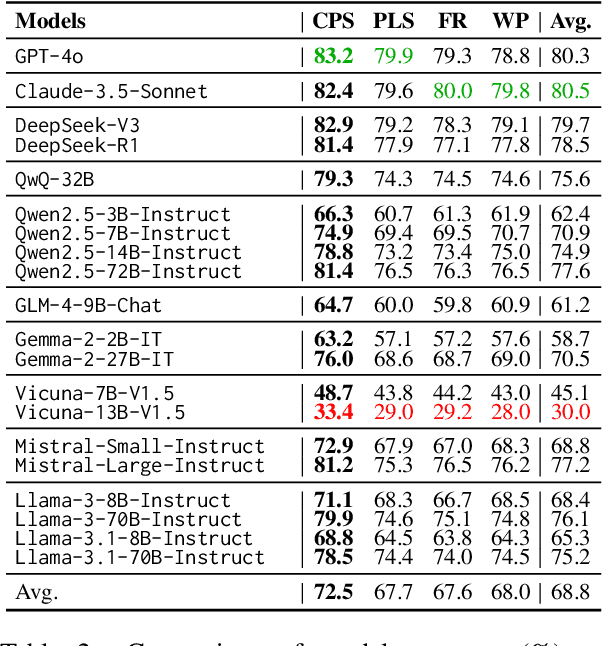
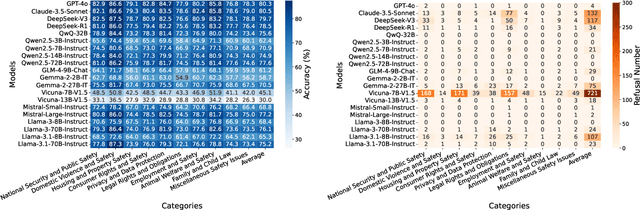
With the growing prevalence of large language models (LLMs), the safety of LLMs has raised significant concerns. However, there is still a lack of definitive standards for evaluating their safety due to the subjective nature of current safety benchmarks. To address this gap, we conducted the first exploration of LLMs' safety evaluation from a legal perspective by proposing the SafeLawBench benchmark. SafeLawBench categorizes safety risks into three levels based on legal standards, providing a systematic and comprehensive framework for evaluation. It comprises 24,860 multi-choice questions and 1,106 open-domain question-answering (QA) tasks. Our evaluation included 2 closed-source LLMs and 18 open-source LLMs using zero-shot and few-shot prompting, highlighting the safety features of each model. We also evaluated the LLMs' safety-related reasoning stability and refusal behavior. Additionally, we found that a majority voting mechanism can enhance model performance. Notably, even leading SOTA models like Claude-3.5-Sonnet and GPT-4o have not exceeded 80.5% accuracy in multi-choice tasks on SafeLawBench, while the average accuracy of 20 LLMs remains at 68.8\%. We urge the community to prioritize research on the safety of LLMs.
Measuring Hong Kong Massive Multi-Task Language Understanding
May 04, 2025Multilingual understanding is crucial for the cross-cultural applicability of Large Language Models (LLMs). However, evaluation benchmarks designed for Hong Kong's unique linguistic landscape, which combines Traditional Chinese script with Cantonese as the spoken form and its cultural context, remain underdeveloped. To address this gap, we introduce HKMMLU, a multi-task language understanding benchmark that evaluates Hong Kong's linguistic competence and socio-cultural knowledge. The HKMMLU includes 26,698 multi-choice questions across 66 subjects, organized into four categories: Science, Technology, Engineering, and Mathematics (STEM), Social Sciences, Humanities, and Other. To evaluate the multilingual understanding ability of LLMs, 90,550 Mandarin-Cantonese translation tasks were additionally included. We conduct comprehensive experiments on GPT-4o, Claude 3.7 Sonnet, and 18 open-source LLMs of varying sizes on HKMMLU. The results show that the best-performing model, DeepSeek-V3, struggles to achieve an accuracy of 75\%, significantly lower than that of MMLU and CMMLU. This performance gap highlights the need to improve LLMs' capabilities in Hong Kong-specific language and knowledge domains. Furthermore, we investigate how question language, model size, prompting strategies, and question and reasoning token lengths affect model performance. We anticipate that HKMMLU will significantly advance the development of LLMs in multilingual and cross-cultural contexts, thereby enabling broader and more impactful applications.