 Add to Chrome
 Add to Firefox
 Add to Edge
Constrained Decoding for Cross-lingual Label Projection
Feb 05, 2024
Zero-shot cross-lingual transfer utilizing multilingual LLMs has become a popular learning paradigm for low-resource languages with no labeled training data. However, for NLP tasks that involve fine-grained predictions on words and phrases, the performance of zero-shot cross-lingual transfer learning lags far behind supervised fine-tuning methods. Therefore, it is common to exploit translation and label projection to further improve the performance by (1) translating training data that is available in a high-resource language (e.g., English) together with the gold labels into low-resource languages, and/or (2) translating test data in low-resource languages to a high-source language to run inference on, then projecting the predicted span-level labels back onto the original test data. However, state-of-the-art marker-based label projection methods suffer from translation quality degradation due to the extra label markers injected in the input to the translation model. In this work, we explore a new direction that leverages constrained decoding for label projection to overcome the aforementioned issues. Our new method not only can preserve the quality of translated texts but also has the versatility of being applicable to both translating training and translating test data strategies. This versatility is crucial as our experiments reveal that translating test data can lead to a considerable boost in performance compared to translating only training data. We evaluate on two cross-lingual transfer tasks, namely Named Entity Recognition and Event Argument Extraction, spanning 20 languages. The results demonstrate that our approach outperforms the state-of-the-art marker-based method by a large margin and also shows better performance than other label projection methods that rely on external word alignment.

Spin: An Efficient Secure Computation Framework with GPU Acceleration
Feb 04, 2024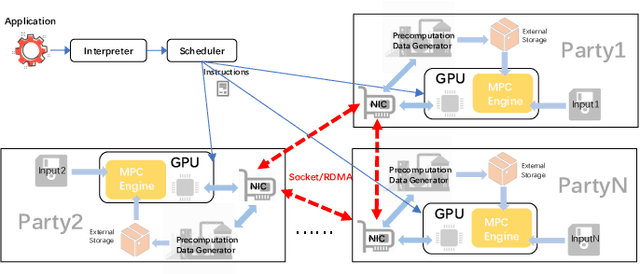
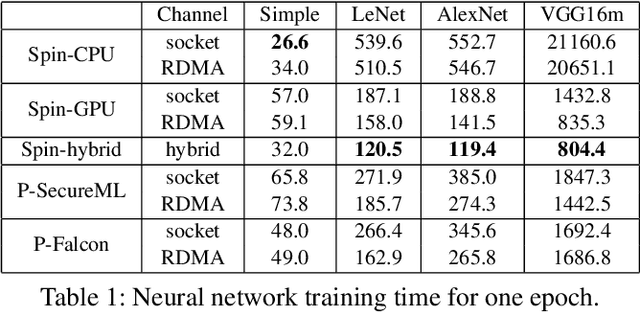
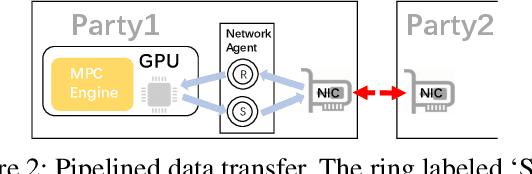
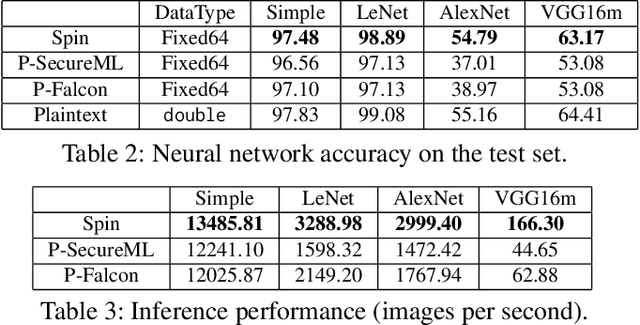
Accuracy and efficiency remain challenges for multi-party computation (MPC) frameworks. Spin is a GPU-accelerated MPC framework that supports multiple computation parties and a dishonest majority adversarial setup. We propose optimized protocols for non-linear functions that are critical for machine learning, as well as several novel optimizations specific to attention that is the fundamental unit of Transformer models, allowing Spin to perform non-trivial CNNs training and Transformer inference without sacrificing security. At the backend level, Spin leverages GPU, CPU, and RDMA-enabled smart network cards for acceleration. Comprehensive evaluations demonstrate that Spin can be up to $2\times$ faster than the state-of-the-art for deep neural network training. For inference on a Transformer model with 18.9 million parameters, our attention-specific optimizations enable Spin to achieve better efficiency, less communication, and better accuracy.
Joint Semantic Communication and Target Sensing for 6G Communication System
Jan 30, 2024


This paper investigates the secure resource allocation for a downlink integrated sensing and communication system with multiple legal users and potential eavesdroppers. In the considered model, the base station (BS) simultaneously transmits sensing and communication signals through beamforming design, where the sensing signals can be viewed as artificial noise to enhance the security of communication signals. To further enhance the security in the semantic layer, the semantic information is extracted from the original information before transmission. The user side can only successfully recover the received information with the help of the knowledge base shared with the BS, which is stored in advance. Our aim is to maximize the sum semantic secrecy rate of all users while maintaining the minimum quality of service for each user and guaranteeing overall sensing performance. To solve this sum semantic secrecy rate maximization problem, an iterative algorithm is proposed using the alternating optimization method. The simulation results demonstrate the superiority of the proposed algorithm in terms of secure semantic communication and reliable detection.
InfoLossQA: Characterizing and Recovering Information Loss in Text Simplification
Jan 29, 2024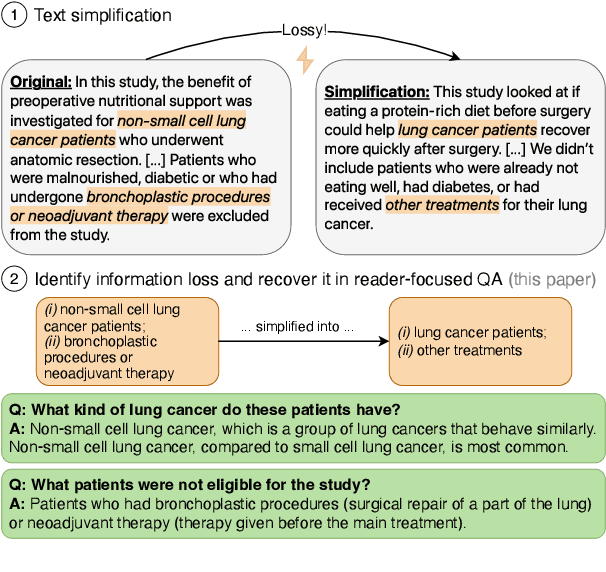
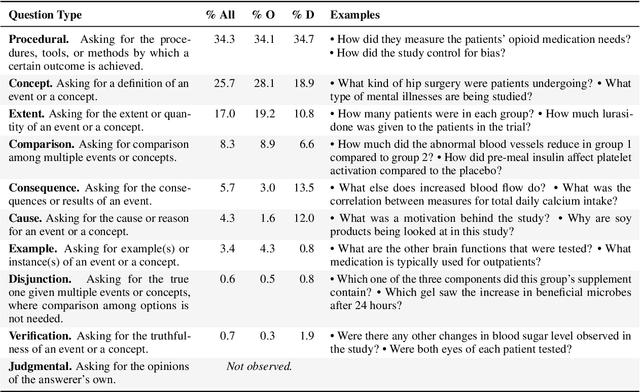
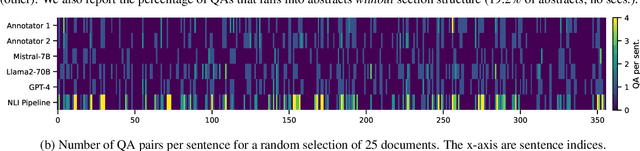
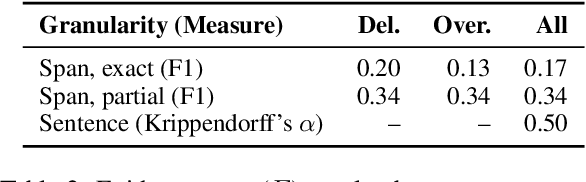
Text simplification aims to make technical texts more accessible to laypeople but often results in deletion of information and vagueness. This work proposes InfoLossQA, a framework to characterize and recover simplification-induced information loss in form of question-and-answer (QA) pairs. Building on the theory of Question Under Discussion, the QA pairs are designed to help readers deepen their knowledge of a text. We conduct a range of experiments with this framework. First, we collect a dataset of 1,000 linguist-curated QA pairs derived from 104 LLM simplifications of scientific abstracts of medical studies. Our analyses of this data reveal that information loss occurs frequently, and that the QA pairs give a high-level overview of what information was lost. Second, we devise two methods for this task: end-to-end prompting of open-source and commercial language models, and a natural language inference pipeline. With a novel evaluation framework considering the correctness of QA pairs and their linguistic suitability, our expert evaluation reveals that models struggle to reliably identify information loss and applying similar standards as humans at what constitutes information loss.
Continuous Field Reconstruction from Sparse Observations with Implicit Neural Networks
Jan 21, 2024
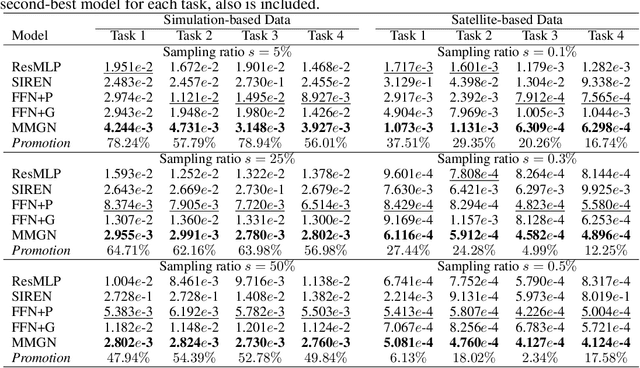
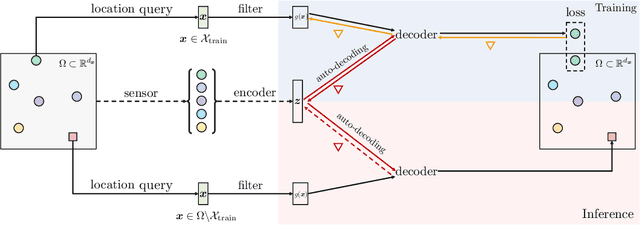
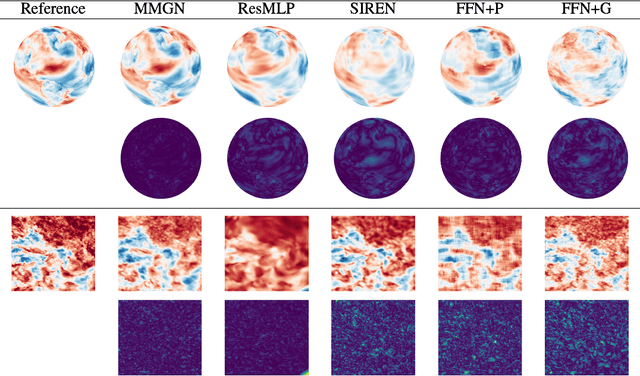
Reliably reconstructing physical fields from sparse sensor data is a challenge that frequently arises in many scientific domains. In practice, the process generating the data often is not understood to sufficient accuracy. Therefore, there is a growing interest in using the deep neural network route to address the problem. This work presents a novel approach that learns a continuous representation of the physical field using implicit neural representations (INRs). Specifically, after factorizing spatiotemporal variability into spatial and temporal components using the separation of variables technique, the method learns relevant basis functions from sparsely sampled irregular data points to develop a continuous representation of the data. In experimental evaluations, the proposed model outperforms recent INR methods, offering superior reconstruction quality on simulation data from a state-of-the-art climate model and a second dataset that comprises ultra-high resolution satellite-based sea surface temperature fields.
VONet: Unsupervised Video Object Learning With Parallel U-Net Attention and Object-wise Sequential VAE
Jan 20, 2024Unsupervised video object learning seeks to decompose video scenes into structural object representations without any supervision from depth, optical flow, or segmentation. We present VONet, an innovative approach that is inspired by MONet. While utilizing a U-Net architecture, VONet employs an efficient and effective parallel attention inference process, generating attention masks for all slots simultaneously. Additionally, to enhance the temporal consistency of each mask across consecutive video frames, VONet develops an object-wise sequential VAE framework. The integration of these innovative encoder-side techniques, in conjunction with an expressive transformer-based decoder, establishes VONet as the leading unsupervised method for object learning across five MOVI datasets, encompassing videos of diverse complexities. Code is available at https://github.com/hnyu/vonet.
CAT-LLM: Prompting Large Language Models with Text Style Definition for Chinese Article-style Transfer
Jan 11, 2024Text style transfer is increasingly prominent in online entertainment and social media. However, existing research mainly concentrates on style transfer within individual English sentences, while ignoring the complexity of long Chinese texts, which limits the wider applicability of style transfer in digital media realm. To bridge this gap, we propose a Chinese Article-style Transfer framework (CAT-LLM), leveraging the capabilities of Large Language Models (LLMs). CAT-LLM incorporates a bespoke, pluggable Text Style Definition (TSD) module aimed at comprehensively analyzing text features in articles, prompting LLMs to efficiently transfer Chinese article-style. The TSD module integrates a series of machine learning algorithms to analyze article-style from both words and sentences levels, thereby aiding LLMs thoroughly grasp the target style without compromising the integrity of the original text. In addition, this module supports dynamic expansion of internal style trees, showcasing robust compatibility and allowing flexible optimization in subsequent research. Moreover, we select five Chinese articles with distinct styles and create five parallel datasets using ChatGPT, enhancing the models' performance evaluation accuracy and establishing a novel paradigm for evaluating subsequent research on article-style transfer. Extensive experimental results affirm that CAT-LLM outperforms current research in terms of transfer accuracy and content preservation, and has remarkable applicability to various types of LLMs.
Unified Diffusion-Based Rigid and Non-Rigid Editing with Text and Image Guidance
Jan 04, 2024Existing text-to-image editing methods tend to excel either in rigid or non-rigid editing but encounter challenges when combining both, resulting in misaligned outputs with the provided text prompts. In addition, integrating reference images for control remains challenging. To address these issues, we present a versatile image editing framework capable of executing both rigid and non-rigid edits, guided by either textual prompts or reference images. We leverage a dual-path injection scheme to handle diverse editing scenarios and introduce an integrated self-attention mechanism for fusion of appearance and structural information. To mitigate potential visual artifacts, we further employ latent fusion techniques to adjust intermediate latents. Compared to previous work, our approach represents a significant advance in achieving precise and versatile image editing. Comprehensive experiments validate the efficacy of our method, showcasing competitive or superior results in text-based editing and appearance transfer tasks, encompassing both rigid and non-rigid settings.
Group Multi-View Transformer for 3D Shape Analysis with Spatial Encoding
Dec 30, 2023In recent years, the results of view-based 3D shape recognition methods have saturated, and models with excellent performance cannot be deployed on memory-limited devices due to their huge size of parameters. To address this problem, we introduce a compression method based on knowledge distillation for this field, which largely reduces the number of parameters while preserving model performance as much as possible. Specifically, to enhance the capabilities of smaller models, we design a high-performing large model called Group Multi-view Vision Transformer (GMViT). In GMViT, the view-level ViT first establishes relationships between view-level features. Additionally, to capture deeper features, we employ the grouping module to enhance view-level features into group-level features. Finally, the group-level ViT aggregates group-level features into complete, well-formed 3D shape descriptors. Notably, in both ViTs, we introduce spatial encoding of camera coordinates as innovative position embeddings. Furthermore, we propose two compressed versions based on GMViT, namely GMViT-simple and GMViT-mini. To enhance the training effectiveness of the small models, we introduce a knowledge distillation method throughout the GMViT process, where the key outputs of each GMViT component serve as distillation targets. Extensive experiments demonstrate the efficacy of the proposed method. The large model GMViT achieves excellent 3D classification and retrieval results on the benchmark datasets ModelNet, ShapeNetCore55, and MCB. The smaller models, GMViT-simple and GMViT-mini, reduce the parameter size by 8 and 17.6 times, respectively, and improve shape recognition speed by 1.5 times on average, while preserving at least 90% of the classification and retrieval performance.
The Earth is Flat because: Investigating LLMs' Belief towards Misinformation via Persuasive Conversation
Dec 29, 2023Large Language Models (LLMs) encapsulate vast amounts of knowledge but still remain vulnerable to external misinformation. Existing research mainly studied this susceptibility behavior in a single-turn setting. However, belief can change during a multi-turn conversation, especially a persuasive one. Therefore, in this study, we delve into LLMs' susceptibility to persuasive conversations, particularly on factual questions that they can answer correctly. We first curate the Farm (i.e., Fact to Misinform) dataset, which contains factual questions paired with systematically generated persuasive misinformation. Then, we develop a testing framework to track LLMs' belief changes in a persuasive dialogue. Through extensive experiments, we find that LLMs' correct beliefs on factual knowledge can be easily manipulated by various persuasive strategies.