 Add to Chrome
 Add to Firefox
 Add to Edge
Advancing Narrative Long Video Generation via Training-Free Identity-Aware Memory
May 18, 2026
Autoregressive video generation has improved rapidly in visual fidelity and interactivity, but it still suffers from long-term inconsistency and memory degradation. Most existing solutions either compress historical frames using predefined strategies or retrieve keyframes based on coarse implicit attention signals, both of which fail to handle evolving prompts with shifting entity references, leading to identity drift, character duplication, and attribute loss. To address this, we propose IAMFlow, a training-free identity-aware memory framework that explicitly models and tracks persistent entity identities, enabling consistent generation across prompt transitions. Specifically, an LLM extracts entities with visual attributes from each prompt and assigns unique global IDs for identity-aware memory, while a VLM asynchronously verifies and refines attributes from rendered frames, enabling explicit entity tracking in place of implicit similarity-based matching. To keep the proposed framework computationally practical, we design a systematic inference acceleration pipeline, including asynchronous visual verification, adaptive prompt transition, and model quantization, which achieves faster generation than existing baselines. Furthermore, we introduce NarraStream-Bench, a benchmark for narrative streaming video generation that features 324 multi-prompt scripts spanning six dimensions and a three-dimensional evaluation protocol that integrates both traditional metrics and multimodal large language model-based assessments. Extensive experiments show that IAMFlow, despite being training-free, achieves the best overall performance on NarraStream-Bench, outperforming the strongest baseline by 2.56 points, while achieving a 1.39$\times$ speedup over the most efficient baseline in the 60-second multi-prompt setting.

Divide and Conquer: Decoupled Representation Alignment for Multimodal World Models
May 03, 2026Emerging multi-modal world models attempt to jointly generate videos across diverse modalities (e.g., RGB, depth, and mask), yet they fail to fully exploit the rich priors of existing foundation models. We propose $M^2$-REPA, the first representation alignment method tailored for multi-modal video generation. Our key insight is that foundation models trained on different modality spaces naturally capture distinct domain-specific priors, acting as complementary "experts." Specifically, we first decouple modality-specific features from the diffusion model's intermediate representations, then align each with its corresponding expert foundation model. To this end, we design two synergistic objectives: a multi-modal representation alignment loss that enforces feature-to-expert matching, and a modality-specific decoupling regularization that encourages complementarity across different modalities. This design enables joint optimization, fully exploiting priors from multiple foundation models. Extensive experiments demonstrate that our method significantly outperforms baselines in visual quality and long-term consistency.
When Numbers Speak: Aligning Textual Numerals and Visual Instances in Text-to-Video Diffusion Models
Apr 09, 2026Text-to-video diffusion models have enabled open-ended video synthesis, but often struggle with generating the correct number of objects specified in a prompt. We introduce NUMINA , a training-free identify-then-guide framework for improved numerical alignment. NUMINA identifies prompt-layout inconsistencies by selecting discriminative self- and cross-attention heads to derive a countable latent layout. It then refines this layout conservatively and modulates cross-attention to guide regeneration. On the introduced CountBench, NUMINA improves counting accuracy by up to 7.4% on Wan2.1-1.3B, and by 4.9% and 5.5% on 5B and 14B models, respectively. Furthermore, CLIP alignment is improved while maintaining temporal consistency. These results demonstrate that structural guidance complements seed search and prompt enhancement, offering a practical path toward count-accurate text-to-video diffusion. The code is available at https://github.com/H-EmbodVis/NUMINA.
PointTPA: Dynamic Network Parameter Adaptation for 3D Scene Understanding
Apr 06, 2026Scene-level point cloud understanding remains challenging due to diverse geometries, imbalanced category distributions, and highly varied spatial layouts. Existing methods improve object-level performance but rely on static network parameters during inference, limiting their adaptability to dynamic scene data. We propose PointTPA, a Test-time Parameter Adaptation framework that generates input-aware network parameters for scene-level point clouds. PointTPA adopts a Serialization-based Neighborhood Grouping (SNG) to form locally coherent patches and a Dynamic Parameter Projector (DPP) to produce patch-wise adaptive weights, enabling the backbone to adjust its behavior according to scene-specific variations while maintaining a low parameter overhead. Integrated into the PTv3 structure, PointTPA demonstrates strong parameter efficiency by introducing two lightweight modules of less than 2% of the backbone's parameters. Despite this minimal parameter overhead, PointTPA achieves 78.4% mIoU on ScanNet validation, surpassing existing parameter-efficient fine-tuning (PEFT) methods across multiple benchmarks, highlighting the efficacy of our test-time dynamic network parameter adaptation mechanism in enhancing 3D scene understanding. The code is available at https://github.com/H-EmbodVis/PointTPA.
Out of Sight but Not Out of Mind: Hybrid Memory for Dynamic Video World Models
Mar 26, 2026Video world models have shown immense potential in simulating the physical world, yet existing memory mechanisms primarily treat environments as static canvases. When dynamic subjects hide out of sight and later re-emerge, current methods often struggle, leading to frozen, distorted, or vanishing subjects. To address this, we introduce Hybrid Memory, a novel paradigm requiring models to simultaneously act as precise archivists for static backgrounds and vigilant trackers for dynamic subjects, ensuring motion continuity during out-of-view intervals. To facilitate research in this direction, we construct HM-World, the first large-scale video dataset dedicated to hybrid memory. It features 59K high-fidelity clips with decoupled camera and subject trajectories, encompassing 17 diverse scenes, 49 distinct subjects, and meticulously designed exit-entry events to rigorously evaluate hybrid coherence. Furthermore, we propose HyDRA, a specialized memory architecture that compresses memory into tokens and utilizes a spatiotemporal relevance-driven retrieval mechanism. By selectively attending to relevant motion cues, HyDRA effectively preserves the identity and motion of hidden subjects. Extensive experiments on HM-World demonstrate that our method significantly outperforms state-of-the-art approaches in both dynamic subject consistency and overall generation quality.
Generation Models Know Space: Unleashing Implicit 3D Priors for Scene Understanding
Mar 19, 2026While Multimodal Large Language Models demonstrate impressive semantic capabilities, they often suffer from spatial blindness, struggling with fine-grained geometric reasoning and physical dynamics. Existing solutions typically rely on explicit 3D modalities or complex geometric scaffolding, which are limited by data scarcity and generalization challenges. In this work, we propose a paradigm shift by leveraging the implicit spatial prior within large-scale video generation models. We posit that to synthesize temporally coherent videos, these models inherently learn robust 3D structural priors and physical laws. We introduce VEGA-3D (Video Extracted Generative Awareness), a plug-and-play framework that repurposes a pre-trained video diffusion model as a Latent World Simulator. By extracting spatiotemporal features from intermediate noise levels and integrating them with semantic representations via a token-level adaptive gated fusion mechanism, we enrich MLLMs with dense geometric cues without explicit 3D supervision. Extensive experiments across 3D scene understanding, spatial reasoning, and embodied manipulation benchmarks demonstrate that our method outperforms state-of-the-art baselines, validating that generative priors provide a scalable foundation for physical-world understanding. Code is publicly available at https://github.com/H-EmbodVis/VEGA-3D.
Towards Generalizable Robotic Manipulation in Dynamic Environments
Mar 16, 2026Vision-Language-Action (VLA) models excel in static manipulation but struggle in dynamic environments with moving targets. This performance gap primarily stems from a scarcity of dynamic manipulation datasets and the reliance of mainstream VLAs on single-frame observations, restricting their spatiotemporal reasoning capabilities. To address this, we introduce DOMINO, a large-scale dataset and benchmark for generalizable dynamic manipulation, featuring 35 tasks with hierarchical complexities, over 110K expert trajectories, and a multi-dimensional evaluation suite. Through comprehensive experiments, we systematically evaluate existing VLAs on dynamic tasks, explore effective training strategies for dynamic awareness, and validate the generalizability of dynamic data. Furthermore, we propose PUMA, a dynamics-aware VLA architecture. By integrating scene-centric historical optical flow and specialized world queries to implicitly forecast object-centric future states, PUMA couples history-aware perception with short-horizon prediction. Results demonstrate that PUMA achieves state-of-the-art performance, yielding a 6.3% absolute improvement in success rate over baselines. Moreover, we show that training on dynamic data fosters robust spatiotemporal representations that transfer to static tasks. All code and data are available at https://github.com/H-EmbodVis/DOMINO.
Video Streaming Thinking: VideoLLMs Can Watch and Think Simultaneously
Mar 12, 2026Online Video Large Language Models (VideoLLMs) play a critical role in supporting responsive, real-time interaction. Existing methods focus on streaming perception, lacking a synchronized logical reasoning stream. However, directly applying test-time scaling methods incurs unacceptable response latency. To address this trade-off, we propose Video Streaming Thinking (VST), a novel paradigm for streaming video understanding. It supports a thinking while watching mechanism, which activates reasoning over incoming video clips during streaming. This design improves timely comprehension and coherent cognition while preserving real-time responsiveness by amortizing LLM reasoning latency over video playback. Furthermore, we introduce a comprehensive post-training pipeline that integrates VST-SFT, which structurally adapts the offline VideoLLM to causal streaming reasoning, and VST-RL, which provides end-to-end improvement through self-exploration in a multi-turn video interaction environment. Additionally, we devise an automated training-data synthesis pipeline that uses video knowledge graphs to generate high-quality streaming QA pairs, with an entity-relation grounded streaming Chain-of-Thought to enforce multi-evidence reasoning and sustained attention to the video stream. Extensive evaluations show that VST-7B performs strongly on online benchmarks, e.g. 79.5% on StreamingBench and 59.3% on OVO-Bench. Meanwhile, VST remains competitive on offline long-form or reasoning benchmarks. Compared with Video-R1, VST responds 15.7 times faster and achieves +5.4% improvement on VideoHolmes, demonstrating higher efficiency and strong generalization across diverse video understanding tasks. Code, data, and models will be released at https://github.com/1ranGuan/VST.
ThinkOmni: Lifting Textual Reasoning to Omni-modal Scenarios via Guidance Decoding
Feb 26, 2026Omni-modal reasoning is essential for intelligent systems to understand and draw inferences from diverse data sources. While existing omni-modal large language models (OLLM) excel at perceiving diverse modalities, they lack the complex reasoning abilities of recent large reasoning models (LRM). However, enhancing the reasoning ability of OLLMs through additional training presents significant challenges, including the need for high-quality data, task-specific adaptation, and substantial computational costs. To address these limitations, we propose ThinkOmni, a training-free and data-free framework that lifts textual reasoning to omni-modal scenarios. ThinkOmni introduces two key components: 1) LRM-as-a-Guide, which leverages off-the-shelf LRMs to guide the OLLM decoding process; 2) Stepwise Contrastive Scaling, which adaptively balances perception and reasoning signals without manual hyperparameter tuning. Experiments on six multi-modal reasoning benchmarks demonstrate that ThinkOmni consistently delivers performance improvements, with main results achieving 70.2 on MathVista and 75.5 on MMAU. Overall, ThinkOmni offers a flexible and generalizable solution for omni-modal reasoning and provides new insights into the generalization and application of reasoning capabilities.
MindDrive: A Vision-Language-Action Model for Autonomous Driving via Online Reinforcement Learning
Dec 16, 2025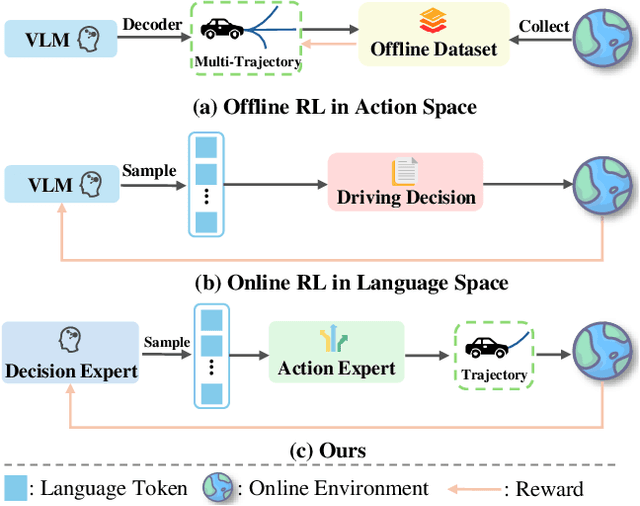
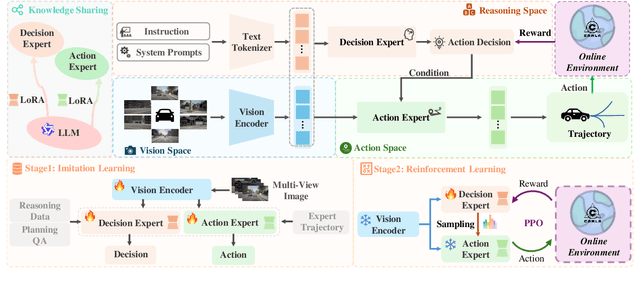
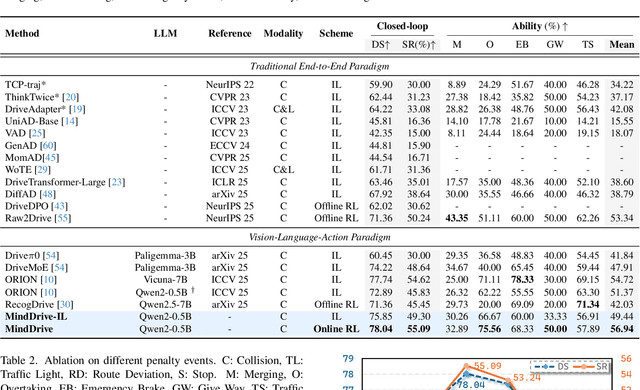
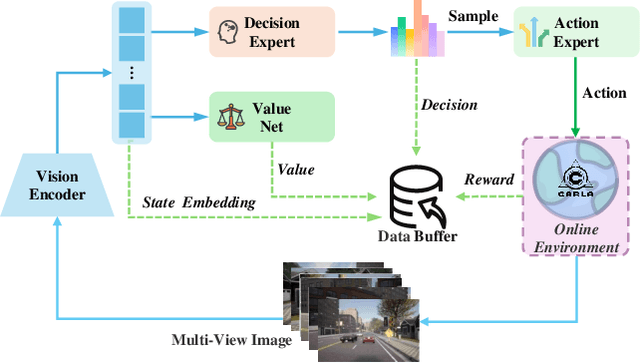
Current Vision-Language-Action (VLA) paradigms in autonomous driving primarily rely on Imitation Learning (IL), which introduces inherent challenges such as distribution shift and causal confusion. Online Reinforcement Learning offers a promising pathway to address these issues through trial-and-error learning. However, applying online reinforcement learning to VLA models in autonomous driving is hindered by inefficient exploration in continuous action spaces. To overcome this limitation, we propose MindDrive, a VLA framework comprising a large language model (LLM) with two distinct sets of LoRA parameters. The one LLM serves as a Decision Expert for scenario reasoning and driving decision-making, while the other acts as an Action Expert that dynamically maps linguistic decisions into feasible trajectories. By feeding trajectory-level rewards back into the reasoning space, MindDrive enables trial-and-error learning over a finite set of discrete linguistic driving decisions, instead of operating directly in a continuous action space. This approach effectively balances optimal decision-making in complex scenarios, human-like driving behavior, and efficient exploration in online reinforcement learning. Using the lightweight Qwen-0.5B LLM, MindDrive achieves Driving Score (DS) of 78.04 and Success Rate (SR) of 55.09% on the challenging Bench2Drive benchmark. To the best of our knowledge, this is the first work to demonstrate the effectiveness of online reinforcement learning for the VLA model in autonomous driving.