 Add to Chrome
 Add to Firefox
 Add to Edge
Ego-Exo4D: Understanding Skilled Human Activity from First- and Third-Person Perspectives
Nov 30, 2023

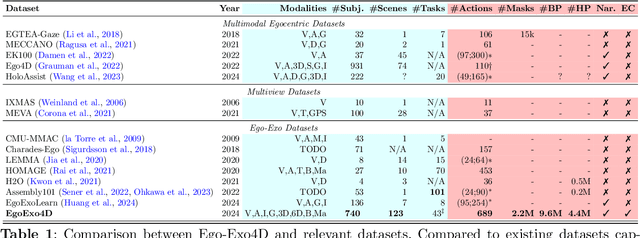

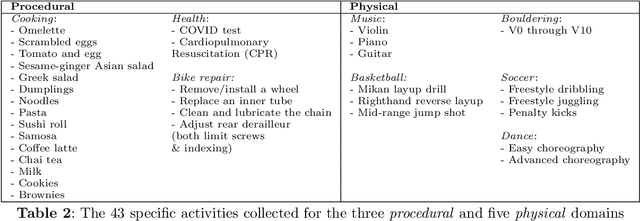
We present Ego-Exo4D, a diverse, large-scale multimodal multiview video dataset and benchmark challenge. Ego-Exo4D centers around simultaneously-captured egocentric and exocentric video of skilled human activities (e.g., sports, music, dance, bike repair). More than 800 participants from 13 cities worldwide performed these activities in 131 different natural scene contexts, yielding long-form captures from 1 to 42 minutes each and 1,422 hours of video combined. The multimodal nature of the dataset is unprecedented: the video is accompanied by multichannel audio, eye gaze, 3D point clouds, camera poses, IMU, and multiple paired language descriptions -- including a novel "expert commentary" done by coaches and teachers and tailored to the skilled-activity domain. To push the frontier of first-person video understanding of skilled human activity, we also present a suite of benchmark tasks and their annotations, including fine-grained activity understanding, proficiency estimation, cross-view translation, and 3D hand/body pose. All resources will be open sourced to fuel new research in the community.

Universal Humanoid Motion Representations for Physics-Based Control
Oct 06, 2023
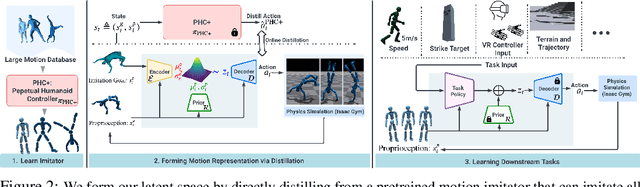
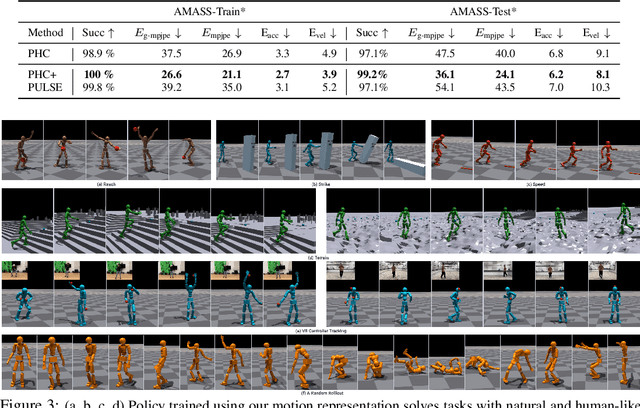
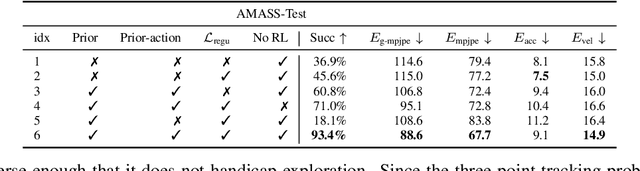
We present a universal motion representation that encompasses a comprehensive range of motor skills for physics-based humanoid control. Due to the high-dimensionality of humanoid control as well as the inherent difficulties in reinforcement learning, prior methods have focused on learning skill embeddings for a narrow range of movement styles (e.g. locomotion, game characters) from specialized motion datasets. This limited scope hampers its applicability in complex tasks. Our work closes this gap, significantly increasing the coverage of motion representation space. To achieve this, we first learn a motion imitator that can imitate all of human motion from a large, unstructured motion dataset. We then create our motion representation by distilling skills directly from the imitator. This is achieved using an encoder-decoder structure with a variational information bottleneck. Additionally, we jointly learn a prior conditioned on proprioception (humanoid's own pose and velocities) to improve model expressiveness and sampling efficiency for downstream tasks. Sampling from the prior, we can generate long, stable, and diverse human motions. Using this latent space for hierarchical RL, we show that our policies solve tasks using natural and realistic human behavior. We demonstrate the effectiveness of our motion representation by solving generative tasks (e.g. strike, terrain traversal) and motion tracking using VR controllers.
TEMPO: Efficient Multi-View Pose Estimation, Tracking, and Forecasting
Sep 14, 2023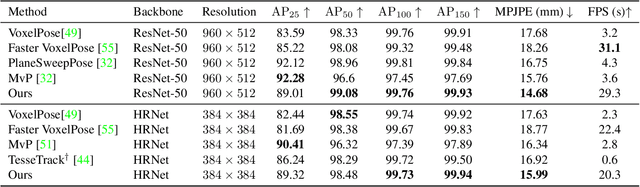
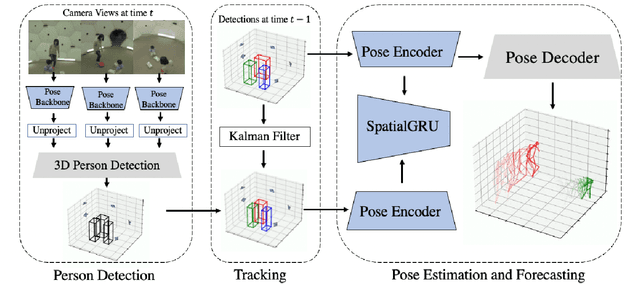
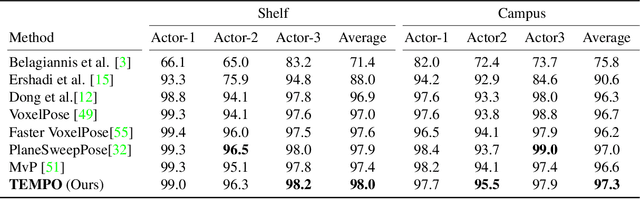
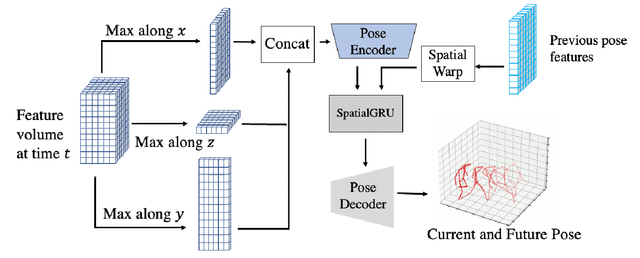
Existing volumetric methods for predicting 3D human pose estimation are accurate, but computationally expensive and optimized for single time-step prediction. We present TEMPO, an efficient multi-view pose estimation model that learns a robust spatiotemporal representation, improving pose accuracy while also tracking and forecasting human pose. We significantly reduce computation compared to the state-of-the-art by recurrently computing per-person 2D pose features, fusing both spatial and temporal information into a single representation. In doing so, our model is able to use spatiotemporal context to predict more accurate human poses without sacrificing efficiency. We further use this representation to track human poses over time as well as predict future poses. Finally, we demonstrate that our model is able to generalize across datasets without scene-specific fine-tuning. TEMPO achieves 10$\%$ better MPJPE with a 33$\times$ improvement in FPS compared to TesseTrack on the challenging CMU Panoptic Studio dataset.
EgoHumans: An Egocentric 3D Multi-Human Benchmark
May 25, 2023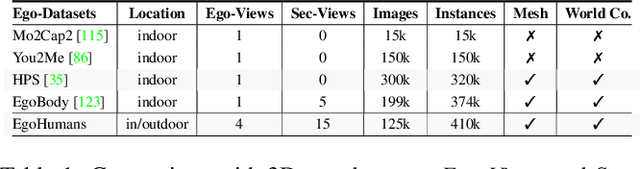
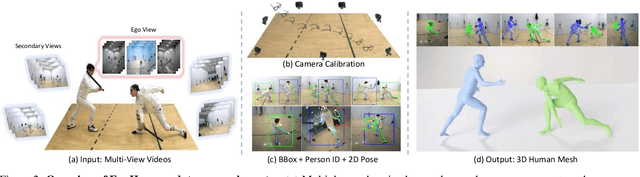
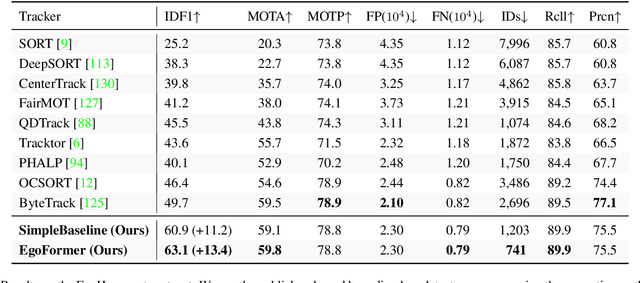
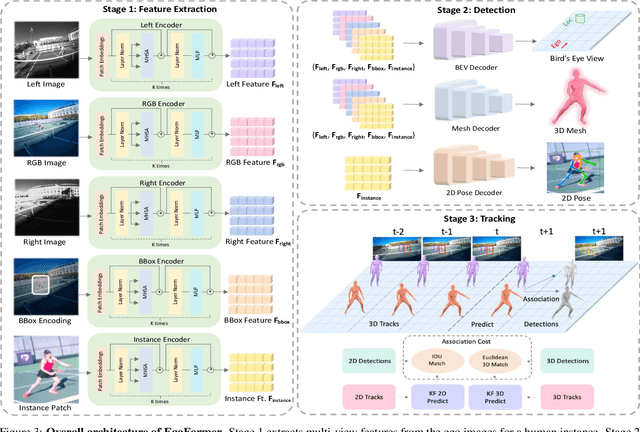
We present EgoHumans, a new multi-view multi-human video benchmark to advance the state-of-the-art of egocentric human 3D pose estimation and tracking. Existing egocentric benchmarks either capture single subject or indoor-only scenarios, which limit the generalization of computer vision algorithms for real-world applications. We propose a novel 3D capture setup to construct a comprehensive egocentric multi-human benchmark in the wild with annotations to support diverse tasks such as human detection, tracking, 2D/3D pose estimation, and mesh recovery. We leverage consumer-grade wearable camera-equipped glasses for the egocentric view, which enables us to capture dynamic activities like playing soccer, fencing, volleyball, etc. Furthermore, our multi-view setup generates accurate 3D ground truth even under severe or complete occlusion. The dataset consists of more than 125k egocentric images, spanning diverse scenes with a particular focus on challenging and unchoreographed multi-human activities and fast-moving egocentric views. We rigorously evaluate existing state-of-the-art methods and highlight their limitations in the egocentric scenario, specifically on multi-human tracking. To address such limitations, we propose EgoFormer, a novel approach with a multi-stream transformer architecture and explicit 3D spatial reasoning to estimate and track the human pose. EgoFormer significantly outperforms prior art by 13.6% IDF1 and 9.3 HOTA on the EgoHumans dataset.
Perpetual Humanoid Control for Real-time Simulated Avatars
May 24, 2023
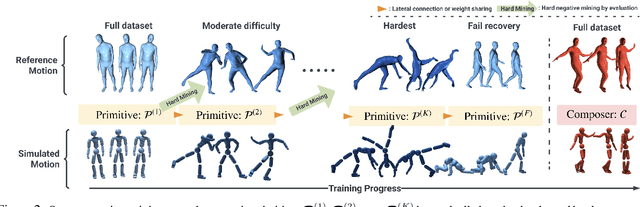
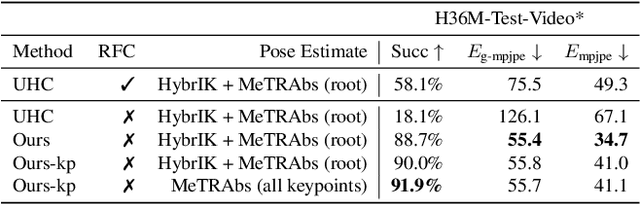
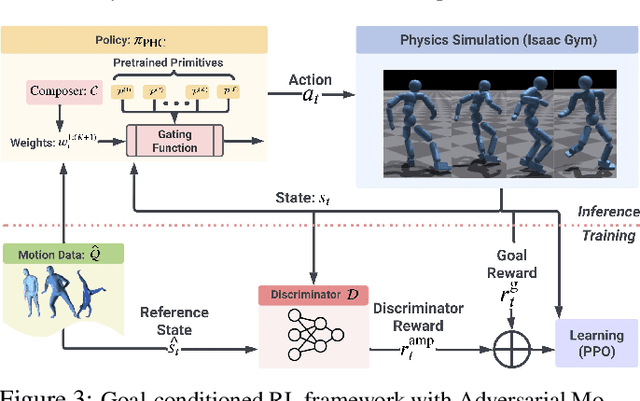
We present a physics-based humanoid controller that achieves high-fidelity motion imitation and fault-tolerant behavior in the presence of noisy input (e.g. pose estimates from video or generated from language) and unexpected falls. Our controller scales up to learning ten thousand motion clips without using any external stabilizing forces and learns to naturally recover from fail-state. Given reference motion, our controller can perpetually control simulated avatars without requiring resets. At its core, we propose the progressive multiplicative control policy (PMCP), which dynamically allocates new network capacity to learn harder and harder motion sequences. PMCP allows efficient scaling for learning from large-scale motion databases and adding new tasks, such as fail-state recovery, without catastrophic forgetting. We demonstrate the effectiveness of our controller by using it to imitate noisy poses from video-based pose estimators and language-based motion generators in a live and real-time multi-person avatar use case.
Type-to-Track: Retrieve Any Object via Prompt-based Tracking
May 22, 2023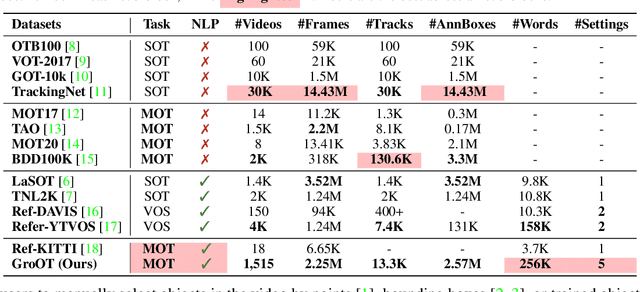
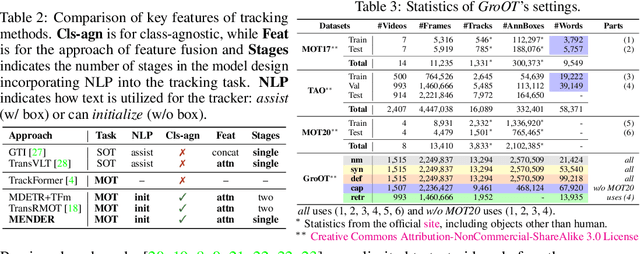
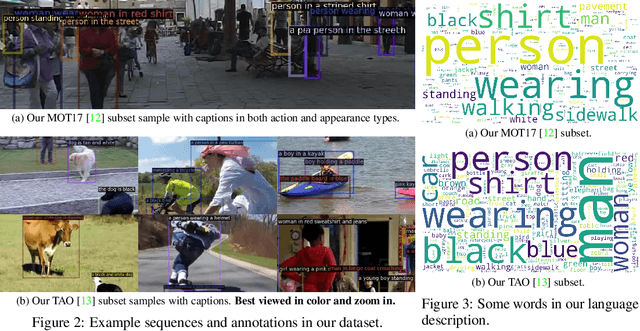
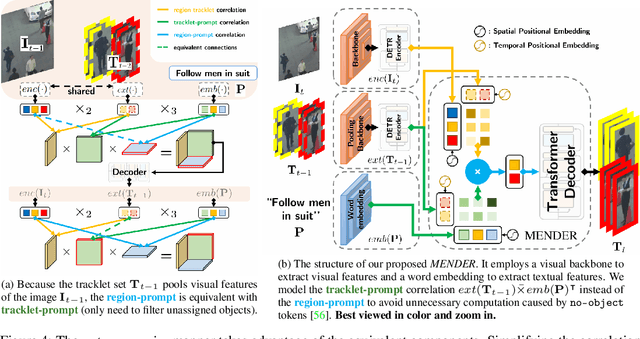
One of the recent trends in vision problems is to use natural language captions to describe the objects of interest. This approach can overcome some limitations of traditional methods that rely on bounding boxes or category annotations. This paper introduces a novel paradigm for Multiple Object Tracking called Type-to-Track, which allows users to track objects in videos by typing natural language descriptions. We present a new dataset for that Grounded Multiple Object Tracking task, called GroOT, that contains videos with various types of objects and their corresponding textual captions describing their appearance and action in detail. Additionally, we introduce two new evaluation protocols and formulate evaluation metrics specifically for this task. We develop a new efficient method that models a transformer-based eMbed-ENcoDE-extRact framework (MENDER) using the third-order tensor decomposition. The experiments in five scenarios show that our MENDER approach outperforms another two-stage design in terms of accuracy and efficiency, up to 14.7% accuracy and 4$\times$ speed faster.
Joint Metrics Matter: A Better Standard for Trajectory Forecasting
May 10, 2023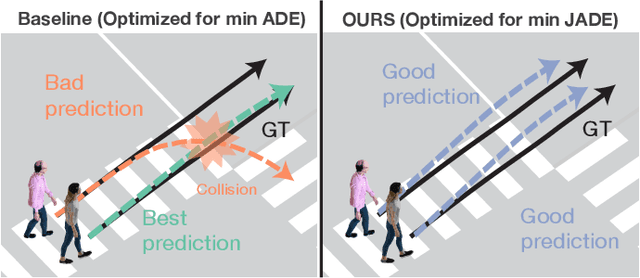
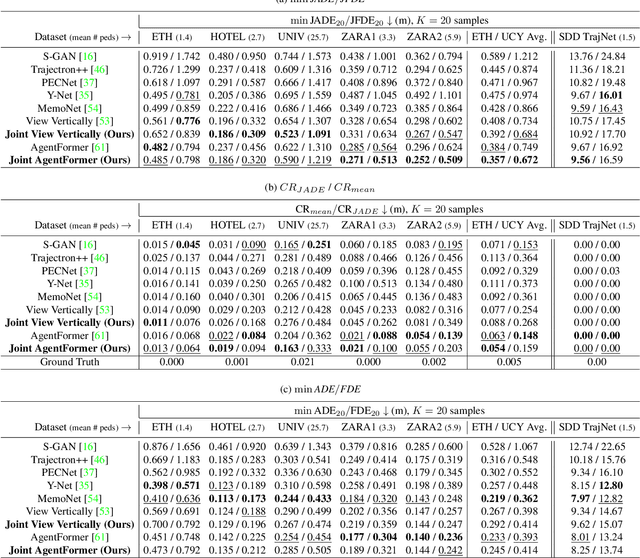
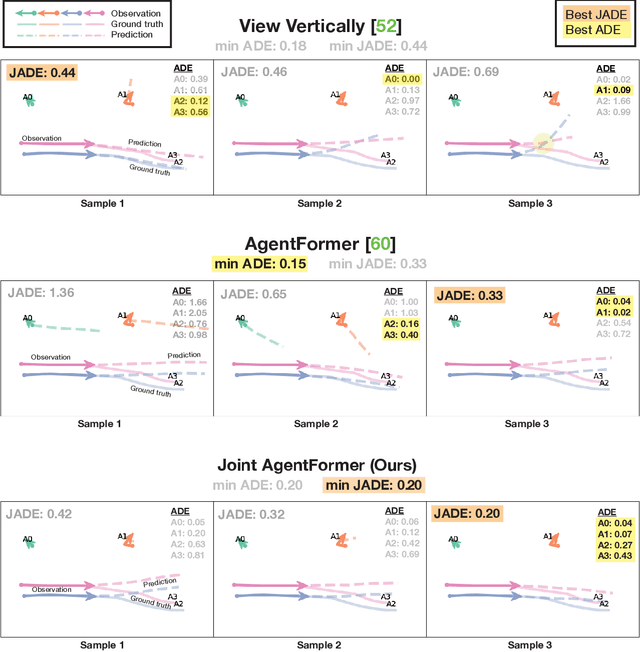
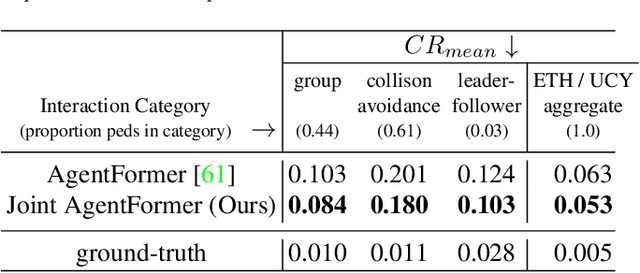
Multi-modal trajectory forecasting methods commonly evaluate using single-agent metrics (marginal metrics), such as minimum Average Displacement Error (ADE) and Final Displacement Error (FDE), which fail to capture joint performance of multiple interacting agents. Only focusing on marginal metrics can lead to unnatural predictions, such as colliding trajectories or diverging trajectories for people who are clearly walking together as a group. Consequently, methods optimized for marginal metrics lead to overly-optimistic estimations of performance, which is detrimental to progress in trajectory forecasting research. In response to the limitations of marginal metrics, we present the first comprehensive evaluation of state-of-the-art (SOTA) trajectory forecasting methods with respect to multi-agent metrics (joint metrics): JADE, JFDE, and collision rate. We demonstrate the importance of joint metrics as opposed to marginal metrics with quantitative evidence and qualitative examples drawn from the ETH / UCY and Stanford Drone datasets. We introduce a new loss function incorporating joint metrics that, when applied to a SOTA trajectory forecasting method, achieves a 7% improvement in JADE / JFDE on the ETH / UCY datasets with respect to the previous SOTA. Our results also indicate that optimizing for joint metrics naturally leads to an improvement in interaction modeling, as evidenced by a 16% decrease in mean collision rate on the ETH / UCY datasets with respect to the previous SOTA.
Trace and Pace: Controllable Pedestrian Animation via Guided Trajectory Diffusion
Apr 04, 2023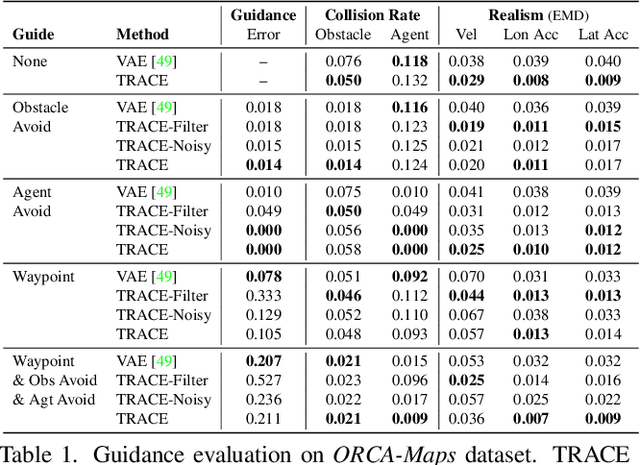
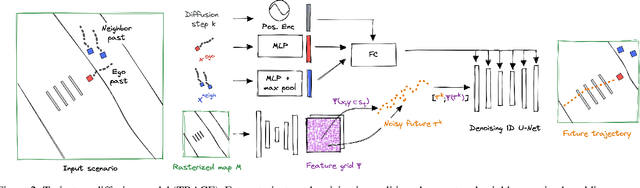
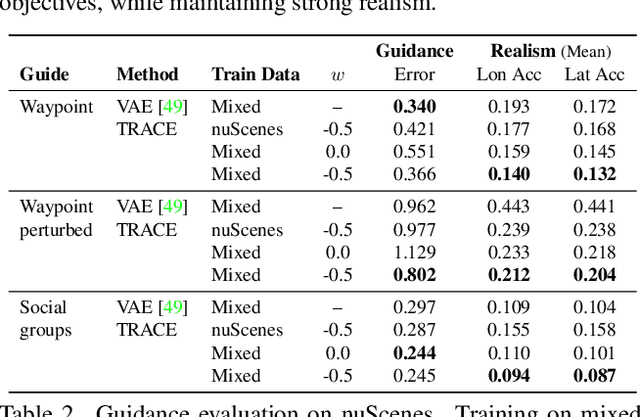
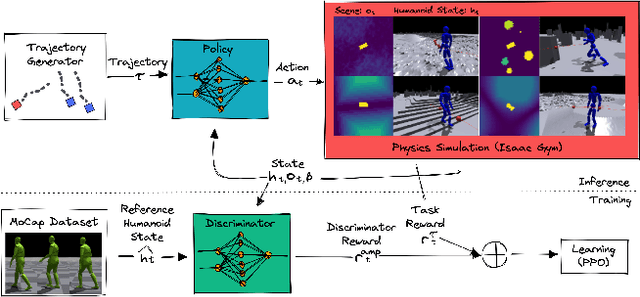
We introduce a method for generating realistic pedestrian trajectories and full-body animations that can be controlled to meet user-defined goals. We draw on recent advances in guided diffusion modeling to achieve test-time controllability of trajectories, which is normally only associated with rule-based systems. Our guided diffusion model allows users to constrain trajectories through target waypoints, speed, and specified social groups while accounting for the surrounding environment context. This trajectory diffusion model is integrated with a novel physics-based humanoid controller to form a closed-loop, full-body pedestrian animation system capable of placing large crowds in a simulated environment with varying terrains. We further propose utilizing the value function learned during RL training of the animation controller to guide diffusion to produce trajectories better suited for particular scenarios such as collision avoidance and traversing uneven terrain. Video results are available on the project page at https://nv-tlabs.github.io/trace-pace .
3D-CLFusion: Fast Text-to-3D Rendering with Contrastive Latent Diffusion
Mar 21, 2023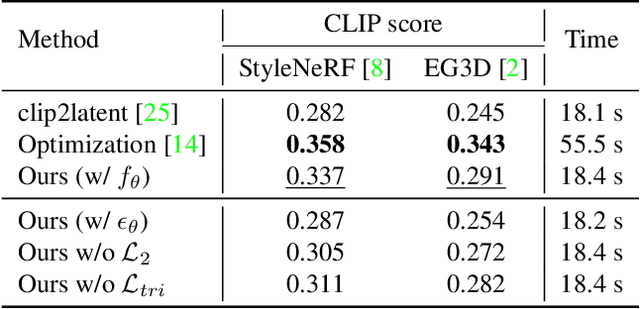
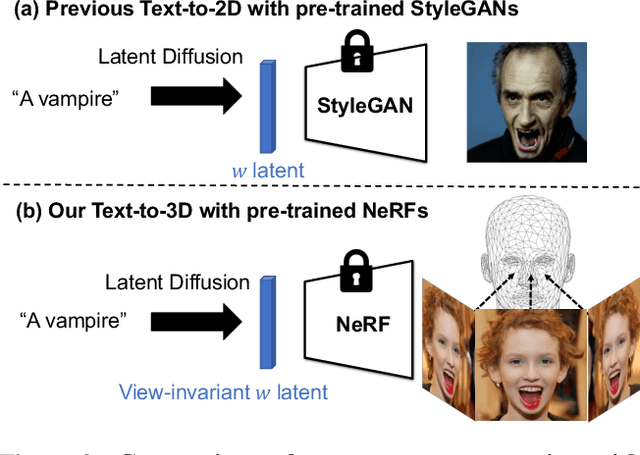
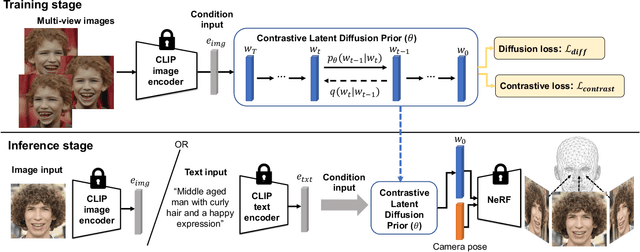
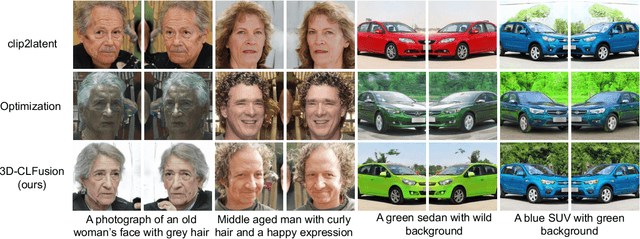
We tackle the task of text-to-3D creation with pre-trained latent-based NeRFs (NeRFs that generate 3D objects given input latent code). Recent works such as DreamFusion and Magic3D have shown great success in generating 3D content using NeRFs and text prompts, but the current approach of optimizing a NeRF for every text prompt is 1) extremely time-consuming and 2) often leads to low-resolution outputs. To address these challenges, we propose a novel method named 3D-CLFusion which leverages the pre-trained latent-based NeRFs and performs fast 3D content creation in less than a minute. In particular, we introduce a latent diffusion prior network for learning the w latent from the input CLIP text/image embeddings. This pipeline allows us to produce the w latent without further optimization during inference and the pre-trained NeRF is able to perform multi-view high-resolution 3D synthesis based on the latent. We note that the novelty of our model lies in that we introduce contrastive learning during training the diffusion prior which enables the generation of the valid view-invariant latent code. We demonstrate through experiments the effectiveness of our proposed view-invariant diffusion process for fast text-to-3D creation, e.g., 100 times faster than DreamFusion. We note that our model is able to serve as the role of a plug-and-play tool for text-to-3D with pre-trained NeRFs.
Deep OC-SORT: Multi-Pedestrian Tracking by Adaptive Re-Identification
Feb 23, 2023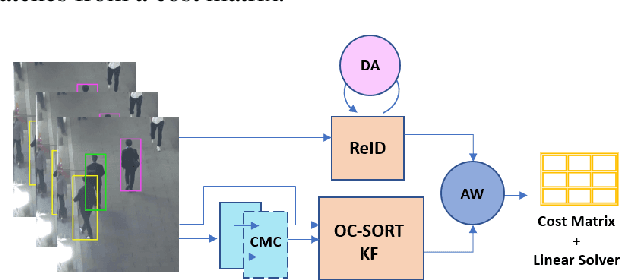
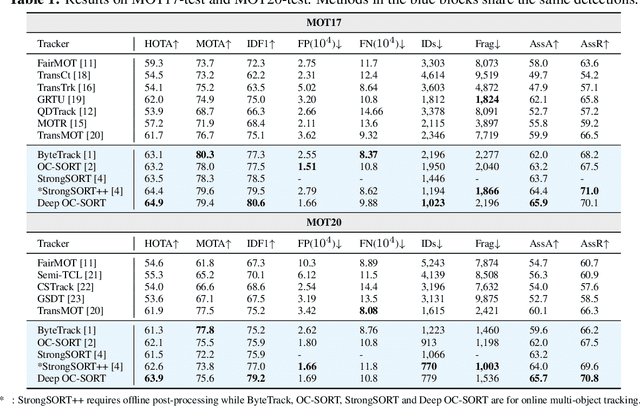
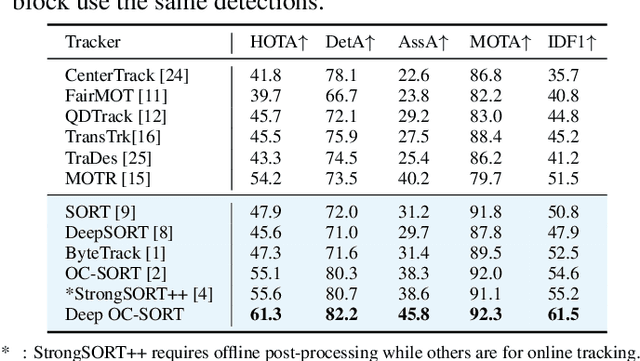
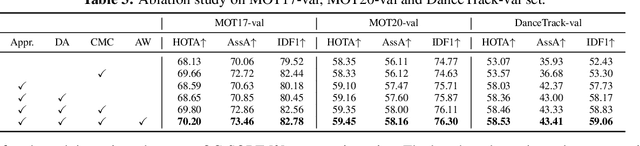
Motion-based association for Multi-Object Tracking (MOT) has recently re-achieved prominence with the rise of powerful object detectors. Despite this, little work has been done to incorporate appearance cues beyond simple heuristic models that lack robustness to feature degradation. In this paper, we propose a novel way to leverage objects' appearances to adaptively integrate appearance matching into existing high-performance motion-based methods. Building upon the pure motion-based method OC-SORT, we achieve 1st place on MOT20 and 2nd place on MOT17 with 63.9 and 64.9 HOTA, respectively. We also achieve 61.3 HOTA on the challenging DanceTrack benchmark as a new state-of-the-art even compared to more heavily-designed methods. The code and models are available at \url{https://github.com/GerardMaggiolino/Deep-OC-SORT}.