 Add to Chrome
 Add to Firefox
 Add to Edge
$p1$: Better Prompt Optimization with Fewer Prompts
Apr 09, 2026
Prompt optimization improves language models without updating their weights by searching for a better system prompt, but its effectiveness varies widely across tasks. We study what makes a task amenable to prompt optimization. We show that the reward variance across different system prompts can be decomposed into two components: variance among responses, which captures generation stochasticity, and variance among system prompts, which captures differences in system prompt quality. Prompt optimization succeeds when variance among system prompts is sufficiently large, but fails when variance among responses dominates the variance of the system prompts. Surprisingly, we further show that scaling to more user prompts can hurt optimization by reducing variance among system prompts, especially on heterogeneous datasets where different user prompts favor different system prompts. Motivated by this insight, we propose $p1$, a simple user prompt filtering method that selects a small subset of user prompts with high variance across candidate system prompts. This subset of user prompts allows one to distinguish a good system prompt from a bad one, making system optimization easier. Experiments on reasoning benchmarks show that $p1$ substantially improves prompt optimization over training on the full dataset and outperforms strong baselines such as GEPA. Notably, training on only two prompts from AIME 24 yields a system prompt that generalizes well to other reasoning benchmarks.

KARL: Knowledge Agents via Reinforcement Learning
Mar 05, 2026We present a system for training enterprise search agents via reinforcement learning that achieves state-of-the-art performance across a diverse suite of hard-to-verify agentic search tasks. Our work makes four core contributions. First, we introduce KARLBench, a multi-capability evaluation suite spanning six distinct search regimes, including constraint-driven entity search, cross-document report synthesis, tabular numerical reasoning, exhaustive entity retrieval, procedural reasoning over technical documentation, and fact aggregation over internal enterprise notes. Second, we show that models trained across heterogeneous search behaviors generalize substantially better than those optimized for any single benchmark. Third, we develop an agentic synthesis pipeline that employs long-horizon reasoning and tool use to generate diverse, grounded, and high-quality training data, with iterative bootstrapping from increasingly capable models. Fourth, we propose a new post-training paradigm based on iterative large-batch off-policy RL that is sample efficient, robust to train-inference engine discrepancies, and naturally extends to multi-task training with out-of-distribution generalization. Compared to Claude 4.6 and GPT 5.2, KARL is Pareto-optimal on KARLBench across cost-quality and latency-quality trade-offs, including tasks that were out-of-distribution during training. With sufficient test-time compute, it surpasses the strongest closed models. These results show that tailored synthetic data in combination with multi-task reinforcement learning enables cost-efficient and high-performing knowledge agents for grounded reasoning.
LLMs Can Learn to Reason Via Off-Policy RL
Feb 22, 2026Reinforcement learning (RL) approaches for Large Language Models (LLMs) frequently use on-policy algorithms, such as PPO or GRPO. However, policy lag from distributed training architectures and differences between the training and inference policies break this assumption, making the data off-policy by design. To rectify this, prior work has focused on making this off-policy data appear more on-policy, either via importance sampling (IS), or by more closely aligning the training and inference policies by explicitly modifying the inference engine. In this work, we embrace off-policyness and propose a novel off-policy RL algorithm that does not require these modifications: Optimal Advantage-based Policy Optimization with Lagged Inference policy (OAPL). We show that OAPL outperforms GRPO with importance sampling on competition math benchmarks, and can match the performance of a publicly available coding model, DeepCoder, on LiveCodeBench, while using 3x fewer generations during training. We further empirically demonstrate that models trained via OAPL have improved test time scaling under the Pass@k metric. OAPL allows for efficient, effective post-training even with lags of more than 400 gradient steps between the training and inference policies, 100x more off-policy than prior approaches.
Step 3.5 Flash: Open Frontier-Level Intelligence with 11B Active Parameters
Feb 11, 2026We introduce Step 3.5 Flash, a sparse Mixture-of-Experts (MoE) model that bridges frontier-level agentic intelligence and computational efficiency. We focus on what matters most when building agents: sharp reasoning and fast, reliable execution. Step 3.5 Flash pairs a 196B-parameter foundation with 11B active parameters for efficient inference. It is optimized with interleaved 3:1 sliding-window/full attention and Multi-Token Prediction (MTP-3) to reduce the latency and cost of multi-round agentic interactions. To reach frontier-level intelligence, we design a scalable reinforcement learning framework that combines verifiable signals with preference feedback, while remaining stable under large-scale off-policy training, enabling consistent self-improvement across mathematics, code, and tool use. Step 3.5 Flash demonstrates strong performance across agent, coding, and math tasks, achieving 85.4% on IMO-AnswerBench, 86.4% on LiveCodeBench-v6 (2024.08-2025.05), 88.2% on tau2-Bench, 69.0% on BrowseComp (with context management), and 51.0% on Terminal-Bench 2.0, comparable to frontier models such as GPT-5.2 xHigh and Gemini 3.0 Pro. By redefining the efficiency frontier, Step 3.5 Flash provides a high-density foundation for deploying sophisticated agents in real-world industrial environments.
Step-DeepResearch Technical Report
Dec 24, 2025As LLMs shift toward autonomous agents, Deep Research has emerged as a pivotal metric. However, existing academic benchmarks like BrowseComp often fail to meet real-world demands for open-ended research, which requires robust skills in intent recognition, long-horizon decision-making, and cross-source verification. To address this, we introduce Step-DeepResearch, a cost-effective, end-to-end agent. We propose a Data Synthesis Strategy Based on Atomic Capabilities to reinforce planning and report writing, combined with a progressive training path from agentic mid-training to SFT and RL. Enhanced by a Checklist-style Judger, this approach significantly improves robustness. Furthermore, to bridge the evaluation gap in the Chinese domain, we establish ADR-Bench for realistic deep research scenarios. Experimental results show that Step-DeepResearch (32B) scores 61.4% on Scale AI Research Rubrics. On ADR-Bench, it significantly outperforms comparable models and rivals SOTA closed-source models like OpenAI and Gemini DeepResearch. These findings prove that refined training enables medium-sized models to achieve expert-level capabilities at industry-leading cost-efficiency.
Step-GUI Technical Report
Dec 19, 2025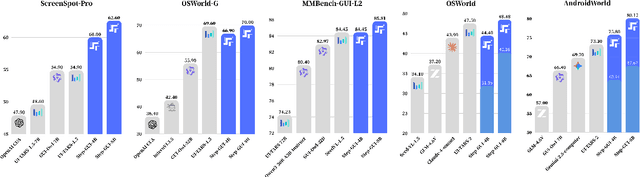
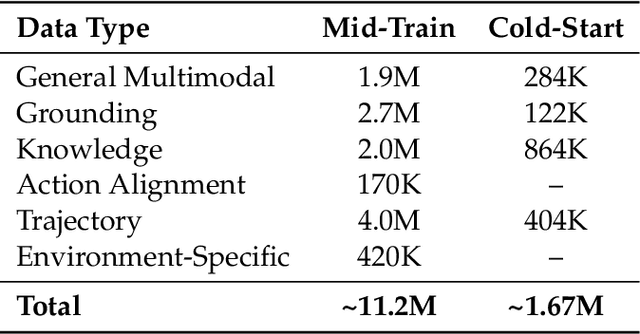
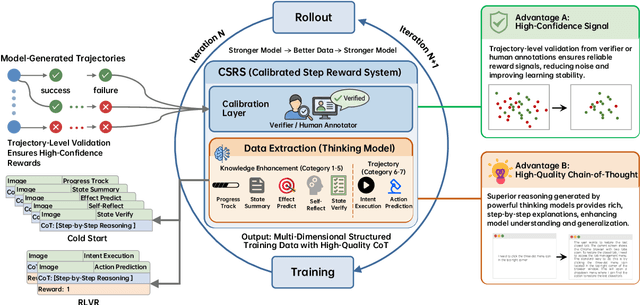
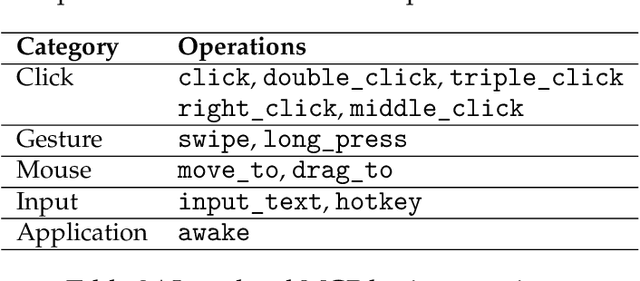
Recent advances in multimodal large language models unlock unprecedented opportunities for GUI automation. However, a fundamental challenge remains: how to efficiently acquire high-quality training data while maintaining annotation reliability? We introduce a self-evolving training pipeline powered by the Calibrated Step Reward System, which converts model-generated trajectories into reliable training signals through trajectory-level calibration, achieving >90% annotation accuracy with 10-100x lower cost. Leveraging this pipeline, we introduce Step-GUI, a family of models (4B/8B) that achieves state-of-the-art GUI performance (8B: 80.2% AndroidWorld, 48.5% OSWorld, 62.6% ScreenShot-Pro) while maintaining robust general capabilities. As GUI agent capabilities improve, practical deployment demands standardized interfaces across heterogeneous devices while protecting user privacy. To this end, we propose GUI-MCP, the first Model Context Protocol for GUI automation with hierarchical architecture that combines low-level atomic operations and high-level task delegation to local specialist models, enabling high-privacy execution where sensitive data stays on-device. Finally, to assess whether agents can handle authentic everyday usage, we introduce AndroidDaily, a benchmark grounded in real-world mobile usage patterns with 3146 static actions and 235 end-to-end tasks across high-frequency daily scenarios (8B: static 89.91%, end-to-end 52.50%). Our work advances the development of practical GUI agents and demonstrates strong potential for real-world deployment in everyday digital interactions.
Step-Audio 2 Technical Report
Jul 24, 2025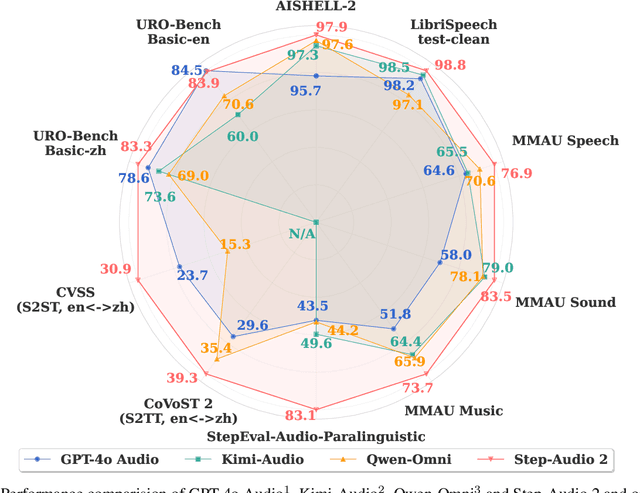
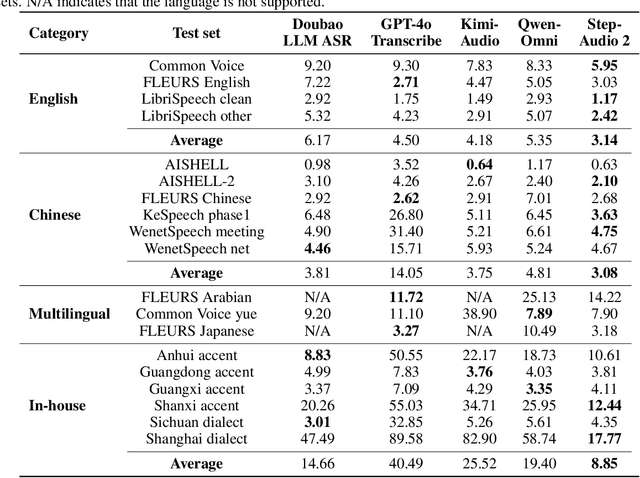
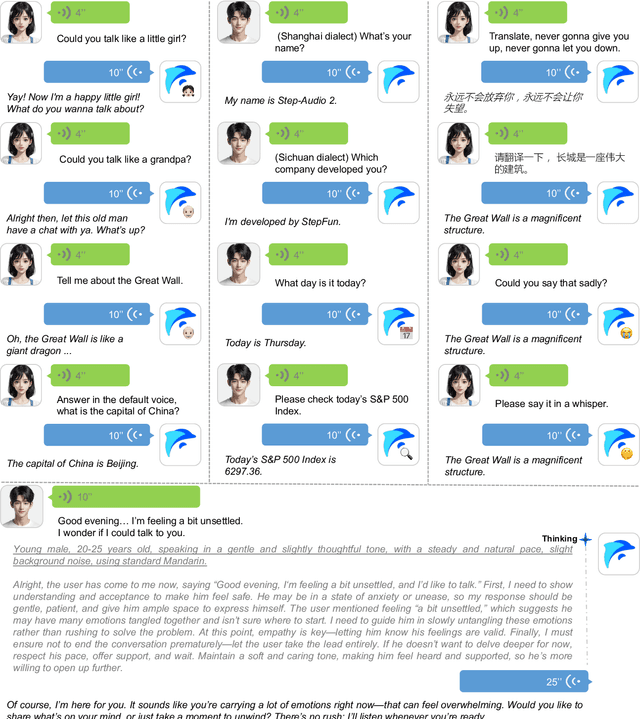
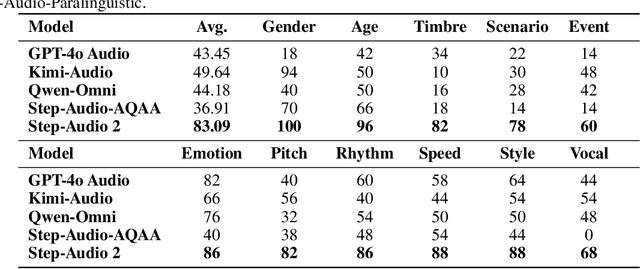
This paper presents Step-Audio 2, an end-to-end multi-modal large language model designed for industry-strength audio understanding and speech conversation. By integrating a latent audio encoder and reasoning-centric reinforcement learning (RL), Step-Audio 2 achieves promising performance in automatic speech recognition (ASR) and audio understanding. To facilitate genuine end-to-end speech conversation, Step-Audio 2 incorporates the generation of discrete audio tokens into language modeling, significantly enhancing its responsiveness to paralinguistic information such as speaking styles and emotions. To effectively leverage the rich textual and acoustic knowledge in real-world data, Step-Audio 2 integrates retrieval-augmented generation (RAG) and is able to call external tools such as web search to mitigate hallucination and audio search to switch timbres. Trained on millions of hours of speech and audio data, Step-Audio 2 delivers intelligence and expressiveness across diverse conversational scenarios. Evaluation results demonstrate that Step-Audio 2 achieves state-of-the-art performance on various audio understanding and conversational benchmarks compared to other open-source and commercial solutions. Please visit https://github.com/stepfun-ai/Step-Audio2 for more information.
HieraEdgeNet: A Multi-Scale Edge-Enhanced Framework for Automated Pollen Recognition
Jun 09, 2025Automated pollen recognition is vital to paleoclimatology, biodiversity monitoring, and public health, yet conventional methods are hampered by inefficiency and subjectivity. Existing deep learning models often struggle to achieve the requisite localization accuracy for microscopic targets like pollen, which are characterized by their minute size, indistinct edges, and complex backgrounds. To overcome this limitation, we introduce HieraEdgeNet, a multi-scale edge-enhancement framework. The framework's core innovation is the introduction of three synergistic modules: the Hierarchical Edge Module (HEM), which explicitly extracts a multi-scale pyramid of edge features that corresponds to the semantic hierarchy at early network stages; the Synergistic Edge Fusion (SEF) module, for deeply fusing these edge priors with semantic information at each respective scale; and the Cross Stage Partial Omni-Kernel Module (CSPOKM), which maximally refines the most detail-rich feature layers using an Omni-Kernel operator - comprising anisotropic large-kernel convolutions and mixed-domain attention - all within a computationally efficient Cross-Stage Partial (CSP) framework. On a large-scale dataset comprising 120 pollen classes, HieraEdgeNet achieves a mean Average Precision (mAP@.5) of 0.9501, significantly outperforming state-of-the-art baseline models such as YOLOv12n and RT-DETR. Furthermore, qualitative analysis confirms that our approach generates feature representations that are more precisely focused on object boundaries. By systematically integrating edge information, HieraEdgeNet provides a robust and powerful solution for high-precision, high-efficiency automated detection of microscopic objects.
Scaling Offline RL via Efficient and Expressive Shortcut Models
May 28, 2025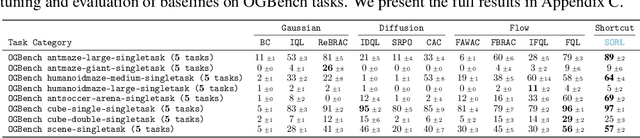
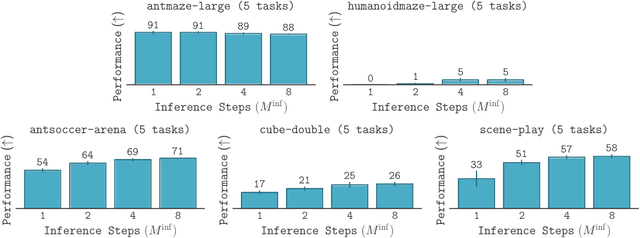
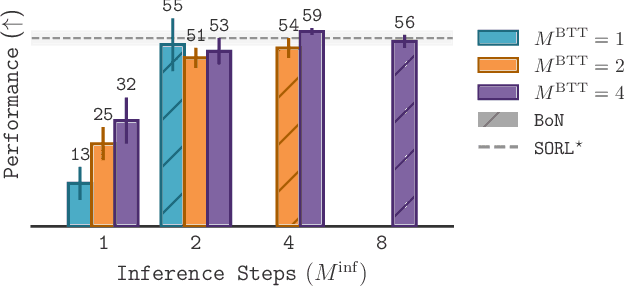
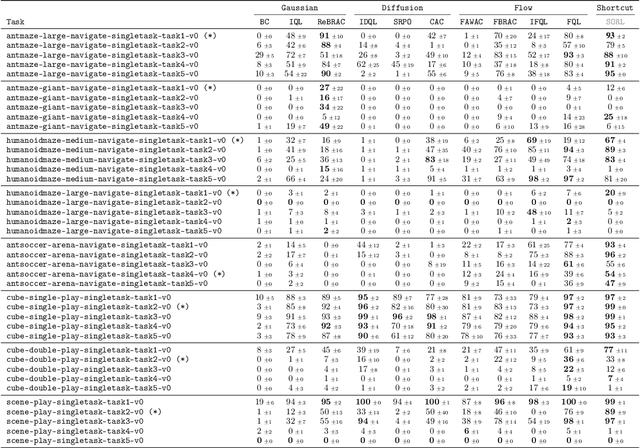
Diffusion and flow models have emerged as powerful generative approaches capable of modeling diverse and multimodal behavior. However, applying these models to offline reinforcement learning (RL) remains challenging due to the iterative nature of their noise sampling processes, making policy optimization difficult. In this paper, we introduce Scalable Offline Reinforcement Learning (SORL), a new offline RL algorithm that leverages shortcut models - a novel class of generative models - to scale both training and inference. SORL's policy can capture complex data distributions and can be trained simply and efficiently in a one-stage training procedure. At test time, SORL introduces both sequential and parallel inference scaling by using the learned Q-function as a verifier. We demonstrate that SORL achieves strong performance across a range of offline RL tasks and exhibits positive scaling behavior with increased test-time compute. We release the code at nico-espinosadice.github.io/projects/sorl.
Efficient Controllable Diffusion via Optimal Classifier Guidance
May 27, 2025The controllable generation of diffusion models aims to steer the model to generate samples that optimize some given objective functions. It is desirable for a variety of applications including image generation, molecule generation, and DNA/sequence generation. Reinforcement Learning (RL) based fine-tuning of the base model is a popular approach but it can overfit the reward function while requiring significant resources. We frame controllable generation as a problem of finding a distribution that optimizes a KL-regularized objective function. We present SLCD -- Supervised Learning based Controllable Diffusion, which iteratively generates online data and trains a small classifier to guide the generation of the diffusion model. Similar to the standard classifier-guided diffusion, SLCD's key computation primitive is classification and does not involve any complex concepts from RL or control. Via a reduction to no-regret online learning analysis, we show that under KL divergence, the output from SLCD provably converges to the optimal solution of the KL-regularized objective. Further, we empirically demonstrate that SLCD can generate high quality samples with nearly the same inference time as the base model in both image generation with continuous diffusion and biological sequence generation with discrete diffusion. Our code is available at https://github.com/Owen-Oertell/slcd