 Add to Chrome
 Add to Firefox
 Add to Edge
GoTTA be Diverse: Rethinking Memory Policies for Test-Time Adaptation
May 19, 2026
Test-time adaptation (TTA) enables a pre-trained model to adapt online to an unlabeled test stream under distribution shift. While most TTA research focuses on the adaptation objective, practical streams also depend critically on the memory used to select which test samples drive adaptation. Existing memory mechanisms are usually evaluated as components of specific TTA algorithms, making it difficult to isolate which memory design choices matter and when they matter. In this work, we provide a systematic benchmark that decouples memory from the adaptation algorithm and evaluates memory policies under unified conditions across i.i.d., non-i.i.d., continual, and practical test streams. Our study shows that effective memory management requires more than retaining recent or class-balanced samples. In particular, intra-class diversity is a key factor for avoiding redundant buffers and maintaining representative adaptation signals under temporally correlated and label-skewed streams. Motivated by this finding, we introduce Guided Observational Test-Time Adaptation (GOTTA), a family of diversity-aware memory policies that combine class-balanced allocation with feature-space diversity. GOTTA memories act as drop-in replacements for existing buffers and can be paired with different TTA objectives. Across corruption benchmarks and video-stream settings, diversity-aware memory improves adaptation most clearly under constrained memory budgets and challenging non-i.i.d. streams, while remaining competitive as memory capacity increases. These results highlight memory management as a first-class component of robust test-time adaptation and identify diversity as a central principle for practical TTA.

Skill-Aligned Annotation for Reliable Evaluation in Text-to-Image Generation
May 13, 2026Text-to-image (T2I) generation has advanced rapidly, making reliable evaluation critical as performance differences between models narrow. Existing evaluation practices typically apply uniform annotation mechanisms, such as Likert-scale or binary question answering (BQA), across heterogeneous evaluation skills, despite fundamental differences in their nature. In this work, we revisit T2I evaluation through the lens of skill-aligned annotation, where annotation strategies reflect the underlying characteristics of each evaluation skill. We systematically compare skill-aligned annotation against uniform baselines and show that it produces more consistent evaluation signals, with higher inter-annotator agreement and improved stability across models. Finally, we present an automated pipeline that instantiates the proposed evaluation protocol, enabling scalable and fine-grained evaluation with spatially grounded feedback. Our work highlights that improving the foundations of image evaluation can increase reliability and efficiency without simply scaling annotation effort. We hope this motivates further research on refining evaluation protocols as a central component of reliable model assessment.
Pixels or Positions? Benchmarking Modalities in Group Activity Recognition
Nov 16, 2025Group Activity Recognition (GAR) is well studied on the video modality for surveillance and indoor team sports (e.g., volleyball, basketball). Yet, other modalities such as agent positions and trajectories over time, i.e. tracking, remain comparatively under-explored despite being compact, agent-centric signals that explicitly encode spatial interactions. Understanding whether pixel (video) or position (tracking) modalities leads to better group activity recognition is therefore important to drive further research on the topic. However, no standardized benchmark currently exists that aligns broadcast video and tracking data for the same group activities, leading to a lack of apples-to-apples comparison between these modalities for GAR. In this work, we introduce SoccerNet-GAR, a multimodal dataset built from the $64$ matches of the football World Cup 2022. Specifically, the broadcast videos and player tracking modalities for $94{,}285$ group activities are synchronized and annotated with $10$ categories. Furthermore, we define a unified evaluation protocol to benchmark two strong unimodal approaches: (i) a competitive video-based classifiers and (ii) a tracking-based classifiers leveraging graph neural networks. In particular, our novel role-aware graph architecture for tracking-based GAR directly encodes tactical structure through positional edges and temporal attention. Our tracking model achieves $67.2\%$ balanced accuracy compared to $58.1\%$ for the best video baseline, while training $4.25 \times$ faster with $438 \times$ fewer parameters ($197K$ \vs $86.3M$). This study provides new insights into the relative strengths of pixels and positions for group activity recognition. Overall, it highlights the importance of modality choice and role-aware modeling for GAR.
OpenTAD: A Unified Framework and Comprehensive Study of Temporal Action Detection
Feb 27, 2025Temporal action detection (TAD) is a fundamental video understanding task that aims to identify human actions and localize their temporal boundaries in videos. Although this field has achieved remarkable progress in recent years, further progress and real-world applications are impeded by the absence of a standardized framework. Currently, different methods are compared under different implementation settings, evaluation protocols, etc., making it difficult to assess the real effectiveness of a specific technique. To address this issue, we propose \textbf{OpenTAD}, a unified TAD framework consolidating 16 different TAD methods and 9 standard datasets into a modular codebase. In OpenTAD, minimal effort is required to replace one module with a different design, train a feature-based TAD model in end-to-end mode, or switch between the two. OpenTAD also facilitates straightforward benchmarking across various datasets and enables fair and in-depth comparisons among different methods. With OpenTAD, we comprehensively study how innovations in different network components affect detection performance and identify the most effective design choices through extensive experiments. This study has led to a new state-of-the-art TAD method built upon existing techniques for each component. We have made our code and models available at https://github.com/sming256/OpenTAD.
Combating Missing Modalities in Egocentric Videos at Test Time
Apr 23, 2024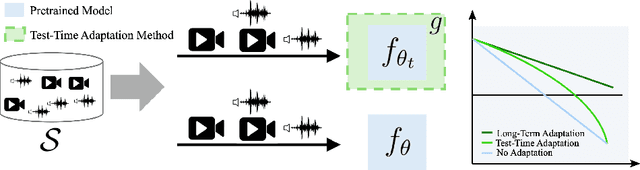

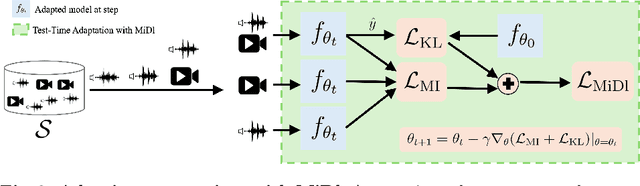
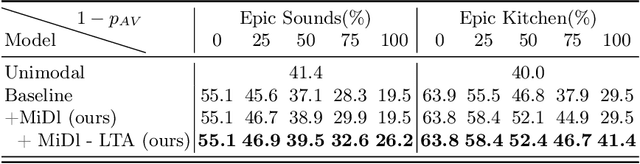
Understanding videos that contain multiple modalities is crucial, especially in egocentric videos, where combining various sensory inputs significantly improves tasks like action recognition and moment localization. However, real-world applications often face challenges with incomplete modalities due to privacy concerns, efficiency needs, or hardware issues. Current methods, while effective, often necessitate retraining the model entirely to handle missing modalities, making them computationally intensive, particularly with large training datasets. In this study, we propose a novel approach to address this issue at test time without requiring retraining. We frame the problem as a test-time adaptation task, where the model adjusts to the available unlabeled data at test time. Our method, MiDl~(Mutual information with self-Distillation), encourages the model to be insensitive to the specific modality source present during testing by minimizing the mutual information between the prediction and the available modality. Additionally, we incorporate self-distillation to maintain the model's original performance when both modalities are available. MiDl represents the first self-supervised, online solution for handling missing modalities exclusively at test time. Through experiments with various pretrained models and datasets, MiDl demonstrates substantial performance improvement without the need for retraining.
Exploring Missing Modality in Multimodal Egocentric Datasets
Jan 21, 2024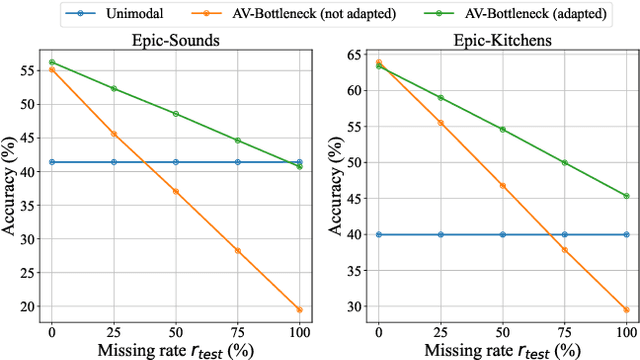
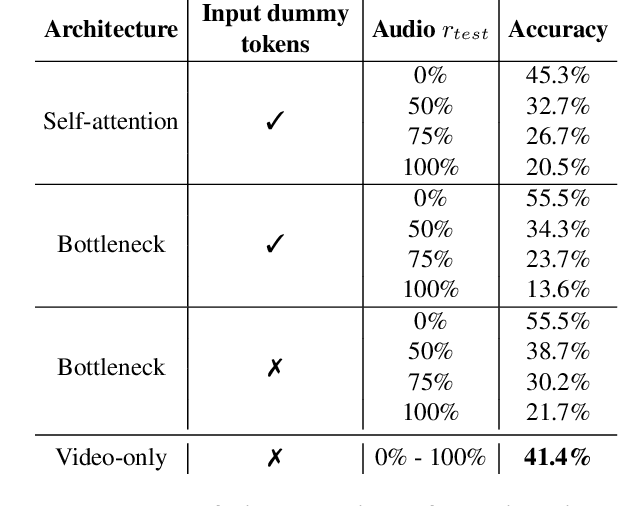
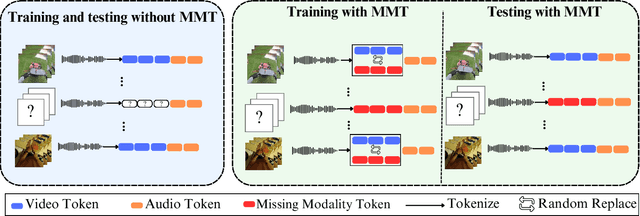
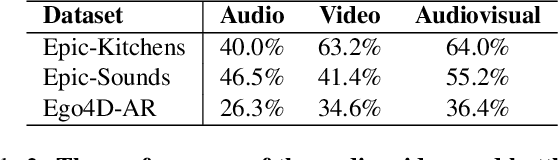
Multimodal video understanding is crucial for analyzing egocentric videos, where integrating multiple sensory signals significantly enhances action recognition and moment localization. However, practical applications often grapple with incomplete modalities due to factors like privacy concerns, efficiency demands, or hardware malfunctions. Addressing this, our study delves into the impact of missing modalities on egocentric action recognition, particularly within transformer-based models. We introduce a novel concept -Missing Modality Token (MMT)-to maintain performance even when modalities are absent, a strategy that proves effective in the Ego4D, Epic-Kitchens, and Epic-Sounds datasets. Our method mitigates the performance loss, reducing it from its original $\sim 30\%$ drop to only $\sim 10\%$ when half of the test set is modal-incomplete. Through extensive experimentation, we demonstrate the adaptability of MMT to different training scenarios and its superiority in handling missing modalities compared to current methods. Our research contributes a comprehensive analysis and an innovative approach, opening avenues for more resilient multimodal systems in real-world settings.
Ego-Exo4D: Understanding Skilled Human Activity from First- and Third-Person Perspectives
Nov 30, 2023
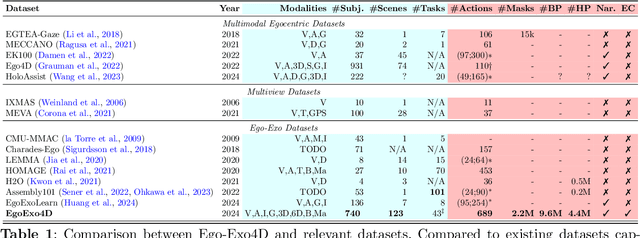

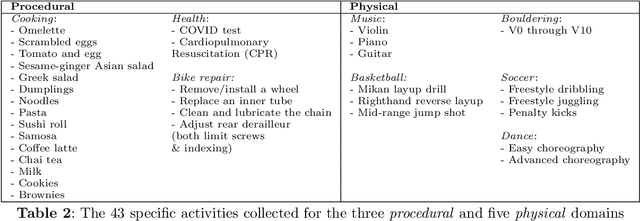
We present Ego-Exo4D, a diverse, large-scale multimodal multiview video dataset and benchmark challenge. Ego-Exo4D centers around simultaneously-captured egocentric and exocentric video of skilled human activities (e.g., sports, music, dance, bike repair). More than 800 participants from 13 cities worldwide performed these activities in 131 different natural scene contexts, yielding long-form captures from 1 to 42 minutes each and 1,422 hours of video combined. The multimodal nature of the dataset is unprecedented: the video is accompanied by multichannel audio, eye gaze, 3D point clouds, camera poses, IMU, and multiple paired language descriptions -- including a novel "expert commentary" done by coaches and teachers and tailored to the skilled-activity domain. To push the frontier of first-person video understanding of skilled human activity, we also present a suite of benchmark tasks and their annotations, including fine-grained activity understanding, proficiency estimation, cross-view translation, and 3D hand/body pose. All resources will be open sourced to fuel new research in the community.
Just a Glimpse: Rethinking Temporal Information for Video Continual Learning
May 28, 2023Class-incremental learning is one of the most important settings for the study of Continual Learning, as it closely resembles real-world application scenarios. With constrained memory sizes, catastrophic forgetting arises as the number of classes/tasks increases. Studying continual learning in the video domain poses even more challenges, as video data contains a large number of frames, which places a higher burden on the replay memory. The current common practice is to sub-sample frames from the video stream and store them in the replay memory. In this paper, we propose SMILE a novel replay mechanism for effective video continual learning based on individual/single frames. Through extensive experimentation, we show that under extreme memory constraints, video diversity plays a more significant role than temporal information. Therefore, our method focuses on learning from a small number of frames that represent a large number of unique videos. On three representative video datasets, Kinetics, UCF101, and ActivityNet, the proposed method achieves state-of-the-art performance, outperforming the previous state-of-the-art by up to 21.49%.
Revisiting Test Time Adaptation under Online Evaluation
Apr 10, 2023

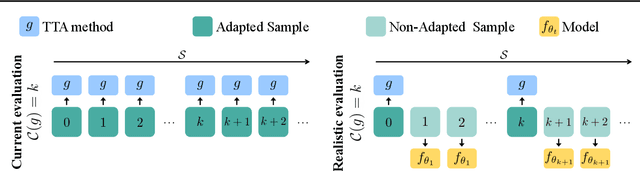
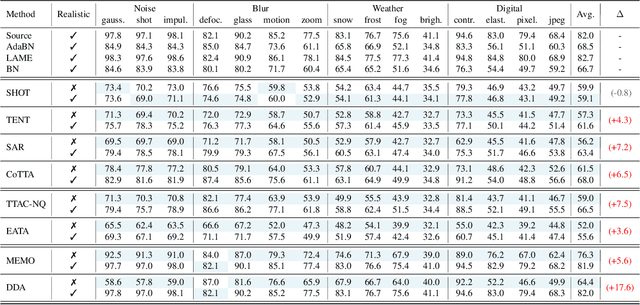
This paper proposes a novel online evaluation protocol for Test Time Adaptation (TTA) methods, which penalizes slower methods by providing them with fewer samples for adaptation. TTA methods leverage unlabeled data at test time to adapt to distribution shifts. Though many effective methods have been proposed, their impressive performance usually comes at the cost of significantly increased computation budgets. Current evaluation protocols overlook the effect of this extra computation cost, affecting their real-world applicability. To address this issue, we propose a more realistic evaluation protocol for TTA methods, where data is received in an online fashion from a constant-speed data stream, thereby accounting for the method's adaptation speed. We apply our proposed protocol to benchmark several TTA methods on multiple datasets and scenarios. Extensive experiments shows that, when accounting for inference speed, simple and fast approaches can outperform more sophisticated but slower methods. For example, SHOT from 2020 outperforms the state-of-the-art method SAR from 2023 under our online setting. Our online evaluation protocol emphasizes the need for developing TTA methods that are efficient and applicable in realistic settings.
SegTAD: Precise Temporal Action Detection via Semantic Segmentation
Mar 03, 2022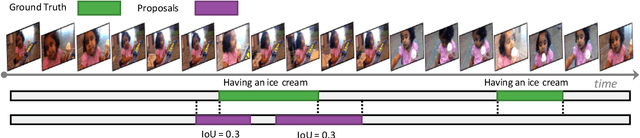
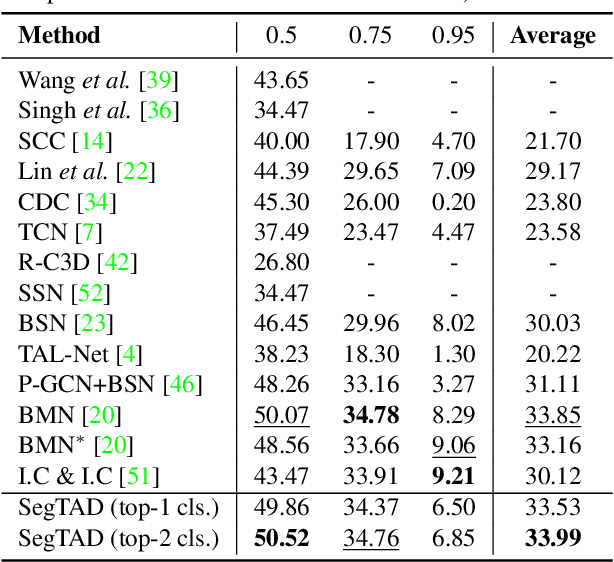
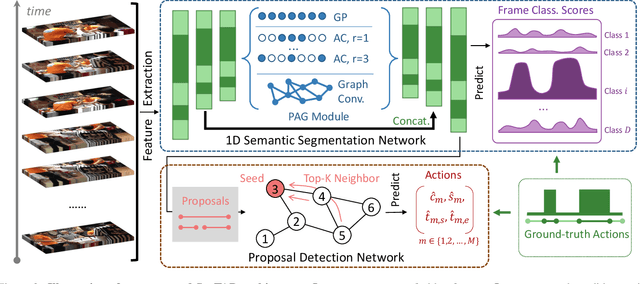
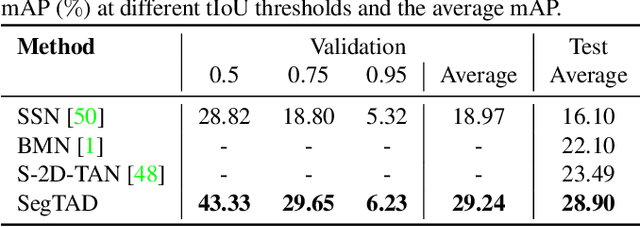
Temporal action detection (TAD) is an important yet challenging task in video analysis. Most existing works draw inspiration from image object detection and tend to reformulate it as a proposal generation - classification problem. However, there are two caveats with this paradigm. First, proposals are not equipped with annotated labels, which have to be empirically compiled, thus the information in the annotations is not necessarily precisely employed in the model training process. Second, there are large variations in the temporal scale of actions, and neglecting this fact may lead to deficient representation in the video features. To address these issues and precisely model temporal action detection, we formulate the task of temporal action detection in a novel perspective of semantic segmentation. Owing to the 1-dimensional property of TAD, we are able to convert the coarse-grained detection annotations to fine-grained semantic segmentation annotations for free. We take advantage of them to provide precise supervision so as to mitigate the impact induced by the imprecise proposal labels. We propose an end-to-end framework SegTAD composed of a 1D semantic segmentation network (1D-SSN) and a proposal detection network (PDN).