 Add to Chrome
 Add to Firefox
 Add to Edge
CauScale: Neural Causal Discovery at Scale
Feb 09, 2026
Causal discovery is essential for advancing data-driven fields such as scientific AI and data analysis, yet existing approaches face significant time- and space-efficiency bottlenecks when scaling to large graphs. To address this challenge, we present CauScale, a neural architecture designed for efficient causal discovery that scales inference to graphs with up to 1000 nodes. CauScale improves time efficiency via a reduction unit that compresses data embeddings and improves space efficiency by adopting tied attention weights to avoid maintaining axis-specific attention maps. To keep high causal discovery accuracy, CauScale adopts a two-stream design: a data stream extracts relational evidence from high-dimensional observations, while a graph stream integrates statistical graph priors and preserves key structural signals. CauScale successfully scales to 500-node graphs during training, where prior work fails due to space limitations. Across testing data with varying graph scales and causal mechanisms, CauScale achieves 99.6% mAP on in-distribution data and 84.4% on out-of-distribution data, while delivering 4-13,000 times inference speedups over prior methods. Our project page is at https://github.com/OpenCausaLab/CauScale.

Modality Gap-Driven Subspace Alignment Training Paradigm For Multimodal Large Language Models
Feb 02, 2026Despite the success of multimodal contrastive learning in aligning visual and linguistic representations, a persistent geometric anomaly, the Modality Gap, remains: embeddings of distinct modalities expressing identical semantics occupy systematically offset regions. Prior approaches to bridge this gap are largely limited by oversimplified isotropic assumptions, hindering their application in large-scale scenarios. In this paper, we address these limitations by precisely characterizing the geometric shape of the modality gap and leveraging it for efficient model scaling. First, we propose the Fixed-frame Modality Gap Theory, which decomposes the modality gap within a frozen reference frame into stable biases and anisotropic residuals. Guided by this precise modeling, we introduce ReAlign, a training-free modality alignment strategy. Utilizing statistics from massive unpaired data, ReAlign aligns text representation into the image representation distribution via a three-step process comprising Anchor, Trace, and Centroid Alignment, thereby explicitly rectifying geometric misalignment. Building on ReAlign, we propose ReVision, a scalable training paradigm for Multimodal Large Language Models (MLLMs). ReVision integrates ReAlign into the pretraining stage, enabling the model to learn the distribution of visual representations from unpaired text before visual instruction tuning, without the need for large-scale, high-quality image-text pairs. Our framework demonstrates that statistically aligned unpaired data can effectively substitute for expensive image-text pairs, offering a robust path for the efficient scaling of MLLMs.
SIN-Bench: Tracing Native Evidence Chains in Long-Context Multimodal Scientific Interleaved Literature
Jan 15, 2026Evaluating whether multimodal large language models truly understand long-form scientific papers remains challenging: answer-only metrics and synthetic "Needle-In-A-Haystack" tests often reward answer matching without requiring a causal, evidence-linked reasoning trace in the document. We propose the "Fish-in-the-Ocean" (FITO) paradigm, which requires models to construct explicit cross-modal evidence chains within native scientific documents. To operationalize FITO, we build SIN-Data, a scientific interleaved corpus that preserves the native interleaving of text and figures. On top of it, we construct SIN-Bench with four progressive tasks covering evidence discovery (SIN-Find), hypothesis verification (SIN-Verify), grounded QA (SIN-QA), and evidence-anchored synthesis (SIN-Summary). We further introduce "No Evidence, No Score", scoring predictions when grounded to verifiable anchors and diagnosing evidence quality via matching, relevance, and logic. Experiments on eight MLLMs show that grounding is the primary bottleneck: Gemini-3-pro achieves the best average overall score (0.573), while GPT-5 attains the highest SIN-QA answer accuracy (0.767) but underperforms on evidence-aligned overall scores, exposing a gap between correctness and traceable support.
OS-Symphony: A Holistic Framework for Robust and Generalist Computer-Using Agent
Jan 12, 2026While Vision-Language Models (VLMs) have significantly advanced Computer-Using Agents (CUAs), current frameworks struggle with robustness in long-horizon workflows and generalization in novel domains. These limitations stem from a lack of granular control over historical visual context curation and the absence of visual-aware tutorial retrieval. To bridge these gaps, we introduce OS-Symphony, a holistic framework that comprises an Orchestrator coordinating two key innovations for robust automation: (1) a Reflection-Memory Agent that utilizes milestone-driven long-term memory to enable trajectory-level self-correction, effectively mitigating visual context loss in long-horizon tasks; (2) Versatile Tool Agents featuring a Multimodal Searcher that adopts a SeeAct paradigm to navigate a browser-based sandbox to synthesize live, visually aligned tutorials, thereby resolving fidelity issues in unseen scenarios. Experimental results demonstrate that OS-Symphony delivers substantial performance gains across varying model scales, establishing new state-of-the-art results on three online benchmarks, notably achieving 65.84% on OSWorld.
InternVLA-A1: Unifying Understanding, Generation and Action for Robotic Manipulation
Jan 05, 2026Prevalent Vision-Language-Action (VLA) models are typically built upon Multimodal Large Language Models (MLLMs) and demonstrate exceptional proficiency in semantic understanding, but they inherently lack the capability to deduce physical world dynamics. Consequently, recent approaches have shifted toward World Models, typically formulated via video prediction; however, these methods often suffer from a lack of semantic grounding and exhibit brittleness when handling prediction errors. To synergize semantic understanding with dynamic predictive capabilities, we present InternVLA-A1. This model employs a unified Mixture-of-Transformers architecture, coordinating three experts for scene understanding, visual foresight generation, and action execution. These components interact seamlessly through a unified masked self-attention mechanism. Building upon InternVL3 and Qwen3-VL, we instantiate InternVLA-A1 at 2B and 3B parameter scales. We pre-train these models on hybrid synthetic-real datasets spanning InternData-A1 and Agibot-World, covering over 533M frames. This hybrid training strategy effectively harnesses the diversity of synthetic simulation data while minimizing the sim-to-real gap. We evaluated InternVLA-A1 across 12 real-world robotic tasks and simulation benchmark. It significantly outperforms leading models like pi0 and GR00T N1.5, achieving a 14.5\% improvement in daily tasks and a 40\%-73.3\% boost in dynamic settings, such as conveyor belt sorting.
Yume-1.5: A Text-Controlled Interactive World Generation Model
Dec 26, 2025Recent approaches have demonstrated the promise of using diffusion models to generate interactive and explorable worlds. However, most of these methods face critical challenges such as excessively large parameter sizes, reliance on lengthy inference steps, and rapidly growing historical context, which severely limit real-time performance and lack text-controlled generation capabilities. To address these challenges, we propose \method, a novel framework designed to generate realistic, interactive, and continuous worlds from a single image or text prompt. \method achieves this through a carefully designed framework that supports keyboard-based exploration of the generated worlds. The framework comprises three core components: (1) a long-video generation framework integrating unified context compression with linear attention; (2) a real-time streaming acceleration strategy powered by bidirectional attention distillation and an enhanced text embedding scheme; (3) a text-controlled method for generating world events. We have provided the codebase in the supplementary material.
UniPercept: Towards Unified Perceptual-Level Image Understanding across Aesthetics, Quality, Structure, and Texture
Dec 25, 2025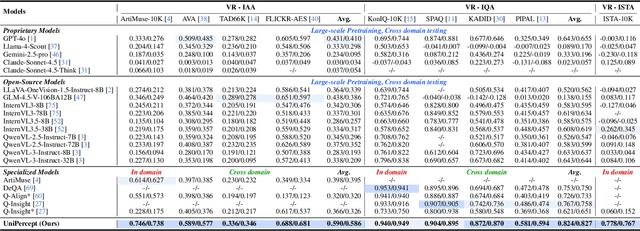
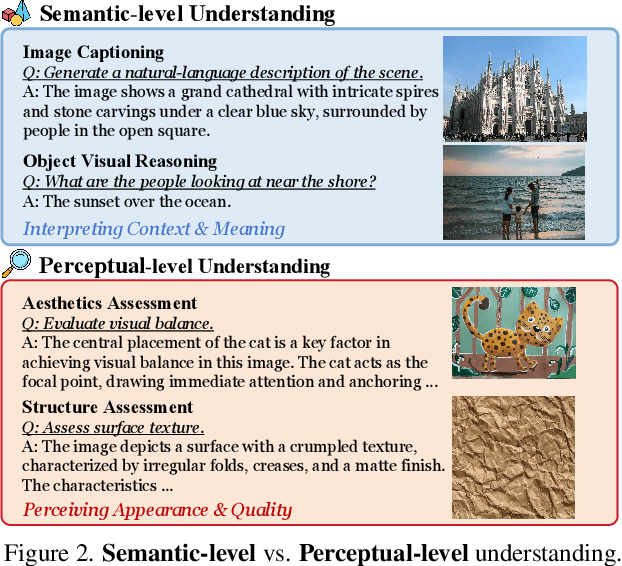
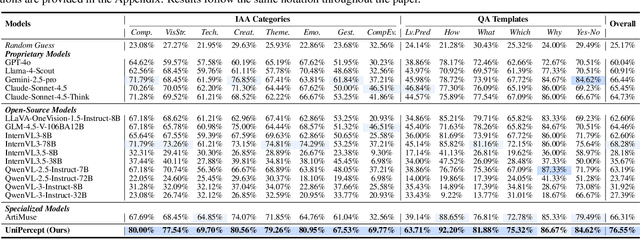
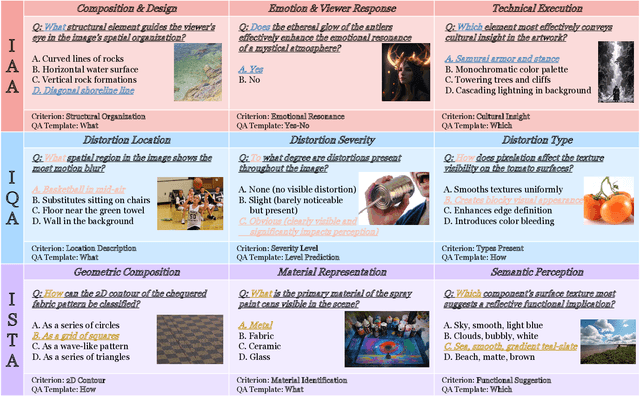
Multimodal large language models (MLLMs) have achieved remarkable progress in visual understanding tasks such as visual grounding, segmentation, and captioning. However, their ability to perceive perceptual-level image features remains limited. In this work, we present UniPercept-Bench, a unified framework for perceptual-level image understanding across three key domains: Aesthetics, Quality, Structure and Texture. We establish a hierarchical definition system and construct large-scale datasets to evaluate perceptual-level image understanding. Based on this foundation, we develop a strong baseline UniPercept trained via Domain-Adaptive Pre-Training and Task-Aligned RL, enabling robust generalization across both Visual Rating (VR) and Visual Question Answering (VQA) tasks. UniPercept outperforms existing MLLMs on perceptual-level image understanding and can serve as a plug-and-play reward model for text-to-image generation. This work defines Perceptual-Level Image Understanding in the era of MLLMs and, through the introduction of a comprehensive benchmark together with a strong baseline, provides a solid foundation for advancing perceptual-level multimodal image understanding.
OS-Oracle: A Comprehensive Framework for Cross-Platform GUI Critic Models
Dec 18, 2025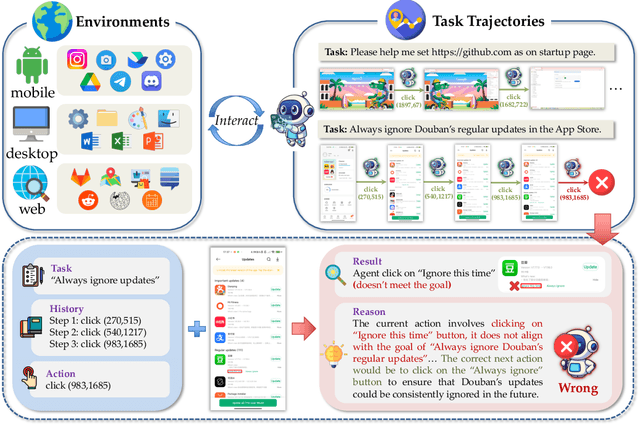
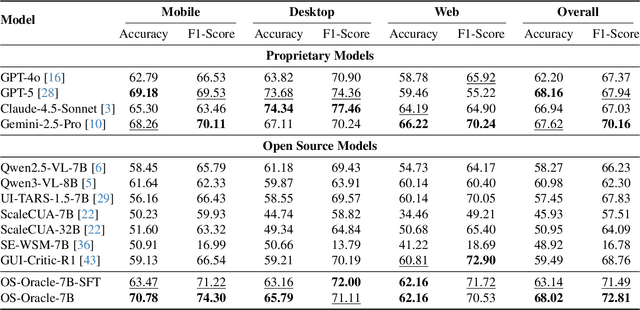
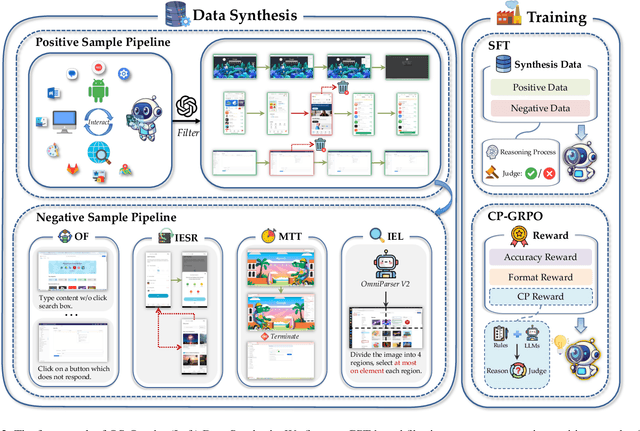
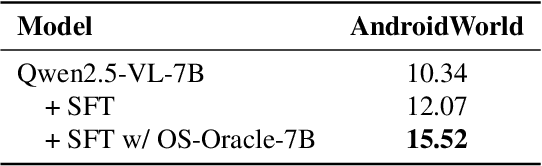
With VLM-powered computer-using agents (CUAs) becoming increasingly capable at graphical user interface (GUI) navigation and manipulation, reliable step-level decision-making has emerged as a key bottleneck for real-world deployment. In long-horizon workflows, errors accumulate quickly and irreversible actions can cause unintended consequences, motivating critic models that assess each action before execution. While critic models offer a promising solution, their effectiveness is hindered by the lack of diverse, high-quality GUI feedback data and public critic benchmarks for step-level evaluation in computer use. To bridge these gaps, we introduce OS-Oracle that makes three core contributions: (1) a scalable data pipeline for synthesizing cross-platform GUI critic data; (2) a two-stage training paradigm combining supervised fine-tuning (SFT) and consistency-preserving group relative policy optimization (CP-GRPO); (3) OS-Critic Bench, a holistic benchmark for evaluating critic model performance across Mobile, Web, and Desktop platforms. Leveraging this framework, we curate a high-quality dataset containing 310k critic samples. The resulting critic model, OS-Oracle-7B, achieves state-of-the-art performance among open-source VLMs on OS-Critic Bench, and surpasses proprietary models on the mobile domain. Furthermore, when serving as a pre-critic, OS-Oracle-7B improves the performance of native GUI agents such as UI-TARS-1.5-7B in OSWorld and AndroidWorld environments. The code is open-sourced at https://github.com/numbmelon/OS-Oracle.
LongVie 2: Multimodal Controllable Ultra-Long Video World Model
Dec 15, 2025Building video world models upon pretrained video generation systems represents an important yet challenging step toward general spatiotemporal intelligence. A world model should possess three essential properties: controllability, long-term visual quality, and temporal consistency. To this end, we take a progressive approach-first enhancing controllability and then extending toward long-term, high-quality generation. We present LongVie 2, an end-to-end autoregressive framework trained in three stages: (1) Multi-modal guidance, which integrates dense and sparse control signals to provide implicit world-level supervision and improve controllability; (2) Degradation-aware training on the input frame, bridging the gap between training and long-term inference to maintain high visual quality; and (3) History-context guidance, which aligns contextual information across adjacent clips to ensure temporal consistency. We further introduce LongVGenBench, a comprehensive benchmark comprising 100 high-resolution one-minute videos covering diverse real-world and synthetic environments. Extensive experiments demonstrate that LongVie 2 achieves state-of-the-art performance in long-range controllability, temporal coherence, and visual fidelity, and supports continuous video generation lasting up to five minutes, marking a significant step toward unified video world modeling.
ShotDirector: Directorially Controllable Multi-Shot Video Generation with Cinematographic Transitions
Dec 11, 2025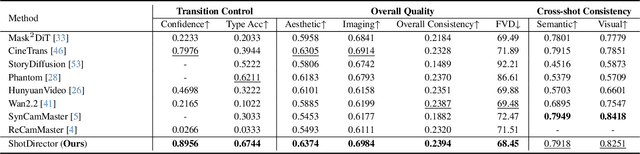
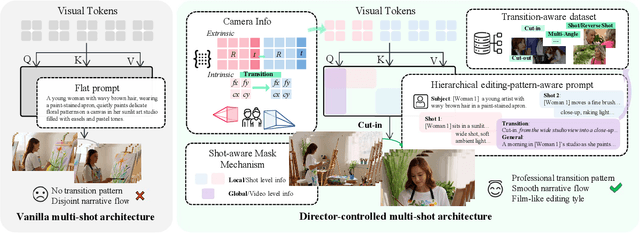

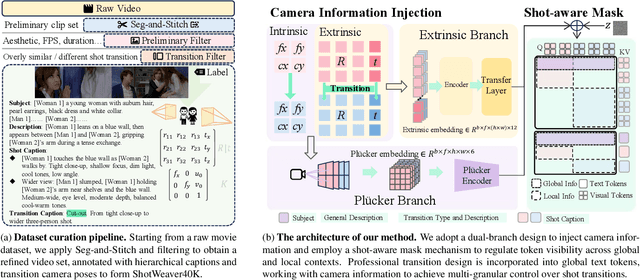
Shot transitions play a pivotal role in multi-shot video generation, as they determine the overall narrative expression and the directorial design of visual storytelling. However, recent progress has primarily focused on low-level visual consistency across shots, neglecting how transitions are designed and how cinematographic language contributes to coherent narrative expression. This often leads to mere sequential shot changes without intentional film-editing patterns. To address this limitation, we propose ShotDirector, an efficient framework that integrates parameter-level camera control and hierarchical editing-pattern-aware prompting. Specifically, we adopt a camera control module that incorporates 6-DoF poses and intrinsic settings to enable precise camera information injection. In addition, a shot-aware mask mechanism is employed to introduce hierarchical prompts aware of professional editing patterns, allowing fine-grained control over shot content. Through this design, our framework effectively combines parameter-level conditions with high-level semantic guidance, achieving film-like controllable shot transitions. To facilitate training and evaluation, we construct ShotWeaver40K, a dataset that captures the priors of film-like editing patterns, and develop a set of evaluation metrics for controllable multi-shot video generation. Extensive experiments demonstrate the effectiveness of our framework.