 Add to Chrome
 Add to Firefox
 Add to Edge
Dr. DocBench: A Comprehensive Benchmark for Expert-Level and Difficult Document Parsing
May 31, 2026
Document parsing and recognition are fundamental capabilities for vision-language models (VLMs) and document processing systems. However, existing Optical Character Recognition (OCR) and document parsing benchmarks are increasingly limited in coverage and difficulty: many focus on common document genres or uniformly sampled pages where modern parsers already perform strongly, while offering limited annotation for expert-domain structures such as chemical formula, music notation, complex tables, and cross-page layouts. We introduce Dr. DocBench, a difficulty-aware benchmark for expert-level document parsing. Built from a large-scale multilingual book corpus, Dr. DocBench spans 52 BISAC subject domains and selects challenging documents through parser-failure-based sampling, targeting cases where multiple state-of-the-art systems struggle. It contains 4,514 annotated pages from long documents averaging around 100 pages, with 65k high-quality page- and block-level annotations for layout, reading order, hierarchical relations, and domain-specific visual contents. Evaluations of pipeline-based parsers and general-purpose VLMs show that strong performance on existing benchmarks does not transfer to our expert-level document parsing. Our analysis reveals substantial failures across subjects, content types, and structural attributes, highlighting Dr. DocBench as a comprehensive testbed for diagnosing and advancing document intelligence.

MD-Face: MoE-Enhanced Label-Free Disentangled Representation for Interactive Facial Attribute Editing
Apr 22, 2026GAN-based facial attribute editing is widely used in virtual avatars and social media but often suffers from attribute entanglement, where modifying one face attribute unintentionally alters others. While supervised disentangled representation learning can address this, it relies heavily on labeled data, incurring high annotation costs. To address these challenges, we propose MD-Face, a label-free disentangled representation learning framework based on Mixture of Experts (MoE). MD-Face utilizes a MoE backbone with a gating mechanism that dynamically allocates experts, enabling the model to learn semantic vectors with greater independence. To further enhance attribute entanglement, we introduce a geometry-aware loss, which aligns each semantic vector with its corresponding Semantic Boundary Vector (SBV) through a Jacobian-based pushforward method. Experiments with ProGAN and StyleGAN show that MD-Face outperforms unsupervised baselines and competes with supervised ones. Compared to diffusion-based methods, it offers better image quality and lower inference latency, making it ideal for interactive editing.
ChartNet: A Million-Scale, High-Quality Multimodal Dataset for Robust Chart Understanding
Mar 28, 2026Understanding charts requires models to jointly reason over geometric visual patterns, structured numerical data, and natural language -- a capability where current vision-language models (VLMs) remain limited. We introduce ChartNet, a high-quality, million-scale multimodal dataset designed to advance chart interpretation and reasoning. ChartNet leverages a novel code-guided synthesis pipeline to generate 1.5 million diverse chart samples spanning 24 chart types and 6 plotting libraries. Each sample consists of five aligned components: plotting code, rendered chart image, data table, natural language summary, and question-answering with reasoning, providing fine-grained cross-modal alignment. To capture the full spectrum of chart comprehension, ChartNet additionally includes specialized subsets encompassing human annotated data, real-world data, safety, and grounding. Moreover, a rigorous quality-filtering pipeline ensures visual fidelity, semantic accuracy, and diversity across chart representations. Fine-tuning on ChartNet consistently improves results across benchmarks, demonstrating its utility as large-scale supervision for multimodal models. As the largest open-source dataset of its kind, ChartNet aims to support the development of foundation models with robust and generalizable capabilities for data visualization understanding. The dataset is publicly available at https://huggingface.co/datasets/ibm-granite/ChartNet
IGU-LoRA: Adaptive Rank Allocation via Integrated Gradients and Uncertainty-Aware Scoring
Mar 14, 2026As large language models (LLMs) scale to billions of parameters, full-parameter fine-tuning becomes compute- and memory-prohibitive. Parameter-efficient fine-tuning (PEFT) mitigates this issue by updating only a small set of task-specific parameters while keeping the base model frozen. Among PEFT approaches, low-rank adaptation (LoRA) is widely adopted; however, it enforces a uniform rank across layers despite substantial variation in layer importance, motivating {layerwise} rank allocation. Recent adaptive-rank variants (e.g., AdaLoRA) allocate ranks based on importance scores, yet typically rely on instantaneous gradients that capture only local sensitivity, overlooking non-local, pathwise effects within the same layer, which yields unstable and biased scores. To address this limitation, we introduce IGU-LoRA, an adaptive-rank LoRA that (i) computes within-layer Integrated Gradients (IG) sensitivities and aggregates them into a layer-level score for rank allocation, and (ii) applies an uncertainty-aware scheme using exponential moving averages with deviation tracking to suppress noisy updates and calibrate rank selection. Theoretically, we prove an upper bound on the composite trapezoidal rule approximation error for parameter-space IG under a pathwise Hessian-Lipschitz condition, which informs the quadrature budget. Across diverse tasks and architectures, IGU-LoRA consistently outperforms strong PEFT baselines at matched parameter budgets, improving downstream accuracy and robustness. Ablations confirm the contributions of pathwise within-layer sensitivity estimates and uncertainty-aware selection to effective rank allocation. Our code is publicly available at https://github.com/withyou12/igulora.git
HY3D-Bench: Generation of 3D Assets
Feb 03, 2026While recent advances in neural representations and generative models have revolutionized 3D content creation, the field remains constrained by significant data processing bottlenecks. To address this, we introduce HY3D-Bench, an open-source ecosystem designed to establish a unified, high-quality foundation for 3D generation. Our contributions are threefold: (1) We curate a library of 250k high-fidelity 3D objects distilled from large-scale repositories, employing a rigorous pipeline to deliver training-ready artifacts, including watertight meshes and multi-view renderings; (2) We introduce structured part-level decomposition, providing the granularity essential for fine-grained perception and controllable editing; and (3) We bridge real-world distribution gaps via a scalable AIGC synthesis pipeline, contributing 125k synthetic assets to enhance diversity in long-tail categories. Validated empirically through the training of Hunyuan3D-2.1-Small, HY3D-Bench democratizes access to robust data resources, aiming to catalyze innovation across 3D perception, robotics, and digital content creation.
SIN-Bench: Tracing Native Evidence Chains in Long-Context Multimodal Scientific Interleaved Literature
Jan 15, 2026Evaluating whether multimodal large language models truly understand long-form scientific papers remains challenging: answer-only metrics and synthetic "Needle-In-A-Haystack" tests often reward answer matching without requiring a causal, evidence-linked reasoning trace in the document. We propose the "Fish-in-the-Ocean" (FITO) paradigm, which requires models to construct explicit cross-modal evidence chains within native scientific documents. To operationalize FITO, we build SIN-Data, a scientific interleaved corpus that preserves the native interleaving of text and figures. On top of it, we construct SIN-Bench with four progressive tasks covering evidence discovery (SIN-Find), hypothesis verification (SIN-Verify), grounded QA (SIN-QA), and evidence-anchored synthesis (SIN-Summary). We further introduce "No Evidence, No Score", scoring predictions when grounded to verifiable anchors and diagnosing evidence quality via matching, relevance, and logic. Experiments on eight MLLMs show that grounding is the primary bottleneck: Gemini-3-pro achieves the best average overall score (0.573), while GPT-5 attains the highest SIN-QA answer accuracy (0.767) but underperforms on evidence-aligned overall scores, exposing a gap between correctness and traceable support.
NL2Repo-Bench: Towards Long-Horizon Repository Generation Evaluation of Coding Agents
Dec 14, 2025Recent advances in coding agents suggest rapid progress toward autonomous software development, yet existing benchmarks fail to rigorously evaluate the long-horizon capabilities required to build complete software systems. Most prior evaluations focus on localized code generation, scaffolded completion, or short-term repair tasks, leaving open the question of whether agents can sustain coherent reasoning, planning, and execution over the extended horizons demanded by real-world repository construction. To address this gap, we present NL2Repo Bench, a benchmark explicitly designed to evaluate the long-horizon repository generation ability of coding agents. Given only a single natural-language requirements document and an empty workspace, agents must autonomously design the architecture, manage dependencies, implement multi-module logic, and produce a fully installable Python library. Our experiments across state-of-the-art open- and closed-source models reveal that long-horizon repository generation remains largely unsolved: even the strongest agents achieve below 40% average test pass rates and rarely complete an entire repository correctly. Detailed analysis uncovers fundamental long-horizon failure modes, including premature termination, loss of global coherence, fragile cross-file dependencies, and inadequate planning over hundreds of interaction steps. NL2Repo Bench establishes a rigorous, verifiable testbed for measuring sustained agentic competence and highlights long-horizon reasoning as a central bottleneck for the next generation of autonomous coding agents.
Hunyuan3D Studio: End-to-End AI Pipeline for Game-Ready 3D Asset Generation
Sep 16, 2025
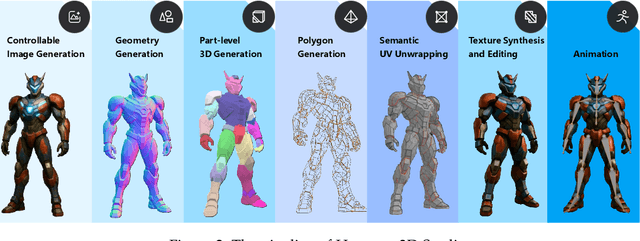

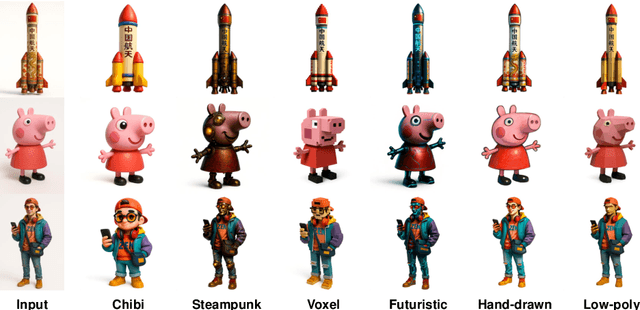
The creation of high-quality 3D assets, a cornerstone of modern game development, has long been characterized by labor-intensive and specialized workflows. This paper presents Hunyuan3D Studio, an end-to-end AI-powered content creation platform designed to revolutionize the game production pipeline by automating and streamlining the generation of game-ready 3D assets. At its core, Hunyuan3D Studio integrates a suite of advanced neural modules (such as Part-level 3D Generation, Polygon Generation, Semantic UV, etc.) into a cohesive and user-friendly system. This unified framework allows for the rapid transformation of a single concept image or textual description into a fully-realized, production-quality 3D model complete with optimized geometry and high-fidelity PBR textures. We demonstrate that assets generated by Hunyuan3D Studio are not only visually compelling but also adhere to the stringent technical requirements of contemporary game engines, significantly reducing iteration time and lowering the barrier to entry for 3D content creation. By providing a seamless bridge from creative intent to technical asset, Hunyuan3D Studio represents a significant leap forward for AI-assisted workflows in game development and interactive media.
X-Part: high fidelity and structure coherent shape decomposition
Sep 10, 2025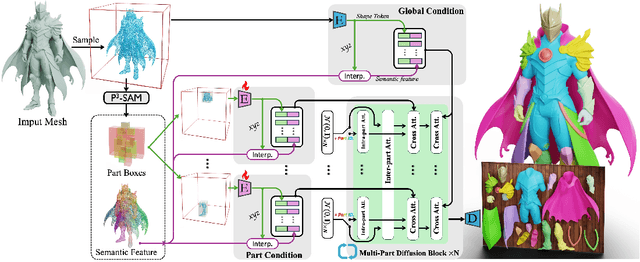
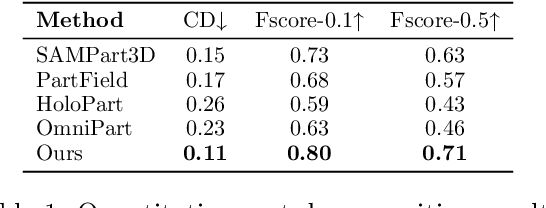
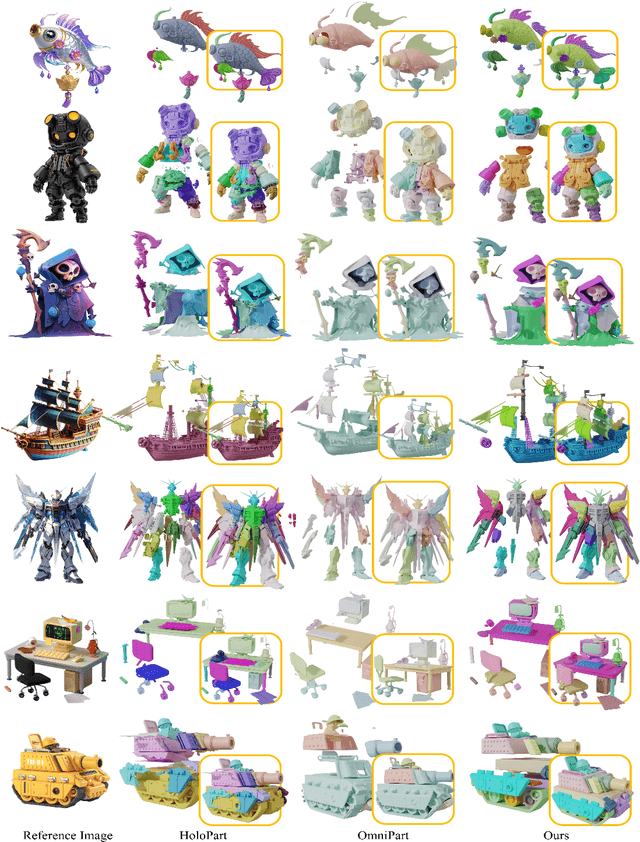
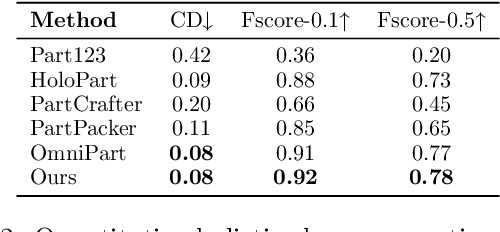
Generating 3D shapes at part level is pivotal for downstream applications such as mesh retopology, UV mapping, and 3D printing. However, existing part-based generation methods often lack sufficient controllability and suffer from poor semantically meaningful decomposition. To this end, we introduce X-Part, a controllable generative model designed to decompose a holistic 3D object into semantically meaningful and structurally coherent parts with high geometric fidelity. X-Part exploits the bounding box as prompts for the part generation and injects point-wise semantic features for meaningful decomposition. Furthermore, we design an editable pipeline for interactive part generation. Extensive experimental results show that X-Part achieves state-of-the-art performance in part-level shape generation. This work establishes a new paradigm for creating production-ready, editable, and structurally sound 3D assets. Codes will be released for public research.
Hunyuan3D 2.1: From Images to High-Fidelity 3D Assets with Production-Ready PBR Material
Jun 18, 20253D AI-generated content (AIGC) is a passionate field that has significantly accelerated the creation of 3D models in gaming, film, and design. Despite the development of several groundbreaking models that have revolutionized 3D generation, the field remains largely accessible only to researchers, developers, and designers due to the complexities involved in collecting, processing, and training 3D models. To address these challenges, we introduce Hunyuan3D 2.1 as a case study in this tutorial. This tutorial offers a comprehensive, step-by-step guide on processing 3D data, training a 3D generative model, and evaluating its performance using Hunyuan3D 2.1, an advanced system for producing high-resolution, textured 3D assets. The system comprises two core components: the Hunyuan3D-DiT for shape generation and the Hunyuan3D-Paint for texture synthesis. We will explore the entire workflow, including data preparation, model architecture, training strategies, evaluation metrics, and deployment. By the conclusion of this tutorial, you will have the knowledge to finetune or develop a robust 3D generative model suitable for applications in gaming, virtual reality, and industrial design.