 Add to Chrome
 Add to Firefox
 Add to Edge
CAPF: Guiding Search-Agent Rollouts with Credit-Attenuated Privileged Feedback
Jun 01, 2026
Recent LLM search agents use reinforcement learning with verifiable rewards (RLVR) to learn search-augmented reasoning from outcome rewards. On hard problems, these agents rarely sample end-to-end successful rollouts, leaving outcome-only RLVR with few positive-reward trajectories. We argue that improving learning on such problems requires additional guidance during training, and RLVR already contains verifier-side information that can provide it. This information can identify errors or omissions in the agent's submitted answer and guide revision within the rollout. We propose a training-time mechanism called \textbf{Credit-Attenuated Privileged Feedback} (CAPF), which makes this verifier-side information available through a Privileged Feedback call during training. CAPF lets the policy revise zero-reward attempts into positive-reward repair trajectories and attenuates credit for the feedback call and earlier actions to accommodate deployment without this call. Empirical research demonstrates that CAPF improves Qwen3-4B's average exact-match score from 44.7% under outcome-only RLVR to 48.5% on seven open-domain QA benchmarks.

VEPO: Variable Entropy Policy Optimization for Low-Resource Language Foundation Models
Mar 19, 2026Large language models frequently exhibit suboptimal performance on low resource languages, primarily due to inefficient subword segmentation and systemic training data imbalances. In this paper, we propose Variable Entropy Policy Optimization (VEPO), which leverages Reinforcement Learning with Verifiable Rewards to incorporate deterministic structural constraints into the policy alignment process. This framework ensures prescribed sequence length, robust format consistency, and rigorous linguistic well formedness, all enforced during training. Central to our approach is a variable entropy mechanism that enables the model to dynamically calibrate the equilibrium between literal fidelity and semantic naturalness by modulating the exploration exploitation manifold. By integrating entropy tempered advantage estimation with asymmetric clipping, VEPO sustains robust exploration while mitigating policy collapse. Empirical evaluations across 90 FLORES-200, COMET-22, chrF directions demonstrate that VEPO yields substantial improvements in both tokenization efficiency and translation quality, bridging the performance gap for underrepresented languages.
Modality Gap-Driven Subspace Alignment Training Paradigm For Multimodal Large Language Models
Feb 02, 2026Despite the success of multimodal contrastive learning in aligning visual and linguistic representations, a persistent geometric anomaly, the Modality Gap, remains: embeddings of distinct modalities expressing identical semantics occupy systematically offset regions. Prior approaches to bridge this gap are largely limited by oversimplified isotropic assumptions, hindering their application in large-scale scenarios. In this paper, we address these limitations by precisely characterizing the geometric shape of the modality gap and leveraging it for efficient model scaling. First, we propose the Fixed-frame Modality Gap Theory, which decomposes the modality gap within a frozen reference frame into stable biases and anisotropic residuals. Guided by this precise modeling, we introduce ReAlign, a training-free modality alignment strategy. Utilizing statistics from massive unpaired data, ReAlign aligns text representation into the image representation distribution via a three-step process comprising Anchor, Trace, and Centroid Alignment, thereby explicitly rectifying geometric misalignment. Building on ReAlign, we propose ReVision, a scalable training paradigm for Multimodal Large Language Models (MLLMs). ReVision integrates ReAlign into the pretraining stage, enabling the model to learn the distribution of visual representations from unpaired text before visual instruction tuning, without the need for large-scale, high-quality image-text pairs. Our framework demonstrates that statistically aligned unpaired data can effectively substitute for expensive image-text pairs, offering a robust path for the efficient scaling of MLLMs.
Flatter Tokens are More Valuable for Speculative Draft Model Training
Jan 26, 2026Speculative Decoding (SD) is a key technique for accelerating Large Language Model (LLM) inference, but it typically requires training a draft model on a large dataset. We approach this problem from a data-centric perspective, finding that not all training samples contribute equally to the SD acceptance rate. Specifically, our theoretical analysis and empirical validation reveals that tokens inducing flatter predictive distributions from the target model are more valuable than those yielding sharply peaked distributions. Based on this insight, we propose flatness, a new metric to quantify this property, and develop the Sample-level-flatness-based Dataset Distillation (SFDD) approach, which filters the training data to retain only the most valuable samples. Experiments on the EAGLE framework demonstrate that SFDD can achieve over 2$\times$ training speedup using only 50% of the data, while keeping the final model's inference speedup within 4% of the full-dataset baseline. This work introduces an effective, data-centric approach that substantially improves the training efficiency for Speculative Decoding. Our code is available at https://anonymous.4open.science/r/Flatness.
HI-TransPA: Hearing Impairments Translation Personal Assistant
Nov 14, 2025Hearing-impaired individuals often face significant barriers in daily communication due to the inherent challenges of producing clear speech. To address this, we introduce the Omni-Model paradigm into assistive technology and present HI-TransPA, an instruction-driven audio-visual personal assistant. The model fuses indistinct speech with lip dynamics, enabling both translation and dialogue within a single multimodal framework. To address the distinctive pronunciation patterns of hearing-impaired speech and the limited adaptability of existing models, we develop a multimodal preprocessing and curation pipeline that detects facial landmarks, stabilizes the lip region, and quantitatively evaluates sample quality. These quality scores guide a curriculum learning strategy that first trains on clean, high-confidence samples and progressively incorporates harder cases to strengthen model robustness. Architecturally, we employs a novel unified 3D-Resampler to efficiently encode the lip dynamics, which is critical for accurate interpretation. Experiments on purpose-built HI-Dialogue dataset show that HI-TransPA achieves state-of-the-art performance in both literal accuracy and semantic fidelity. Our work establishes a foundation for applying Omni-Models to assistive communication technology, providing an end-to-end modeling framework and essential processing tools for future research.
MIRAGE: A Multi-modal Benchmark for Spatial Perception, Reasoning, and Intelligence
May 15, 2025Spatial perception and reasoning are core components of human cognition, encompassing object recognition, spatial relational understanding, and dynamic reasoning. Despite progress in computer vision, existing benchmarks reveal significant gaps in models' abilities to accurately recognize object attributes and reason about spatial relationships, both essential for dynamic reasoning. To address these limitations, we propose MIRAGE, a multi-modal benchmark designed to evaluate models' capabilities in Counting (object attribute recognition), Relation (spatial relational reasoning), and Counting with Relation. Through diverse and complex scenarios requiring fine-grained recognition and reasoning, MIRAGE highlights critical limitations in state-of-the-art models, underscoring the need for improved representations and reasoning frameworks. By targeting these foundational abilities, MIRAGE provides a pathway toward spatiotemporal reasoning in future research.
ST-Think: How Multimodal Large Language Models Reason About 4D Worlds from Ego-Centric Videos
Mar 16, 2025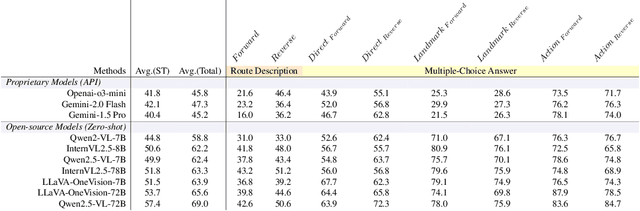
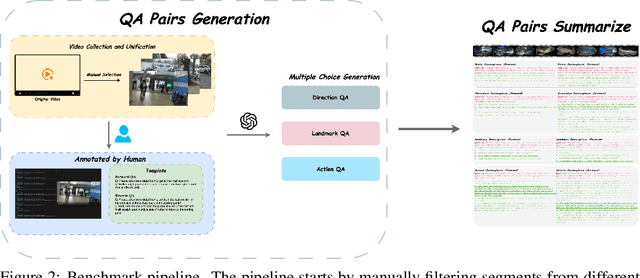
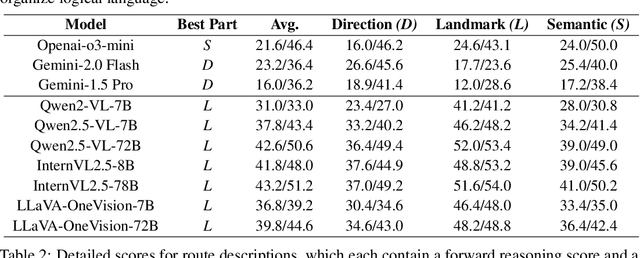

Humans excel at spatio-temporal reasoning, effortlessly interpreting dynamic visual events from an egocentric viewpoint. However, whether multimodal large language models (MLLMs) can similarly comprehend the 4D world remains uncertain. This paper explores multimodal spatio-temporal reasoning from an egocentric perspective, aiming to equip MLLMs with human-like reasoning capabilities. To support this objective, we introduce Ego-ST Bench, a novel benchmark containing over 5,000 question-answer pairs across four categories, systematically evaluating spatial, temporal, and integrated spatio-temporal reasoning. Additionally, we propose the ST-R1 Video model, a video-based reasoning model that incorporates reverse thinking into its reinforcement learning process, significantly enhancing performance. We combine long-chain-of-thought (long-CoT) supervised fine-tuning with Group Relative Policy Optimization (GRPO) reinforcement learning, achieving notable improvements with limited high-quality data. Ego-ST Bench and ST-R1 provide valuable insights and resources for advancing video-based spatio-temporal reasoning research.
AdaptiveStep: Automatically Dividing Reasoning Step through Model Confidence
Feb 19, 2025Current approaches for training Process Reward Models (PRMs) often involve breaking down responses into multiple reasoning steps using rule-based techniques, such as using predefined placeholder tokens or setting the reasoning step's length into a fixed size. These approaches overlook the fact that specific words do not typically mark true decision points in a text. To address this, we propose AdaptiveStep, a method that divides reasoning steps based on the model's confidence in predicting the next word. This division method provides more decision-making information at each step, enhancing downstream tasks, such as reward model learning. Moreover, our method does not require manual annotation. We demonstrate its effectiveness through experiments with AdaptiveStep-trained PRMs in mathematical reasoning and code generation tasks. Experimental results indicate that the outcome PRM achieves state-of-the-art Best-of-N performance, surpassing greedy search strategy with token-level value-guided decoding, while also reducing construction costs by over 30% compared to existing open-source PRMs. In addition, we provide a thorough analysis and case study on the PRM's performance, transferability, and generalization capabilities.