 Add to Chrome
 Add to Firefox
 Add to Edge
WorldRover: A Scalable Synthetic Video Data Engine for World Exploration with Rich Annotations
Aug 16, 2026
Learning to generate or reconstruct explorable worlds requires video paired with more than RGB: camera motion, scene geometry, temporal correspondence and, for interactive models, control signals. Real capture can provide some of these signals, but dense geometry and long-range correspondence usually rely on estimation or specialised instrumentation. Rendering provides these quantities directly, yet existing synthetic resources rarely combine them on the same frames while also supporting controlled changes of viewpoint and appearance. We introduce WorldRover, a data engine for generating richly annotated, long-range explorations of artist-built environments. At its core, WorldRover-Engine is an Unreal Engine pipeline that executes and offline-renders minute-scale routes while preserving their full trajectories and scene geometry. The same exploration can be replayed from first-person, third-person, and 360 panoramic cameras under different environmental states. Using WorldRover-Engine, we construct WorldRover-10M, whose sequences pair RGB with metric depth, camera trajectories, and trajectory-derived action signals throughout each exploration. Third-person subsets additionally provide dense optical flow, long-range 2D/3D point tracks with visibility, and a character trajectory distinct from the camera trajectory. The engine can render a traversal from first-person, third-person and 360 panoramic viewpoints, under different environmental states or with a neutral white material, while preserving the route and scene geometry. WorldRover therefore turns long-horizon world exploration into a scalable data-generation problem, providing supervision for models that must build, maintain, and revisit coherent representations of an explorable world.

AlayaWorld: Interactive Long-Horizon World Modeling -- Full Technical Report
Jul 20, 2026Unlike conventional video game development, which relies on labor-intensive pipelines for asset production, animation, physics, and programming, video world models generate interactive environments from user inputs instantly. It enable us to create customized, explorable, and continuously evolving virtual world from text, an image, or video. Realizing this vision requires four tightly coupled capabilities: interaction, persistent spatiotemporal consistency, stable long-horizon generation, and efficient response. We present AlayaWorld, an interactive long-horizon video world model that generates 24-fps video at 540p and 720p. Built on a 15B video diffusion transformer, AlayaWorld generates short latent chunks autoregressively under camera trajectories and switchable text prompts. Its bounded visual context combines a persistent sink frame, compressed temporal history, geometry-aligned spatial memory, and recent-frame conditioning. To reduce long-term drift, the model is trained with corrupted histories and prediction residuals collected from its own roll-outs. We further introduce a discrete autoregressive distillation formulation that combines distribution-matching distillation, self-forcing++, and consistency distillation, reducing inference from approximately 30 sampling steps to four steps per chunk. On iWorld-Bench, AlayaWorld achieves the best performance over long-horizon generation. Conceived as a full-stack, open-source, and long-term project, AlayaWorld is intended to provide an extensible foundation for future research on interactive video world models.
AlayaWorld: Long-Horizon and Playable Video World Generation
Jul 07, 2026Game worlds have traditionally been built through labor-intensive production pipelines, making them costly to develop, difficult to customization, and expensive to modify after deployment. Recent advances in video world models offer a fundamentally different paradigm. Rather than explicitly authoring every component of a virtual environment, these models autoregressively synthesize future observations conditioned on the current world state and user interactions, enabling playable worlds to be generated online. Trained on both gameplay recordings and real-world videos, they can capture diverse visual appearances and physical dynamics, opening new opportunities for interactive applications beyond gaming, including embodied intelligence. In this paper, we present \textbf{AlayaWorld}, a full-stack open-source framework for building interactive generative worlds. AlayaWorld enables open-ended real-time interaction, allowing users to freely navigate and perform diverse actions such as combat, spell casting, and monster summoning. The framework unifies the complete development-from data preparation model architecture, model training, inference acceleration, and deployment-within a modular and extensible architecture. Alongside the framework, we release reproducible pipelines, reference implementations, evaluation tools, and comprehensive documentation, establishing a practical foundation for future research and real-time applications of generative world models.
WorldMark: A Unified Benchmark Suite for Interactive Video World Models
Apr 23, 2026Interactive video generation models such as Genie, YUME, HY-World, and Matrix-Game are advancing rapidly, yet every model is evaluated on its own benchmark with private scenes and trajectories, making fair cross-model comparison impossible. Existing public benchmarks offer useful metrics such as trajectory error, aesthetic scores, and VLM-based judgments, but none supplies the standardized test conditions -- identical scenes, identical action sequences, and a unified control interface -- needed to make those metrics comparable across models with heterogeneous inputs. We introduce WorldMark, the first benchmark that provides such a common playing field for interactive Image-to-Video world models. WorldMark contributes: (1) a unified action-mapping layer that translates a shared WASD-style action vocabulary into each model's native control format, enabling apples-to-apples comparison across six major models on identical scenes and trajectories; (2) a hierarchical test suite of 500 evaluation cases covering first- and third-person viewpoints, photorealistic and stylized scenes, and three difficulty tiers from Easy to Hard spanning 20-60s; and (3) a modular evaluation toolkit for Visual Quality, Control Alignment, and World Consistency, designed so that researchers can reuse our standardized inputs while plugging in their own metrics as the field evolves. We will release all data, evaluation code, and model outputs to facilitate future research. Beyond offline metrics, we launch World Model Arena (warena.ai), an online platform where anyone can pit leading world models against each other in side-by-side battles and watch the live leaderboard.
Yume-1.5: A Text-Controlled Interactive World Generation Model
Dec 26, 2025Recent approaches have demonstrated the promise of using diffusion models to generate interactive and explorable worlds. However, most of these methods face critical challenges such as excessively large parameter sizes, reliance on lengthy inference steps, and rapidly growing historical context, which severely limit real-time performance and lack text-controlled generation capabilities. To address these challenges, we propose \method, a novel framework designed to generate realistic, interactive, and continuous worlds from a single image or text prompt. \method achieves this through a carefully designed framework that supports keyboard-based exploration of the generated worlds. The framework comprises three core components: (1) a long-video generation framework integrating unified context compression with linear attention; (2) a real-time streaming acceleration strategy powered by bidirectional attention distillation and an enhanced text embedding scheme; (3) a text-controlled method for generating world events. We have provided the codebase in the supplementary material.
SVBench: Evaluation of Video Generation Models on Social Reasoning
Dec 25, 2025Recent text-to-video generation models exhibit remarkable progress in visual realism, motion fidelity, and text-video alignment, yet they remain fundamentally limited in their ability to generate socially coherent behavior. Unlike humans, who effortlessly infer intentions, beliefs, emotions, and social norms from brief visual cues, current models tend to render literal scenes without capturing the underlying causal or psychological logic. To systematically evaluate this gap, we introduce the first benchmark for social reasoning in video generation. Grounded in findings from developmental and social psychology, our benchmark organizes thirty classic social cognition paradigms into seven core dimensions, including mental-state inference, goal-directed action, joint attention, social coordination, prosocial behavior, social norms, and multi-agent strategy. To operationalize these paradigms, we develop a fully training-free agent-based pipeline that (i) distills the reasoning mechanism of each experiment, (ii) synthesizes diverse video-ready scenarios, (iii) enforces conceptual neutrality and difficulty control through cue-based critique, and (iv) evaluates generated videos using a high-capacity VLM judge across five interpretable dimensions of social reasoning. Using this framework, we conduct the first large-scale study across seven state-of-the-art video generation systems. Our results reveal substantial performance gaps: while modern models excel in surface-level plausibility, they systematically fail in intention recognition, belief reasoning, joint attention, and prosocial inference.
PreGenie: An Agentic Framework for High-quality Visual Presentation Generation
May 27, 2025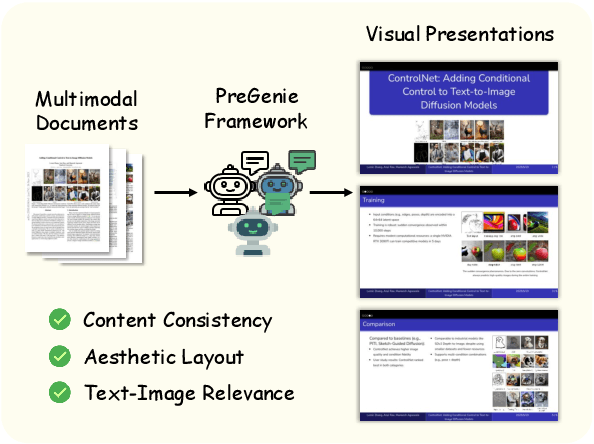
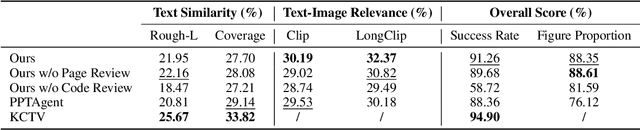
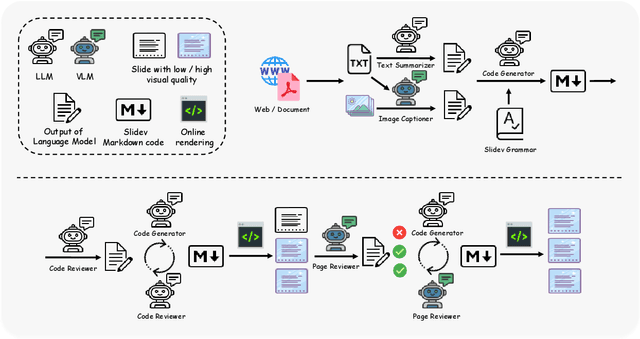
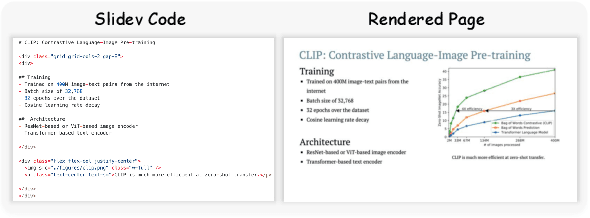
Visual presentations are vital for effective communication. Early attempts to automate their creation using deep learning often faced issues such as poorly organized layouts, inaccurate text summarization, and a lack of image understanding, leading to mismatched visuals and text. These limitations restrict their application in formal contexts like business and scientific research. To address these challenges, we propose PreGenie, an agentic and modular framework powered by multimodal large language models (MLLMs) for generating high-quality visual presentations. PreGenie is built on the Slidev presentation framework, where slides are rendered from Markdown code. It operates in two stages: (1) Analysis and Initial Generation, which summarizes multimodal input and generates initial code, and (2) Review and Re-generation, which iteratively reviews intermediate code and rendered slides to produce final, high-quality presentations. Each stage leverages multiple MLLMs that collaborate and share information. Comprehensive experiments demonstrate that PreGenie excels in multimodal understanding, outperforming existing models in both aesthetics and content consistency, while aligning more closely with human design preferences.
POSTA: A Go-to Framework for Customized Artistic Poster Generation
Mar 19, 2025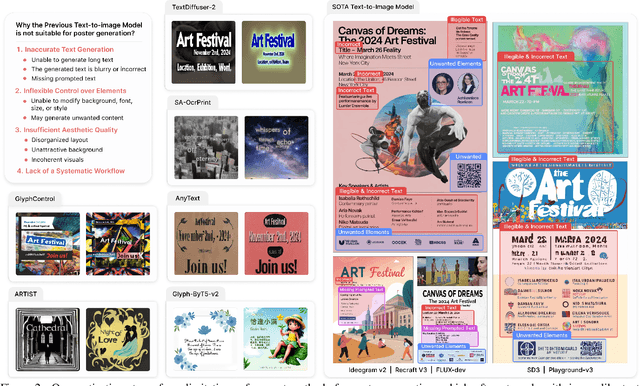
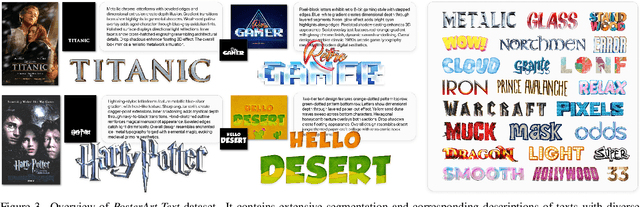

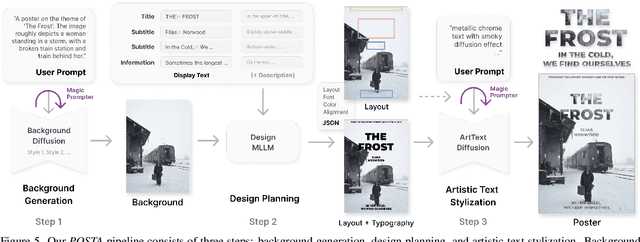
Poster design is a critical medium for visual communication. Prior work has explored automatic poster design using deep learning techniques, but these approaches lack text accuracy, user customization, and aesthetic appeal, limiting their applicability in artistic domains such as movies and exhibitions, where both clear content delivery and visual impact are essential. To address these limitations, we present POSTA: a modular framework powered by diffusion models and multimodal large language models (MLLMs) for customized artistic poster generation. The framework consists of three modules. Background Diffusion creates a themed background based on user input. Design MLLM then generates layout and typography elements that align with and complement the background style. Finally, to enhance the poster's aesthetic appeal, ArtText Diffusion applies additional stylization to key text elements. The final result is a visually cohesive and appealing poster, with a fully modular process that allows for complete customization. To train our models, we develop the PosterArt dataset, comprising high-quality artistic posters annotated with layout, typography, and pixel-level stylized text segmentation. Our comprehensive experimental analysis demonstrates POSTA's exceptional controllability and design diversity, outperforming existing models in both text accuracy and aesthetic quality.
Long-Video Audio Synthesis with Multi-Agent Collaboration
Mar 17, 2025Video-to-audio synthesis, which generates synchronized audio for visual content, critically enhances viewer immersion and narrative coherence in film and interactive media. However, video-to-audio dubbing for long-form content remains an unsolved challenge due to dynamic semantic shifts, temporal misalignment, and the absence of dedicated datasets. While existing methods excel in short videos, they falter in long scenarios (e.g., movies) due to fragmented synthesis and inadequate cross-scene consistency. We propose LVAS-Agent, a novel multi-agent framework that emulates professional dubbing workflows through collaborative role specialization. Our approach decomposes long-video synthesis into four steps including scene segmentation, script generation, sound design and audio synthesis. Central innovations include a discussion-correction mechanism for scene/script refinement and a generation-retrieval loop for temporal-semantic alignment. To enable systematic evaluation, we introduce LVAS-Bench, the first benchmark with 207 professionally curated long videos spanning diverse scenarios. Experiments demonstrate superior audio-visual alignment over baseline methods. Project page: https://lvas-agent.github.io
Reflection of Episodes: Learning to Play Game from Expert and Self Experiences
Feb 19, 2025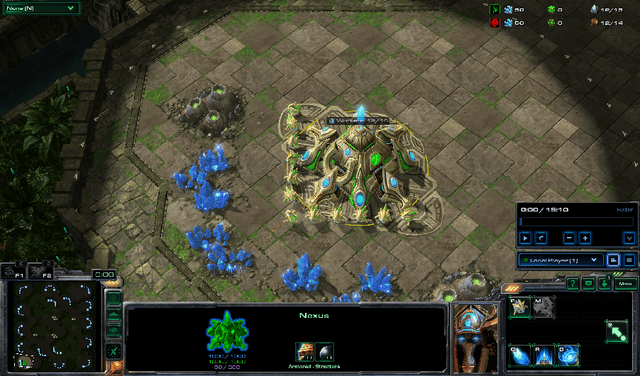
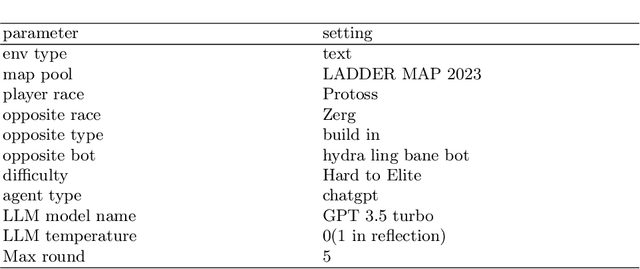
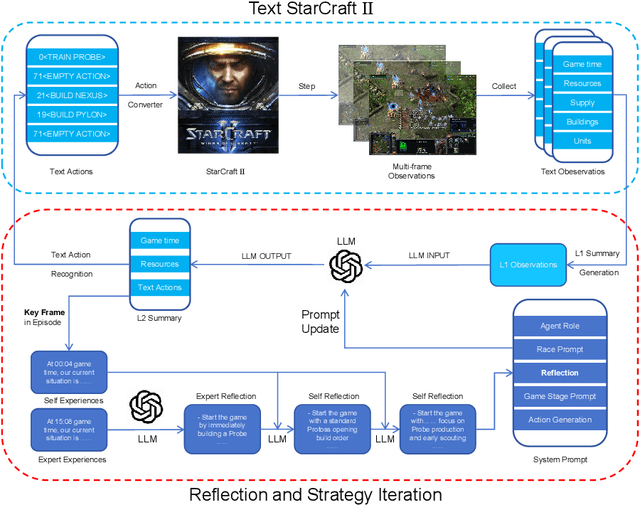

StarCraft II is a complex and dynamic real-time strategy (RTS) game environment, which is very suitable for artificial intelligence and reinforcement learning research. To address the problem of Large Language Model(LLM) learning in complex environments through self-reflection, we propose a Reflection of Episodes(ROE) framework based on expert experience and self-experience. This framework first obtains key information in the game through a keyframe selection method, then makes decisions based on expert experience and self-experience. After a game is completed, it reflects on the previous experience to obtain new self-experience. Finally, in the experiment, our method beat the robot under the Very Hard difficulty in TextStarCraft II. We analyze the data of the LLM in the process of the game in detail, verified its effectiveness.