 Add to Chrome
 Add to Firefox
 Add to Edge
Toward Generalizable Deblurring: Leveraging Massive Blur Priors with Linear Attention for Real-World Scenarios
Jan 10, 2026
Image deblurring has advanced rapidly with deep learning, yet most methods exhibit poor generalization beyond their training datasets, with performance dropping significantly in real-world scenarios. Our analysis shows this limitation stems from two factors: datasets face an inherent trade-off between realism and coverage of diverse blur patterns, and algorithmic designs remain restrictive, as pixel-wise losses drive models toward local detail recovery while overlooking structural and semantic consistency, whereas diffusion-based approaches, though perceptually strong, still fail to generalize when trained on narrow datasets with simplistic strategies. Through systematic investigation, we identify blur pattern diversity as the decisive factor for robust generalization and propose Blur Pattern Pretraining (BPP), which acquires blur priors from simulation datasets and transfers them through joint fine-tuning on real data. We further introduce Motion and Semantic Guidance (MoSeG) to strengthen blur priors under severe degradation, and integrate it into GLOWDeblur, a Generalizable reaL-wOrld lightWeight Deblur model that combines convolution-based pre-reconstruction & domain alignment module with a lightweight diffusion backbone. Extensive experiments on six widely-used benchmarks and two real-world datasets validate our approach, confirming the importance of blur priors for robust generalization and demonstrating that the lightweight design of GLOWDeblur ensures practicality in real-world applications. The project page is available at https://vegdog007.github.io/GLOWDeblur_Website/.

UniPercept: Towards Unified Perceptual-Level Image Understanding across Aesthetics, Quality, Structure, and Texture
Dec 25, 2025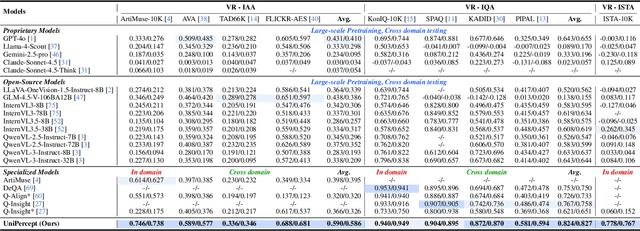
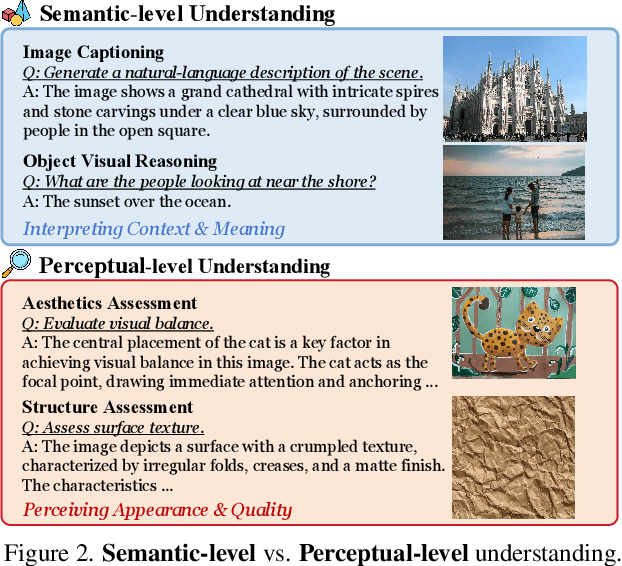
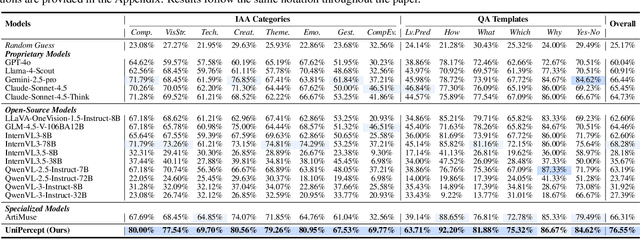
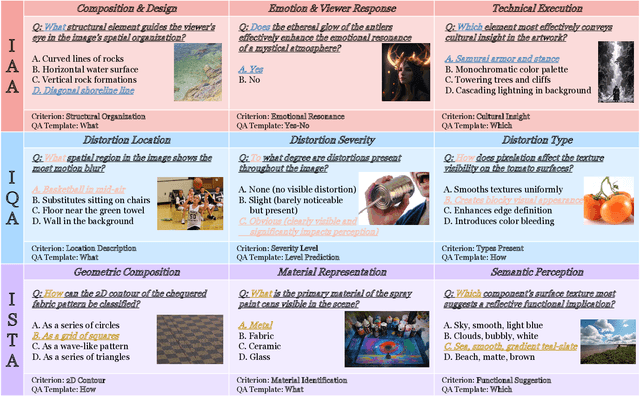
Multimodal large language models (MLLMs) have achieved remarkable progress in visual understanding tasks such as visual grounding, segmentation, and captioning. However, their ability to perceive perceptual-level image features remains limited. In this work, we present UniPercept-Bench, a unified framework for perceptual-level image understanding across three key domains: Aesthetics, Quality, Structure and Texture. We establish a hierarchical definition system and construct large-scale datasets to evaluate perceptual-level image understanding. Based on this foundation, we develop a strong baseline UniPercept trained via Domain-Adaptive Pre-Training and Task-Aligned RL, enabling robust generalization across both Visual Rating (VR) and Visual Question Answering (VQA) tasks. UniPercept outperforms existing MLLMs on perceptual-level image understanding and can serve as a plug-and-play reward model for text-to-image generation. This work defines Perceptual-Level Image Understanding in the era of MLLMs and, through the introduction of a comprehensive benchmark together with a strong baseline, provides a solid foundation for advancing perceptual-level multimodal image understanding.