 Add to Chrome
 Add to Firefox
 Add to Edge
Chimera: Designing and Chinchilla-Scaling Hybrid Visual Diffusion Transformers
Jul 30, 2026
Visual generation increasingly requires high-resolution images, long videos, and multimodal context, making the quadratic cost of full attention prohibitive. We introduce Chimera, a hybrid visual diffusion backbone with a principled scaling recipe. Chimera processes text, image, and video tokens in one raster-ordered stream without positional embeddings. It combines Kimi Delta Attention (KDA) for long-context state tracking with O(N) complexity, interleaved Multi-head Latent Attention (MLA) for direct global interaction, and modality-aware short convolutions for local spatiotemporal context. Sparse Mixture-of-Experts (MoE) layers expand capacity while controlling activated compute. To scale this heterogeneous architecture, we introduce HeteroP, a module-wise scheme that transfers hyperparameters across width and depth according to each tensor's functional fan-in and model depth. HeteroP yields a consistently tuned family used to fit Chinchilla-style compute-optimal laws for activated model size, training-token count, and image-video data ratio. Guided by these laws, we train an 11B-parameter Chimera with 2B activated parameters. Experiments show three results. First, measured by pretraining diffusion loss, the dense backbone is 1.7x as compute-efficient as a matched full-attention Wan-2.1 2B baseline, while the complete system reaches 7.3x. Second, without length-specific fine-tuning, Chimera extrapolates zero-shot from 5-second training clips to 30-second videos, with only 6.5% FID degradation in the last five seconds. Third, the fitted laws show that compute-optimal image pretraining divides compute nearly evenly between activated model size and training-token count, whereas video pretraining modestly favors model size at higher budgets. These results establish a foundation for designing and scaling efficient long-context diffusion architectures.

Calibrated Closed-Form Uncertainty for Radiative Gaussian Splatting in Sparse-View CT
Jul 15, 2026Radiative Gaussian splatting has made sparse-view CT reconstruction fast, but existing methods output point estimates with no notion of where the reconstruction can be trusted. We exploit a property of transmissive X-ray imaging that RGB splatting cannot claim -- projection and voxelization are strictly linear in the per-Gaussian densities -- to equip radiative Gaussians with a variational density posterior whose predictive variance propagates in closed form, exactly, in a single forward pass, in both volume space ($σ^2(x)=\sum_i g_i(x)^2 s_i^2$) and projection space ($\mathrm{Var}[I_p]=\sum_i w_{i,p}^2 s_i^2$). We present the first systematic calibration study for Gaussian-splatting CT (Spearman / AUSE / ECE with temperature scaling), showing that the resulting per-voxel uncertainty ranks true reconstruction error on 14 of 15 scenes of the official benchmark across three view budgets -- 9 of 15 additionally meeting our magnitude-calibration target after a single temperature -- while the perturbation-ensemble heuristic of concurrent work, transplanted to voxel space under the same protocol on our development scenes, does not (rank correlation as low as $-0.08$). We then dissect why uncalibrated acquisition scores can nevertheless select acceptable views, identifying three regimes -- flat (isotropic, balanced), pathological (degenerate coverage), and anisotropic -- and showing, in controlled single-scene testbeds, that principled uncertainty earns a measurable premium only in the last, motivating a coverage-gated, maturity-scheduled acquisition policy; the same calibrated posterior further points toward a dose-adaptive stopping rule, whose experimental validation we leave to future work.
FLARE: Diffusion for Hybrid Language Model
Jun 01, 2026Autoregressive (AR) large language models (LLMs) have achieved broad practical success, but sequential decoding remains a key bottleneck for low-latency deployment. Recent efficient-inference work has progressed along two axes: reducing the cost of each model invocation through efficient architectures, and reducing serial decoding steps through parallel generation. Hybrid attention backbones address the former, while diffusion language models (dLLMs) pursue the latter via iterative parallel denoising. Combining these advantages remains challenging: AR-to-dLLM conversion often fails to preserve seed-checkpoint capability, and hybrid-attention recurrent states and masking constraints make diffusion training and serving nontrivial. We present FLARE, a systematic conversion framework for hybrid-attention LLMs. Our analysis identifies transfer data quality as the primary determinant of capability preservation, outweighing loss formulation and attention-mask design. The resulting framework combines a token-equal AR-and-diffusion objective, hardware-aware kernels, and unified inference, enabling one checkpoint to support both AR-style verified decoding and diffusion-style parallel denoising. Starting from strong AR checkpoints with limited post-training data, FLARE is competitive with leading open-source dLLMs across model scales and delivers consistent throughput gains over open-source dLLM baselines in single-GPU concurrent serving. Our results further suggest that practical dLLMs are limited not only by decoding algorithms, but also by transfer data quality and the training inefficiency of current block-diffusion objectives, motivating joint design of data, objectives, architectures, and inference systems.
Smaller Models are Natural Explorers for Policy-Level Diversity in GRPO
May 29, 2026We identify a new dimension for enhancing rollout diversity in Group Relative Policy Optimization (GRPO) for LLMs. While GRPO relies on diverse rollouts, prevailing strategies primarily increase diversity by injecting more token-level randomness, which may introduce step-wise noise and lead to incoherent trajectories. We uncover that smaller models within the same model family inherently exhibit higher policy-level diversity, indicated by their superior pass@k relative to larger counterparts as sample counts increase. Unlike token-level noise, this diversity is temporally correlated, preserves logical consistency, and provides structured exploration signals for gradient estimation. We thus propose S2L-PO (Small-to-Large Policy Optimization), a framework that leverages fixed small models as natural explorers to train larger models. To balance exploration and exploitation, we design a progressive annealing strategy that transitions from offline small-model rollouts to the large learner's own sampling. This shift elegantly avoids mid-training performance drops caused by the small model's capacity limits, achieving faster convergence and unlocking a higher performance ceiling. S2L-PO improves accuracy on diverse mathematical reasoning benchmarks (e.g., +8.8% on AIME 24 using a 1.7B explorer to guide the 8B model) while reducing rollout compute.
Color Matters: Demosaicing-Guided Color Correlation Training for Generalizable AI-Generated Image Detection
Jan 30, 2026As realistic AI-generated images threaten digital authenticity, we address the generalization failure of generative artifact-based detectors by exploiting the intrinsic properties of the camera imaging pipeline. Concretely, we investigate color correlations induced by the color filter array (CFA) and demosaicing, and propose a Demosaicing-guided Color Correlation Training (DCCT) framework for AI-generated image detection. By simulating the CFA sampling pattern, we decompose each color image into a single-channel input (as the condition) and the remaining two channels as the ground-truth targets (for prediction). A self-supervised U-Net is trained to model the conditional distribution of the missing channels from the given one, parameterized via a mixture of logistic functions. Our theoretical analysis reveals that DCCT targets a provable distributional difference in color-correlation features between photographic and AI-generated images. By leveraging these distinct features to construct a binary classifier, DCCT achieves state-of-the-art generalization and robustness, significantly outperforming prior methods across over 20 unseen generators.
SIN-Bench: Tracing Native Evidence Chains in Long-Context Multimodal Scientific Interleaved Literature
Jan 15, 2026Evaluating whether multimodal large language models truly understand long-form scientific papers remains challenging: answer-only metrics and synthetic "Needle-In-A-Haystack" tests often reward answer matching without requiring a causal, evidence-linked reasoning trace in the document. We propose the "Fish-in-the-Ocean" (FITO) paradigm, which requires models to construct explicit cross-modal evidence chains within native scientific documents. To operationalize FITO, we build SIN-Data, a scientific interleaved corpus that preserves the native interleaving of text and figures. On top of it, we construct SIN-Bench with four progressive tasks covering evidence discovery (SIN-Find), hypothesis verification (SIN-Verify), grounded QA (SIN-QA), and evidence-anchored synthesis (SIN-Summary). We further introduce "No Evidence, No Score", scoring predictions when grounded to verifiable anchors and diagnosing evidence quality via matching, relevance, and logic. Experiments on eight MLLMs show that grounding is the primary bottleneck: Gemini-3-pro achieves the best average overall score (0.573), while GPT-5 attains the highest SIN-QA answer accuracy (0.767) but underperforms on evidence-aligned overall scores, exposing a gap between correctness and traceable support.
DuetSVG: Unified Multimodal SVG Generation with Internal Visual Guidance
Dec 11, 2025Recent vision-language model (VLM)-based approaches have achieved impressive results on SVG generation. However, because they generate only text and lack visual signals during decoding, they often struggle with complex semantics and fail to produce visually appealing or geometrically coherent SVGs. We introduce DuetSVG, a unified multimodal model that jointly generates image tokens and corresponding SVG tokens in an end-to-end manner. DuetSVG is trained on both image and SVG datasets. At inference, we apply a novel test-time scaling strategy that leverages the model's native visual predictions as guidance to improve SVG decoding quality. Extensive experiments show that our method outperforms existing methods, producing visually faithful, semantically aligned, and syntactically clean SVGs across a wide range of applications.
Flash-Splat: 3D Reflection Removal with Flash Cues and Gaussian Splats
Oct 03, 2024We introduce a simple yet effective approach for separating transmitted and reflected light. Our key insight is that the powerful novel view synthesis capabilities provided by modern inverse rendering methods (e.g.,~3D Gaussian splatting) allow one to perform flash/no-flash reflection separation using unpaired measurements -- this relaxation dramatically simplifies image acquisition over conventional paired flash/no-flash reflection separation methods. Through extensive real-world experiments, we demonstrate our method, Flash-Splat, accurately reconstructs both transmitted and reflected scenes in 3D. Our method outperforms existing 3D reflection separation methods, which do not leverage illumination control, by a large margin. Our project webpage is at https://flash-splat.github.io/.
Anno-incomplete Multi-dataset Detection
Aug 29, 2024


Object detectors have shown outstanding performance on various public datasets. However, annotating a new dataset for a new task is usually unavoidable in real, since 1) a single existing dataset usually does not contain all object categories needed; 2) using multiple datasets usually suffers from annotation incompletion and heterogeneous features. We propose a novel problem as "Annotation-incomplete Multi-dataset Detection", and develop an end-to-end multi-task learning architecture which can accurately detect all the object categories with multiple partially annotated datasets. Specifically, we propose an attention feature extractor which helps to mine the relations among different datasets. Besides, a knowledge amalgamation training strategy is incorporated to accommodate heterogeneous features from different sources. Extensive experiments on different object detection datasets demonstrate the effectiveness of our methods and an improvement of 2.17%, 2.10% in mAP can be achieved on COCO and VOC respectively.
Revocable Backdoor for Deep Model Trading
Aug 01, 2024
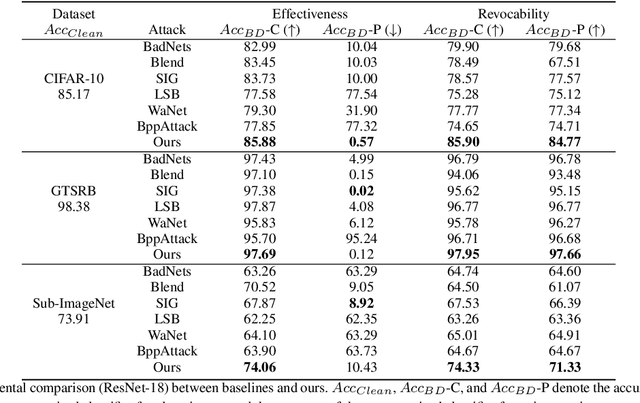
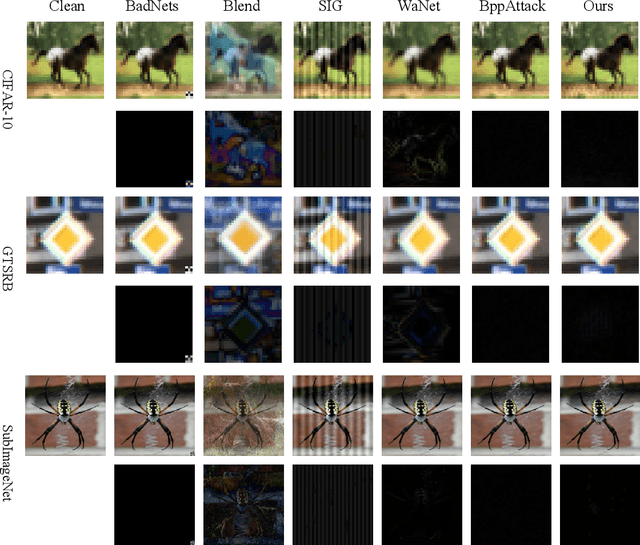
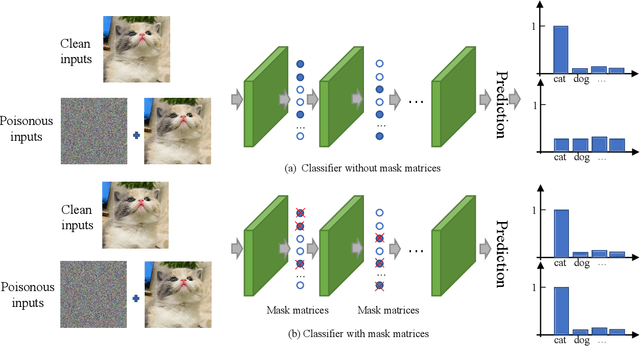
Deep models are being applied in numerous fields and have become a new important digital product. Meanwhile, previous studies have shown that deep models are vulnerable to backdoor attacks, in which compromised models return attacker-desired results when a trigger appears. Backdoor attacks severely break the trust-worthiness of deep models. In this paper, we turn this weakness of deep models into a strength, and propose a novel revocable backdoor and deep model trading scenario. Specifically, we aim to compromise deep models without degrading their performance, meanwhile, we can easily detoxify poisoned models without re-training the models. We design specific mask matrices to manage the internal feature maps of the models. These mask matrices can be used to deactivate the backdoors. The revocable backdoor can be adopted in the deep model trading scenario. Sellers train models with revocable backdoors as a trial version. Buyers pay a deposit to sellers and obtain a trial version of the deep model. If buyers are satisfied with the trial version, they pay a final payment to sellers and sellers send mask matrices to buyers to withdraw revocable backdoors. We demonstrate the feasibility and robustness of our revocable backdoor by various datasets and network architectures.