 Add to Chrome
 Add to Firefox
 Add to Edge
Foundation Models in Robotics: Applications, Challenges, and the Future
Dec 13, 2023
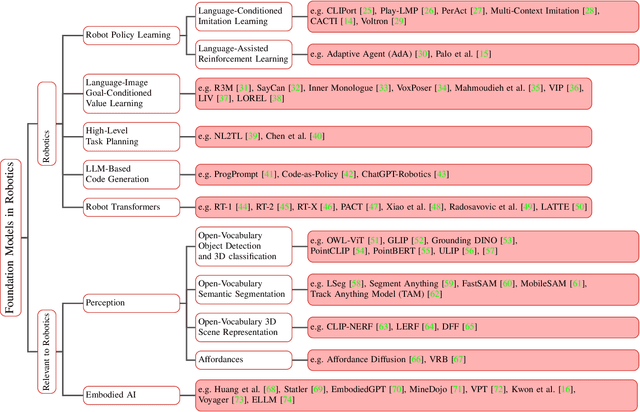


We survey applications of pretrained foundation models in robotics. Traditional deep learning models in robotics are trained on small datasets tailored for specific tasks, which limits their adaptability across diverse applications. In contrast, foundation models pretrained on internet-scale data appear to have superior generalization capabilities, and in some instances display an emergent ability to find zero-shot solutions to problems that are not present in the training data. Foundation models may hold the potential to enhance various components of the robot autonomy stack, from perception to decision-making and control. For example, large language models can generate code or provide common sense reasoning, while vision-language models enable open-vocabulary visual recognition. However, significant open research challenges remain, particularly around the scarcity of robot-relevant training data, safety guarantees and uncertainty quantification, and real-time execution. In this survey, we study recent papers that have used or built foundation models to solve robotics problems. We explore how foundation models contribute to improving robot capabilities in the domains of perception, decision-making, and control. We discuss the challenges hindering the adoption of foundation models in robot autonomy and provide opportunities and potential pathways for future advancements. The GitHub project corresponding to this paper (Preliminary release. We are committed to further enhancing and updating this work to ensure its quality and relevance) can be found here: https://github.com/robotics-survey/Awesome-Robotics-Foundation-Models

Aria-NeRF: Multimodal Egocentric View Synthesis
Nov 11, 2023


We seek to accelerate research in developing rich, multimodal scene models trained from egocentric data, based on differentiable volumetric ray-tracing inspired by Neural Radiance Fields (NeRFs). The construction of a NeRF-like model from an egocentric image sequence plays a pivotal role in understanding human behavior and holds diverse applications within the realms of VR/AR. Such egocentric NeRF-like models may be used as realistic simulations, contributing significantly to the advancement of intelligent agents capable of executing tasks in the real-world. The future of egocentric view synthesis may lead to novel environment representations going beyond today's NeRFs by augmenting visual data with multimodal sensors such as IMU for egomotion tracking, audio sensors to capture surface texture and human language context, and eye-gaze trackers to infer human attention patterns in the scene. To support and facilitate the development and evaluation of egocentric multimodal scene modeling, we present a comprehensive multimodal egocentric video dataset. This dataset offers a comprehensive collection of sensory data, featuring RGB images, eye-tracking camera footage, audio recordings from a microphone, atmospheric pressure readings from a barometer, positional coordinates from GPS, connectivity details from Wi-Fi and Bluetooth, and information from dual-frequency IMU datasets (1kHz and 800Hz) paired with a magnetometer. The dataset was collected with the Meta Aria Glasses wearable device platform. The diverse data modalities and the real-world context captured within this dataset serve as a robust foundation for furthering our understanding of human behavior and enabling more immersive and intelligent experiences in the realms of VR, AR, and robotics.
Lyra: Orchestrating Dual Correction in Automated Theorem Proving
Oct 07, 2023Large Language Models (LLMs) present an intriguing avenue for exploration in the field of formal theorem proving. Nevertheless, their full potential, particularly concerning the mitigation of hallucinations and refinement through prover error messages, remains an area that has yet to be thoroughly investigated. To enhance the effectiveness of LLMs in the field, we introduce the Lyra, a new framework that employs two distinct correction mechanisms: Tool Correction (TC) and Conjecture Correction (CC). To implement Tool Correction in the post-processing of formal proofs, we leverage prior knowledge to utilize predefined prover tools (e.g., Sledgehammer) for guiding the replacement of incorrect tools. Tool Correction significantly contributes to mitigating hallucinations, thereby improving the overall accuracy of the proof. In addition, we introduce Conjecture Correction, an error feedback mechanism designed to interact with prover to refine formal proof conjectures with prover error messages. Compared to the previous refinement framework, the proposed Conjecture Correction refines generation with instruction but does not collect paired (generation, error & refinement) prompts. Our method has achieved state-of-the-art (SOTA) performance on both miniF2F validation (48.0% -> 55.3%) and test (45.5% -> 51.2%). We also present 3 IMO problems solved by Lyra. We believe Tool Correction (post-process for hallucination mitigation) and Conjecture Correction (subgoal adjustment from interaction with environment) could provide a promising avenue for future research in this field.
Connected Autonomous Vehicle Motion Planning with Video Predictions from Smart, Self-Supervised Infrastructure
Sep 14, 2023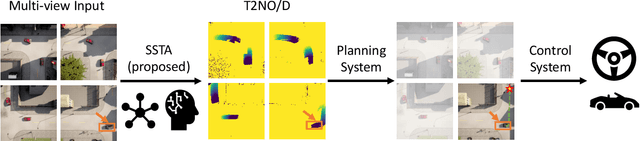
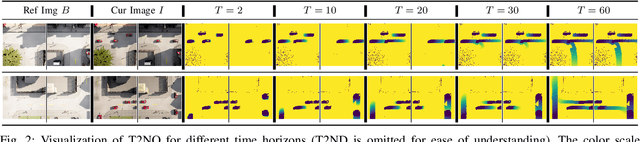
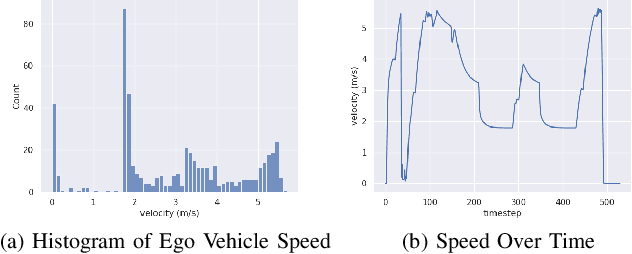
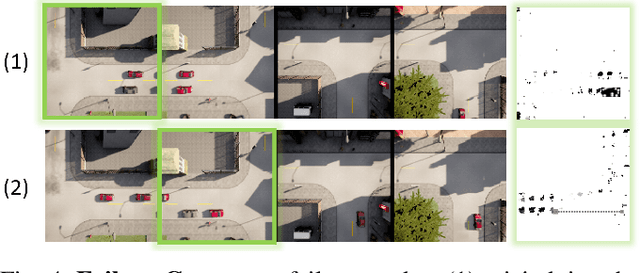
Connected autonomous vehicles (CAVs) promise to enhance safety, efficiency, and sustainability in urban transportation. However, this is contingent upon a CAV correctly predicting the motion of surrounding agents and planning its own motion safely. Doing so is challenging in complex urban environments due to frequent occlusions and interactions among many agents. One solution is to leverage smart infrastructure to augment a CAV's situational awareness; the present work leverages a recently proposed "Self-Supervised Traffic Advisor" (SSTA) framework of smart sensors that teach themselves to generate and broadcast useful video predictions of road users. In this work, SSTA predictions are modified to predict future occupancy instead of raw video, which reduces the data footprint of broadcast predictions. The resulting predictions are used within a planning framework, demonstrating that this design can effectively aid CAV motion planning. A variety of numerical experiments study the key factors that make SSTA outputs useful for practical CAV planning in crowded urban environments.
Graph-Based Model-Agnostic Data Subsampling for Recommendation Systems
May 25, 2023Data subsampling is widely used to speed up the training of large-scale recommendation systems. Most subsampling methods are model-based and often require a pre-trained pilot model to measure data importance via e.g. sample hardness. However, when the pilot model is misspecified, model-based subsampling methods deteriorate. Since model misspecification is persistent in real recommendation systems, we instead propose model-agnostic data subsampling methods by only exploring input data structure represented by graphs. Specifically, we study the topology of the user-item graph to estimate the importance of each user-item interaction (an edge in the user-item graph) via graph conductance, followed by a propagation step on the network to smooth out the estimated importance value. Since our proposed method is model-agnostic, we can marry the merits of both model-agnostic and model-based subsampling methods. Empirically, we show that combing the two consistently improves over any single method on the used datasets. Experimental results on KuaiRec and MIND datasets demonstrate that our proposed methods achieve superior results compared to baseline approaches.
Large AI Models in Health Informatics: Applications, Challenges, and the Future
Mar 21, 2023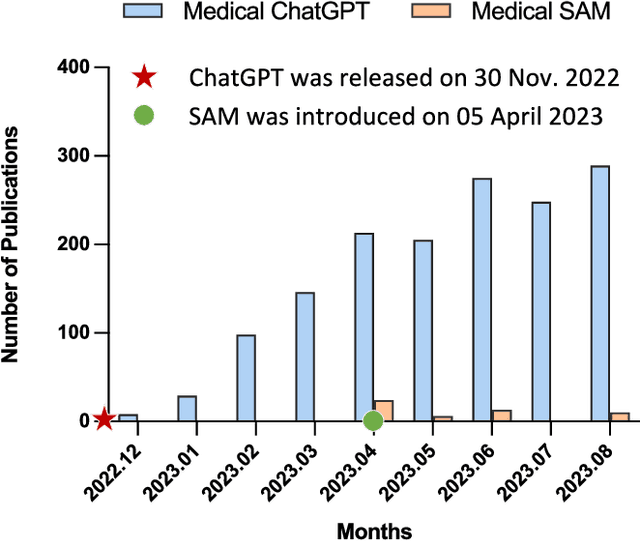
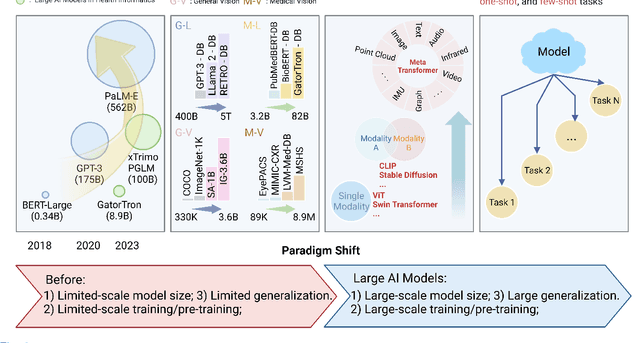
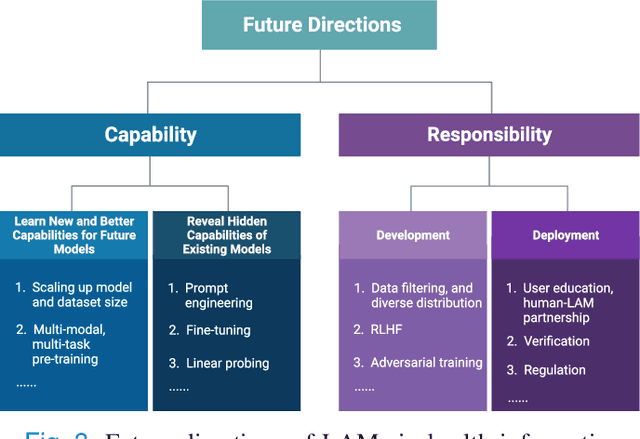
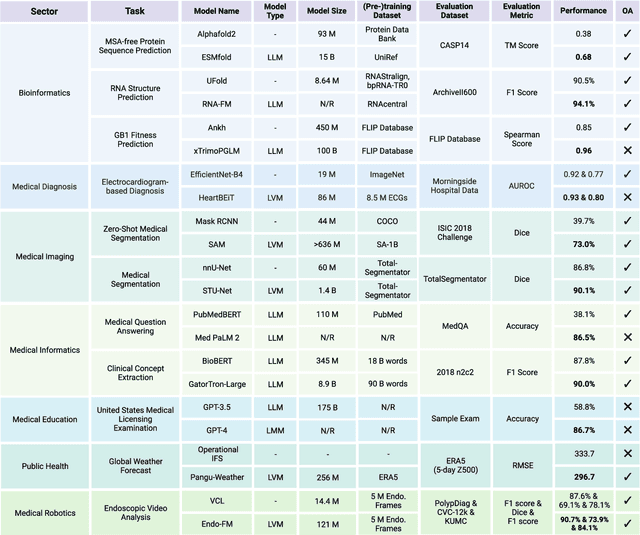
Large AI models, or foundation models, are models recently emerging with massive scales both parameter-wise and data-wise, the magnitudes of which often reach beyond billions. Once pretrained, large AI models demonstrate impressive performance in various downstream tasks. A concrete example is the recent debut of ChatGPT, whose capability has compelled people's imagination about the far-reaching influence that large AI models can have and their potential to transform different domains of our life. In health informatics, the advent of large AI models has brought new paradigms for the design of methodologies. The scale of multimodality data in the biomedical and health domain has been ever-expanding especially since the community embraced the era of deep learning, which provides the ground to develop, validate, and advance large AI models for breakthroughs in health-related areas. This article presents an up-to-date comprehensive review of large AI models, from background to their applications. We identify seven key sectors that large AI models are applicable and might have substantial influence, including 1) molecular biology and drug discovery; 2) medical diagnosis and decision-making; 3) medical imaging and vision; 4) medical informatics; 5) medical education; 6) public health; and 7) medical robotics. We examine their challenges in health informatics, followed by a critical discussion about potential future directions and pitfalls of large AI models in transforming the field of health informatics.
MimicPlay: Long-Horizon Imitation Learning by Watching Human Play
Feb 24, 2023
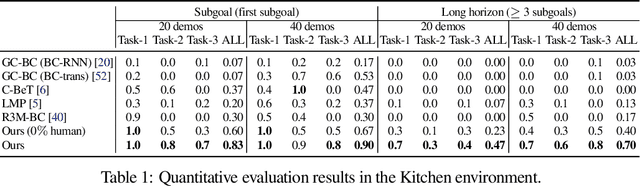
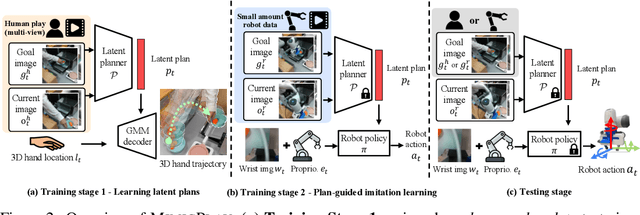
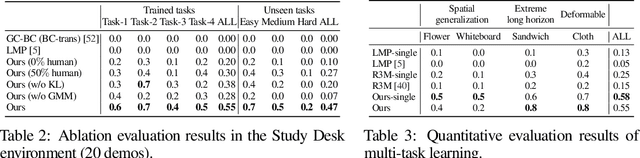
Imitation Learning from human demonstrations is a promising paradigm to teach robots manipulation skills in the real world, but learning complex long-horizon tasks often requires an unattainable amount of demonstrations. To reduce the high data requirement, we resort to human play data - video sequences of people freely interacting with the environment using their hands. We hypothesize that even with different morphologies, human play data contain rich and salient information about physical interactions that can readily facilitate robot policy learning. Motivated by this, we introduce a hierarchical learning framework named MimicPlay that learns latent plans from human play data to guide low-level visuomotor control trained on a small number of teleoperated demonstrations. With systematic evaluations of 14 long-horizon manipulation tasks in the real world, we show that MimicPlay dramatically outperforms state-of-the-art imitation learning methods in task success rate, generalization ability, and robustness to disturbances. More details and video results could be found at https://mimic-play.github.io
Netflix and Forget: Efficient and Exact Machine Unlearning from Bi-linear Recommendations
Feb 13, 2023People break up, miscarry, and lose loved ones. Their online streaming and shopping recommendations, however, do not necessarily update, and may serve as unhappy reminders of their loss. When users want to renege on their past actions, they expect the recommender platforms to erase selective data at the model level. Ideally, given any specified user history, the recommender can unwind or "forget", as if the record was not part of training. To that end, this paper focuses on simple but widely deployed bi-linear models for recommendations based on matrix completion. Without incurring the cost of re-training, and without degrading the model unnecessarily, we develop Unlearn-ALS by making a few key modifications to the fine-tuning procedure under Alternating Least Squares optimisation, thus applicable to any bi-linear models regardless of the training procedure. We show that Unlearn-ALS is consistent with retraining without \emph{any} model degradation and exhibits rapid convergence, making it suitable for a large class of existing recommenders.
Label Inference Attack against Split Learning under Regression Setting
Jan 18, 2023

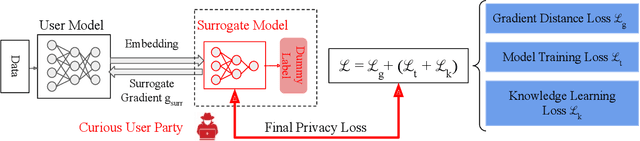

As a crucial building block in vertical Federated Learning (vFL), Split Learning (SL) has demonstrated its practice in the two-party model training collaboration, where one party holds the features of data samples and another party holds the corresponding labels. Such method is claimed to be private considering the shared information is only the embedding vectors and gradients instead of private raw data and labels. However, some recent works have shown that the private labels could be leaked by the gradients. These existing attack only works under the classification setting where the private labels are discrete. In this work, we step further to study the leakage in the scenario of the regression model, where the private labels are continuous numbers (instead of discrete labels in classification). This makes previous attacks harder to infer the continuous labels due to the unbounded output range. To address the limitation, we propose a novel learning-based attack that integrates gradient information and extra learning regularization objectives in aspects of model training properties, which can infer the labels under regression settings effectively. The comprehensive experiments on various datasets and models have demonstrated the effectiveness of our proposed attack. We hope our work can pave the way for future analyses that make the vFL framework more secure.
DGRec: Graph Neural Network for Recommendation with Diversified Embedding Generation
Nov 27, 2022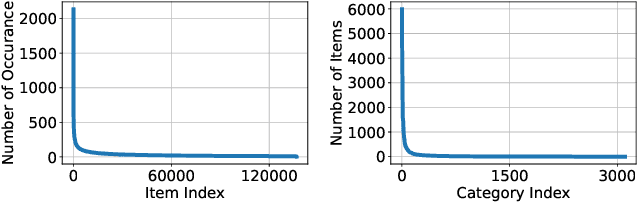
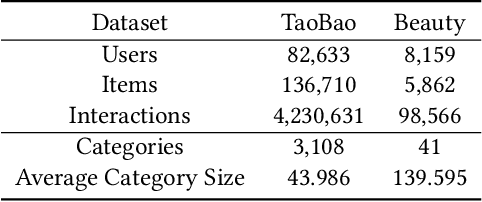

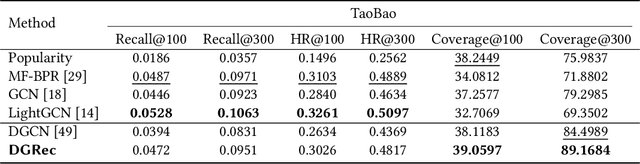
Graph Neural Network (GNN) based recommender systems have been attracting more and more attention in recent years due to their excellent performance in accuracy. Representing user-item interactions as a bipartite graph, a GNN model generates user and item representations by aggregating embeddings of their neighbors. However, such an aggregation procedure often accumulates information purely based on the graph structure, overlooking the redundancy of the aggregated neighbors and resulting in poor diversity of the recommended list. In this paper, we propose diversifying GNN-based recommender systems by directly improving the embedding generation procedure. Particularly, we utilize the following three modules: submodular neighbor selection to find a subset of diverse neighbors to aggregate for each GNN node, layer attention to assign attention weights for each layer, and loss reweighting to focus on the learning of items belonging to long-tail categories. Blending the three modules into GNN, we present DGRec(Diversified GNN-based Recommender System) for diversified recommendation. Experiments on real-world datasets demonstrate that the proposed method can achieve the best diversity while keeping the accuracy comparable to state-of-the-art GNN-based recommender systems.