 Add to Chrome
 Add to Firefox
 Add to Edge
MEDSYN: Benchmarking Multi-EviDence SYNthesis in Complex Clinical Cases for Multimodal Large Language Models
Feb 25, 2026
Multimodal large language models (MLLMs) have shown great potential in medical applications, yet existing benchmarks inadequately capture real-world clinical complexity. We introduce MEDSYN, a multilingual, multimodal benchmark of highly complex clinical cases with up to 7 distinct visual clinical evidence (CE) types per case. Mirroring clinical workflow, we evaluate 18 MLLMs on differential diagnosis (DDx) generation and final diagnosis (FDx) selection. While top models often match or even outperform human experts on DDx generation, all MLLMs exhibit a much larger DDx--FDx performance gap compared to expert clinicians, indicating a failure mode in synthesis of heterogeneous CE types. Ablations attribute this failure to (i) overreliance on less discriminative textual CE ($\it{e.g.}$, medical history) and (ii) a cross-modal CE utilization gap. We introduce Evidence Sensitivity to quantify the latter and show that a smaller gap correlates with higher diagnostic accuracy. Finally, we demonstrate how it can be used to guide interventions to improve model performance. We will open-source our benchmark and code.

Large AI Models in Health Informatics: Applications, Challenges, and the Future
Mar 21, 2023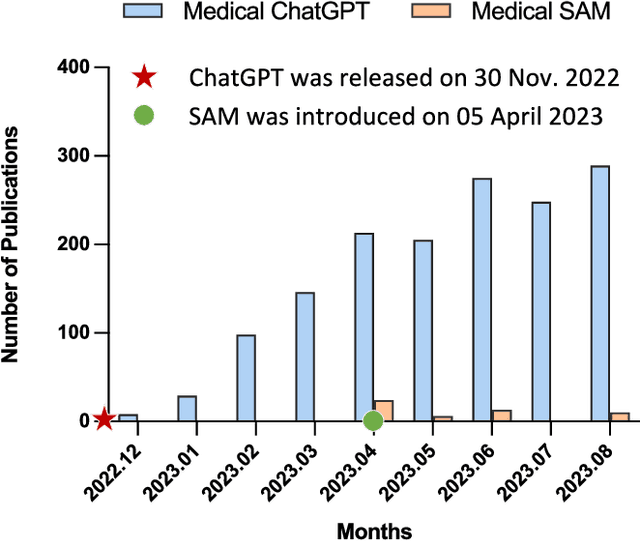
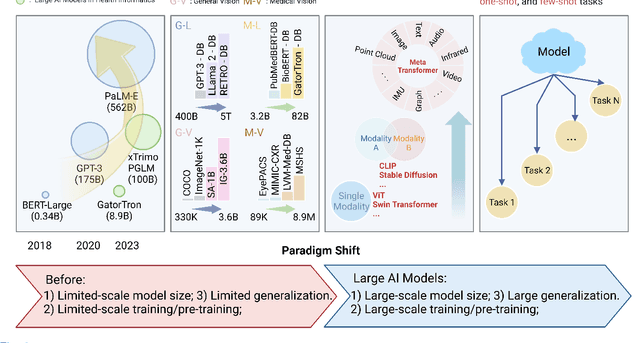
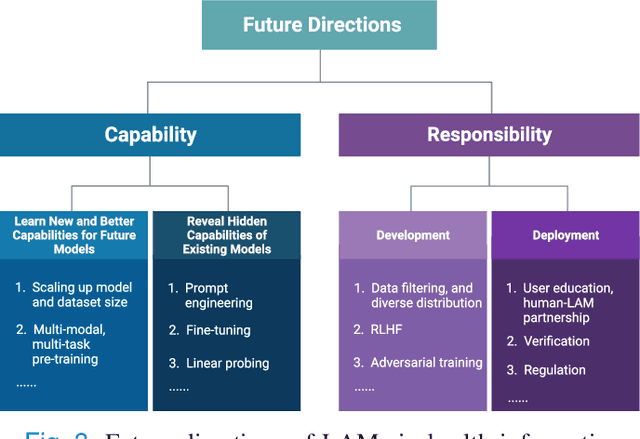
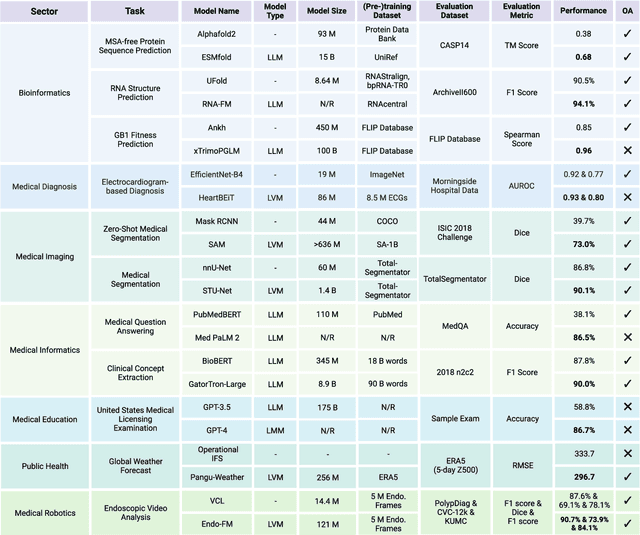
Large AI models, or foundation models, are models recently emerging with massive scales both parameter-wise and data-wise, the magnitudes of which often reach beyond billions. Once pretrained, large AI models demonstrate impressive performance in various downstream tasks. A concrete example is the recent debut of ChatGPT, whose capability has compelled people's imagination about the far-reaching influence that large AI models can have and their potential to transform different domains of our life. In health informatics, the advent of large AI models has brought new paradigms for the design of methodologies. The scale of multimodality data in the biomedical and health domain has been ever-expanding especially since the community embraced the era of deep learning, which provides the ground to develop, validate, and advance large AI models for breakthroughs in health-related areas. This article presents an up-to-date comprehensive review of large AI models, from background to their applications. We identify seven key sectors that large AI models are applicable and might have substantial influence, including 1) molecular biology and drug discovery; 2) medical diagnosis and decision-making; 3) medical imaging and vision; 4) medical informatics; 5) medical education; 6) public health; and 7) medical robotics. We examine their challenges in health informatics, followed by a critical discussion about potential future directions and pitfalls of large AI models in transforming the field of health informatics.