 Add to Chrome
 Add to Firefox
 Add to Edge
LoopFM: Learning frOm HistOrical RePresentations of Foundation Model for Recommendation
May 28, 2026
Knowledge distillation (KD) transfers a single scalar prediction from a large foundation model (FM) to compact vertical models (VMs), suffering from diminishing transfer ratio -- the fraction of FM improvement captured by the VM -- as a single scalar cannot convey the rich intermediate knowledge that larger FMs learn. To address this bottleneck, we propose LoopFM (Learning frOm HistOrical ReP*resentations of FM), a framework that opens a high-bandwidth transfer channel by structuring FM intermediate embeddings as input features (e.g., user history sequence) for downstream VMs, without requiring real-time FM inference at serving and architectural coupling between FM and VM. We provide a theoretical framework for LoopFM with a gain decomposition and transfer-ratio analysis. On three public benchmarks, LoopFM demonstrates strong AUC improvements (e.g., 6\%+ on TaobaoAd) and complementary knowledge transfer capability with KD. On industrial-scale systems (billions of examples, trillion-parameter FMs), LoopFM approximately doubles the knowledge transfer ratio on top of KD, delivering a +0.5\% conversion improvement in Y1H1, and a +1.03\% and +1.22\% conversion improvement from two individual launches respectively in Y1H2.

Chain-of-Models Pre-Training: Rethinking Training Acceleration of Vision Foundation Models
Apr 14, 2026In this paper, we present Chain-of-Models Pre-Training (CoM-PT), a novel performance-lossless training acceleration method for vision foundation models (VFMs). This approach fundamentally differs from existing acceleration methods in its core motivation: rather than optimizing each model individually, CoM-PT is designed to accelerate the training pipeline at the model family level, scaling efficiently as the model family expands. Specifically, CoM-PT establishes a pre-training sequence for the model family, arranged in ascending order of model size, called model chain. In this chain, only the smallest model undergoes standard individual pre-training, while the other models are efficiently trained through sequential inverse knowledge transfer from their smaller predecessors by jointly reusing the knowledge in the parameter space and the feature space. As a result, CoM-PT enables all models to achieve performance that is mostly superior to standard individual training while significantly reducing training cost, and this is extensively validated across 45 datasets spanning zero-shot and fine-tuning tasks. Notably, its efficient scaling property yields a remarkable phenomenon: training more models even results in higher efficiency. For instance, when pre-training on CC3M: i) given ViT-L as the largest model, progressively prepending smaller models to the model chain reduces computational complexity by up to 72%; ii) within a fixed model size range, as the VFM family scales across 3, 4, and 7 models, the acceleration ratio of CoM-PT exhibits a striking leap: from 4.13X to 5.68X and 7.09X. Since CoM-PT is naturally agnostic to specific pre-training paradigms, we open-source the code to spur further extensions in more computationally intensive scenarios, such as large language model pre-training.
Performance Characterization of Frequency-Selective Wireless Power Transfer Toward Scalable Untethered Magnetic Actuation
Apr 13, 2026Frequency-selective wireless power transfer provides a feasible route to enable independent actuation and control of multiple untethered robots in a common workspace; however, the scalability remains unquantified, particularly the maximum number of resonators that can be reliably addressed within a given frequency bandwidth. To address this, we formulate the relationship between resonator quality factor (Q-factor) and the number of individually addressable inductor-capacitor (LC) resonant energy harvesters within a fixed radio-frequency (RF) spectrum, and we convert selectively activated harvested energy into mechanical motion. We theoretically proved and experimentally demonstrated that scalability depends primarily on the Q-factor. For this proof-of-concept study, we define effective series resistance as a function of frequency allocating bandwidths to discrete actuators. We provide design equations for scaling untethered magnetic actuation with Q-factor optimization. Resonator networks spanning bandwidths from 100kHz to 1MHz were analyzed to quantify how increasing the number of resonators affects independent addressability. We validated the approach experimentally by fabricating three centimeter-scale untethered actuators that selectively trigger the motion of mechanical beams at 734kHz, 785kHz, and 855kHz. We also characterized the generated mechanical force and the activation bandwidth of each actuator, confirming that no unintended cross-triggering occurred.
Kunlun: Establishing Scaling Laws for Massive-Scale Recommendation Systems through Unified Architecture Design
Feb 13, 2026Deriving predictable scaling laws that govern the relationship between model performance and computational investment is crucial for designing and allocating resources in massive-scale recommendation systems. While such laws are established for large language models, they remain challenging for recommendation systems, especially those processing both user history and context features. We identify poor scaling efficiency as the main barrier to predictable power-law scaling, stemming from inefficient modules with low Model FLOPs Utilization (MFU) and suboptimal resource allocation. We introduce Kunlun, a scalable architecture that systematically improves model efficiency and resource allocation. Our low-level optimizations include Generalized Dot-Product Attention (GDPA), Hierarchical Seed Pooling (HSP), and Sliding Window Attention. Our high-level innovations feature Computation Skip (CompSkip) and Event-level Personalization. These advances increase MFU from 17% to 37% on NVIDIA B200 GPUs and double scaling efficiency over state-of-the-art methods. Kunlun is now deployed in major Meta Ads models, delivering significant production impact.
DTCCL: Disengagement-Triggered Contrastive Continual Learning for Autonomous Bus Planners
Dec 22, 2025Autonomous buses run on fixed routes but must operate in open, dynamic urban environments. Disengagement events on these routes are often geographically concentrated and typically arise from planner failures in highly interactive regions. Such policy-level failures are difficult to correct using conventional imitation learning, which easily overfits to sparse disengagement data. To address this issue, this paper presents a Disengagement-Triggered Contrastive Continual Learning (DTCCL) framework that enables autonomous buses to improve planning policies through real-world operation. Each disengagement triggers cloud-based data augmentation that generates positive and negative samples by perturbing surrounding agents while preserving route context. Contrastive learning refines policy representations to better distinguish safe and unsafe behaviors, and continual updates are applied in a cloud-edge loop without human supervision. Experiments on urban bus routes demonstrate that DTCCL improves overall planning performance by 48.6 percent compared with direct retraining, validating its effectiveness for scalable, closed-loop policy improvement in autonomous public transport.
Seeing the Invisible: Machine learning-Based QPI Kernel Extraction via Latent Alignment
Jun 05, 2025Quasiparticle interference (QPI) imaging is a powerful tool for probing electronic structures in quantum materials, but extracting the single-scatterer QPI pattern (i.e., the kernel) from a multi-scatterer image remains a fundamentally ill-posed inverse problem. In this work, we propose the first AI-based framework for QPI kernel extraction. We introduce a two-step learning strategy that decouples kernel representation learning from observation-to-kernel inference. In the first step, we train a variational autoencoder to learn a compact latent space of scattering kernels. In the second step, we align the latent representation of QPI observations with those of the pre-learned kernels using a dedicated encoder. This design enables the model to infer kernels robustly even under complex, entangled scattering conditions. We construct a diverse and physically realistic QPI dataset comprising 100 unique kernels and evaluate our method against a direct one-step baseline. Experimental results demonstrate that our approach achieves significantly higher extraction accuracy, and improved generalization to unseen kernels.
Training Large Recommendation Models via Graph-Language Token Alignment
Feb 26, 2025


Recommender systems (RS) have become essential tools for helping users efficiently navigate the overwhelming amount of information on e-commerce and social platforms. However, traditional RS relying on Collaborative Filtering (CF) struggles to integrate the rich semantic information from textual data. Meanwhile, large language models (LLMs) have shown promising results in natural language processing, but directly using LLMs for recommendation introduces challenges, such as ambiguity in generating item predictions and inefficiencies in scalability. In this paper, we propose a novel framework to train Large Recommendation models via Graph-Language Token Alignment. By aligning item and user nodes from the interaction graph with pretrained LLM tokens, GLTA effectively leverages the reasoning abilities of LLMs. Furthermore, we introduce Graph-Language Logits Matching (GLLM) to optimize token alignment for end-to-end item prediction, eliminating ambiguity in the free-form text as recommendation results. Extensive experiments on three benchmark datasets demonstrate the effectiveness of GLTA, with ablation studies validating each component.
Robust density estimation over star-shaped density classes
Jan 17, 2025We establish a novel criterion for comparing the performance of two densities, $g_1$ and $g_2$, within the context of corrupted data. Utilizing this criterion, we propose an algorithm to construct a density estimator within a star-shaped density class, $\mathcal{F}$, under conditions of data corruption. We proceed to derive the minimax upper and lower bounds for density estimation across this star-shaped density class, characterized by densities that are uniformly bounded above and below (in the sup norm), in the presence of adversarially corrupted data. Specifically, we assume that a fraction $\epsilon \leq \frac{1}{3}$ of the $N$ observations are arbitrarily corrupted. We obtain the minimax upper bound $\max\{ \tau_{\overline{J}}^2, \epsilon \} \wedge d^2$. Under certain conditions, we obtain the minimax risk, up to proportionality constants, under the squared $L_2$ loss as $$ \max\left\{ \tau^{*2} \wedge d^2, \epsilon \wedge d^2 \right\}, $$ where $\tau^* := \sup\left\{ \tau : N\tau^2 \leq \log \mathcal{M}_{\mathcal{F}}^{\text{loc}}(\tau, c) \right\}$ for a sufficiently large constant $c$. Here, $\mathcal{M}_{\mathcal{F}}^{\text{loc}}(\tau, c)$ denotes the local entropy of the set $\mathcal{F}$, and $d$ is the $L_2$ diameter of $\mathcal{F}$.
Reverse Region-to-Entity Annotation for Pixel-Level Visual Entity Linking
Dec 18, 2024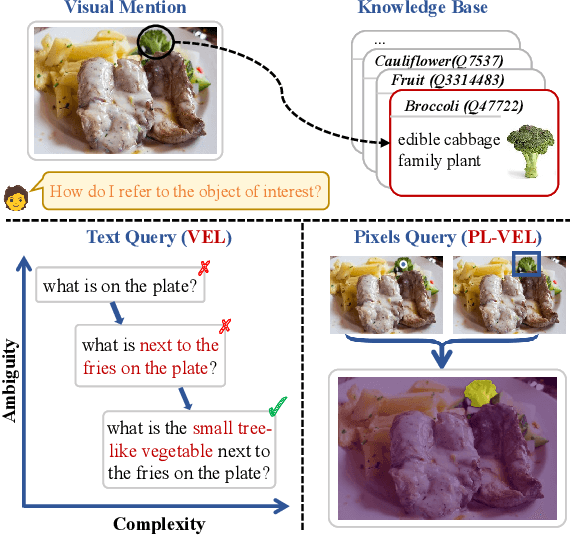
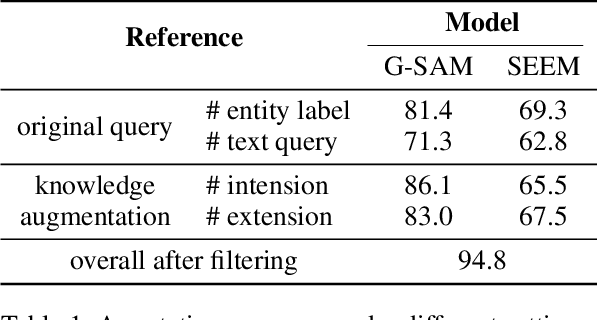
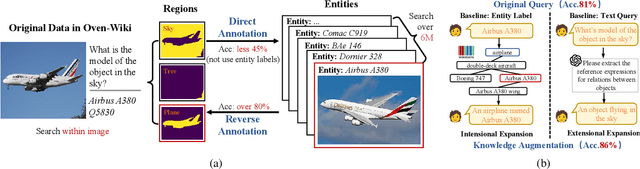
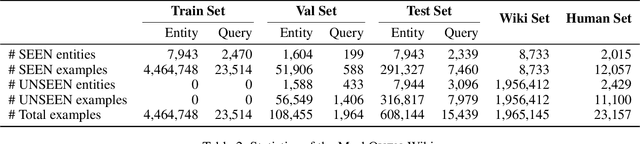
Visual Entity Linking (VEL) is a crucial task for achieving fine-grained visual understanding, matching objects within images (visual mentions) to entities in a knowledge base. Previous VEL tasks rely on textual inputs, but writing queries for complex scenes can be challenging. Visual inputs like clicks or bounding boxes offer a more convenient alternative. Therefore, we propose a new task, Pixel-Level Visual Entity Linking (PL-VEL), which uses pixel masks from visual inputs to refer to objects, supplementing reference methods for VEL. To facilitate research on this task, we have constructed the MaskOVEN-Wiki dataset through an entirely automatic reverse region-entity annotation framework. This dataset contains over 5 million annotations aligning pixel-level regions with entity-level labels, which will advance visual understanding towards fine-grained. Moreover, as pixel masks correspond to semantic regions in an image, we enhance previous patch-interacted attention with region-interacted attention by a visual semantic tokenization approach. Manual evaluation results indicate that the reverse annotation framework achieved a 94.8% annotation success rate. Experimental results show that models trained on this dataset improved accuracy by 18 points compared to zero-shot models. Additionally, the semantic tokenization method achieved a 5-point accuracy improvement over the trained baseline.
A Collaborative Ensemble Framework for CTR Prediction
Nov 20, 2024


Recent advances in foundation models have established scaling laws that enable the development of larger models to achieve enhanced performance, motivating extensive research into large-scale recommendation models. However, simply increasing the model size in recommendation systems, even with large amounts of data, does not always result in the expected performance improvements. In this paper, we propose a novel framework, Collaborative Ensemble Training Network (CETNet), to leverage multiple distinct models, each with its own embedding table, to capture unique feature interaction patterns. Unlike naive model scaling, our approach emphasizes diversity and collaboration through collaborative learning, where models iteratively refine their predictions. To dynamically balance contributions from each model, we introduce a confidence-based fusion mechanism using general softmax, where model confidence is computed via negation entropy. This design ensures that more confident models have a greater influence on the final prediction while benefiting from the complementary strengths of other models. We validate our framework on three public datasets (AmazonElectronics, TaobaoAds, and KuaiVideo) as well as a large-scale industrial dataset from Meta, demonstrating its superior performance over individual models and state-of-the-art baselines. Additionally, we conduct further experiments on the Criteo and Avazu datasets to compare our method with the multi-embedding paradigm. Our results show that our framework achieves comparable or better performance with smaller embedding sizes, offering a scalable and efficient solution for CTR prediction tasks.