 Add to Chrome
 Add to Firefox
 Add to Edge
GeomVerse: A Systematic Evaluation of Large Models for Geometric Reasoning
Dec 19, 2023
Large language models have shown impressive results for multi-hop mathematical reasoning when the input question is only textual. Many mathematical reasoning problems, however, contain both text and image. With the ever-increasing adoption of vision language models (VLMs), understanding their reasoning abilities for such problems is crucial. In this paper, we evaluate the reasoning capabilities of VLMs along various axes through the lens of geometry problems. We procedurally create a synthetic dataset of geometry questions with controllable difficulty levels along multiple axes, thus enabling a systematic evaluation. The empirical results obtained using our benchmark for state-of-the-art VLMs indicate that these models are not as capable in subjects like geometry (and, by generalization, other topics requiring similar reasoning) as suggested by previous benchmarks. This is made especially clear by the construction of our benchmark at various depth levels, since solving higher-depth problems requires long chains of reasoning rather than additional memorized knowledge. We release the dataset for further research in this area.

Omni-SMoLA: Boosting Generalist Multimodal Models with Soft Mixture of Low-rank Experts
Dec 01, 2023Large multi-modal models (LMMs) exhibit remarkable performance across numerous tasks. However, generalist LMMs often suffer from performance degradation when tuned over a large collection of tasks. Recent research suggests that Mixture of Experts (MoE) architectures are useful for instruction tuning, but for LMMs of parameter size around O(50-100B), the prohibitive cost of replicating and storing the expert models severely limits the number of experts we can use. We propose Omni-SMoLA, an architecture that uses the Soft MoE approach to (softly) mix many multimodal low rank experts, and avoids introducing a significant number of new parameters compared to conventional MoE models. The core intuition here is that the large model provides a foundational backbone, while different lightweight experts residually learn specialized knowledge, either per-modality or multimodally. Extensive experiments demonstrate that the SMoLA approach helps improve the generalist performance across a broad range of generative vision-and-language tasks, achieving new SoTA generalist performance that often matches or outperforms single specialized LMM baselines, as well as new SoTA specialist performance.
Non-Intrusive Adaptation: Input-Centric Parameter-efficient Fine-Tuning for Versatile Multimodal Modeling
Oct 18, 2023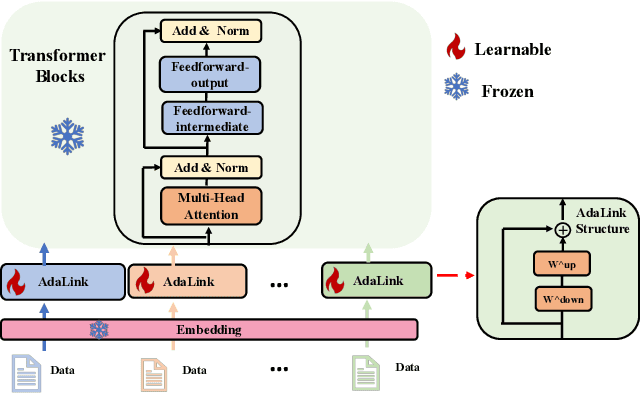

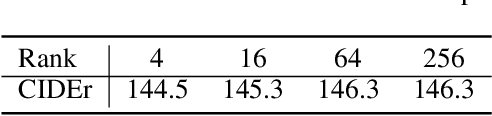

Large language models (LLMs) and vision language models (VLMs) demonstrate excellent performance on a wide range of tasks by scaling up parameter counts from O(10^9) to O(10^{12}) levels and further beyond. These large scales make it impossible to adapt and deploy fully specialized models given a task of interest. Parameter-efficient fine-tuning (PEFT) emerges as a promising direction to tackle the adaptation and serving challenges for such large models. We categorize PEFT techniques into two types: intrusive and non-intrusive. Intrusive PEFT techniques directly change a model's internal architecture. Though more flexible, they introduce significant complexities for training and serving. Non-intrusive PEFT techniques leave the internal architecture unchanged and only adapt model-external parameters, such as embeddings for input. In this work, we describe AdaLink as a non-intrusive PEFT technique that achieves competitive performance compared to SoTA intrusive PEFT (LoRA) and full model fine-tuning (FT) on various tasks. We evaluate using both text-only and multimodal tasks, with experiments that account for both parameter-count scaling and training regime (with and without instruction tuning).
PaLI-3 Vision Language Models: Smaller, Faster, Stronger
Oct 17, 2023


This paper presents PaLI-3, a smaller, faster, and stronger vision language model (VLM) that compares favorably to similar models that are 10x larger. As part of arriving at this strong performance, we compare Vision Transformer (ViT) models pretrained using classification objectives to contrastively (SigLIP) pretrained ones. We find that, while slightly underperforming on standard image classification benchmarks, SigLIP-based PaLI shows superior performance across various multimodal benchmarks, especially on localization and visually-situated text understanding. We scale the SigLIP image encoder up to 2 billion parameters, and achieves a new state-of-the-art on multilingual cross-modal retrieval. We hope that PaLI-3, at only 5B parameters, rekindles research on fundamental pieces of complex VLMs, and could fuel a new generation of scaled-up models.
Open X-Embodiment: Robotic Learning Datasets and RT-X Models
Oct 17, 2023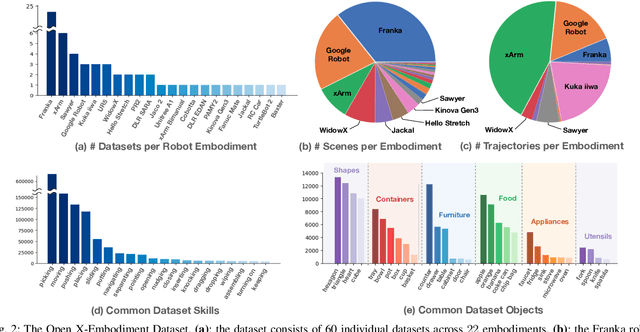
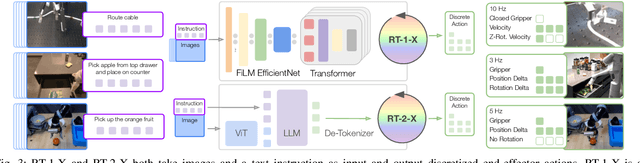


Large, high-capacity models trained on diverse datasets have shown remarkable successes on efficiently tackling downstream applications. In domains from NLP to Computer Vision, this has led to a consolidation of pretrained models, with general pretrained backbones serving as a starting point for many applications. Can such a consolidation happen in robotics? Conventionally, robotic learning methods train a separate model for every application, every robot, and even every environment. Can we instead train generalist X-robot policy that can be adapted efficiently to new robots, tasks, and environments? In this paper, we provide datasets in standardized data formats and models to make it possible to explore this possibility in the context of robotic manipulation, alongside experimental results that provide an example of effective X-robot policies. We assemble a dataset from 22 different robots collected through a collaboration between 21 institutions, demonstrating 527 skills (160266 tasks). We show that a high-capacity model trained on this data, which we call RT-X, exhibits positive transfer and improves the capabilities of multiple robots by leveraging experience from other platforms. More details can be found on the project website $\href{https://robotics-transformer-x.github.io}{\text{robotics-transformer-x.github.io}}$.
CausalLM is not optimal for in-context learning
Sep 03, 2023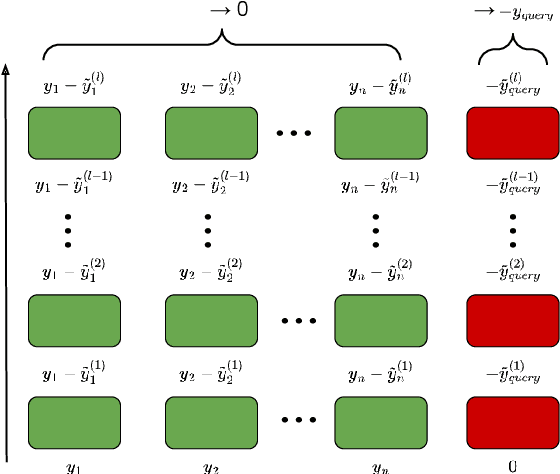
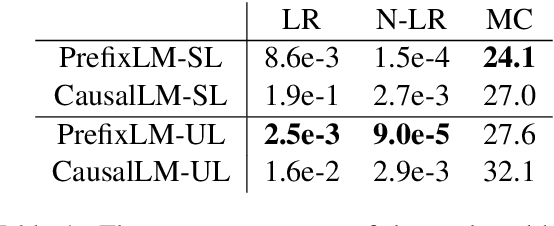
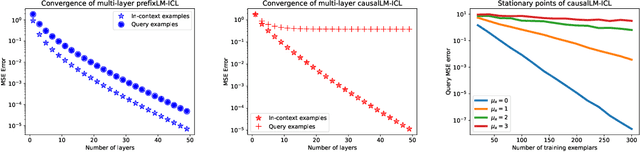
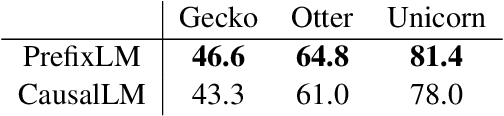
Recent empirical evidence indicates that transformer based in-context learning performs better when using a prefix language model (prefixLM), in which in-context samples can all attend to each other, compared to causal language models (causalLM), which use auto-regressive attention that prohibits in-context samples to attend to future samples. While this result is intuitive, it is not understood from a theoretical perspective. In this paper we take a theoretical approach and analyze the convergence behavior of prefixLM and causalLM under a certain parameter construction. Our analysis shows that both LM types converge to their stationary points at a linear rate, but that while prefixLM converges to the optimal solution of linear regression, causalLM convergence dynamics follows that of an online gradient descent algorithm, which is not guaranteed to be optimal even as the number of samples grows infinitely. We supplement our theoretical claims with empirical experiments over synthetic and real tasks and using various types of transformers. Our experiments verify that causalLM consistently underperforms prefixLM in all settings.
RT-2: Vision-Language-Action Models Transfer Web Knowledge to Robotic Control
Jul 28, 2023We study how vision-language models trained on Internet-scale data can be incorporated directly into end-to-end robotic control to boost generalization and enable emergent semantic reasoning. Our goal is to enable a single end-to-end trained model to both learn to map robot observations to actions and enjoy the benefits of large-scale pretraining on language and vision-language data from the web. To this end, we propose to co-fine-tune state-of-the-art vision-language models on both robotic trajectory data and Internet-scale vision-language tasks, such as visual question answering. In contrast to other approaches, we propose a simple, general recipe to achieve this goal: in order to fit both natural language responses and robotic actions into the same format, we express the actions as text tokens and incorporate them directly into the training set of the model in the same way as natural language tokens. We refer to such category of models as vision-language-action models (VLA) and instantiate an example of such a model, which we call RT-2. Our extensive evaluation (6k evaluation trials) shows that our approach leads to performant robotic policies and enables RT-2 to obtain a range of emergent capabilities from Internet-scale training. This includes significantly improved generalization to novel objects, the ability to interpret commands not present in the robot training data (such as placing an object onto a particular number or icon), and the ability to perform rudimentary reasoning in response to user commands (such as picking up the smallest or largest object, or the one closest to another object). We further show that incorporating chain of thought reasoning allows RT-2 to perform multi-stage semantic reasoning, for example figuring out which object to pick up for use as an improvised hammer (a rock), or which type of drink is best suited for someone who is tired (an energy drink).
PaLI-X: On Scaling up a Multilingual Vision and Language Model
May 29, 2023


We present the training recipe and results of scaling up PaLI-X, a multilingual vision and language model, both in terms of size of the components and the breadth of its training task mixture. Our model achieves new levels of performance on a wide-range of varied and complex tasks, including multiple image-based captioning and question-answering tasks, image-based document understanding and few-shot (in-context) learning, as well as object detection, video question answering, and video captioning. PaLI-X advances the state-of-the-art on most vision-and-language benchmarks considered (25+ of them). Finally, we observe emerging capabilities, such as complex counting and multilingual object detection, tasks that are not explicitly in the training mix.
Entity-Focused Dense Passage Retrieval for Outside-Knowledge Visual Question Answering
Oct 18, 2022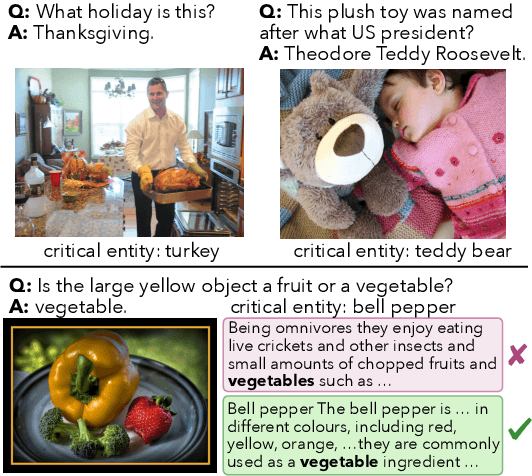
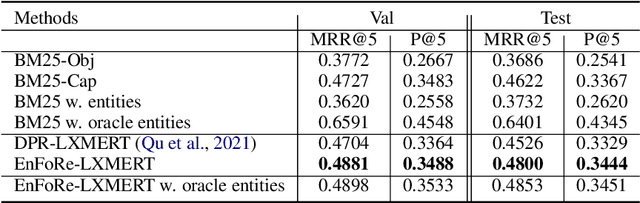
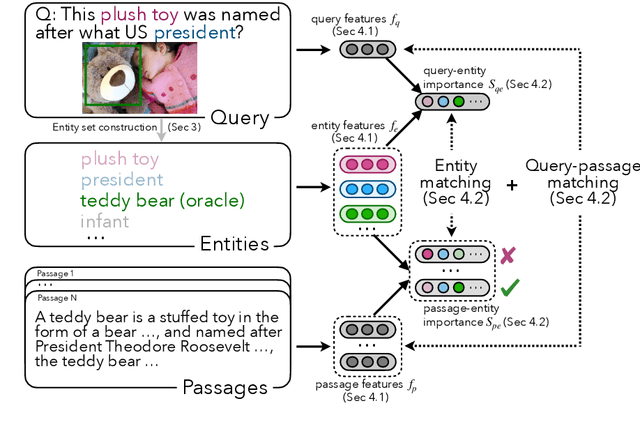
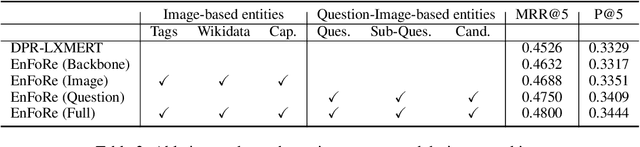
Most Outside-Knowledge Visual Question Answering (OK-VQA) systems employ a two-stage framework that first retrieves external knowledge given the visual question and then predicts the answer based on the retrieved content. However, the retrieved knowledge is often inadequate. Retrievals are frequently too general and fail to cover specific knowledge needed to answer the question. Also, the naturally available supervision (whether the passage contains the correct answer) is weak and does not guarantee question relevancy. To address these issues, we propose an Entity-Focused Retrieval (EnFoRe) model that provides stronger supervision during training and recognizes question-relevant entities to help retrieve more specific knowledge. Experiments show that our EnFoRe model achieves superior retrieval performance on OK-VQA, the currently largest outside-knowledge VQA dataset. We also combine the retrieved knowledge with state-of-the-art VQA models, and achieve a new state-of-the-art performance on OK-VQA.
Multi-Modal Answer Validation for Knowledge-Based VQA
Mar 23, 2021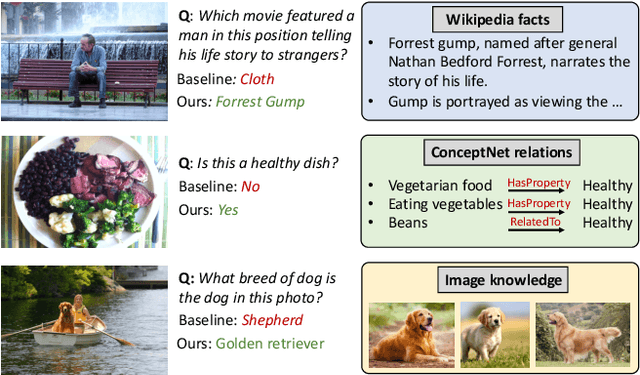
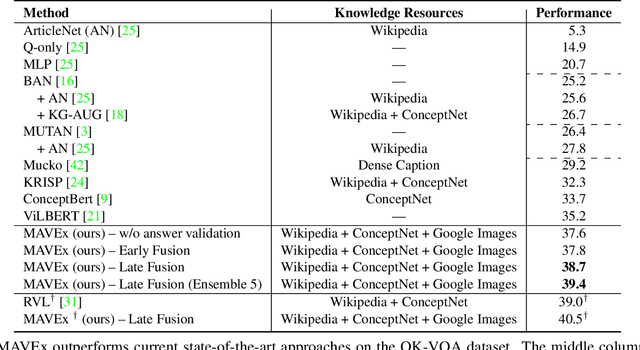
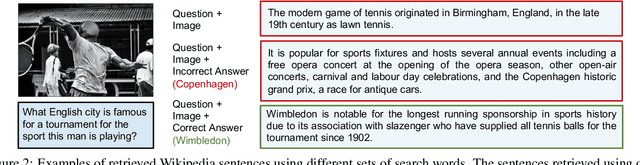
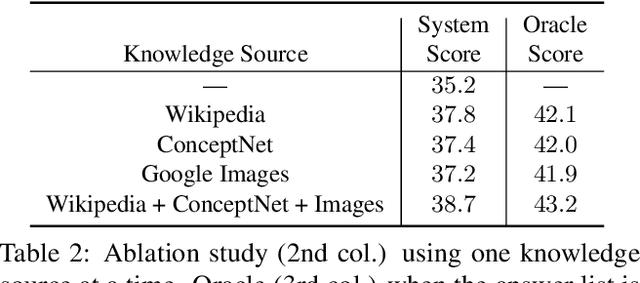
The problem of knowledge-based visual question answering involves answering questions that require external knowledge in addition to the content of the image. Such knowledge typically comes in a variety of forms, including visual, textual, and commonsense knowledge. The use of more knowledge sources, however, also increases the chance of retrieving more irrelevant or noisy facts, making it difficult to comprehend the facts and find the answer. To address this challenge, we propose Multi-modal Answer Validation using External knowledge (MAVEx), where the idea is to validate a set of promising answer candidates based on answer-specific knowledge retrieval. This is in contrast to existing approaches that search for the answer in a vast collection of often irrelevant facts. Our approach aims to learn which knowledge source should be trusted for each answer candidate and how to validate the candidate using that source. We consider a multi-modal setting, relying on both textual and visual knowledge resources, including images searched using Google, sentences from Wikipedia articles, and concepts from ConceptNet. Our experiments with OK-VQA, a challenging knowledge-based VQA dataset, demonstrate that MAVEx achieves new state-of-the-art results.