 Add to Chrome
 Add to Firefox
 Add to Edge
Temporal Human Motion Composition
Papers and Code
UniMotion: A Unified Framework for Motion-Text-Vision Understanding and Generation
Mar 23, 2026
We present UniMotion, to our knowledge the first unified framework for simultaneous understanding and generation of human motion, natural language, and RGB images within a single architecture. Existing unified models handle only restricted modality subsets (e.g., Motion-Text or static Pose-Image) and predominantly rely on discrete tokenization, which introduces quantization errors and disrupts temporal continuity. UniMotion overcomes both limitations through a core principle: treating motion as a first-class continuous modality on equal footing with RGB. A novel Cross-Modal Aligned Motion VAE (CMA-VAE) and symmetric dual-path embedders construct parallel continuous pathways for Motion and RGB within a shared LLM backbone. To inject visual-semantic priors into motion representations without requiring images at inference, we propose Dual-Posterior KL Alignment (DPA), which distills a vision-fused encoder's richer posterior into the motion-only encoder. To address the cold-start problem -- where text supervision alone is too sparse to calibrate the newly introduced motion pathway -- we further propose Latent Reconstruction Alignment (LRA), a self-supervised pre-training strategy that uses dense motion latents as unambiguous conditions to co-calibrate the embedder, backbone, and flow head, establishing a stable motion-aware foundation for all downstream tasks. UniMotion achieves state-of-the-art performance across seven tasks spanning any-to-any understanding, generation, and editing among the three modalities, with especially strong advantages on cross-modal compositional tasks.

UMO: Unified In-Context Learning Unlocks Motion Foundation Model Priors
Mar 16, 2026Large-scale foundation models (LFMs) have recently made impressive progress in text-to-motion generation by learning strong generative priors from massive 3D human motion datasets and paired text descriptions. However, how to effectively and efficiently leverage such single-purpose motion LFMs, i.e., text-to-motion synthesis, in more diverse cross-modal and in-context motion generation downstream tasks remains largely unclear. Prior work typically adapts pretrained generative priors to individual downstream tasks in a task-specific manner. In contrast, our goal is to unlock such priors to support a broad spectrum of downstream motion generation tasks within a single unified framework. To bridge this gap, we present UMO, a simple yet general unified formulation that casts diverse downstream tasks into compositions of atomic per-frame operations, enabling in-context adaptation to unlock the generative priors of pretrained DiT-based motion LFMs. Specifically, UMO introduces three learnable frame-level meta-operation embeddings to specify per-frame intent and employs lightweight temporal fusion to inject in-context cues into the pretrained backbone, with negligible runtime overhead compared to the base model. With this design, UMO finetunes the pretrained model, originally limited to text-to-motion generation, to support diverse previously unsupported tasks, including temporal inpainting, text-guided motion editing, text-serialized geometric constraints, and multi-identity reaction generation. Experiments demonstrate that UMO consistently outperforms task-specific and training-free baselines across a wide range of benchmarks, despite using a single unified model. Code and model will be publicly available. Project Page: https://oliver-cong02.github.io/UMO.github.io/
FrankenMotion: Part-level Human Motion Generation and Composition
Jan 15, 2026Human motion generation from text prompts has made remarkable progress in recent years. However, existing methods primarily rely on either sequence-level or action-level descriptions due to the absence of fine-grained, part-level motion annotations. This limits their controllability over individual body parts. In this work, we construct a high-quality motion dataset with atomic, temporally-aware part-level text annotations, leveraging the reasoning capabilities of large language models (LLMs). Unlike prior datasets that either provide synchronized part captions with fixed time segments or rely solely on global sequence labels, our dataset captures asynchronous and semantically distinct part movements at fine temporal resolution. Based on this dataset, we introduce a diffusion-based part-aware motion generation framework, namely FrankenMotion, where each body part is guided by its own temporally-structured textual prompt. This is, to our knowledge, the first work to provide atomic, temporally-aware part-level motion annotations and have a model that allows motion generation with both spatial (body part) and temporal (atomic action) control. Experiments demonstrate that FrankenMotion outperforms all previous baseline models adapted and retrained for our setting, and our model can compose motions unseen during training. Our code and dataset will be publicly available upon publication.
Tuning-free Visual Effect Transfer across Videos
Jan 13, 2026We present RefVFX, a new framework that transfers complex temporal effects from a reference video onto a target video or image in a feed-forward manner. While existing methods excel at prompt-based or keyframe-conditioned editing, they struggle with dynamic temporal effects such as dynamic lighting changes or character transformations, which are difficult to describe via text or static conditions. Transferring a video effect is challenging, as the model must integrate the new temporal dynamics with the input video's existing motion and appearance. % To address this, we introduce a large-scale dataset of triplets, where each triplet consists of a reference effect video, an input image or video, and a corresponding output video depicting the transferred effect. Creating this data is non-trivial, especially the video-to-video effect triplets, which do not exist naturally. To generate these, we propose a scalable automated pipeline that creates high-quality paired videos designed to preserve the input's motion and structure while transforming it based on some fixed, repeatable effect. We then augment this data with image-to-video effects derived from LoRA adapters and code-based temporal effects generated through programmatic composition. Building on our new dataset, we train our reference-conditioned model using recent text-to-video backbones. Experimental results demonstrate that RefVFX produces visually consistent and temporally coherent edits, generalizes across unseen effect categories, and outperforms prompt-only baselines in both quantitative metrics and human preference. See our website https://tuningfreevisualeffects-maker.github.io/Tuning-free-Visual-Effect-Transfer-across-Videos-Project-Page/
Interact2Ar: Full-Body Human-Human Interaction Generation via Autoregressive Diffusion Models
Dec 22, 2025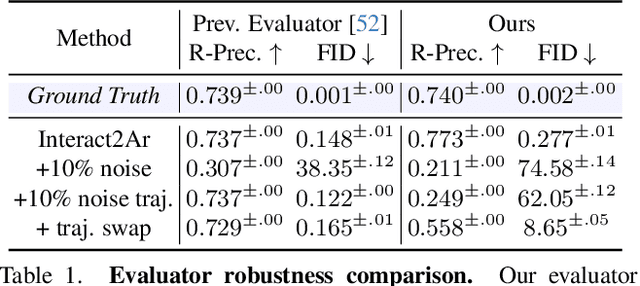
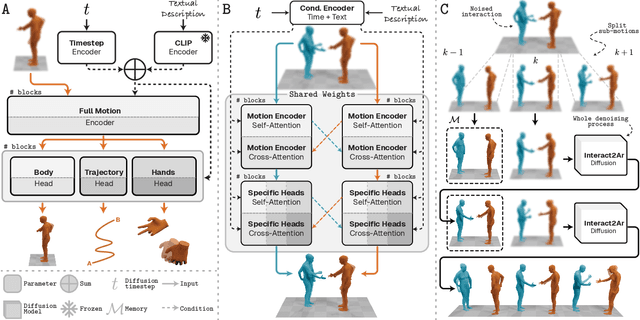
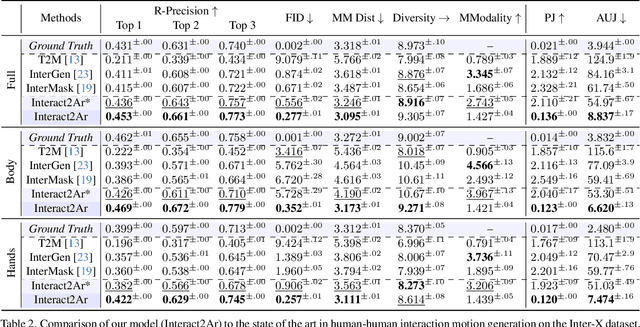
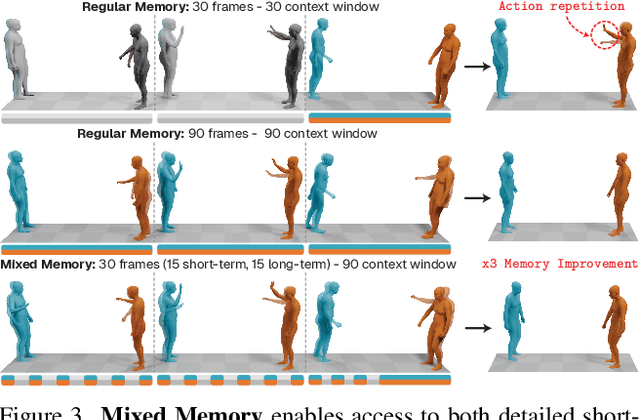
Generating realistic human-human interactions is a challenging task that requires not only high-quality individual body and hand motions, but also coherent coordination among all interactants. Due to limitations in available data and increased learning complexity, previous methods tend to ignore hand motions, limiting the realism and expressivity of the interactions. Additionally, current diffusion-based approaches generate entire motion sequences simultaneously, limiting their ability to capture the reactive and adaptive nature of human interactions. To address these limitations, we introduce Interact2Ar, the first end-to-end text-conditioned autoregressive diffusion model for generating full-body, human-human interactions. Interact2Ar incorporates detailed hand kinematics through dedicated parallel branches, enabling high-fidelity full-body generation. Furthermore, we introduce an autoregressive pipeline coupled with a novel memory technique that facilitates adaptation to the inherent variability of human interactions using efficient large context windows. The adaptability of our model enables a series of downstream applications, including temporal motion composition, real-time adaptation to disturbances, and extension beyond dyadic to multi-person scenarios. To validate the generated motions, we introduce a set of robust evaluators and extended metrics designed specifically for assessing full-body interactions. Through quantitative and qualitative experiments, we demonstrate the state-of-the-art performance of Interact2Ar.
Visual Grounding from Event Cameras
Sep 11, 2025Event cameras capture changes in brightness with microsecond precision and remain reliable under motion blur and challenging illumination, offering clear advantages for modeling highly dynamic scenes. Yet, their integration with natural language understanding has received little attention, leaving a gap in multimodal perception. To address this, we introduce Talk2Event, the first large-scale benchmark for language-driven object grounding using event data. Built on real-world driving scenarios, Talk2Event comprises 5,567 scenes, 13,458 annotated objects, and more than 30,000 carefully validated referring expressions. Each expression is enriched with four structured attributes -- appearance, status, relation to the viewer, and relation to surrounding objects -- that explicitly capture spatial, temporal, and relational cues. This attribute-centric design supports interpretable and compositional grounding, enabling analysis that moves beyond simple object recognition to contextual reasoning in dynamic environments. We envision Talk2Event as a foundation for advancing multimodal and temporally-aware perception, with applications spanning robotics, human-AI interaction, and so on.
Spatial-Temporal Multi-Scale Quantization for Flexible Motion Generation
Aug 12, 2025Despite significant advancements in human motion generation, current motion representations, typically formulated as discrete frame sequences, still face two critical limitations: (i) they fail to capture motion from a multi-scale perspective, limiting the capability in complex patterns modeling; (ii) they lack compositional flexibility, which is crucial for model's generalization in diverse generation tasks. To address these challenges, we introduce MSQ, a novel quantization method that compresses the motion sequence into multi-scale discrete tokens across spatial and temporal dimensions. MSQ employs distinct encoders to capture body parts at varying spatial granularities and temporally interpolates the encoded features into multiple scales before quantizing them into discrete tokens. Building on this representation, we establish a generative mask modeling model to effectively support motion editing, motion control, and conditional motion generation. Through quantitative and qualitative analysis, we show that our quantization method enables the seamless composition of motion tokens without requiring specialized design or re-training. Furthermore, extensive evaluations demonstrate that our approach outperforms existing baseline methods on various benchmarks.
Motion-R1: Chain-of-Thought Reasoning and Reinforcement Learning for Human Motion Generation
Jun 12, 2025Recent advances in large language models, especially in natural language understanding and reasoning, have opened new possibilities for text-to-motion generation. Although existing approaches have made notable progress in semantic alignment and motion synthesis, they often rely on end-to-end mapping strategies that fail to capture deep linguistic structures and logical reasoning. Consequently, generated motions tend to lack controllability, consistency, and diversity. To address these limitations, we propose Motion-R1, a unified motion-language modeling framework that integrates a Chain-of-Thought mechanism. By explicitly decomposing complex textual instructions into logically structured action paths, Motion-R1 provides high-level semantic guidance for motion generation, significantly enhancing the model's ability to interpret and execute multi-step, long-horizon, and compositionally rich commands. To train our model, we adopt Group Relative Policy Optimization, a reinforcement learning algorithm designed for large models, which leverages motion quality feedback to optimize reasoning chains and motion synthesis jointly. Extensive experiments across multiple benchmark datasets demonstrate that Motion-R1 achieves competitive or superior performance compared to state-of-the-art methods, particularly in scenarios requiring nuanced semantic understanding and long-term temporal coherence. The code, model and data will be publicly available.
Dynamic Motion Blending for Versatile Motion Editing
Mar 26, 2025Text-guided motion editing enables high-level semantic control and iterative modifications beyond traditional keyframe animation. Existing methods rely on limited pre-collected training triplets, which severely hinders their versatility in diverse editing scenarios. We introduce MotionCutMix, an online data augmentation technique that dynamically generates training triplets by blending body part motions based on input text. While MotionCutMix effectively expands the training distribution, the compositional nature introduces increased randomness and potential body part incoordination. To model such a rich distribution, we present MotionReFit, an auto-regressive diffusion model with a motion coordinator. The auto-regressive architecture facilitates learning by decomposing long sequences, while the motion coordinator mitigates the artifacts of motion composition. Our method handles both spatial and temporal motion edits directly from high-level human instructions, without relying on additional specifications or Large Language Models. Through extensive experiments, we show that MotionReFit achieves state-of-the-art performance in text-guided motion editing.
Video-SafetyBench: A Benchmark for Safety Evaluation of Video LVLMs
May 17, 2025The increasing deployment of Large Vision-Language Models (LVLMs) raises safety concerns under potential malicious inputs. However, existing multimodal safety evaluations primarily focus on model vulnerabilities exposed by static image inputs, ignoring the temporal dynamics of video that may induce distinct safety risks. To bridge this gap, we introduce Video-SafetyBench, the first comprehensive benchmark designed to evaluate the safety of LVLMs under video-text attacks. It comprises 2,264 video-text pairs spanning 48 fine-grained unsafe categories, each pairing a synthesized video with either a harmful query, which contains explicit malice, or a benign query, which appears harmless but triggers harmful behavior when interpreted alongside the video. To generate semantically accurate videos for safety evaluation, we design a controllable pipeline that decomposes video semantics into subject images (what is shown) and motion text (how it moves), which jointly guide the synthesis of query-relevant videos. To effectively evaluate uncertain or borderline harmful outputs, we propose RJScore, a novel LLM-based metric that incorporates the confidence of judge models and human-aligned decision threshold calibration. Extensive experiments show that benign-query video composition achieves average attack success rates of 67.2%, revealing consistent vulnerabilities to video-induced attacks. We believe Video-SafetyBench will catalyze future research into video-based safety evaluation and defense strategies.