 Add to Chrome
 Add to Firefox
 Add to Edge
EgoPlay: Event-Triggered Video Editing for Egocentric Streams
Jul 27, 2026
We introduce EgoPlay, an event-triggered video-to-video editor for egocentric streams, obtained by fine-tuning a pretrained V2V diffusion transformer on event-conditioned data built primarily from Ego4D. Given a monocular video and an event-triggered prompt of the form "when X happens, do Y," EgoPlay infers whether and when event X occurs, preserves pre-event frames, and applies edit Y only to the post-event continuation. Rather than cascading a separate event detector with an editor, EgoPlay learns event recognition, temporal restraint, and pixel-level editing jointly in a single end-to-end model, while also handling negative and multi-event prompts. To support this, we construct a large-scale dataset of 106K event-triggered clip-prompt pairs spanning positive triggers, fabricated-trigger negatives, and multi-event prompts. We then train a bidirectional video diffusion editor with event-triggered supervision and derive a causal variant for chunk-by-chunk streamable inference. We further introduce an event-aware evaluation protocol that separately measures post-trigger editing quality, pre-trigger preservation, and false-trigger robustness. On the Ego4D benchmark, EgoPlay substantially outperforms EgoEdit, the state-of-the-art instruction-based egocentric video editing baseline, with relative gains of 17.7%, 16.9%, and 16.4% in editing quality, visual quality, and background consistency. It also surpasses a VLM-guided detector-editor baseline by 15.7%, 14.5%, and 13.5% on the same metrics, while using less than half the GPU memory.

MeshLoom: Feed-Forward Non-Rigid Registration of Mesh Sequences
Jun 15, 2026We present MeshLoom, a feed-forward registration network that directly reconstructs vertex deformations across mesh sequences. Our approach advances non-rigid registration beyond existing models, which are typically constrained by costly per-instance optimization, narrow object categories, pairwise-only inputs, or merely intermediate outputs. The network is simple and efficient, registering multiple meshes within seconds. At its core lies a topology-aware encoder--decoder design. Specifically, we first introduce a topology-aware point representation that encodes the anchor (reference) mesh's topology into its per-vertex features. This representation strengthens the network's understanding of the anchor-mesh geometry and disambiguates points that are Euclidean-close yet geodesically distant. We then propose a multi-modal encoder that fuses this anchor-mesh representation with complementary cues from each frame, such as shape latents and image features. These multi-source signals are compressed into a compact global motion embedding that captures dense inter-frame correspondence. A lightweight decoder then queries this global embedding with the anchor-mesh point representation, retrieving per-vertex deformations at target timestamps. Through extensive experiments across diverse motions and object categories, we show that MeshLoom achieves state-of-the-art results on non-rigid registration. In addition, we find that our global embedding-then-query paradigm naturally enables the network to generate deformations at intermediate timestamps, which extends MeshLoom to motion interpolation and mesh morphing. Project page: https://meshloom.github.io/ .
GeoStream: Toward Precise Camera Controlled Streaming Video Generation
Jun 13, 2026Accurate interactive camera control is essential for video-based world models, but most existing approaches learn camera motion implicitly, leading to inaccurate control under out-of-distribution trajectories. Explicit geometric conditioning improves controllability, but existing methods are non-autoregressive and rely on a static 3D cache built from an initial frame, which becomes ineffective once the viewpoint moves beyond the original frustum. We propose GeoStream, a framework that enables precise metric-scale camera control in autoregressive streaming video generation. Our method maintains a self-refreshing 3D cache that is periodically updated online from the model's own outputs: we estimate depth from the most recently generated frame, unproject to 3D, and reproject into the target view to produce point reprojections as geometric conditioning for subsequent synthesis. By the same principle, the conditioning seen during training is also rendered from the student's own generated frames, yielding a fully on-policy distillation that naturally aligns the train and inference conditioning distributions. Unlike prior work that uses off-policy condition noising, our approach trains the model against the exact error distribution it encounters at inference, mitigating both standard autoregressive drift and the second-order geometric feedback loop that arises when the cache itself is derived from generated outputs. Quantitative and qualitative results show that our approach substantially improves camera controllability.
Helix4D: Complex 4D Mesh Generation
May 25, 2026Current video-to-4D methods struggle with complex topology changes, transparent materials, thin structures, and inner surfaces. We present Helix4D, a dynamic mesh generation framework by inheriting the expressive representation of Trellis2, adapting it from image-to-3D to video-conditioned 4D generation. Our design arises from two key questions: (a) how to enable Trellis2's frame-local attention to share information across frames while preserving its pretrained quality on rare cases such as transparent objects and inner surfaces, and (b) how to inject temporal information into a purely 3D positional encoding without breaking pretrained capabilities. We address (a) with a sliding-window cross-frame attention and anchor on the first frame. The first frame is generated by the base Trellis2 model and injected into our model, letting it inherit Trellis2's quality in rare cases through cross-frame attention. We address (b) with a 4D temporal encoding that repurposes redundant low-frequency spatial RoPE bands for time, extending the encoding from 3D with no additional parameters. Extensive experiments show the effectiveness of Helix4D for high-quality dynamic mesh generation on ActionBench and our own challenging complex dynamics set.
NearID: Identity Representation Learning via Near-identity Distractors
Apr 02, 2026When evaluating identity-focused tasks such as personalized generation and image editing, existing vision encoders entangle object identity with background context, leading to unreliable representations and metrics. We introduce the first principled framework to address this vulnerability using Near-identity (NearID) distractors, where semantically similar but distinct instances are placed on the exact same background as a reference image, eliminating contextual shortcuts and isolating identity as the sole discriminative signal. Based on this principle, we present the NearID dataset (19K identities, 316K matched-context distractors) together with a strict margin-based evaluation protocol. Under this setting, pre-trained encoders perform poorly, achieving Sample Success Rates (SSR), a strict margin-based identity discrimination metric, as low as 30.7% and often ranking distractors above true cross-view matches. We address this by learning identity-aware representations on a frozen backbone using a two-tier contrastive objective enforcing the hierarchy: same identity > NearID distractor > random negative. This improves SSR to 99.2%, enhances part-level discrimination by 28.0%, and yields stronger alignment with human judgments on DreamBench++, a human-aligned benchmark for personalization. Project page: https://gorluxor.github.io/NearID/
ArtifactLens: Hundreds of Labels Are Enough for Artifact Detection with VLMs
Feb 10, 2026Modern image generators produce strikingly realistic images, where only artifacts like distorted hands or warped objects reveal their synthetic origin. Detecting these artifacts is essential: without detection, we cannot benchmark generators or train reward models to improve them. Current detectors fine-tune VLMs on tens of thousands of labeled images, but this is expensive to repeat whenever generators evolve or new artifact types emerge. We show that pretrained VLMs already encode the knowledge needed to detect artifacts - with the right scaffolding, this capability can be unlocked using only a few hundred labeled examples per artifact category. Our system, ArtifactLens, achieves state-of-the-art on five human artifact benchmarks (the first evaluation across multiple datasets) while requiring orders of magnitude less labeled data. The scaffolding consists of a multi-component architecture with in-context learning and text instruction optimization, with novel improvements to each. Our methods generalize to other artifact types - object morphology, animal anatomy, and entity interactions - and to the distinct task of AIGC detection.
Visual Personalization Turing Test
Jan 30, 2026We introduce the Visual Personalization Turing Test (VPTT), a new paradigm for evaluating contextual visual personalization based on perceptual indistinguishability, rather than identity replication. A model passes the VPTT if its output (image, video, 3D asset, etc.) is indistinguishable to a human or calibrated VLM judge from content a given person might plausibly create or share. To operationalize VPTT, we present the VPTT Framework, integrating a 10k-persona benchmark (VPTT-Bench), a visual retrieval-augmented generator (VPRAG), and the VPTT Score, a text-only metric calibrated against human and VLM judgments. We show high correlation across human, VLM, and VPTT evaluations, validating the VPTT Score as a reliable perceptual proxy. Experiments demonstrate that VPRAG achieves the best alignment-originality balance, offering a scalable and privacy-safe foundation for personalized generative AI.
Tuning-free Visual Effect Transfer across Videos
Jan 13, 2026We present RefVFX, a new framework that transfers complex temporal effects from a reference video onto a target video or image in a feed-forward manner. While existing methods excel at prompt-based or keyframe-conditioned editing, they struggle with dynamic temporal effects such as dynamic lighting changes or character transformations, which are difficult to describe via text or static conditions. Transferring a video effect is challenging, as the model must integrate the new temporal dynamics with the input video's existing motion and appearance. % To address this, we introduce a large-scale dataset of triplets, where each triplet consists of a reference effect video, an input image or video, and a corresponding output video depicting the transferred effect. Creating this data is non-trivial, especially the video-to-video effect triplets, which do not exist naturally. To generate these, we propose a scalable automated pipeline that creates high-quality paired videos designed to preserve the input's motion and structure while transforming it based on some fixed, repeatable effect. We then augment this data with image-to-video effects derived from LoRA adapters and code-based temporal effects generated through programmatic composition. Building on our new dataset, we train our reference-conditioned model using recent text-to-video backbones. Experimental results demonstrate that RefVFX produces visually consistent and temporally coherent edits, generalizes across unseen effect categories, and outperforms prompt-only baselines in both quantitative metrics and human preference. See our website https://tuningfreevisualeffects-maker.github.io/Tuning-free-Visual-Effect-Transfer-across-Videos-Project-Page/
Zero-Shot Dynamic Concept Personalization with Grid-Based LoRA
Jul 23, 2025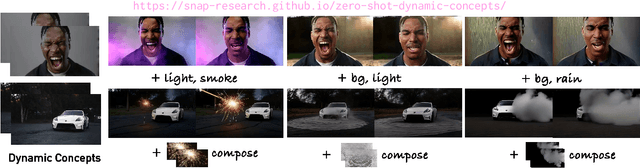
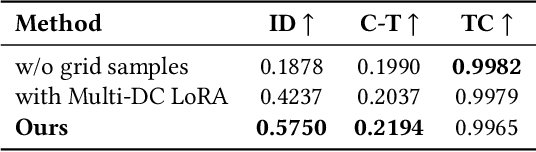
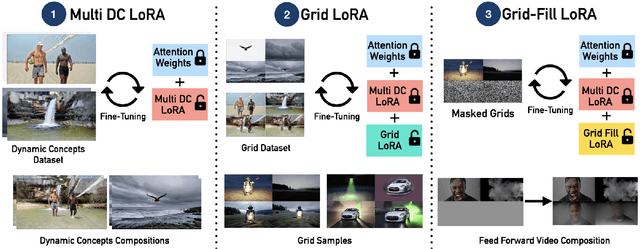
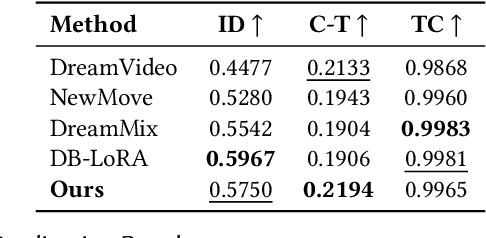
Recent advances in text-to-video generation have enabled high-quality synthesis from text and image prompts. While the personalization of dynamic concepts, which capture subject-specific appearance and motion from a single video, is now feasible, most existing methods require per-instance fine-tuning, limiting scalability. We introduce a fully zero-shot framework for dynamic concept personalization in text-to-video models. Our method leverages structured 2x2 video grids that spatially organize input and output pairs, enabling the training of lightweight Grid-LoRA adapters for editing and composition within these grids. At inference, a dedicated Grid Fill module completes partially observed layouts, producing temporally coherent and identity preserving outputs. Once trained, the entire system operates in a single forward pass, generalizing to previously unseen dynamic concepts without any test-time optimization. Extensive experiments demonstrate high-quality and consistent results across a wide range of subjects beyond trained concepts and editing scenarios.
Dynamic Concepts Personalization from Single Videos
Feb 20, 2025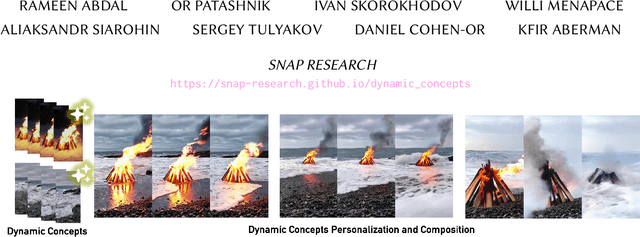
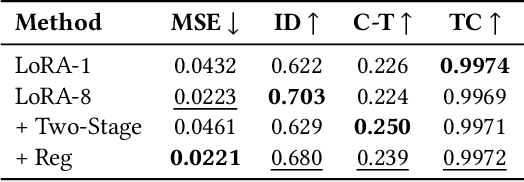
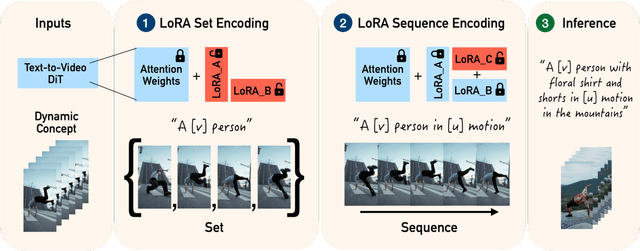
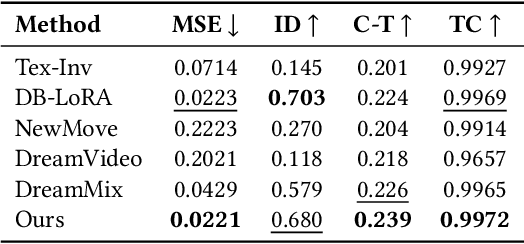
Personalizing generative text-to-image models has seen remarkable progress, but extending this personalization to text-to-video models presents unique challenges. Unlike static concepts, personalizing text-to-video models has the potential to capture dynamic concepts, i.e., entities defined not only by their appearance but also by their motion. In this paper, we introduce Set-and-Sequence, a novel framework for personalizing Diffusion Transformers (DiTs)-based generative video models with dynamic concepts. Our approach imposes a spatio-temporal weight space within an architecture that does not explicitly separate spatial and temporal features. This is achieved in two key stages. First, we fine-tune Low-Rank Adaptation (LoRA) layers using an unordered set of frames from the video to learn an identity LoRA basis that represents the appearance, free from temporal interference. In the second stage, with the identity LoRAs frozen, we augment their coefficients with Motion Residuals and fine-tune them on the full video sequence, capturing motion dynamics. Our Set-and-Sequence framework results in a spatio-temporal weight space that effectively embeds dynamic concepts into the video model's output domain, enabling unprecedented editability and compositionality while setting a new benchmark for personalizing dynamic concepts.