 Add to Chrome
 Add to Firefox
 Add to Edge
Enhancing the Forecasting Capability of Multi-Model Blending Algorithms for Extreme Precipitation via Joint Use of Station and Gridded Observations
Jul 06, 2026
Accurate extreme precipitation forecasting is critical for disaster mitigation but remains challenging for numerical weather prediction (NWP) models due to systemic intensity underestimation and spatial displacement. Traditional precipitation multi-model blending algorithms perform pixel-by-pixel blending on the forecast field based on weights, which may lead to the expansion of precipitation areas and the smoothing of extreme values. This study proposes an U-Net based two-stage framework: probability classification followed by value reconstruction, to blend forecasts from six major NWP models. A novel station-grid joint supervision mechanism is introduced by integrating observations from 2411 national meteorological stations in China into the loss function, simultaneously constraining spatial structures and peak intensities. Evaluations using independent samples from the 2025 flood season demonstrate that our model significantly outperforms both individual NWPs and current operational products. For rainstorms (>=50 mm), the Threat Score (TS) improved by 38.4% compared to the best NWP. Notably, for extreme events (>=100 mm) driven by extratropical cyclones and the subtropical high, the model successfully elevated the TS to above 0.1, transforming forecasts from having negligible reference value into those with certain operational utility. Furthermore, the model exhibits data-driven spatial correction capabilities, effectively realigning systematic rainbelt displacements with actual precipitation centers. The inclusion of station observations specifically enhanced the TS for rainstorms by 10.4% and effectively balanced the Bias. These results highlight the efficacy of multi-source joint supervision in enhancing the capture of extreme precipitation events.

ChinaHeritaQA: A Culturally-Grounded Visual Question Answering Dataset for World Heritage Sites in China
Jun 08, 2026We introduce ChinaHeritaQA, a multimodal benchmark dataset for evaluating the cultural reasoning abilities of vision-language models (VLMs) on UNESCO World Heritage sites in China. The dataset comprises 2,279 in-the-wild images paired with 14,133 bilingual (Chinese/English) multiple-choice QA pairs spanning seven cognitive dimensions, from basic identity recognition to historical periodization and architectural analysis. Guided by a UNESCO-aligned heritage ontology and verified through rigorous human annotation, the dataset ensures linguistic quality and factual consistency. Evaluations of state-of-the-art VLMs reveal that while top models exceed human performance on average, substantial task-level variation emerges: models excel at visual recognition but struggle with culturally grounded reasoning. Performance also varies by dynasty and region. ChinaHeritaQA reveals that strong visual retrieval does not extend to cultural and historical understanding. We release the dataset to support future research on culturally aware multimodal learning.
NextMotionQA: Benchmarking and Judging Human Motion Understanding with Vision-Language Models
Jun 03, 2026Reliable evaluation of human motion understanding is fundamental to advancing embodied AI, robotics, and animation. However, existing benchmarks suffer from coarse semantic granularity, undifferentiated difficulty, limited annotation quality, and pervasive answer ambiguity, leaving them unable to diagnose where current models fail. To bridge this gap, we introduce NextMotionQA, a comprehensive benchmark that leverages vision-language models (VLMs) for semi-automated, expert-verified dataset. NextMotionQA features three complementary tasks: multiple-choice question answering, video captioning, and fine-grained error correction. Each task is systematically structured across three core semantic axes and stratified into three task complexity levels. Our extensive evaluation of twelve representative VLMs uncovers critical capability gaps and weakness that remain invisible under conventional, single-task evaluations. In a complementary direction, recent work has begun using VLMs as judges for text-to-motion evaluation; we ask whether they show the same degradation under harder tasks. We find that VLMs align strongly with expert ratings on coarse criteria (Cohen's κ=0.70) but break down on fine-grained, part-level judgment (κ=0.10), validating the paradigm in its strong regime while clarifying its limits.
Shot-Aware Frame Sampling for Video Understanding
Mar 18, 2026Video frame sampling is essential for efficient long-video understanding with Vision-Language Models (VLMs), since dense inputs are costly and often exceed context limits. Yet when only a small number of frames can be retained, existing samplers often fail to balance broad video coverage with brief but critical events, which can lead to unreliable downstream predictions. To address this issue, we present InfoShot, a task-agnostic, shot-aware frame sampler for long-video understanding. InfoShot first partitions a video into semantically consistent shots, and then selects two complementary keyframes from each shot: one to represent the main content and one to capture unusual within-shot changes. This design is guided by an information-theoretic objective that encourages the sampled set to retain high information about both shot structure and sparse within-shot deviations. In this way, it improves the chance of preserving both overall video context and short decision-critical moments without requiring any retraining. To better evaluate such short-lived events, we further introduce SynFlash, a synthetic benchmark with controllable sub-second anomaly patterns and frame-level ground truth, and we also evaluate InfoShot on existing anomaly datasets and general video understanding tasks. Experiments show that InfoShot improves anomaly hit rate and downstream Video-QA accuracy under frame number constraints, while matching or outperforming strong baselines on standard video understanding benchmarks.
MeTok: An Efficient Meteorological Tokenization with Hyper-Aligned Group Learning for Precipitation Nowcasting
Mar 14, 2026Recently, Transformer-based architectures have advanced meteorological prediction. However, this position-centric tokenizer conflicts with the core principle of meteorological systems, where the weather phenomena undoubtedly involve synergistic interactions among multiple elements while positional information constitutes merely a component of the boundary conditions. This paper focuses primarily on the task of precipitation nowcasting and develops an efficient distribution-centric Meteorological Tokenization (MeTok) scheme, which spatially sequences to group similar meteorological features. Based on the rearrangement, realigned group learning enhances robustness across precipitation patterns, especially extreme ones. Specifically, we introduce the Hyper-Aligned Grouping Transformer (HyAGTransformer) with two key improvements: 1) The Grouping Attention (GA) mechanism uses MeTok to enable self-aligned learning of features from different precipitation patterns; 2) The Neighborhood Feed-Forward Network (N-FFN) integrates adjacent group features, aggregating contextual information to boost patch embedding discriminability. Experiments on the ERA5 dataset for 6-hour forecasts show our method improves the IoU metric by at least 8.2% in extreme precipitation prediction compared to other methods. Additionally, it gains performance with more training data and increased parameters, demonstrating scalability, stability, and superiority over traditional methods.
UniComp: A Unified Evaluation of Large Language Model Compression via Pruning, Quantization and Distillation
Feb 11, 2026Model compression is increasingly essential for deploying large language models (LLMs), yet existing evaluations are limited in method coverage and focus primarily on knowledge-centric benchmarks. Thus, we introduce UniComp, a unified evaluation framework for comparing pruning, quantization, and knowledge distillation. UniComp evaluates compressed models along three dimensions: performance, reliability, and efficiency, using a diverse set of capability- and safety-oriented benchmarks together with a hardware-aware efficiency analysis. Through extensive evaluation of six compression techniques on modern LLMs across more than 40 datasets, we find that (i) compression exhibits a consistent knowledge bias, where knowledge-intensive tasks are relatively preserved while reasoning, multilingual, and instruction-following capabilities degrade substantially; (ii) quantization provides the best overall trade-off between retained performance and efficiency, whereas distillation yields strong runtime acceleration gains at high computational cost; and (iii) task-specific calibration can significantly improve the reasoning ability of pruned models by up to 50%.
FrankenMotion: Part-level Human Motion Generation and Composition
Jan 15, 2026Human motion generation from text prompts has made remarkable progress in recent years. However, existing methods primarily rely on either sequence-level or action-level descriptions due to the absence of fine-grained, part-level motion annotations. This limits their controllability over individual body parts. In this work, we construct a high-quality motion dataset with atomic, temporally-aware part-level text annotations, leveraging the reasoning capabilities of large language models (LLMs). Unlike prior datasets that either provide synchronized part captions with fixed time segments or rely solely on global sequence labels, our dataset captures asynchronous and semantically distinct part movements at fine temporal resolution. Based on this dataset, we introduce a diffusion-based part-aware motion generation framework, namely FrankenMotion, where each body part is guided by its own temporally-structured textual prompt. This is, to our knowledge, the first work to provide atomic, temporally-aware part-level motion annotations and have a model that allows motion generation with both spatial (body part) and temporal (atomic action) control. Experiments demonstrate that FrankenMotion outperforms all previous baseline models adapted and retrained for our setting, and our model can compose motions unseen during training. Our code and dataset will be publicly available upon publication.
Beyond Demographics: Enhancing Cultural Value Survey Simulation with Multi-Stage Personality-Driven Cognitive Reasoning
Aug 25, 2025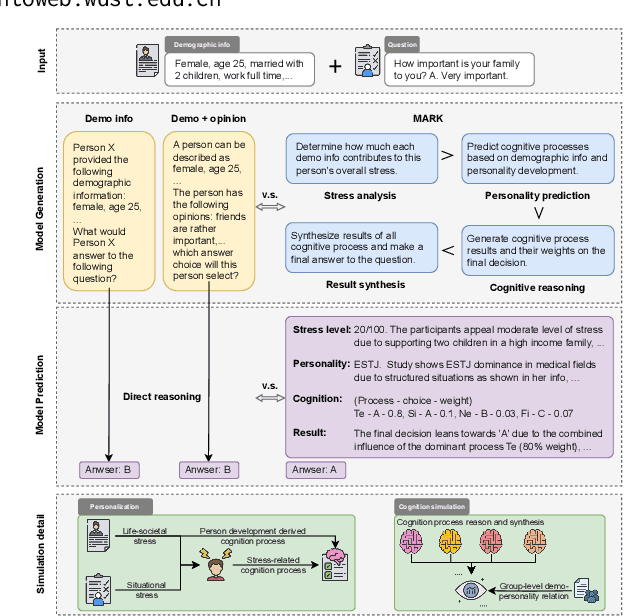

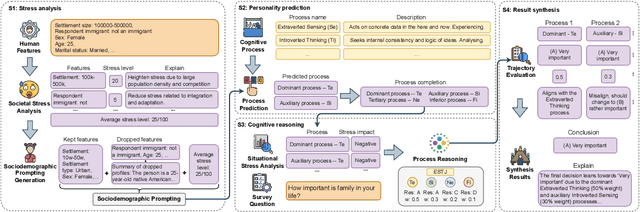
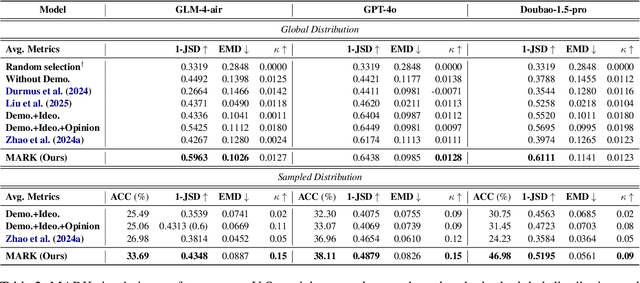
Introducing MARK, the Multi-stAge Reasoning frameworK for cultural value survey response simulation, designed to enhance the accuracy, steerability, and interpretability of large language models in this task. The system is inspired by the type dynamics theory in the MBTI psychological framework for personality research. It effectively predicts and utilizes human demographic information for simulation: life-situational stress analysis, group-level personality prediction, and self-weighted cognitive imitation. Experiments on the World Values Survey show that MARK outperforms existing baselines by 10% accuracy and reduces the divergence between model predictions and human preferences. This highlights the potential of our framework to improve zero-shot personalization and help social scientists interpret model predictions.
MDPO: Overcoming the Training-Inference Divide of Masked Diffusion Language Models
Aug 18, 2025Diffusion language models, as a promising alternative to traditional autoregressive (AR) models, enable faster generation and richer conditioning on bidirectional context. However, they suffer from a key discrepancy between training and inference: during inference, MDLMs progressively reveal the structure of the generated sequence by producing fewer and fewer masked tokens, whereas this structure is ignored in training as tokens are masked at random. Although this discrepancy between training and inference can lead to suboptimal performance, it has been largely overlooked by previous works, leaving closing this gap between the two stages an open problem. To address this, we frame the problem of learning effective denoising trajectories as a sequential decision-making problem and use the resulting framework to apply reinforcement learning. We propose a novel Masked Diffusion Policy Optimization (MDPO) to exploit the Markov property diffusion possesses and explicitly train the model under the same progressive refining schedule used at inference. MDPO matches the performance of the previous state-of-the-art (SOTA) method with 60x fewer gradient updates, while achieving average improvements of 9.6% on MATH500 and 54.2% on Countdown over SOTA when trained within the same number of weight updates. Additionally, we improve the remasking strategy of MDLMs as a plug-in inference replacement to overcome the limitation that the model cannot refine tokens flexibly. This simple yet effective training-free strategy, what we refer to as RCR, consistently improves performance and yields additional gains when combined with MDPO. Our findings establish great potential for investigating the discrepancy between pre-training and inference of MDLMs. Code: https://github.com/autonomousvision/mdpo. Project Page: https://cli212.github.io/MDPO/.
QuaDMix: Quality-Diversity Balanced Data Selection for Efficient LLM Pretraining
Apr 23, 2025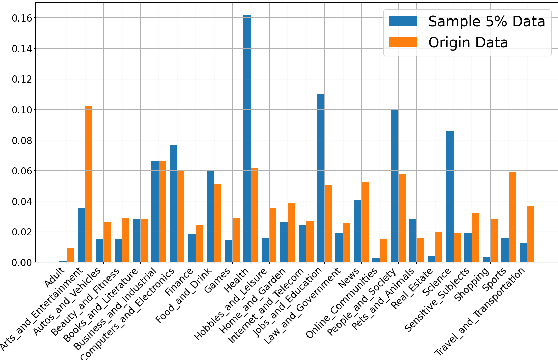
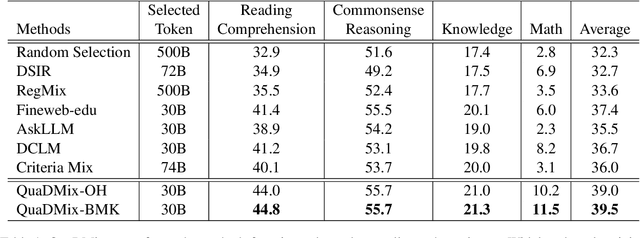
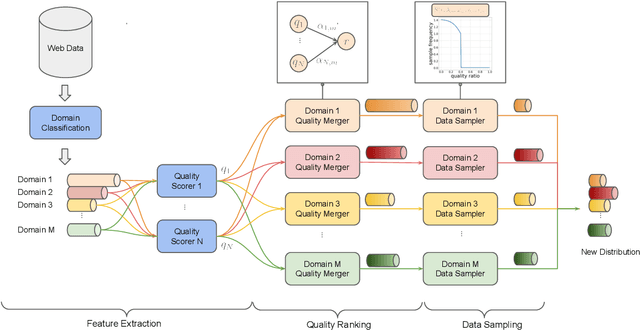
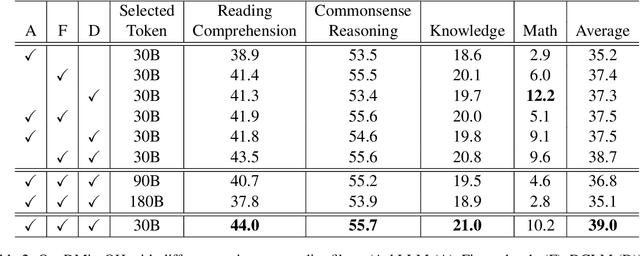
Quality and diversity are two critical metrics for the training data of large language models (LLMs), positively impacting performance. Existing studies often optimize these metrics separately, typically by first applying quality filtering and then adjusting data proportions. However, these approaches overlook the inherent trade-off between quality and diversity, necessitating their joint consideration. Given a fixed training quota, it is essential to evaluate both the quality of each data point and its complementary effect on the overall dataset. In this paper, we introduce a unified data selection framework called QuaDMix, which automatically optimizes the data distribution for LLM pretraining while balancing both quality and diversity. Specifically, we first propose multiple criteria to measure data quality and employ domain classification to distinguish data points, thereby measuring overall diversity. QuaDMix then employs a unified parameterized data sampling function that determines the sampling probability of each data point based on these quality and diversity related labels. To accelerate the search for the optimal parameters involved in the QuaDMix framework, we conduct simulated experiments on smaller models and use LightGBM for parameters searching, inspired by the RegMix method. Our experiments across diverse models and datasets demonstrate that QuaDMix achieves an average performance improvement of 7.2% across multiple benchmarks. These results outperform the independent strategies for quality and diversity, highlighting the necessity and ability to balance data quality and diversity.