 Add to Chrome
 Add to Firefox
 Add to Edge
Ms. Forcing: Efficient Streaming Video Generation with Multi-Scale Patchification and Attention
Jul 23, 2026
Streaming video diffusion models have made substantial progress toward interactive and dynamic world simulation, but the nested autoregressive and denoising loops of conventional next-frame generation hinder real-time deployment. Recent rolling-window methods pipeline denoising across multiple consecutive frames at different noise levels, improving throughput and long-horizon stability. However, they tokenize every state at the same fine spatial granularity, leaving substantial noise-dependent redundancy in the joint denoising window. We propose Ms.Forcing, an efficient streaming video generation paradigm that adapts spatial granularity to each state's noise level. Its Multi-Scale Patchification (MSP) assigns coarser patches to noisier states, reducing the active-window token count by 45%, while Multi-Scale Self-Attention (MSSA) matches the density of visible non-sink keys and values to each query scale to further reduce attention cost. Because both schedules are fixed by window position, Ms.Forcing retains a static, hardware-friendly computation graph. We further introduce Homogeneous-Noise-Level DMD (H-DMD), which assembles each fake video from clean predictions sharing the same source noise level, thereby reducing the mismatch between DMD training sequences and inference-time rollouts. The multi-scale design helps offset the additional training cost of backpropagating through overlapping windows. We include both quantitative and qualitative experiments to show that Ms.Forcing reaches 22.84 FPS on a single H200 GPU, 39.6% faster than Rolling Forcing, while significantly improving VBench scores in both short video and long video generation setting.

Deform360: A Massive Multi-view Visuotactile Dataset for Deformable World Models
Jul 06, 2026Predicting object dynamics (i.e., world modeling) is a fundamental challenge for robotic manipulation, and modeling deformable objects presents a particularly difficult case due to their high-dimensional state spaces and complex material properties. While current world models approach this through two distinct paradigms: learning the dynamics over the 2D pixel space or more explicit 3D geometric space. A systematic understanding of their relative strengths and limitations remains elusive due to the lack of diverse, large-scale real-world data. To address this, we present Deform360, a large-scale visuotactile dataset featuring 198 daily-life objects, 1,980 interaction sequences, and over 215 hours of observations from 41 surround-view cameras and bimanual tactile grippers to capture both global motion and contact-induced local deformations. Leveraging a novel markerless visuotactile 3D tracking pipeline to extract dense geometry and motion, we systematically evaluate current state-of-the-art world models, comparing 2D video models against 3D particle models. Finally, we provide a preliminary demonstration indicating the real-world applicability of our dataset by performing robot planning tasks on deformable objects. Our analysis reveals key insights into the trade-offs between structural priors and scalability, providing a solid benchmark for future research in generalizable deformable object-centric world modeling. Project website: https://deform360.lhy.xyz
UMO: Unified In-Context Learning Unlocks Motion Foundation Model Priors
Mar 16, 2026Large-scale foundation models (LFMs) have recently made impressive progress in text-to-motion generation by learning strong generative priors from massive 3D human motion datasets and paired text descriptions. However, how to effectively and efficiently leverage such single-purpose motion LFMs, i.e., text-to-motion synthesis, in more diverse cross-modal and in-context motion generation downstream tasks remains largely unclear. Prior work typically adapts pretrained generative priors to individual downstream tasks in a task-specific manner. In contrast, our goal is to unlock such priors to support a broad spectrum of downstream motion generation tasks within a single unified framework. To bridge this gap, we present UMO, a simple yet general unified formulation that casts diverse downstream tasks into compositions of atomic per-frame operations, enabling in-context adaptation to unlock the generative priors of pretrained DiT-based motion LFMs. Specifically, UMO introduces three learnable frame-level meta-operation embeddings to specify per-frame intent and employs lightweight temporal fusion to inject in-context cues into the pretrained backbone, with negligible runtime overhead compared to the base model. With this design, UMO finetunes the pretrained model, originally limited to text-to-motion generation, to support diverse previously unsupported tasks, including temporal inpainting, text-guided motion editing, text-serialized geometric constraints, and multi-identity reaction generation. Experiments demonstrate that UMO consistently outperforms task-specific and training-free baselines across a wide range of benchmarks, despite using a single unified model. Code and model will be publicly available. Project Page: https://oliver-cong02.github.io/UMO.github.io/
PackUV: Packed Gaussian UV Maps for 4D Volumetric Video
Feb 26, 2026Volumetric videos offer immersive 4D experiences, but remain difficult to reconstruct, store, and stream at scale. Existing Gaussian Splatting based methods achieve high-quality reconstruction but break down on long sequences, temporal inconsistency, and fail under large motions and disocclusions. Moreover, their outputs are typically incompatible with conventional video coding pipelines, preventing practical applications. We introduce PackUV, a novel 4D Gaussian representation that maps all Gaussian attributes into a sequence of structured, multi-scale UV atlas, enabling compact, image-native storage. To fit this representation from multi-view videos, we propose PackUV-GS, a temporally consistent fitting method that directly optimizes Gaussian parameters in the UV domain. A flow-guided Gaussian labeling and video keyframing module identifies dynamic Gaussians, stabilizes static regions, and preserves temporal coherence even under large motions and disocclusions. The resulting UV atlas format is the first unified volumetric video representation compatible with standard video codecs (e.g., FFV1) without losing quality, enabling efficient streaming within existing multimedia infrastructure. To evaluate long-duration volumetric capture, we present PackUV-2B, the largest multi-view video dataset to date, featuring more than 50 synchronized cameras, substantial motion, and frequent disocclusions across 100 sequences and 2B (billion) frames. Extensive experiments demonstrate that our method surpasses existing baselines in rendering fidelity while scaling to sequences up to 30 minutes with consistent quality.
* https://ivl.cs.brown.edu/packuv
VideoGPA: Distilling Geometry Priors for 3D-Consistent Video Generation
Jan 30, 2026While recent video diffusion models (VDMs) produce visually impressive results, they fundamentally struggle to maintain 3D structural consistency, often resulting in object deformation or spatial drift. We hypothesize that these failures arise because standard denoising objectives lack explicit incentives for geometric coherence. To address this, we introduce VideoGPA (Video Geometric Preference Alignment), a data-efficient self-supervised framework that leverages a geometry foundation model to automatically derive dense preference signals that guide VDMs via Direct Preference Optimization (DPO). This approach effectively steers the generative distribution toward inherent 3D consistency without requiring human annotations. VideoGPA significantly enhances temporal stability, physical plausibility, and motion coherence using minimal preference pairs, consistently outperforming state-of-the-art baselines in extensive experiments.
VIVA: VLM-Guided Instruction-Based Video Editing with Reward Optimization
Dec 18, 2025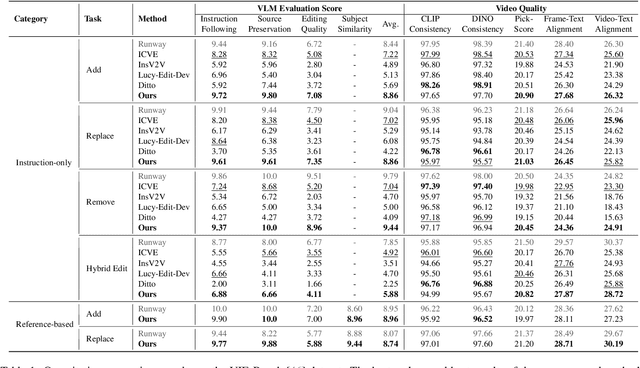
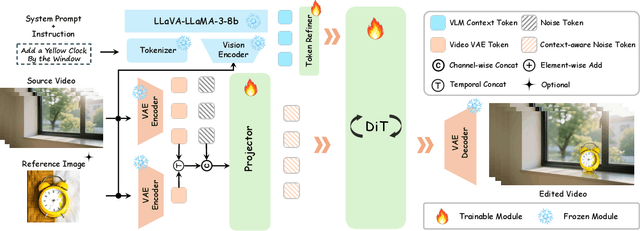
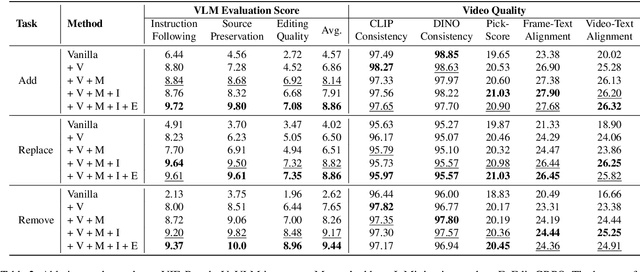
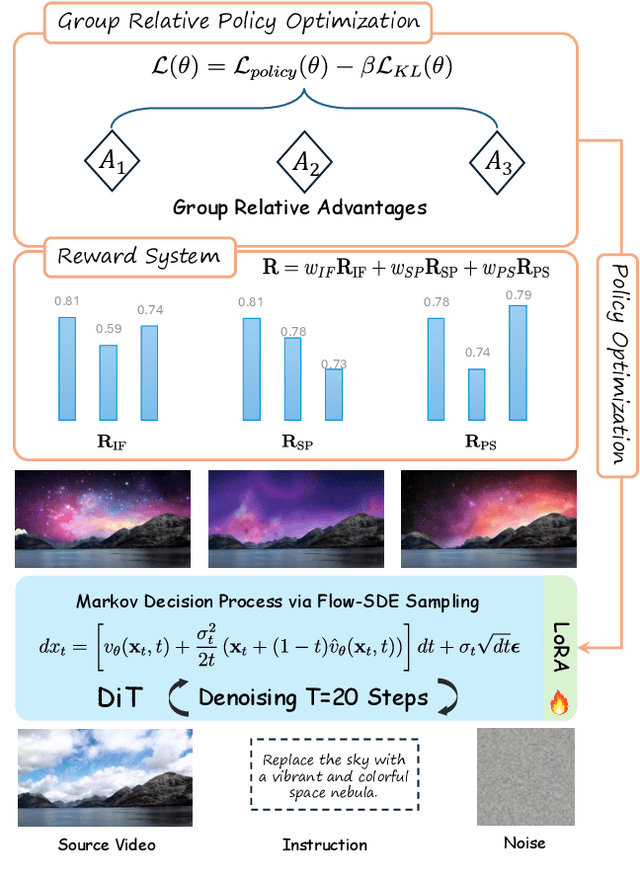
Instruction-based video editing aims to modify an input video according to a natural-language instruction while preserving content fidelity and temporal coherence. However, existing diffusion-based approaches are often trained on paired data of simple editing operations, which fundamentally limits their ability to generalize to diverse and complex, real-world instructions. To address this generalization gap, we propose VIVA, a scalable framework for instruction-based video editing that leverages VLM-guided encoding and reward optimization. First, we introduce a VLM-based instructor that encodes the textual instruction, the first frame of the source video, and an optional reference image into visually-grounded instruction representations, providing fine-grained spatial and semantic context for the diffusion transformer backbone. Second, we propose a post-training stage, Edit-GRPO, which adapts Group Relative Policy Optimization to the domain of video editing, directly optimizing the model for instruction-faithful, content-preserving, and aesthetically pleasing edits using relative rewards. Furthermore, we propose a data construction pipeline designed to synthetically generate diverse, high-fidelity paired video-instruction data of basic editing operations. Extensive experiments show that VIVA achieves superior instruction following, generalization, and editing quality over state-of-the-art methods. Website: https://viva-paper.github.io
GenHSI: Controllable Generation of Human-Scene Interaction Videos
Jun 24, 2025Large-scale pre-trained video diffusion models have exhibited remarkable capabilities in diverse video generation. However, existing solutions face several challenges in using these models to generate long movie-like videos with rich human-object interactions that include unrealistic human-scene interaction, lack of subject identity preservation, and require expensive training. We propose GenHSI, a training-free method for controllable generation of long human-scene interaction videos (HSI). Taking inspiration from movie animation, our key insight is to overcome the limitations of previous work by subdividing the long video generation task into three stages: (1) script writing, (2) pre-visualization, and (3) animation. Given an image of a scene, a user description, and multiple images of a person, we use these three stages to generate long-videos that preserve human-identity and provide rich human-scene interactions. Script writing converts complex human tasks into simple atomic tasks that are used in the pre-visualization stage to generate 3D keyframes (storyboards). These 3D keyframes are rendered and animated by off-the-shelf video diffusion models for consistent long video generation with rich contacts in a 3D-aware manner. A key advantage of our work is that we alleviate the need for scanned, accurate scenes and create 3D keyframes from single-view images. We are the first to generate a long video sequence with a consistent camera pose that contains arbitrary numbers of character actions without training. Experiments demonstrate that our method can generate long videos that effectively preserve scene content and character identity with plausible human-scene interaction from a single image scene. Visit our project homepage https://kunkun0w0.github.io/project/GenHSI/ for more information.
Art3D: Training-Free 3D Generation from Flat-Colored Illustration
Apr 14, 2025Large-scale pre-trained image-to-3D generative models have exhibited remarkable capabilities in diverse shape generations. However, most of them struggle to synthesize plausible 3D assets when the reference image is flat-colored like hand drawings due to the lack of 3D illusion, which are often the most user-friendly input modalities in art content creation. To this end, we propose Art3D, a training-free method that can lift flat-colored 2D designs into 3D. By leveraging structural and semantic features with pre- trained 2D image generation models and a VLM-based realism evaluation, Art3D successfully enhances the three-dimensional illusion in reference images, thus simplifying the process of generating 3D from 2D, and proves adaptable to a wide range of painting styles. To benchmark the generalization performance of existing image-to-3D models on flat-colored images without 3D feeling, we collect a new dataset, Flat-2D, with over 100 samples. Experimental results demonstrate the performance and robustness of Art3D, exhibiting superior generalizable capacity and promising practical applicability. Our source code and dataset will be publicly available on our project page: https://joy-jy11.github.io/ .
Oscillation Inversion: Understand the structure of Large Flow Model through the Lens of Inversion Method
Nov 17, 2024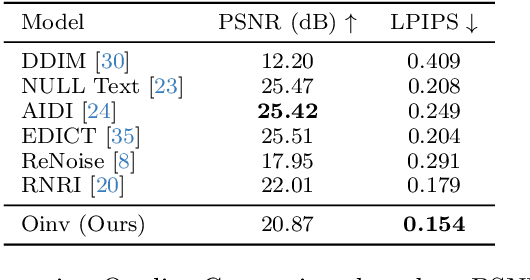
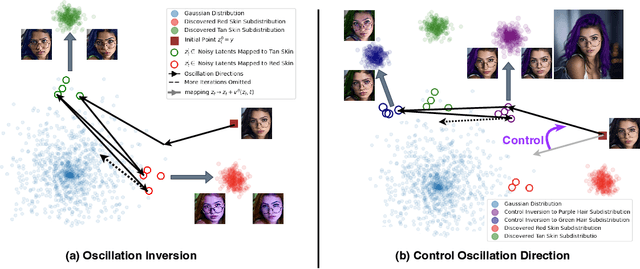
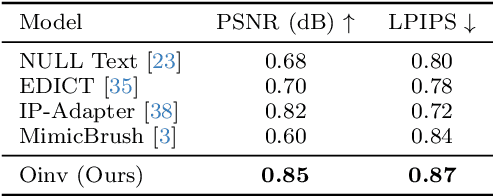

We explore the oscillatory behavior observed in inversion methods applied to large-scale text-to-image diffusion models, with a focus on the "Flux" model. By employing a fixed-point-inspired iterative approach to invert real-world images, we observe that the solution does not achieve convergence, instead oscillating between distinct clusters. Through both toy experiments and real-world diffusion models, we demonstrate that these oscillating clusters exhibit notable semantic coherence. We offer theoretical insights, showing that this behavior arises from oscillatory dynamics in rectified flow models. Building on this understanding, we introduce a simple and fast distribution transfer technique that facilitates image enhancement, stroke-based recoloring, as well as visual prompt-guided image editing. Furthermore, we provide quantitative results demonstrating the effectiveness of our method for tasks such as image enhancement, makeup transfer, reconstruction quality, and guided sampling quality. Higher-quality examples of videos and images are available at \href{https://yanyanzheng96.github.io/oscillation_inversion/}{this link}.
4DRecons: 4D Neural Implicit Deformable Objects Reconstruction from a single RGB-D Camera with Geometrical and Topological Regularizations
Jun 14, 2024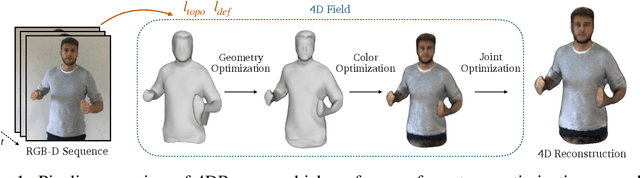
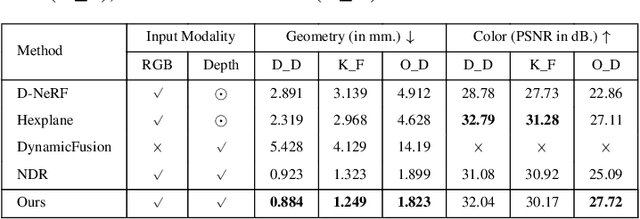
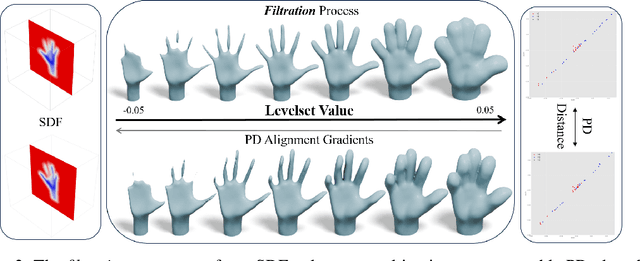
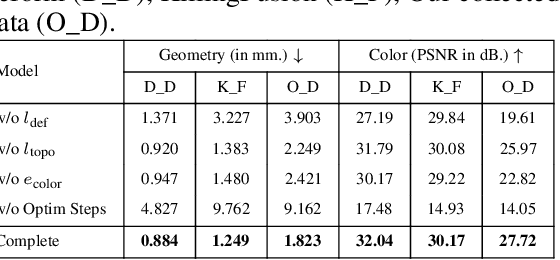
This paper presents a novel approach 4DRecons that takes a single camera RGB-D sequence of a dynamic subject as input and outputs a complete textured deforming 3D model over time. 4DRecons encodes the output as a 4D neural implicit surface and presents an optimization procedure that combines a data term and two regularization terms. The data term fits the 4D implicit surface to the input partial observations. We address fundamental challenges in fitting a complete implicit surface to partial observations. The first regularization term enforces that the deformation among adjacent frames is as rigid as possible (ARAP). To this end, we introduce a novel approach to compute correspondences between adjacent textured implicit surfaces, which are used to define the ARAP regularization term. The second regularization term enforces that the topology of the underlying object remains fixed over time. This regularization is critical for avoiding self-intersections that are typical in implicit-based reconstructions. We have evaluated the performance of 4DRecons on a variety of datasets. Experimental results show that 4DRecons can handle large deformations and complex inter-part interactions and outperform state-of-the-art approaches considerably.