 Add to Chrome
 Add to Firefox
 Add to Edge
UniAct: Unified Motion Generation and Action Streaming for Humanoid Robots
Dec 30, 2025
A long-standing objective in humanoid robotics is the realization of versatile agents capable of following diverse multimodal instructions with human-level flexibility. Despite advances in humanoid control, bridging high-level multimodal perception with whole-body execution remains a significant bottleneck. Existing methods often struggle to translate heterogeneous instructions -- such as language, music, and trajectories -- into stable, real-time actions. Here we show that UniAct, a two-stage framework integrating a fine-tuned MLLM with a causal streaming pipeline, enables humanoid robots to execute multimodal instructions with sub-500 ms latency. By unifying inputs through a shared discrete codebook via FSQ, UniAct ensures cross-modal alignment while constraining motions to a physically grounded manifold. This approach yields a 19% improvement in the success rate of zero-shot tracking of imperfect reference motions. We validate UniAct on UniMoCap, our 20-hour humanoid motion benchmark, demonstrating robust generalization across diverse real-world scenarios. Our results mark a critical step toward responsive, general-purpose humanoid assistants capable of seamless interaction through unified perception and control.

Dynamic Motion Blending for Versatile Motion Editing
Mar 26, 2025Text-guided motion editing enables high-level semantic control and iterative modifications beyond traditional keyframe animation. Existing methods rely on limited pre-collected training triplets, which severely hinders their versatility in diverse editing scenarios. We introduce MotionCutMix, an online data augmentation technique that dynamically generates training triplets by blending body part motions based on input text. While MotionCutMix effectively expands the training distribution, the compositional nature introduces increased randomness and potential body part incoordination. To model such a rich distribution, we present MotionReFit, an auto-regressive diffusion model with a motion coordinator. The auto-regressive architecture facilitates learning by decomposing long sequences, while the motion coordinator mitigates the artifacts of motion composition. Our method handles both spatial and temporal motion edits directly from high-level human instructions, without relying on additional specifications or Large Language Models. Through extensive experiments, we show that MotionReFit achieves state-of-the-art performance in text-guided motion editing.
Autonomous Character-Scene Interaction Synthesis from Text Instruction
Oct 04, 2024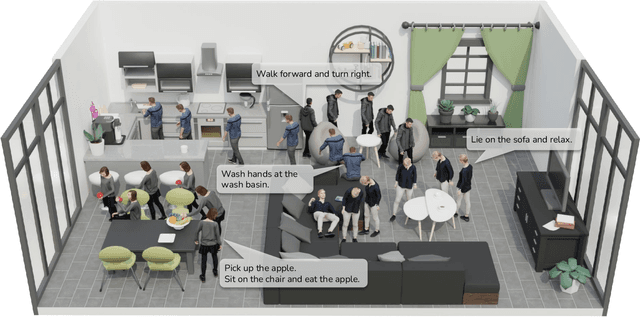


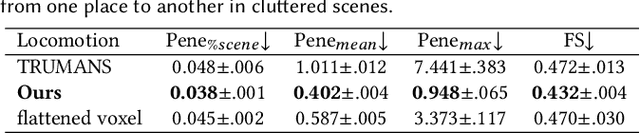
Synthesizing human motions in 3D environments, particularly those with complex activities such as locomotion, hand-reaching, and human-object interaction, presents substantial demands for user-defined waypoints and stage transitions. These requirements pose challenges for current models, leading to a notable gap in automating the animation of characters from simple human inputs. This paper addresses this challenge by introducing a comprehensive framework for synthesizing multi-stage scene-aware interaction motions directly from a single text instruction and goal location. Our approach employs an auto-regressive diffusion model to synthesize the next motion segment, along with an autonomous scheduler predicting the transition for each action stage. To ensure that the synthesized motions are seamlessly integrated within the environment, we propose a scene representation that considers the local perception both at the start and the goal location. We further enhance the coherence of the generated motion by integrating frame embeddings with language input. Additionally, to support model training, we present a comprehensive motion-captured dataset comprising 16 hours of motion sequences in 120 indoor scenes covering 40 types of motions, each annotated with precise language descriptions. Experimental results demonstrate the efficacy of our method in generating high-quality, multi-stage motions closely aligned with environmental and textual conditions.