 Add to Chrome
 Add to Firefox
 Add to Edge
ShotDirector: Directorially Controllable Multi-Shot Video Generation with Cinematographic Transitions
Dec 11, 2025
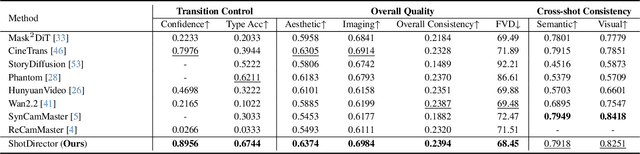
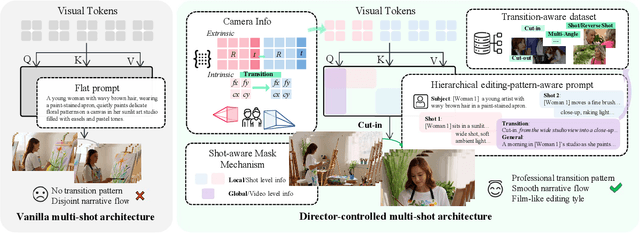

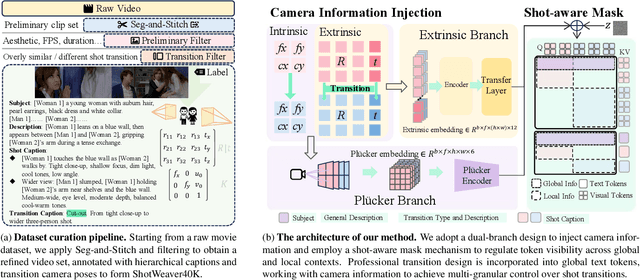
Shot transitions play a pivotal role in multi-shot video generation, as they determine the overall narrative expression and the directorial design of visual storytelling. However, recent progress has primarily focused on low-level visual consistency across shots, neglecting how transitions are designed and how cinematographic language contributes to coherent narrative expression. This often leads to mere sequential shot changes without intentional film-editing patterns. To address this limitation, we propose ShotDirector, an efficient framework that integrates parameter-level camera control and hierarchical editing-pattern-aware prompting. Specifically, we adopt a camera control module that incorporates 6-DoF poses and intrinsic settings to enable precise camera information injection. In addition, a shot-aware mask mechanism is employed to introduce hierarchical prompts aware of professional editing patterns, allowing fine-grained control over shot content. Through this design, our framework effectively combines parameter-level conditions with high-level semantic guidance, achieving film-like controllable shot transitions. To facilitate training and evaluation, we construct ShotWeaver40K, a dataset that captures the priors of film-like editing patterns, and develop a set of evaluation metrics for controllable multi-shot video generation. Extensive experiments demonstrate the effectiveness of our framework.

P1: Mastering Physics Olympiads with Reinforcement Learning
Nov 17, 2025Recent progress in large language models (LLMs) has moved the frontier from puzzle-solving to science-grade reasoning-the kind needed to tackle problems whose answers must stand against nature, not merely fit a rubric. Physics is the sharpest test of this shift, which binds symbols to reality in a fundamental way, serving as the cornerstone of most modern technologies. In this work, we manage to advance physics research by developing large language models with exceptional physics reasoning capabilities, especially excel at solving Olympiad-level physics problems. We introduce P1, a family of open-source physics reasoning models trained entirely through reinforcement learning (RL). Among them, P1-235B-A22B is the first open-source model with Gold-medal performance at the latest International Physics Olympiad (IPhO 2025), and wins 12 gold medals out of 13 international/regional physics competitions in 2024/2025. P1-30B-A3B also surpasses almost all other open-source models on IPhO 2025, getting a silver medal. Further equipped with an agentic framework PhysicsMinions, P1-235B-A22B+PhysicsMinions achieves overall No.1 on IPhO 2025, and obtains the highest average score over the 13 physics competitions. Besides physics, P1 models also present great performance on other reasoning tasks like math and coding, showing the great generalibility of P1 series.
ViCO: A Training Strategy towards Semantic Aware Dynamic High-Resolution
Oct 14, 2025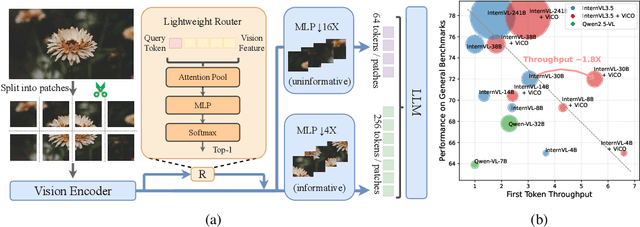
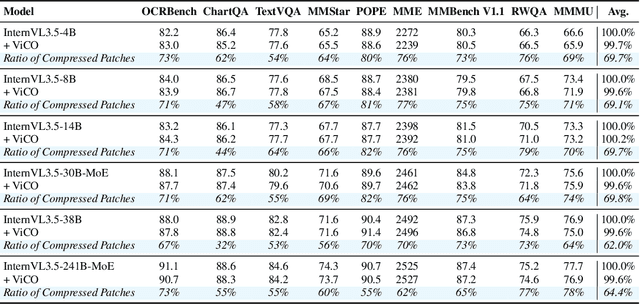
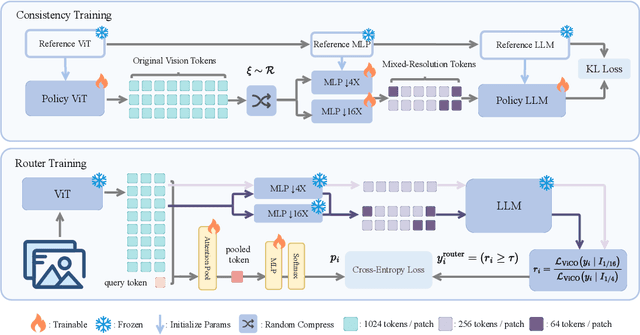
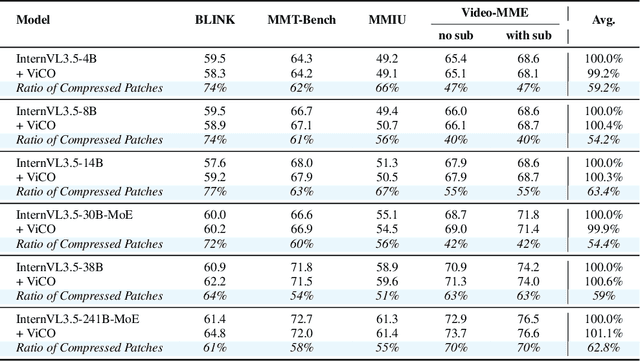
Existing Multimodal Large Language Models (MLLMs) suffer from increased inference costs due to the additional vision tokens introduced by image inputs. In this work, we propose Visual Consistency Learning (ViCO), a novel training algorithm that enables the model to represent images of varying semantic complexities using different numbers of vision tokens. The key idea behind our method is to employ multiple MLP connectors, each with a different image compression ratio, to downsample the vision tokens based on the semantic complexity of the image. During training, we minimize the KL divergence between the responses conditioned on different MLP connectors. At inference time, we introduce an image router, termed Visual Resolution Router (ViR), that automatically selects the appropriate compression rate for each image patch. Compared with existing dynamic high-resolution strategies, which adjust the number of visual tokens based on image resolutions, our method dynamically adapts the number of visual tokens according to semantic complexity. Experimental results demonstrate that our method can reduce the number of vision tokens by up to 50% while maintaining the model's perception, reasoning, and OCR capabilities. We hope this work will contribute to the development of more efficient MLLMs. The code and models will be released to facilitate future research.
Learning on the Job: An Experience-Driven Self-Evolving Agent for Long-Horizon Tasks
Oct 09, 2025Large Language Models have demonstrated remarkable capabilities across diverse domains, yet significant challenges persist when deploying them as AI agents for real-world long-horizon tasks. Existing LLM agents suffer from a critical limitation: they are test-time static and cannot learn from experience, lacking the ability to accumulate knowledge and continuously improve on the job. To address this challenge, we propose MUSE, a novel agent framework that introduces an experience-driven, self-evolving system centered around a hierarchical Memory Module. MUSE organizes diverse levels of experience and leverages them to plan and execute long-horizon tasks across multiple applications. After each sub-task execution, the agent autonomously reflects on its trajectory, converting the raw trajectory into structured experience and integrating it back into the Memory Module. This mechanism enables the agent to evolve beyond its static pretrained parameters, fostering continuous learning and self-evolution. We evaluate MUSE on the long-horizon productivity benchmark TAC. It achieves new SOTA performance by a significant margin using only a lightweight Gemini-2.5 Flash model. Sufficient Experiments demonstrate that as the agent autonomously accumulates experience, it exhibits increasingly superior task completion capabilities, as well as robust continuous learning and self-evolution capabilities. Moreover, the accumulated experience from MUSE exhibits strong generalization properties, enabling zero-shot improvement on new tasks. MUSE establishes a new paradigm for AI agents capable of real-world productivity task automation.
MinerU2.5: A Decoupled Vision-Language Model for Efficient High-Resolution Document Parsing
Sep 26, 2025We introduce MinerU2.5, a 1.2B-parameter document parsing vision-language model that achieves state-of-the-art recognition accuracy while maintaining exceptional computational efficiency. Our approach employs a coarse-to-fine, two-stage parsing strategy that decouples global layout analysis from local content recognition. In the first stage, the model performs efficient layout analysis on downsampled images to identify structural elements, circumventing the computational overhead of processing high-resolution inputs. In the second stage, guided by the global layout, it performs targeted content recognition on native-resolution crops extracted from the original image, preserving fine-grained details in dense text, complex formulas, and tables. To support this strategy, we developed a comprehensive data engine that generates diverse, large-scale training corpora for both pretraining and fine-tuning. Ultimately, MinerU2.5 demonstrates strong document parsing ability, achieving state-of-the-art performance on multiple benchmarks, surpassing both general-purpose and domain-specific models across various recognition tasks, while maintaining significantly lower computational overhead.
ScaleCUA: Scaling Open-Source Computer Use Agents with Cross-Platform Data
Sep 18, 2025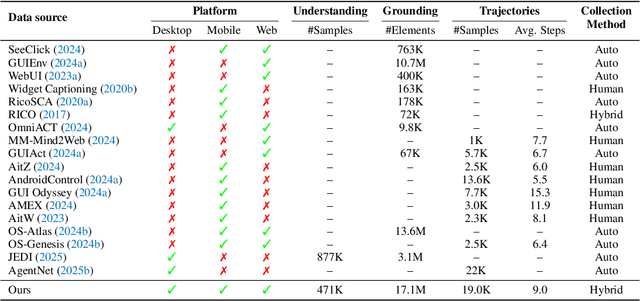
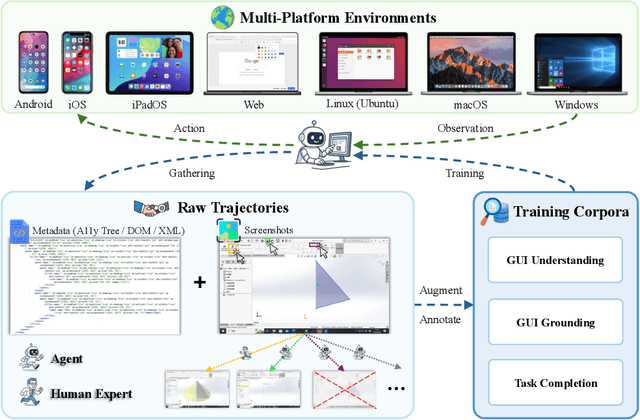
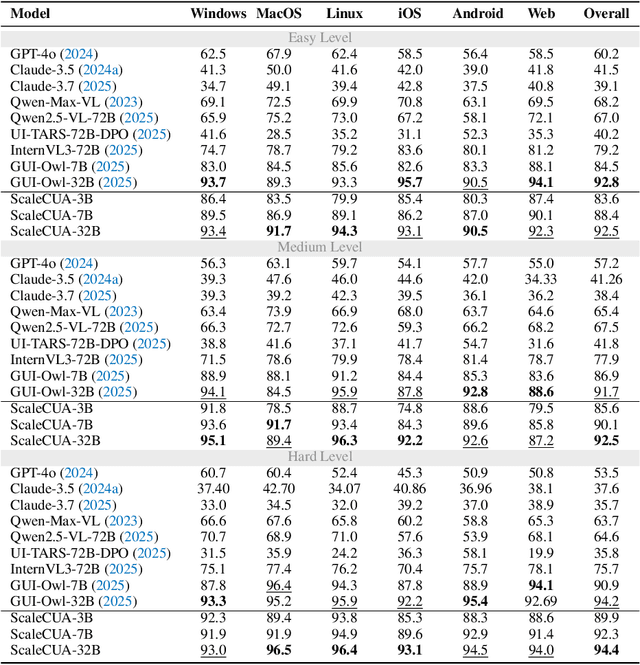
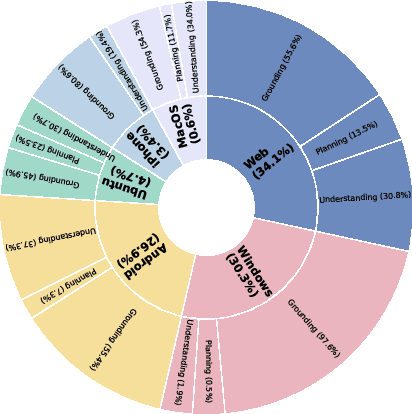
Vision-Language Models (VLMs) have enabled computer use agents (CUAs) that operate GUIs autonomously, showing great potential, yet progress is limited by the lack of large-scale, open-source computer use data and foundation models. In this work, we introduce ScaleCUA, a step toward scaling open-source CUAs. It offers a large-scale dataset spanning 6 operating systems and 3 task domains, built via a closed-loop pipeline uniting automated agents with human experts. Trained on this scaled-up data, ScaleCUA can operate seamlessly across platforms. Specifically, it delivers strong gains over baselines (+26.6 on WebArena-Lite-v2, +10.7 on ScreenSpot-Pro) and sets new state-of-the-art results (94.4% on MMBench-GUI L1-Hard, 60.6% on OSWorld-G, 47.4% on WebArena-Lite-v2). These findings underscore the power of data-driven scaling for general-purpose computer use agents. We will release data, models, and code to advance future research: https://github.com/OpenGVLab/ScaleCUA.
GenExam: A Multidisciplinary Text-to-Image Exam
Sep 17, 2025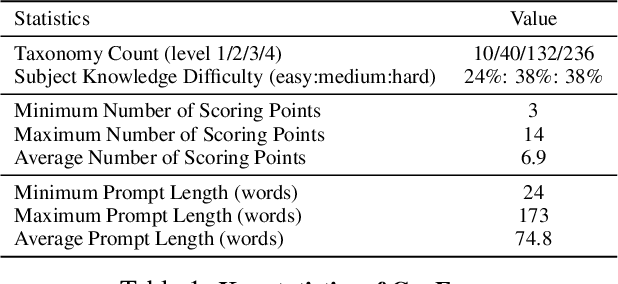
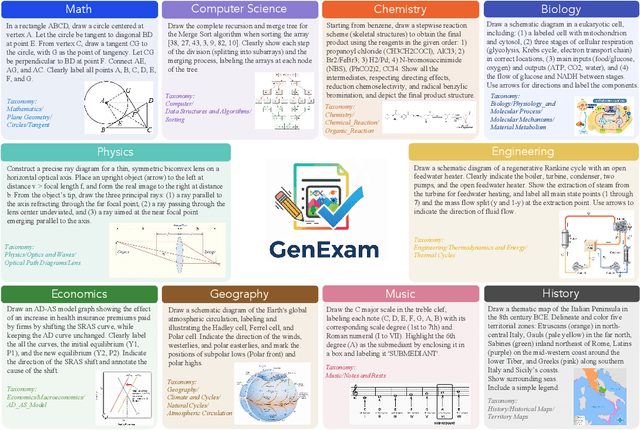
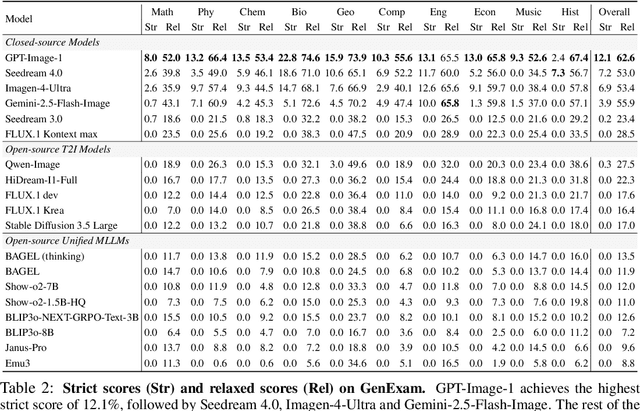
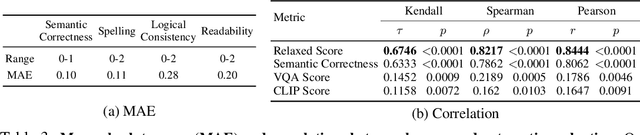
Exams are a fundamental test of expert-level intelligence and require integrated understanding, reasoning, and generation. Existing exam-style benchmarks mainly focus on understanding and reasoning tasks, and current generation benchmarks emphasize the illustration of world knowledge and visual concepts, neglecting the evaluation of rigorous drawing exams. We introduce GenExam, the first benchmark for multidisciplinary text-to-image exams, featuring 1,000 samples across 10 subjects with exam-style prompts organized under a four-level taxonomy. Each problem is equipped with ground-truth images and fine-grained scoring points to enable a precise evaluation of semantic correctness and visual plausibility. Experiments show that even state-of-the-art models such as GPT-Image-1 and Gemini-2.5-Flash-Image achieve less than 15% strict scores, and most models yield almost 0%, suggesting the great challenge of our benchmark. By framing image generation as an exam, GenExam offers a rigorous assessment of models' ability to integrate knowledge, reasoning, and generation, providing insights on the path to general AGI.
A Survey of Scientific Large Language Models: From Data Foundations to Agent Frontiers
Aug 28, 2025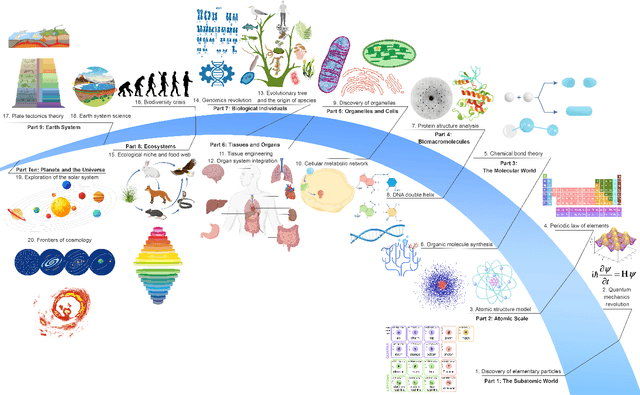
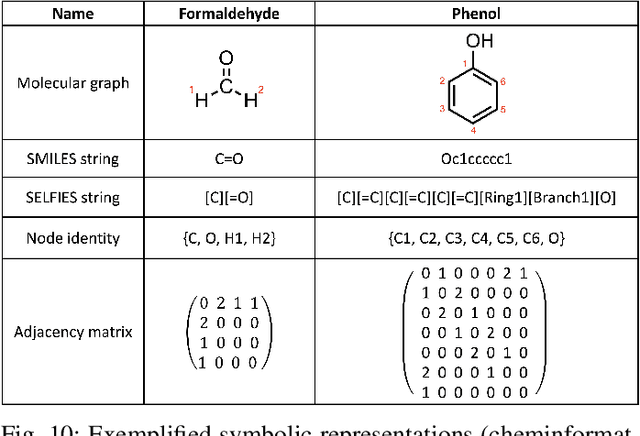
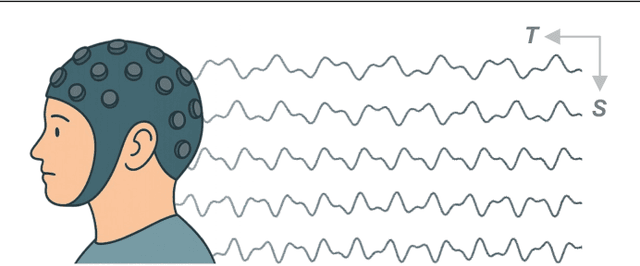
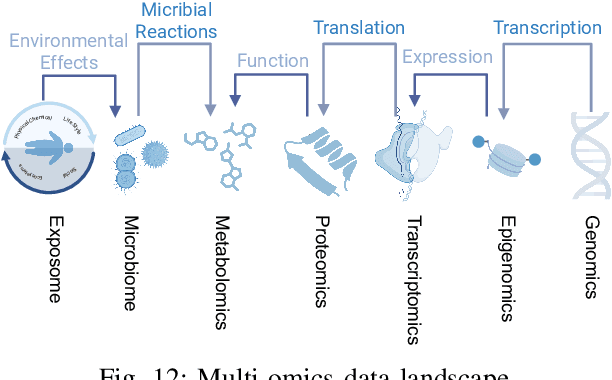
Scientific Large Language Models (Sci-LLMs) are transforming how knowledge is represented, integrated, and applied in scientific research, yet their progress is shaped by the complex nature of scientific data. This survey presents a comprehensive, data-centric synthesis that reframes the development of Sci-LLMs as a co-evolution between models and their underlying data substrate. We formulate a unified taxonomy of scientific data and a hierarchical model of scientific knowledge, emphasizing the multimodal, cross-scale, and domain-specific challenges that differentiate scientific corpora from general natural language processing datasets. We systematically review recent Sci-LLMs, from general-purpose foundations to specialized models across diverse scientific disciplines, alongside an extensive analysis of over 270 pre-/post-training datasets, showing why Sci-LLMs pose distinct demands -- heterogeneous, multi-scale, uncertainty-laden corpora that require representations preserving domain invariance and enabling cross-modal reasoning. On evaluation, we examine over 190 benchmark datasets and trace a shift from static exams toward process- and discovery-oriented assessments with advanced evaluation protocols. These data-centric analyses highlight persistent issues in scientific data development and discuss emerging solutions involving semi-automated annotation pipelines and expert validation. Finally, we outline a paradigm shift toward closed-loop systems where autonomous agents based on Sci-LLMs actively experiment, validate, and contribute to a living, evolving knowledge base. Collectively, this work provides a roadmap for building trustworthy, continually evolving artificial intelligence (AI) systems that function as a true partner in accelerating scientific discovery.
InternVL3.5: Advancing Open-Source Multimodal Models in Versatility, Reasoning, and Efficiency
Aug 25, 2025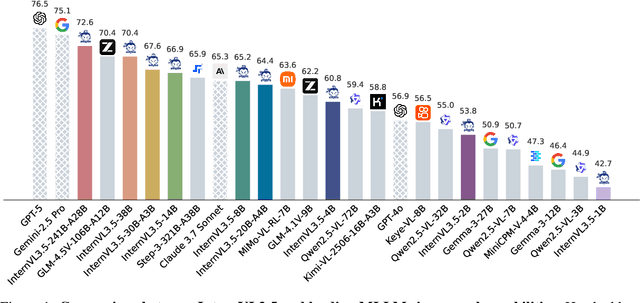
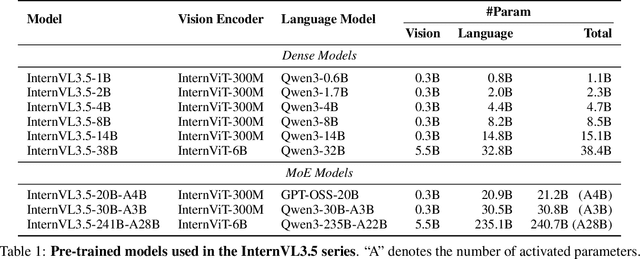
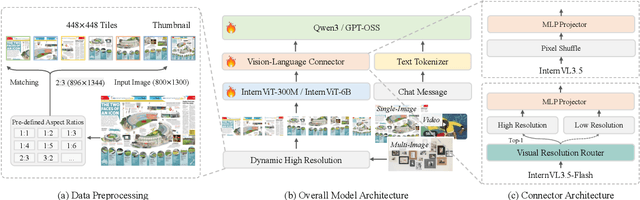
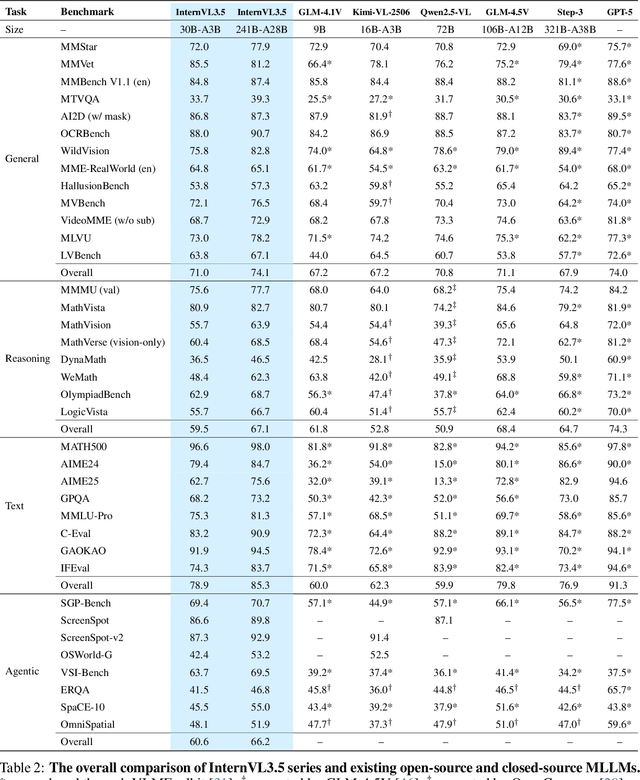
We introduce InternVL 3.5, a new family of open-source multimodal models that significantly advances versatility, reasoning capability, and inference efficiency along the InternVL series. A key innovation is the Cascade Reinforcement Learning (Cascade RL) framework, which enhances reasoning through a two-stage process: offline RL for stable convergence and online RL for refined alignment. This coarse-to-fine training strategy leads to substantial improvements on downstream reasoning tasks, e.g., MMMU and MathVista. To optimize efficiency, we propose a Visual Resolution Router (ViR) that dynamically adjusts the resolution of visual tokens without compromising performance. Coupled with ViR, our Decoupled Vision-Language Deployment (DvD) strategy separates the vision encoder and language model across different GPUs, effectively balancing computational load. These contributions collectively enable InternVL3.5 to achieve up to a +16.0\% gain in overall reasoning performance and a 4.05$\times$ inference speedup compared to its predecessor, i.e., InternVL3. In addition, InternVL3.5 supports novel capabilities such as GUI interaction and embodied agency. Notably, our largest model, i.e., InternVL3.5-241B-A28B, attains state-of-the-art results among open-source MLLMs across general multimodal, reasoning, text, and agentic tasks -- narrowing the performance gap with leading commercial models like GPT-5. All models and code are publicly released.
LIA-X: Interpretable Latent Portrait Animator
Aug 13, 2025We introduce LIA-X, a novel interpretable portrait animator designed to transfer facial dynamics from a driving video to a source portrait with fine-grained control. LIA-X is an autoencoder that models motion transfer as a linear navigation of motion codes in latent space. Crucially, it incorporates a novel Sparse Motion Dictionary that enables the model to disentangle facial dynamics into interpretable factors. Deviating from previous 'warp-render' approaches, the interpretability of the Sparse Motion Dictionary allows LIA-X to support a highly controllable 'edit-warp-render' strategy, enabling precise manipulation of fine-grained facial semantics in the source portrait. This helps to narrow initial differences with the driving video in terms of pose and expression. Moreover, we demonstrate the scalability of LIA-X by successfully training a large-scale model with approximately 1 billion parameters on extensive datasets. Experimental results show that our proposed method outperforms previous approaches in both self-reenactment and cross-reenactment tasks across several benchmarks. Additionally, the interpretable and controllable nature of LIA-X supports practical applications such as fine-grained, user-guided image and video editing, as well as 3D-aware portrait video manipulation.