 Add to Chrome
 Add to Firefox
 Add to Edge
SimpleOPD: Simple Tokenizer-Agnostic On-Policy Distillation for Long-Context Reasoning
Aug 14, 2026
On-policy distillation (OPD) offers a promising way to transfer reasoning capabilities from stronger teacher models, but applying it to long-context reasoning teachers and short-context students introduces practical challenges, including tokenizer mismatch, teacher-student distribution mismatch, response length explosion, and training instability. In this work, we study this setting by transferring proof-reasoning capabilities from the long-context reasoning model SU-01 to short-context student models. To handle tokenizer differences, we perform OPD in a shared text space and align only tokens that occupy identical text spans under the student and teacher tokenizers. To mitigate the problem of excessive generation length and frequent truncation, we introduce a student reference KL loss and mask the advantages of special termination tokens such as </think> and <|im_end|>. This strategy constrains the student from drifting excessively from its initial policy, thereby mitigating the teacher-student distribution mismatch problem and fostering steady length growth. Experiments on both same-family and different-family student models, including Qwen3, Qwen3.5, Intern-S2, GLM-4.7, Gemma-4, show consistent gains in mathematical reasoning, especially natural-language math proving. Notably, Intern-S2-Preview improves by 21.2 points on ProofBench, reaching 55.2 and surpassing Gemini-2.5-Pro. It also improves on science benchmarks such as HLE and HiPhO, suggesting that OPD transfers reasoning capabilities that generalize beyond the mathematical training domain.

Scaling the Horizon, Not the Parameters: Reaching Trillion-Parameter Performance with a 35B Agent
Jun 29, 2026We introduce Agents-A1, a 35B Mixture-of-Experts Agentic Model that reaches trillion-parameter-level performance by scaling the agent horizon. We investigate agent-horizon scaling from two perspectives: scaling long-horizon trajectories and scaling heterogeneous agent abilities. To support this goal, we build a long-horizon knowledge-action infrastructure that connects external knowledge, actions, observations, and verifier outcomes, producing agentic trajectories with an average length of 45K tokens. Based on this, we train Agents-A1 with a three-stage recipe. First, we perform full-domain supervised fine-tuning to align the base model with broad agentic behaviors. Second, we train domain-level teacher models to capture specialized expertise in each domain. Third, we propose a multi-teacher domain-routed on-policy distillation with salient vocabulary alignment to improve knowledge transfer efficiency across different domains, unifying six heterogeneous domains into one deployable student model. Agents-A1 achieves strong and broad performance for long-horizon agent benchmarks. Compared with 1T-parameter model such as Kimi-K2.6 and DeepSeek-V4-pro, Agents-A1 achieves leading results on SEAL-0 (56.4), IFBench (80.6), HiPhO (46.4), FrontierScience-Olympiad (79.0), and MolBench-Bind (56.8), and remains highly competitive on SciCode (44.3), HLE (47.6) and BrowseComp (75.5). We hope this work provides the community with a practical path for scaling the horizon using a 35B agent that can reach or match the performance of 1T models on long-horizon tasks.
Agents-K1: Towards Agent-native Knowledge Orchestration
Jun 11, 2026Current LLM-based research agents have advanced through agent orchestration, yet largely overlook scientific knowledge orchestration. Existing works often reduce papers to abstracts, surface mentions, and flat \texttt{cites} edges, omitting key entities, claims, evidence, mechanisms, and method lineages essential for scientific reasoning. To this end, we introduce \textbf{Agents-K1}, an end-to-end knowledge orchestration pipeline that converts raw documents into agent-native scientific knowledge graphs. Agents-K1 integrates three components under a unifying theoretical foundation: a multimodal parser whose five-module schema captures entities, multimodal evidence, citations, and typed inter-entity relations across the full paper rather than abstracts alone; a 4B information-extraction backbone trained with GRPO under a rule-based reward; and a graphanything CLI, a tri-source agent interface that unifies web search, multimodal graph retrieval, and cross-document traversal. On top of this, we process 2.46 million scientific papers across six subjects to produce \textbf{Scholar-KG}, of which we release a one-million-paper subset, and the full Scholar-KG is accessible via the SCP link below. The same pipeline can be extended to general-domain corpora and to schema-conformant data synthesis. Extensive experiments demonstrate that Agents-K1 achieves superior performance in scientific information extraction, knowledge graph construction, and multi-hop scientific reasoning.
P1-VL: Bridging Visual Perception and Scientific Reasoning in Physics Olympiads
Feb 10, 2026The transition from symbolic manipulation to science-grade reasoning represents a pivotal frontier for Large Language Models (LLMs), with physics serving as the critical test anchor for binding abstract logic to physical reality. Physics demands that a model maintain physical consistency with the laws governing the universe, a task that fundamentally requires multimodal perception to ground abstract logic in reality. At the Olympiad level, diagrams are often constitutive rather than illustrative, containing essential constraints, such as boundary conditions and spatial symmetries, that are absent from the text. To bridge this visual-logical gap, we introduce P1-VL, a family of open-source vision-language models engineered for advanced scientific reasoning. Our method harmonizes Curriculum Reinforcement Learning, which employs progressive difficulty expansion to stabilize post-training, with Agentic Augmentation, enabling iterative self-verification at inference. Evaluated on HiPhO, a rigorous benchmark of 13 exams from 2024-2025, our flagship P1-VL-235B-A22B becomes the first open-source Vision-Language Model (VLM) to secure 12 gold medals and achieves the state-of-the-art performance in the open-source models. Our agent-augmented system achieves the No.2 overall rank globally, trailing only Gemini-3-Pro. Beyond physics, P1-VL demonstrates remarkable scientific reasoning capacity and generalizability, establishing significant leads over base models in STEM benchmarks. By open-sourcing P1-VL, we provide a foundational step toward general-purpose physical intelligence to better align visual perceptions with abstract physical laws for machine scientific discovery.
InternAgent-1.5: A Unified Agentic Framework for Long-Horizon Autonomous Scientific Discovery
Feb 09, 2026We introduce InternAgent-1.5, a unified system designed for end-to-end scientific discovery across computational and empirical domains. The system is built on a structured architecture composed of three coordinated subsystems for generation, verification, and evolution. These subsystems are supported by foundational capabilities for deep research, solution optimization, and long horizon memory. The architecture allows InternAgent-1.5 to operate continuously across extended discovery cycles while maintaining coherent and improving behavior. It also enables the system to coordinate computational modeling and laboratory experimentation within a single unified system. We evaluate InternAgent-1.5 on scientific reasoning benchmarks such as GAIA, HLE, GPQA, and FrontierScience, and the system achieves leading performance that demonstrates strong foundational capabilities. Beyond these benchmarks, we further assess two categories of discovery tasks. In algorithm discovery tasks, InternAgent-1.5 autonomously designs competitive methods for core machine learning problems. In empirical discovery tasks, it executes complete computational or wet lab experiments and produces scientific findings in earth, life, biological, and physical domains. Overall, these results show that InternAgent-1.5 provides a general and scalable framework for autonomous scientific discovery.
Probing Scientific General Intelligence of LLMs with Scientist-Aligned Workflows
Dec 18, 2025Despite advances in scientific AI, a coherent framework for Scientific General Intelligence (SGI)-the ability to autonomously conceive, investigate, and reason across scientific domains-remains lacking. We present an operational SGI definition grounded in the Practical Inquiry Model (PIM: Deliberation, Conception, Action, Perception) and operationalize it via four scientist-aligned tasks: deep research, idea generation, dry/wet experiments, and experimental reasoning. SGI-Bench comprises over 1,000 expert-curated, cross-disciplinary samples inspired by Science's 125 Big Questions, enabling systematic evaluation of state-of-the-art LLMs. Results reveal gaps: low exact match (10--20%) in deep research despite step-level alignment; ideas lacking feasibility and detail; high code executability but low execution result accuracy in dry experiments; low sequence fidelity in wet protocols; and persistent multimodal comparative-reasoning challenges. We further introduce Test-Time Reinforcement Learning (TTRL), which optimizes retrieval-augmented novelty rewards at inference, enhancing hypothesis novelty without reference answer. Together, our PIM-grounded definition, workflow-centric benchmark, and empirical insights establish a foundation for AI systems that genuinely participate in scientific discovery.
P1: Mastering Physics Olympiads with Reinforcement Learning
Nov 17, 2025Recent progress in large language models (LLMs) has moved the frontier from puzzle-solving to science-grade reasoning-the kind needed to tackle problems whose answers must stand against nature, not merely fit a rubric. Physics is the sharpest test of this shift, which binds symbols to reality in a fundamental way, serving as the cornerstone of most modern technologies. In this work, we manage to advance physics research by developing large language models with exceptional physics reasoning capabilities, especially excel at solving Olympiad-level physics problems. We introduce P1, a family of open-source physics reasoning models trained entirely through reinforcement learning (RL). Among them, P1-235B-A22B is the first open-source model with Gold-medal performance at the latest International Physics Olympiad (IPhO 2025), and wins 12 gold medals out of 13 international/regional physics competitions in 2024/2025. P1-30B-A3B also surpasses almost all other open-source models on IPhO 2025, getting a silver medal. Further equipped with an agentic framework PhysicsMinions, P1-235B-A22B+PhysicsMinions achieves overall No.1 on IPhO 2025, and obtains the highest average score over the 13 physics competitions. Besides physics, P1 models also present great performance on other reasoning tasks like math and coding, showing the great generalibility of P1 series.
HiPhO: How Far Are (M)LLMs from Humans in the Latest High School Physics Olympiad Benchmark?
Sep 10, 2025
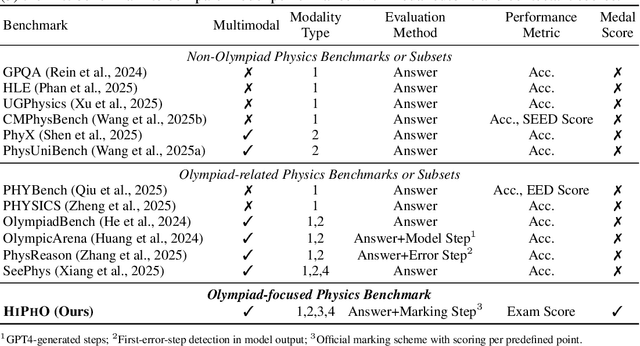
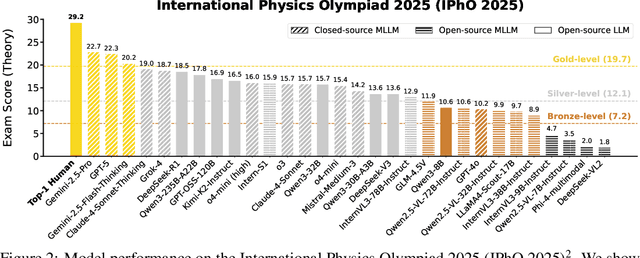
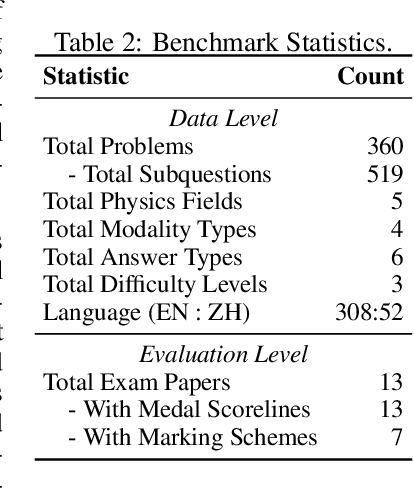
Recently, the physical capabilities of (M)LLMs have garnered increasing attention. However, existing benchmarks for physics suffer from two major gaps: they neither provide systematic and up-to-date coverage of real-world physics competitions such as physics Olympiads, nor enable direct performance comparison with humans. To bridge these gaps, we present HiPhO, the first benchmark dedicated to high school physics Olympiads with human-aligned evaluation. Specifically, HiPhO highlights three key innovations. (1) Comprehensive Data: It compiles 13 latest Olympiad exams from 2024-2025, spanning both international and regional competitions, and covering mixed modalities that encompass problems spanning text-only to diagram-based. (2) Professional Evaluation: We adopt official marking schemes to perform fine-grained grading at both the answer and step level, fully aligned with human examiners to ensure high-quality and domain-specific evaluation. (3) Comparison with Human Contestants: We assign gold, silver, and bronze medals to models based on official medal thresholds, thereby enabling direct comparison between (M)LLMs and human contestants. Our large-scale evaluation of 30 state-of-the-art (M)LLMs shows that: across 13 exams, open-source MLLMs mostly remain at or below the bronze level; open-source LLMs show promising progress with occasional golds; closed-source reasoning MLLMs can achieve 6 to 12 gold medals; and most models still have a significant gap from full marks. These results highlight a substantial performance gap between open-source models and top students, the strong physical reasoning capabilities of closed-source reasoning models, and the fact that there is still significant room for improvement. HiPhO, as a rigorous, human-aligned, and Olympiad-focused benchmark for advancing multimodal physical reasoning, is open-source and available at https://github.com/SciYu/HiPhO.
KAE: Kolmogorov-Arnold Auto-Encoder for Representation Learning
Dec 31, 2024


The Kolmogorov-Arnold Network (KAN) has recently gained attention as an alternative to traditional multi-layer perceptrons (MLPs), offering improved accuracy and interpretability by employing learnable activation functions on edges. In this paper, we introduce the Kolmogorov-Arnold Auto-Encoder (KAE), which integrates KAN with autoencoders (AEs) to enhance representation learning for retrieval, classification, and denoising tasks. Leveraging the flexible polynomial functions in KAN layers, KAE captures complex data patterns and non-linear relationships. Experiments on benchmark datasets demonstrate that KAE improves latent representation quality, reduces reconstruction errors, and achieves superior performance in downstream tasks such as retrieval, classification, and denoising, compared to standard autoencoders and other KAN variants. These results suggest KAE's potential as a useful tool for representation learning. Our code is available at \url{https://github.com/SciYu/KAE/}.