 Add to Chrome
 Add to Firefox
 Add to Edge
ComAct: Reframing Professional Software Manipulation via COM-as-Action Paradigm
Jun 11, 2026
Existing computer-use agents remain fundamentally limited in professional software manipulation: GUI-based agents suffer from fragile visual grounding and long-horizon error accumulation, while API-basedapproaches struggle with heterogeneous protocols and inaccessible commercial interfaces. In this work,we identify the Component Object Model (COM) as a unified executable abstraction, proposing COM-as-Action: a new paradigm that reframes professional software interaction as deterministic program synthesisrather than sequential visual control. To validate this paradigm in the most demanding environments, weintroduce ComCADBench, the first benchmark for agents operating real industrial CAD software. Ourexperiments reveal a substantial paradigm gap: frontier proprietary models achieve near-zero successunder GUI-based interaction, whereas COM-based execution yields substantial immediate gains. Tobridge the remaining gap between syntactic correctness and geometric accuracy, we develop ComActor, aself-correcting agent trained through a progressive three-stage framework, alongside ComForge, a scalableplatform for large-scale training in Windows containers. Extensive experiments show that ComActorachieves state-of-the-art performance on ComCADBench, with strong resilience in long-horizon taskswhere baselines collapse, and generalizes to external CAD benchmark.

IterCAD: An Iterative Multimodal Agent for Visually-Grounded CAD Generation and Editing
Jun 11, 2026Computer-Aided Design is pivotal in modern manufacturing, yet existing automated methods predominantly rely on open-loop, one-shot generation, creating a mismatch with iterative real-world practices. In this paper, we present IterCAD, a unified multimodal agent framework for closed-loop, interactive CAD generation and editing. We formulate the task as a multi-turn interaction between a multimodal agent and an executable CAD sandbox, covering three tasks: Drawing-to-Code, Text-to-Code, and Interactive Editing. To support this, we develop a data synthesis pipeline incorporating advanced industrial manufacturing features to generate standard-compliant multi-view engineering drawings, complex code-editing tasks, and high-fidelity interaction trajectories. We optimize the agent via progressive SFT followed by geometry-aware reinforcement learning with viable-prefix masking to enhance code executability and geometric fidelity. Finally, we introduce the IterCAD-Bench evaluation suite and propose the Chamfer Distance Tolerance-Recall (CD-TR) curve alongside its AUC-TR metric, establishing a survivor-bias-free standard that unifies code validity and geometric precision. Extensive experiments demonstrate that IterCAD achieves highly competitive performance across multiple benchmarks, significantly outperforming existing approaches in both code executability and geometric precision, while exhibiting superior capabilities in closed-loop iterative refinement.
The Agent's First Day: Benchmarking Learning, Exploration, and Scheduling in the Workplace Scenarios
Jan 13, 2026The rapid evolution of Multi-modal Large Language Models (MLLMs) has advanced workflow automation; however, existing research mainly targets performance upper bounds in static environments, overlooking robustness for stochastic real-world deployment. We identify three key challenges: dynamic task scheduling, active exploration under uncertainty, and continuous learning from experience. To bridge this gap, we introduce \method{}, a dynamic evaluation environment that simulates a "trainee" agent continuously exploring a novel setting. Unlike traditional benchmarks, \method{} evaluates agents along three dimensions: (1) context-aware scheduling for streaming tasks with varying priorities; (2) prudent information acquisition to reduce hallucination via active exploration; and (3) continuous evolution by distilling generalized strategies from rule-based, dynamically generated tasks. Experiments show that cutting-edge agents have significant deficiencies in dynamic environments, especially in active exploration and continual learning. Our work establishes a framework for assessing agent reliability, shifting evaluation from static tests to realistic, production-oriented scenarios. Our codes are available at https://github.com/KnowledgeXLab/EvoEnv
Milestones over Outcome: Unlocking Geometric Reasoning with Sub-Goal Verifiable Reward
Jan 08, 2026Multimodal Large Language Models (MLLMs) struggle with complex geometric reasoning, largely because "black box" outcome-based supervision fails to distinguish between lucky guesses and rigorous deduction. To address this, we introduce a paradigm shift towards subgoal-level evaluation and learning. We first construct GeoGoal, a benchmark synthesized via a rigorous formal verification data engine, which converts abstract proofs into verifiable numeric subgoals. This structure reveals a critical divergence between reasoning quality and outcome accuracy. Leveraging this, we propose the Sub-Goal Verifiable Reward (SGVR) framework, which replaces sparse signals with dense rewards based on the Skeleton Rate. Experiments demonstrate that SGVR not only enhances geometric performance (+9.7%) but also exhibits strong generalization, transferring gains to general math (+8.0%) and other general reasoning tasks (+2.8%), demonstrating broad applicability across diverse domains.
GeoBench: Rethinking Multimodal Geometric Problem-Solving via Hierarchical Evaluation
Dec 30, 2025Geometric problem solving constitutes a critical branch of mathematical reasoning, requiring precise analysis of shapes and spatial relationships. Current evaluations of geometric reasoning in vision-language models (VLMs) face limitations, including the risk of test data contamination from textbook-based benchmarks, overemphasis on final answers over reasoning processes, and insufficient diagnostic granularity. To address these issues, we present GeoBench, a hierarchical benchmark featuring four reasoning levels in geometric problem-solving: Visual Perception, Goal-Oriented Planning, Rigorous Theorem Application, and Self-Reflective Backtracking. Through six formally verified tasks generated via TrustGeoGen, we systematically assess capabilities ranging from attribute extraction to logical error correction. Experiments reveal that while reasoning models like OpenAI-o3 outperform general MLLMs, performance declines significantly with increasing task complexity. Key findings demonstrate that sub-goal decomposition and irrelevant premise filtering critically influence final problem-solving accuracy, whereas Chain-of-Thought prompting unexpectedly degrades performance in some tasks. These findings establish GeoBench as a comprehensive benchmark while offering actionable guidelines for developing geometric problem-solving systems.
SymDrive: Realistic and Controllable Driving Simulator via Symmetric Auto-regressive Online Restoration
Dec 25, 2025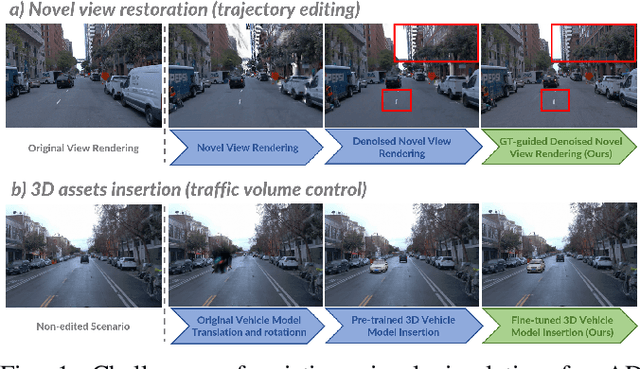
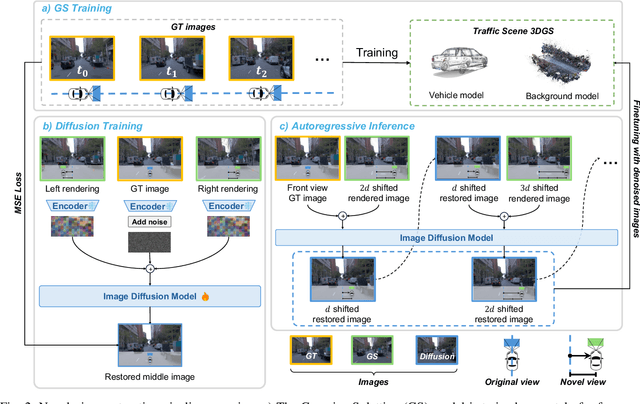
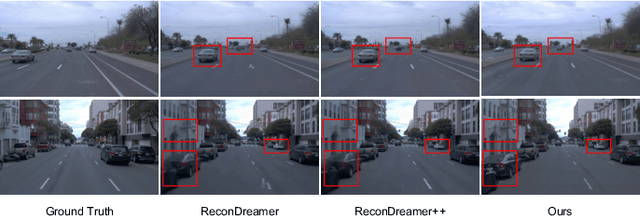
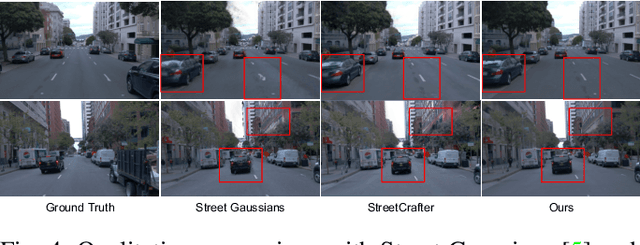
High-fidelity and controllable 3D simulation is essential for addressing the long-tail data scarcity in Autonomous Driving (AD), yet existing methods struggle to simultaneously achieve photorealistic rendering and interactive traffic editing. Current approaches often falter in large-angle novel view synthesis and suffer from geometric or lighting artifacts during asset manipulation. To address these challenges, we propose SymDrive, a unified diffusion-based framework capable of joint high-quality rendering and scene editing. We introduce a Symmetric Auto-regressive Online Restoration paradigm, which constructs paired symmetric views to recover fine-grained details via a ground-truth-guided dual-view formulation and utilizes an auto-regressive strategy for consistent lateral view generation. Furthermore, we leverage this restoration capability to enable a training-free harmonization mechanism, treating vehicle insertion as context-aware inpainting to ensure seamless lighting and shadow consistency. Extensive experiments demonstrate that SymDrive achieves state-of-the-art performance in both novel-view enhancement and realistic 3D vehicle insertion.
Learning on the Job: An Experience-Driven Self-Evolving Agent for Long-Horizon Tasks
Oct 09, 2025Large Language Models have demonstrated remarkable capabilities across diverse domains, yet significant challenges persist when deploying them as AI agents for real-world long-horizon tasks. Existing LLM agents suffer from a critical limitation: they are test-time static and cannot learn from experience, lacking the ability to accumulate knowledge and continuously improve on the job. To address this challenge, we propose MUSE, a novel agent framework that introduces an experience-driven, self-evolving system centered around a hierarchical Memory Module. MUSE organizes diverse levels of experience and leverages them to plan and execute long-horizon tasks across multiple applications. After each sub-task execution, the agent autonomously reflects on its trajectory, converting the raw trajectory into structured experience and integrating it back into the Memory Module. This mechanism enables the agent to evolve beyond its static pretrained parameters, fostering continuous learning and self-evolution. We evaluate MUSE on the long-horizon productivity benchmark TAC. It achieves new SOTA performance by a significant margin using only a lightweight Gemini-2.5 Flash model. Sufficient Experiments demonstrate that as the agent autonomously accumulates experience, it exhibits increasingly superior task completion capabilities, as well as robust continuous learning and self-evolution capabilities. Moreover, the accumulated experience from MUSE exhibits strong generalization properties, enabling zero-shot improvement on new tasks. MUSE establishes a new paradigm for AI agents capable of real-world productivity task automation.
O$^2$-Searcher: A Searching-based Agent Model for Open-Domain Open-Ended Question Answering
May 22, 2025
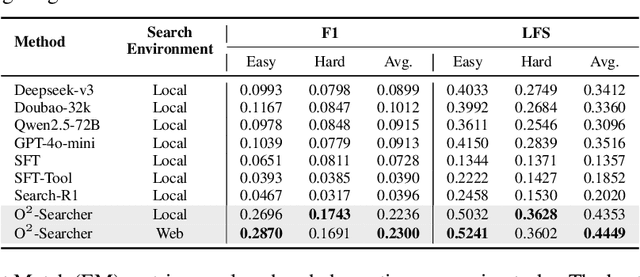
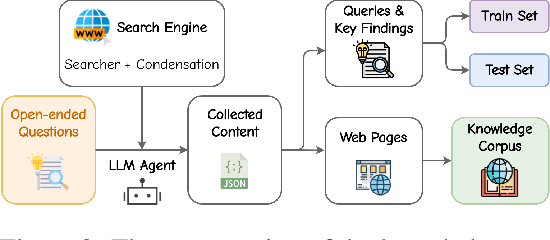
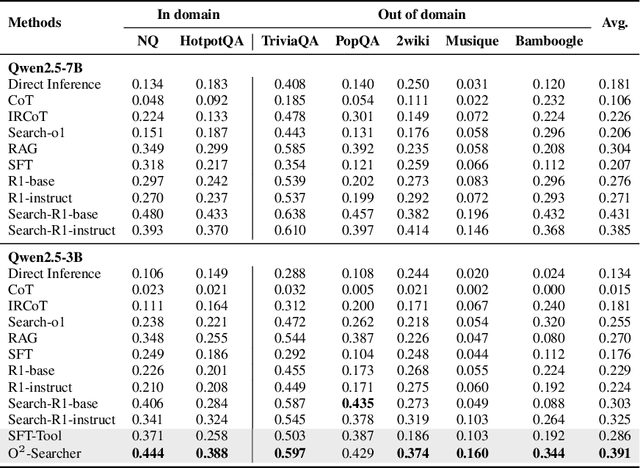
Large Language Models (LLMs), despite their advancements, are fundamentally limited by their static parametric knowledge, hindering performance on tasks requiring open-domain up-to-date information. While enabling LLMs to interact with external knowledge environments is a promising solution, current efforts primarily address closed-end problems. Open-ended questions, which characterized by lacking a standard answer or providing non-unique and diverse answers, remain underexplored. To bridge this gap, we present O$^2$-Searcher, a novel search agent leveraging reinforcement learning to effectively tackle both open-ended and closed-ended questions in the open domain. O$^2$-Searcher leverages an efficient, locally simulated search environment for dynamic knowledge acquisition, effectively decoupling the external world knowledge from model's sophisticated reasoning processes. It employs a unified training mechanism with meticulously designed reward functions, enabling the agent to identify problem types and adapt different answer generation strategies. Furthermore, to evaluate performance on complex open-ended tasks, we construct O$^2$-QA, a high-quality benchmark featuring 300 manually curated, multi-domain open-ended questions with associated web page caches. Extensive experiments show that O$^2$-Searcher, using only a 3B model, significantly surpasses leading LLM agents on O$^2$-QA. It also achieves SOTA results on various closed-ended QA benchmarks against similarly-sized models, while performing on par with much larger ones.
TrustGeoGen: Scalable and Formal-Verified Data Engine for Trustworthy Multi-modal Geometric Problem Solving
Apr 22, 2025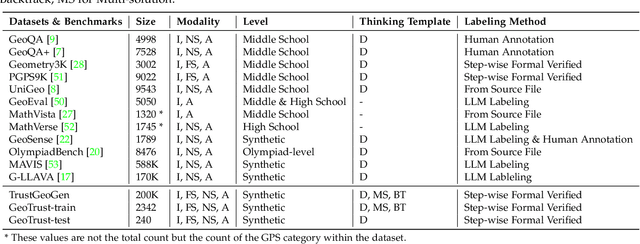
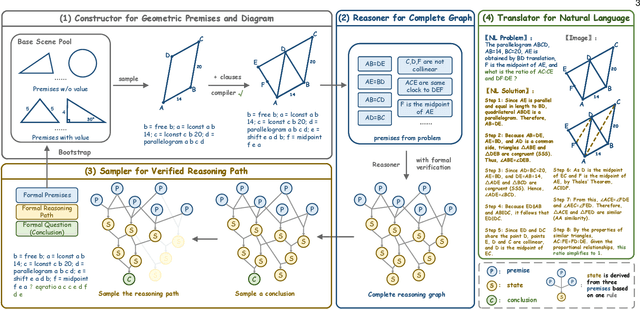
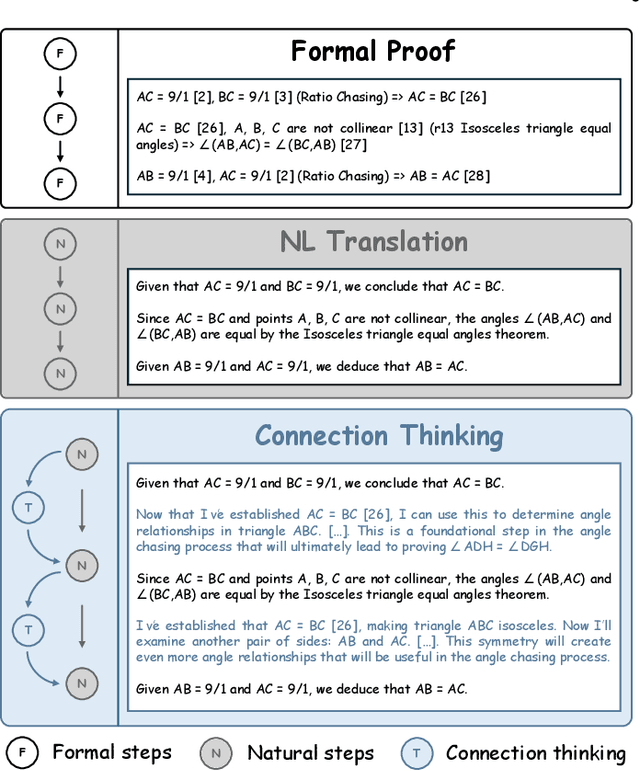
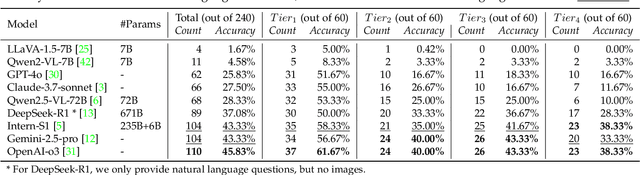
Mathematical geometric problem solving (GPS) often requires effective integration of multimodal information and verifiable logical coherence. Despite the fast development of large language models in general problem solving, it remains unresolved regarding with both methodology and benchmarks, especially given the fact that exiting synthetic GPS benchmarks are often not self-verified and contain noise and self-contradicted information due to the illusion of LLMs. In this paper, we propose a scalable data engine called TrustGeoGen for problem generation, with formal verification to provide a principled benchmark, which we believe lays the foundation for the further development of methods for GPS. The engine synthesizes geometric data through four key innovations: 1) multimodal-aligned generation of diagrams, textual descriptions, and stepwise solutions; 2) formal verification ensuring rule-compliant reasoning paths; 3) a bootstrapping mechanism enabling complexity escalation via recursive state generation and 4) our devised GeoExplore series algorithms simultaneously produce multi-solution variants and self-reflective backtracking traces. By formal logical verification, TrustGeoGen produces GeoTrust-200K dataset with guaranteed modality integrity, along with GeoTrust-test testset. Experiments reveal the state-of-the-art models achieve only 49.17\% accuracy on GeoTrust-test, demonstrating its evaluation stringency. Crucially, models trained on GeoTrust achieve OOD generalization on GeoQA, significantly reducing logical inconsistencies relative to pseudo-label annotated by OpenAI-o1. Our code is available at https://github.com/Alpha-Innovator/TrustGeoGen
MM-Eureka: Exploring Visual Aha Moment with Rule-based Large-scale Reinforcement Learning
Mar 10, 2025We present MM-Eureka, a multimodal reasoning model that successfully extends large-scale rule-based reinforcement learning (RL) to multimodal reasoning. While rule-based RL has shown remarkable success in improving LLMs' reasoning abilities in text domains, its application to multimodal settings has remained challenging. Our work reproduces key characteristics of text-based RL systems like DeepSeek-R1 in the multimodal space, including steady increases in accuracy reward and response length, and the emergence of reflection behaviors. We demonstrate that both instruction-tuned and pre-trained models can develop strong multimodal reasoning capabilities through rule-based RL without supervised fine-tuning, showing superior data efficiency compared to alternative approaches. We open-source our complete pipeline to foster further research in this area. We release all our codes, models, data, etc. at https://github.com/ModalMinds/MM-EUREKA