 Add to Chrome
 Add to Firefox
 Add to Edge
MetaReason: Precise Interleaved Multimodal Reasoning via Editing Meta Information for Solving Geometry Problems
Aug 15, 2026
Although visual reasoning is crucial for solving complex geometry tasks, existing vision-language models rely heavily on text-only reasoning. Some recent methods introduce intermediate visual states to facilitate reasoning, but they are often hindered by inaccurate geometric representations and low rendering fidelity, ultimately leading to unreliable outputs. To address these limitations, we propose MetaReason, a framework for multimodal reasoning in plane geometry that leverages structured meta-information to enable accurate auxiliary-line construction. The framework first parses geometric images into meta-information, performs controllable edits with predefined tools to synthesize high-fidelity visual states, and then conducts reasoning based on these augmented views. To support this framework, we construct TutorGeo, a comprehensive dataset containing 17k image-to-meta conversion samples, 60k text-only reasoning traces, and 60k interleaved multimodal reasoning traces. Using this dataset, we combine supervised fine-tuning and reinforcement learning to develop robust multimodal reasoning capabilities. We also introduce ExamGeo, a benchmark derived from real-world examination problems that enables systematic evaluation across varying difficulty levels. Experimental results demonstrate that MetaReason significantly outperforms existing open-source models and achieves competitive performance against proprietary models.

AutoTrainess: Teaching Language Models to Improve Language Models Autonomously
Jun 30, 2026Training language models (LMs) remains a highly human-intensive process, even as frontier language model agents become increasingly capable at software engineering and other long-horizon tasks. A central challenge is that autonomous post-training is not just a coding problem: it requires the agent to repeatedly plan iterations, construct benchmark-aligned data, run stable training jobs, evaluate checkpoints, and preserve experiment state across many hours of interaction. We present AutoTrainess, a LM agent that exposes these operations as a repository of agent-computer interfaces for planning, data preparation, training, evaluation, and logging. Rather than leaving the agent to operate in a raw CLI environment with an underspecified action space, AutoTrainess externalizes prior human experience as explicit workflows, rules, and execution constraints that guide the agent toward effective and reliable training behavior. On PostTrainBench, AutoTrainess consistently outperforms CLI-only baselines, achieving 26.94 average score with GPT-5.4 (Codex) versus 23.21 for CLI-only. It also generalizes across models and harnesses, improving DeepSeek-V4-Flash (OpenCode) from 12.13 to 19.58.
InternVL-U: Democratizing Unified Multimodal Models for Understanding, Reasoning, Generation and Editing
Mar 10, 2026Unified multimodal models (UMMs) that integrate understanding, reasoning, generation, and editing face inherent trade-offs between maintaining strong semantic comprehension and acquiring powerful generation capabilities. In this report, we present InternVL-U, a lightweight 4B-parameter UMM that democratizes these capabilities within a unified framework. Guided by the principles of unified contextual modeling and modality-specific modular design with decoupled visual representations, InternVL-U integrates a state-of-the-art Multimodal Large Language Model (MLLM) with a specialized MMDiT-based visual generation head. To further bridge the gap between aesthetic generation and high-level intelligence, we construct a comprehensive data synthesis pipeline targeting high-semantic-density tasks, such as text rendering and scientific reasoning, under a reasoning-centric paradigm that leverages Chain-of-Thought (CoT) to better align abstract user intent with fine-grained visual generation details. Extensive experiments demonstrate that InternVL-U achieves a superior performance - efficiency balance. Despite using only 4B parameters, it consistently outperforms unified baseline models with over 3x larger scales such as BAGEL (14B) on various generation and editing tasks, while retaining strong multimodal understanding and reasoning capabilities.
GenExam: A Multidisciplinary Text-to-Image Exam
Sep 17, 2025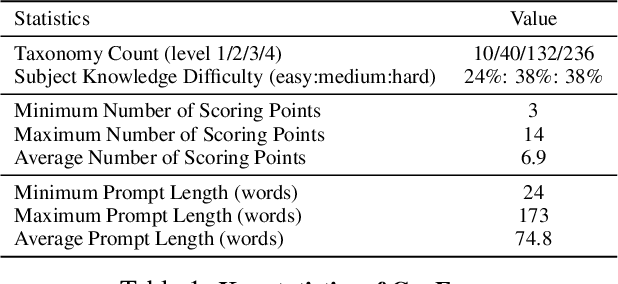
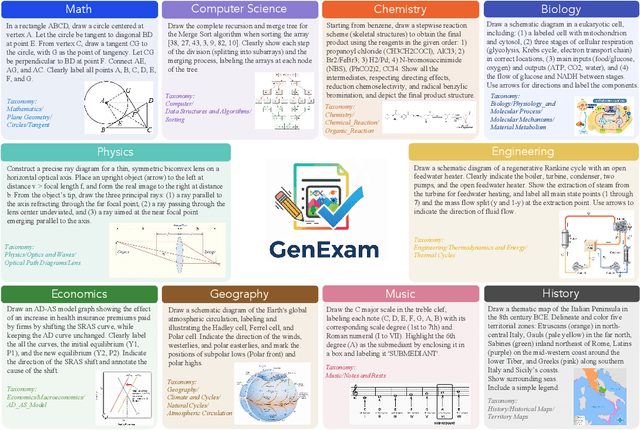
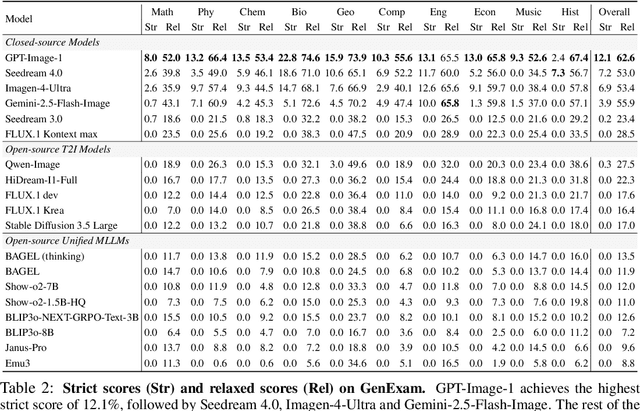
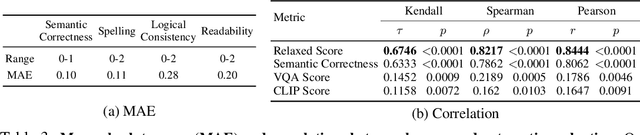
Exams are a fundamental test of expert-level intelligence and require integrated understanding, reasoning, and generation. Existing exam-style benchmarks mainly focus on understanding and reasoning tasks, and current generation benchmarks emphasize the illustration of world knowledge and visual concepts, neglecting the evaluation of rigorous drawing exams. We introduce GenExam, the first benchmark for multidisciplinary text-to-image exams, featuring 1,000 samples across 10 subjects with exam-style prompts organized under a four-level taxonomy. Each problem is equipped with ground-truth images and fine-grained scoring points to enable a precise evaluation of semantic correctness and visual plausibility. Experiments show that even state-of-the-art models such as GPT-Image-1 and Gemini-2.5-Flash-Image achieve less than 15% strict scores, and most models yield almost 0%, suggesting the great challenge of our benchmark. By framing image generation as an exam, GenExam offers a rigorous assessment of models' ability to integrate knowledge, reasoning, and generation, providing insights on the path to general AGI.