 Add to Chrome
 Add to Firefox
 Add to Edge
AlignMamba: Enhancing Multimodal Mamba with Local and Global Cross-modal Alignment
Dec 01, 2024
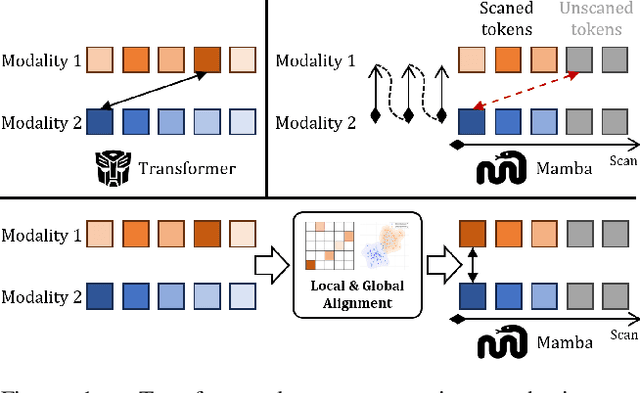
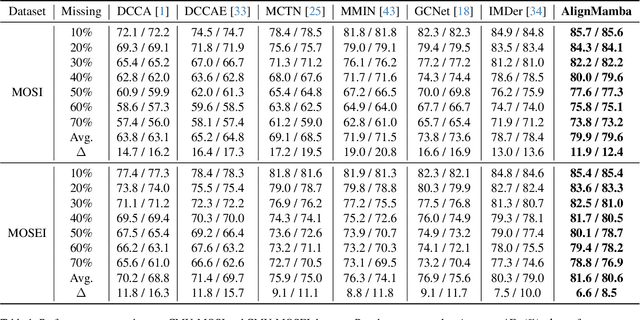
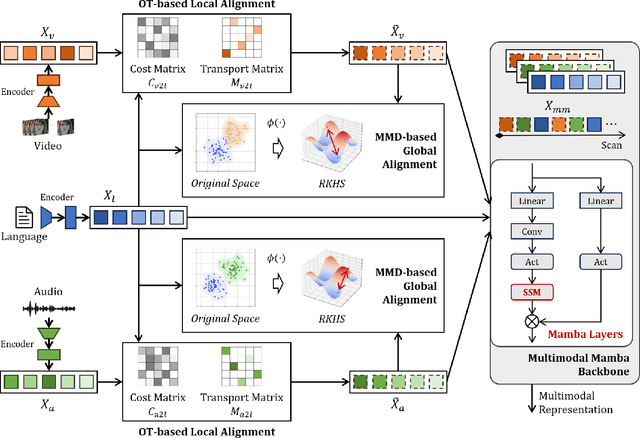
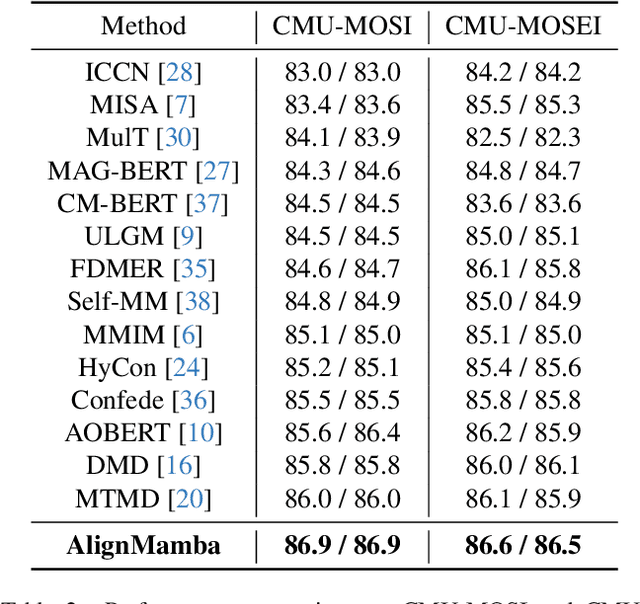
Cross-modal alignment is crucial for multimodal representation fusion due to the inherent heterogeneity between modalities. While Transformer-based methods have shown promising results in modeling inter-modal relationships, their quadratic computational complexity limits their applicability to long-sequence or large-scale data. Although recent Mamba-based approaches achieve linear complexity, their sequential scanning mechanism poses fundamental challenges in comprehensively modeling cross-modal relationships. To address this limitation, we propose AlignMamba, an efficient and effective method for multimodal fusion. Specifically, grounded in Optimal Transport, we introduce a local cross-modal alignment module that explicitly learns token-level correspondences between different modalities. Moreover, we propose a global cross-modal alignment loss based on Maximum Mean Discrepancy to implicitly enforce the consistency between different modal distributions. Finally, the unimodal representations after local and global alignment are passed to the Mamba backbone for further cross-modal interaction and multimodal fusion. Extensive experiments on complete and incomplete multimodal fusion tasks demonstrate the effectiveness and efficiency of the proposed method.

Learn to Unlearn: Meta-Learning-Based Knowledge Graph Embedding Unlearning
Dec 01, 2024
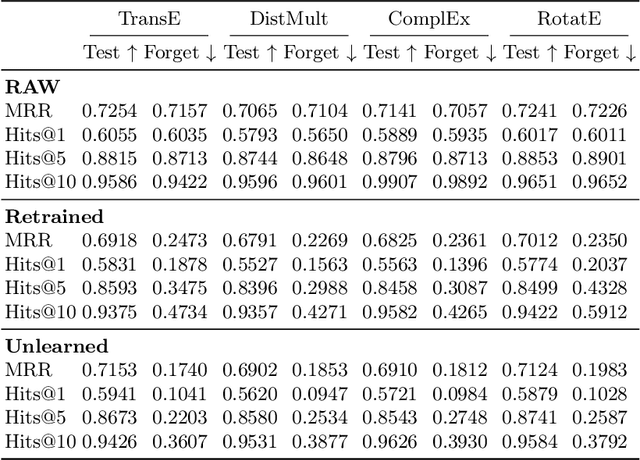


Knowledge graph (KG) embedding methods map entities and relations into continuous vector spaces, improving performance in tasks like link prediction and question answering. With rising privacy concerns, machine unlearning (MU) has emerged as a critical AI technology, enabling models to eliminate the influence of specific data. Existing MU approaches often rely on data obfuscation and adjustments to training loss but lack generalization across unlearning tasks. This paper introduces MetaEU, a Meta-Learning-Based Knowledge Graph Embedding Unlearning framework. MetaEU leverages meta-learning to unlearn specific embeddings, mitigating their impact while preserving model performance on remaining data. Experiments on benchmark datasets demonstrate its effectiveness in KG embedding unlearning.
A Unified Platform for At-Home Post-Stroke Rehabilitation Enabled by Wearable Technologies and Artificial Intelligence
Nov 28, 2024
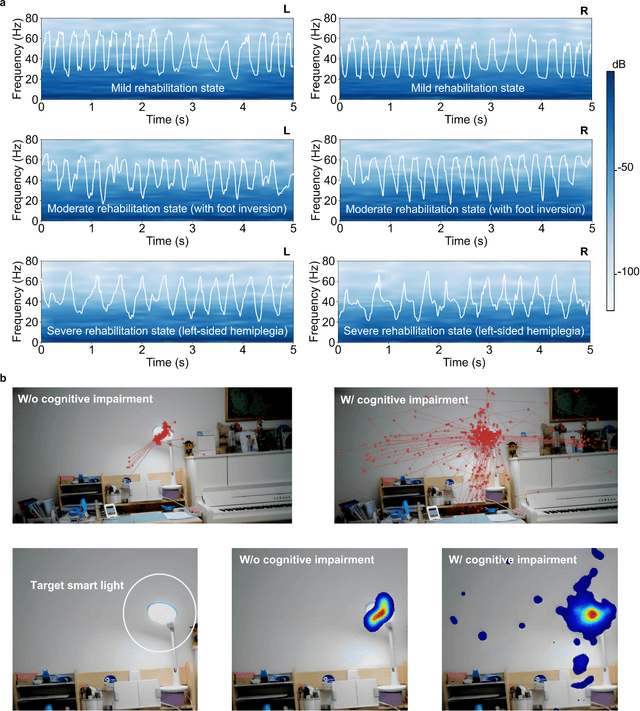


At-home rehabilitation for post-stroke patients presents significant challenges, as continuous, personalized care is often limited outside clinical settings. Additionally, the absence of comprehensive solutions addressing diverse rehabilitation needs in home environments complicates recovery efforts. Here, we introduce a smart home platform that integrates wearable sensors, ambient monitoring, and large language model (LLM)-powered assistance to provide seamless health monitoring and intelligent support. The system leverages machine learning enabled plantar pressure arrays for motor recovery assessment (94% classification accuracy), a wearable eye-tracking module for cognitive evaluation, and ambient sensors for precise smart home control (100% operational success, <1 s latency). Additionally, the LLM-powered agent, Auto-Care, offers real-time interventions, such as health reminders and environmental adjustments, enhancing user satisfaction by 29%. This work establishes a fully integrated platform for long-term, personalized rehabilitation, offering new possibilities for managing chronic conditions and supporting aging populations.
SuperGaussians: Enhancing Gaussian Splatting Using Primitives with Spatially Varying Colors
Nov 28, 2024

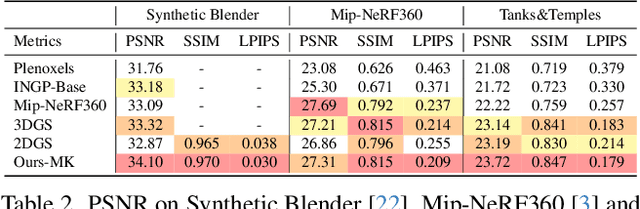

Gaussian Splattings demonstrate impressive results in multi-view reconstruction based on Gaussian explicit representations. However, the current Gaussian primitives only have a single view-dependent color and an opacity to represent the appearance and geometry of the scene, resulting in a non-compact representation. In this paper, we introduce a new method called SuperGaussians that utilizes spatially varying colors and opacity in a single Gaussian primitive to improve its representation ability. We have implemented bilinear interpolation, movable kernels, and even tiny neural networks as spatially varying functions. Quantitative and qualitative experimental results demonstrate that all three functions outperform the baseline, with the best movable kernels achieving superior novel view synthesis performance on multiple datasets, highlighting the strong potential of spatially varying functions.
Multi-Task Label Discovery via Hierarchical Task Tokens for Partially Annotated Dense Predictions
Nov 27, 2024In recent years, simultaneous learning of multiple dense prediction tasks with partially annotated label data has emerged as an important research area. Previous works primarily focus on constructing cross-task consistency or conducting adversarial training to regularize cross-task predictions, which achieve promising performance improvements, while still suffering from the lack of direct pixel-wise supervision for multi-task dense predictions. To tackle this challenge, we propose a novel approach to optimize a set of learnable hierarchical task tokens, including global and fine-grained ones, to discover consistent pixel-wise supervision signals in both feature and prediction levels. Specifically, the global task tokens are designed for effective cross-task feature interactions in a global context. Then, a group of fine-grained task-specific spatial tokens for each task is learned from the corresponding global task tokens. It is embedded to have dense interactions with each task-specific feature map. The learned global and local fine-grained task tokens are further used to discover pseudo task-specific dense labels at different levels of granularity, and they can be utilized to directly supervise the learning of the multi-task dense prediction framework. Extensive experimental results on challenging NYUD-v2, Cityscapes, and PASCAL Context datasets demonstrate significant improvements over existing state-of-the-art methods for partially annotated multi-task dense prediction.
COBRA: A Continual Learning Approach to Vision-Brain Understanding
Nov 25, 2024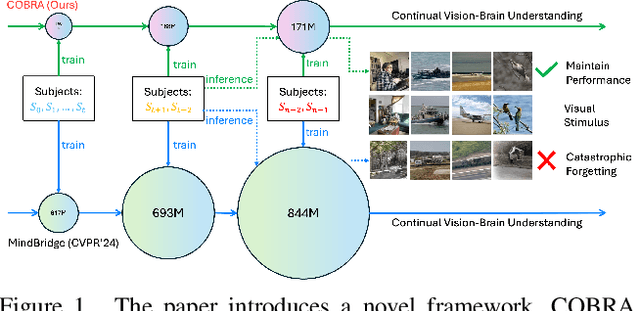


Vision-Brain Understanding (VBU) aims to extract visual information perceived by humans from brain activity recorded through functional Magnetic Resonance Imaging (fMRI). Despite notable advancements in recent years, existing studies in VBU continue to face the challenge of catastrophic forgetting, where models lose knowledge from prior subjects as they adapt to new ones. Addressing continual learning in this field is, therefore, essential. This paper introduces a novel framework called Continual Learning for Vision-Brain (COBRA) to address continual learning in VBU. Our approach includes three novel modules: a Subject Commonality (SC) module, a Prompt-based Subject Specific (PSS) module, and a transformer-based module for fMRI, denoted as MRIFormer module. The SC module captures shared vision-brain patterns across subjects, preserving this knowledge as the model encounters new subjects, thereby reducing the impact of catastrophic forgetting. On the other hand, the PSS module learns unique vision-brain patterns specific to each subject. Finally, the MRIFormer module contains a transformer encoder and decoder that learns the fMRI features for VBU from common and specific patterns. In a continual learning setup, COBRA is trained in new PSS and MRIFormer modules for new subjects, leaving the modules of previous subjects unaffected. As a result, COBRA effectively addresses catastrophic forgetting and achieves state-of-the-art performance in both continual learning and vision-brain reconstruction tasks, surpassing previous methods.
TableTime: Reformulating Time Series Classification as Zero-Shot Table Understanding via Large Language Models
Nov 24, 2024


Large language models (LLMs) have demonstrated their effectiveness in multivariate time series classification (MTSC). Effective adaptation of LLMs for MTSC necessitates informative data representations. Existing LLM-based methods directly encode embeddings for time series within the latent space of LLMs from scratch to align with semantic space of LLMs. Despite their effectiveness, we reveal that these methods conceal three inherent bottlenecks: (1) they struggle to encode temporal and channel-specific information in a lossless manner, both of which are critical components of multivariate time series; (2) it is much difficult to align the learned representation space with the semantic space of the LLMs; (3) they require task-specific retraining, which is both computationally expensive and labor-intensive. To bridge these gaps, we propose TableTime, which reformulates MTSC as a table understanding task. Specifically, TableTime introduces the following strategies: (1) convert multivariate time series into a tabular form, thus minimizing information loss to the greatest extent; (2) represent tabular time series in text format to achieve natural alignment with the semantic space of LLMs; (3) design a reasoning framework that integrates contextual text information, neighborhood assistance, multi-path inference and problem decomposition to enhance the reasoning ability of LLMs and realize zero-shot classification. Extensive experiments performed on 10 publicly representative datasets from UEA archive verify the superiorities of the TableTime.
TPOT: Topology Preserving Optimal Transport in Retinal Fundus Image Enhancement
Nov 03, 2024


Retinal fundus photography enhancement is important for diagnosing and monitoring retinal diseases. However, early approaches to retinal image enhancement, such as those based on Generative Adversarial Networks (GANs), often struggle to preserve the complex topological information of blood vessels, resulting in spurious or missing vessel structures. The persistence diagram, which captures topological features based on the persistence of topological structures under different filtrations, provides a promising way to represent the structure information. In this work, we propose a topology-preserving training paradigm that regularizes blood vessel structures by minimizing the differences of persistence diagrams. We call the resulting framework Topology Preserving Optimal Transport (TPOT). Experimental results on a large-scale dataset demonstrate the superiority of the proposed method compared to several state-of-the-art supervised and unsupervised techniques, both in terms of image quality and performance in the downstream blood vessel segmentation task. The code is available at https://github.com/Retinal-Research/TPOT.
GraphTeam: Facilitating Large Language Model-based Graph Analysis via Multi-Agent Collaboration
Oct 23, 2024

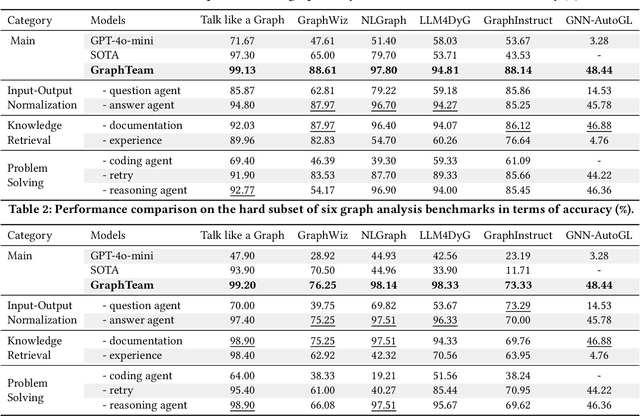

Graphs are widely used for modeling relational data in real-world scenarios, such as social networks and urban computing. Existing LLM-based graph analysis approaches either integrate graph neural networks (GNNs) for specific machine learning tasks, limiting their transferability, or rely solely on LLMs' internal reasoning ability, resulting in suboptimal performance. To address these limitations, we take advantage of recent advances in LLM-based agents, which have shown capabilities of utilizing external knowledge or tools for problem solving. By simulating human problem-solving strategies such as analogy and collaboration, we propose a multi-agent system based on LLMs named GraphTeam, for graph analysis. GraphTeam consists of five LLM-based agents from three modules, and the agents with different specialities can collaborate with each other to address complex problems. Specifically, (1) input-output normalization module: the question agent extracts and refines four key arguments from the original question, facilitating the problem understanding, and the answer agent organizes the results to meet the output requirement; (2) external knowledge retrieval module: we first build a knowledge base consisting of relevant documentation and experience information, and then the search agent retrieves the most relevant entries for each question. (3) problem-solving module: given the retrieved information from search agent, the coding agent uses established algorithms via programming to generate solutions, and in case the coding agent does not work, the reasoning agent will directly compute the results without programming. Extensive experiments on six graph analysis benchmarks demonstrate that GraphTeam achieves state-of-the-art performance with an average 25.85% improvement over the best baseline in terms of accuracy. The code and data are available at https://github.com/BUPT-GAMMA/GraphTeam.
Breaking the Memory Barrier: Near Infinite Batch Size Scaling for Contrastive Loss
Oct 22, 2024


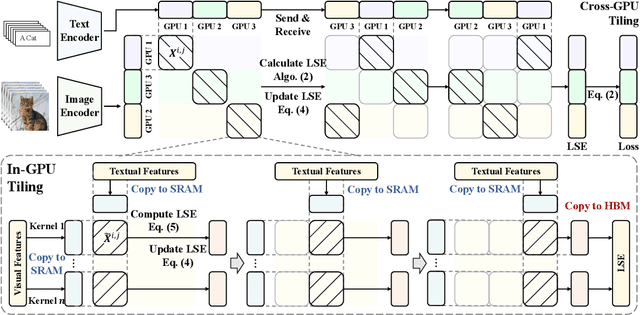
Contrastive loss is a powerful approach for representation learning, where larger batch sizes enhance performance by providing more negative samples to better distinguish between similar and dissimilar data. However, scaling batch sizes is constrained by the quadratic growth in GPU memory consumption, primarily due to the full instantiation of the similarity matrix. To address this, we propose a tile-based computation strategy that partitions the contrastive loss calculation into arbitrary small blocks, avoiding full materialization of the similarity matrix. Furthermore, we introduce a multi-level tiling strategy to leverage the hierarchical structure of distributed systems, employing ring-based communication at the GPU level to optimize synchronization and fused kernels at the CUDA core level to reduce I/O overhead. Experimental results show that the proposed method scales batch sizes to unprecedented levels. For instance, it enables contrastive training of a CLIP-ViT-L/14 model with a batch size of 4M or 12M using 8 or 32 A800 80GB without sacrificing any accuracy. Compared to SOTA memory-efficient solutions, it achieves a two-order-of-magnitude reduction in memory while maintaining comparable speed. The code will be made publicly available.