 Add to Chrome
 Add to Firefox
 Add to Edge
Dynamic SpectraFormer for Ultra-High-Definition Underwater Image Enhancement
Aug 19, 2026
Underwater images suffer from color distortion, haze, and poor visibility due to light refraction and absorption in water. These challenges significantly impact the utilization of Autonomous Underwater Vehicles (AUVs) or marine robots. Typically, color and brightness distortions manifest at lower frequencies, while edge and texture distortions are prevalent at higher frequencies. Traditional methods struggle to concurrently rectify these mixed distortions as they primarily concentrate on the spatial domain. To address these issues, we introduce the Dynamic SpectraFormer, which enhances underwater images through a frequency domain transformer. The Dynamic SpectraFormer introduces an ultra-high-resolution sparse spectrum attention module, which could capture the long-term dependency without losing the universal approximating power. Additionally, we have developed a dynamic spectrum weight generation layer that serves as an adaptive spectrum band selector, accentuating critical frequency bands and suppressing less relevant ones. Consequently, this method significantly improves underwater image quality by addressing both high- and low-frequency distortions. Our extensive ablation studies and comparative evaluations consolidate the Dynamic SpectraFormer's efficacy across multiple underwater image enhancement benchmarks. The source code is available at https://github.com/arifence2024/DynamicSpectraFormer.git.
* 8 pages, 7 figures. Published in the 2024 IEEE/RSJ International Conference on Intelligent Robots and Systems (IROS 2024)

MotionGS-SLAM: Event-Modulated Gaussian Splatting for Motion-Blur Robust SLAM
Aug 15, 2026Current Vision-based SLAM systems fail catastrophically when motion blur corrupts the visual input, as they attempt the ill-posed inverse problem of recovering sharp content from degraded observations. We present MotionGS-SLAM, which fundamentally reimagines motion blur handling through a paradigm shift: rather than removing blur artifacts, we reformulate the challenge as a well-constrained forward problem that generatively models blur formation within the rendering pipeline. By leveraging event cameras' microsecond temporal resolution and immunity to motion blur, we introduce a novel event-modulated Gaussian kernel that dynamically adapts each Gaussian's rasterization based on precise motion cues. Our dual-modulation mechanism transforms 2D Gaussian projections from isotropic dots into anisotropic, motion-aligned elliptical brush strokes (spatial modulation) while adaptively varying exposure integral sampling density based on local velocity (temporal modulation). This physics-based approach enables joint optimization of intra-exposure camera trajectories and 3D scene geometry through blur-aware photometric and event-based constraints. Extensive experiments demonstrate significant improvements over state-of-the-art methods in trajectory accuracy and map quality under severe high-motion conditions.
* 8 pages, 5 figures. Published in the 2026 IEEE International Conference on Robotics and Automation
GaussMemory: Task-Driven 3D Gaussian Scene Memory for Long-Horizon Robotic Manipulation
Aug 15, 2026Long-horizon robotic manipulation fundamentally relies on persistent spatial memory. However, existing 3D memory systems function merely as passive recorders: they store observations using fixed, hand-crafted rules, treating every scene element--whether a critical grasp target or an irrelevant background wall--with equal importance. In this paper, we propose a paradigm shift from passive storage to active, task-driven spatial memory. We argue that a robot's memory should not simply record what it sees, but actively learn how to remember--discovering which objects to track precisely, how aggressively to update them, and what to discard, all learned end-to-end without hand-designed rules. Crucially, this active paradigm is realized by unifying memory update and readout as two sides of the same cognitive process, enabling bidirectional flow where task needs shape update strategies and vice versa. To instantiate this vision, we introduce GaussMemory, which leverages 3D Gaussian Splatting as a persistent geometric substrate. On LIBERO, GaussMemory outperforms MemoryVLA on Goal and Long-10; on VLABench, it surpasses $π_0$-FAST by +5.2% (Track 1) and +6.0% (Track 6).
UAV Video Deblurring via Motion-Aware Diffusion: A Path to Robust Target Detection
Aug 15, 2026Unmanned Aerial Vehicles (UAVs) play a crucial role in various scenarios ranging from disaster response to traffic surveillance. However, aerial video footage often suffers from severe motion blur due to rapid flight maneuvers, vibrations, and camera panning, which can significantly degrade downstream tasks such as target detection. Our goal is to explore a computationally-efficient and effective video deblurring approach to enhance UAV target detection performance. To reduce computational cost, we first propose an Adaptive Latent Scale Selector that dynamically adjusts the latent space resolution according to the intensity of UAV motion, thus balancing detail preservation with inference efficiency. To ensure temporal consistency, we introduce a Multi-Frame Alignment and Learnable Gating module to warp and gate the preceding frames, allowing the model to fuse only relevant temporal information and suppress misaligned or uninformative features. Our method can effectively recover sharp details from the UAV video stream. Extensive experiments on real UAV benchmarks demonstrate that our method not only yields superior deblurring performance but also significantly boosts target detection accuracy, making it highly applicable to robust aerial vision tasks.
RPS: Information Elicitation with Reinforcement Prompt Selection
Apr 15, 2026Large language models (LLMs) have shown remarkable capabilities in dialogue generation and reasoning, yet their effectiveness in eliciting user-known but concealed information in open-ended conversations remains limited. In many interactive AI applications, such as personal assistants, tutoring systems, and legal or clinical support, users often withhold sensitive or uncertain information due to privacy concerns, ambiguity, or social hesitation. This makes it challenging for LLMs to gather complete and contextually relevant inputs. In this work, we define the problem of information elicitation in open-ended dialogue settings and propose Reinforcement Prompt Selection (RPS), a lightweight reinforcement learning framework that formulates prompt selection as a sequential decision-making problem. To analyze this problem in a controlled setting, we design a synthetic experiment, where a reinforcement learning agent outperforms a random query baseline, illustrating the potential of policy-based approaches for adaptive information elicitation. Building on this insight, RPS learns a policy over a pool of prompts to adaptively elicit concealed or incompletely expressed information from users through dialogue. We also introduce IELegal, a new benchmark dataset constructed from real legal case documents, which simulates dialogue-based information elicitation tasks aimed at uncovering case-relevant facts. In this setting, RPS outperforms static prompt baselines, demonstrating the effectiveness of adaptive prompt selection for eliciting critical information in LLM-driven dialogue systems.
From Perception to Action: An Interactive Benchmark for Vision Reasoning
Feb 24, 2026Understanding the physical structure is essential for real-world applications such as embodied agents, interactive design, and long-horizon manipulation. Yet, prevailing Vision-Language Model (VLM) evaluations still center on structure-agnostic, single-turn setups (e.g., VQA), which fail to assess agents' ability to reason about how geometry, contact, and support relations jointly constrain what actions are possible in a dynamic environment. To address this gap, we introduce the Causal Hierarchy of Actions and Interactions (CHAIN) benchmark, an interactive 3D, physics-driven testbed designed to evaluate whether models can understand, plan, and execute structured action sequences grounded in physical constraints. CHAIN shifts evaluation from passive perception to active problem solving, spanning tasks such as interlocking mechanical puzzles and 3D stacking and packing. We conduct a comprehensive study of state-of-the-art VLMs and diffusion-based models under unified interactive settings. Our results show that top-performing models still struggle to internalize physical structure and causal constraints, often failing to produce reliable long-horizon plans and cannot robustly translate perceived structure into effective actions. The project is available at https://social-ai-studio.github.io/CHAIN/.
Learning Text Styles: A Study on Transfer, Attribution, and Verification
Jul 22, 2025This thesis advances the computational understanding and manipulation of text styles through three interconnected pillars: (1) Text Style Transfer (TST), which alters stylistic properties (e.g., sentiment, formality) while preserving content; (2)Authorship Attribution (AA), identifying the author of a text via stylistic fingerprints; and (3) Authorship Verification (AV), determining whether two texts share the same authorship. We address critical challenges in these areas by leveraging parameter-efficient adaptation of large language models (LLMs), contrastive disentanglement of stylistic features, and instruction-based fine-tuning for explainable verification.
Multimodal Mathematical Reasoning with Diverse Solving Perspective
Jul 03, 2025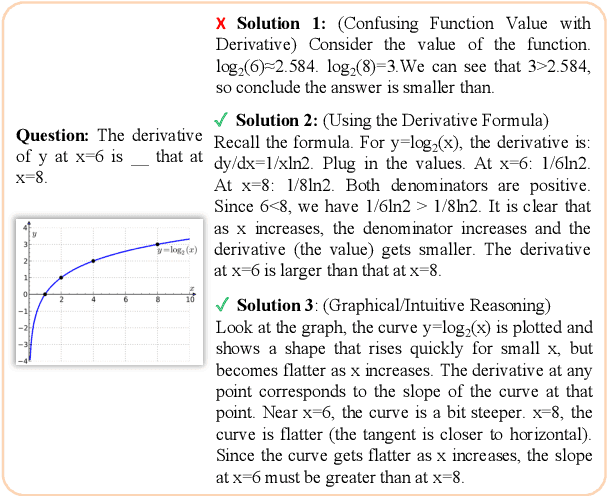
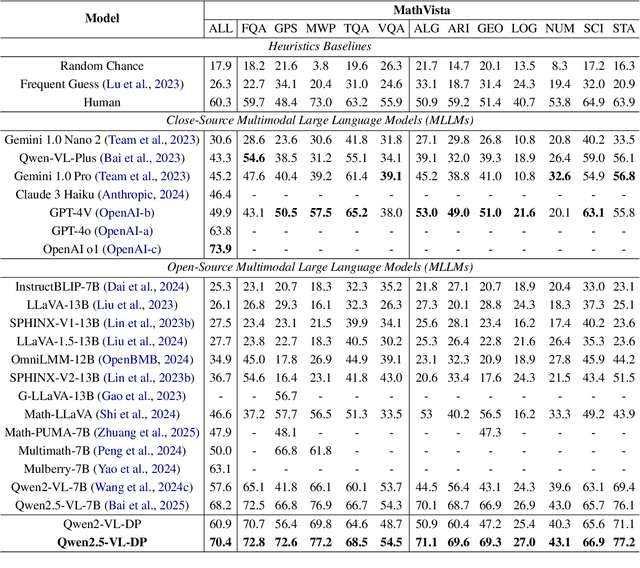
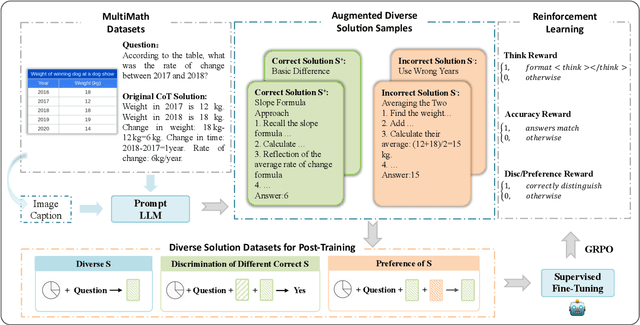
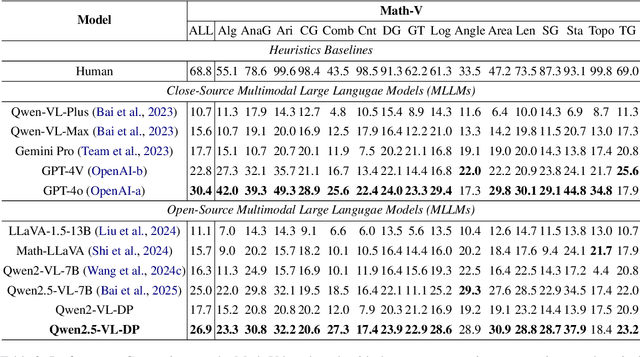
Recent progress in large-scale reinforcement learning (RL) has notably enhanced the reasoning capabilities of large language models (LLMs), especially in mathematical domains. However, current multimodal LLMs (MLLMs) for mathematical reasoning often rely on one-to-one image-text pairs and single-solution supervision, overlooking the diversity of valid reasoning perspectives and internal reflections. In this work, we introduce MathV-DP, a novel dataset that captures multiple diverse solution trajectories for each image-question pair, fostering richer reasoning supervision. We further propose Qwen-VL-DP, a model built upon Qwen-VL, fine-tuned with supervised learning and enhanced via group relative policy optimization (GRPO), a rule-based RL approach that integrates correctness discrimination and diversity-aware reward functions. Our method emphasizes learning from varied reasoning perspectives and distinguishing between correct yet distinct solutions. Extensive experiments on the MathVista's minitest and Math-V benchmarks demonstrate that Qwen-VL-DP significantly outperforms prior base MLLMs in both accuracy and generative diversity, highlighting the importance of incorporating diverse perspectives and reflective reasoning in multimodal mathematical reasoning.
LongWriter-Zero: Mastering Ultra-Long Text Generation via Reinforcement Learning
Jun 23, 2025Ultra-long generation by large language models (LLMs) is a widely demanded scenario, yet it remains a significant challenge due to their maximum generation length limit and overall quality degradation as sequence length increases. Previous approaches, exemplified by LongWriter, typically rely on ''teaching'', which involves supervised fine-tuning (SFT) on synthetic long-form outputs. However, this strategy heavily depends on synthetic SFT data, which is difficult and costly to construct, often lacks coherence and consistency, and tends to be overly artificial and structurally monotonous. In this work, we propose an incentivization-based approach that, starting entirely from scratch and without relying on any annotated or synthetic data, leverages reinforcement learning (RL) to foster the emergence of ultra-long, high-quality text generation capabilities in LLMs. We perform RL training starting from a base model, similar to R1-Zero, guiding it to engage in reasoning that facilitates planning and refinement during the writing process. To support this, we employ specialized reward models that steer the LLM towards improved length control, writing quality, and structural formatting. Experimental evaluations show that our LongWriter-Zero model, trained from Qwen2.5-32B, consistently outperforms traditional SFT methods on long-form writing tasks, achieving state-of-the-art results across all metrics on WritingBench and Arena-Write, and even surpassing 100B+ models such as DeepSeek R1 and Qwen3-235B. We open-source our data and model checkpoints under https://huggingface.co/THU-KEG/LongWriter-Zero-32B
SuperWriter: Reflection-Driven Long-Form Generation with Large Language Models
Jun 04, 2025
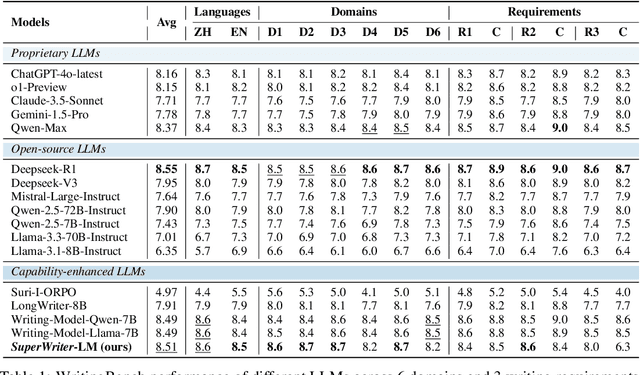

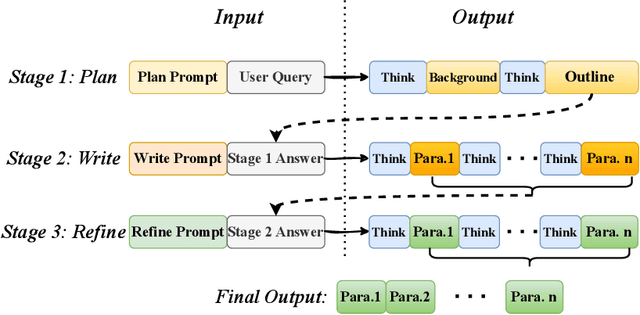
Long-form text generation remains a significant challenge for large language models (LLMs), particularly in maintaining coherence, ensuring logical consistency, and preserving text quality as sequence length increases. To address these limitations, we propose SuperWriter-Agent, an agent-based framework designed to enhance the quality and consistency of long-form text generation. SuperWriter-Agent introduces explicit structured thinking-through planning and refinement stages into the generation pipeline, guiding the model to follow a more deliberate and cognitively grounded process akin to that of a professional writer. Based on this framework, we construct a supervised fine-tuning dataset to train a 7B SuperWriter-LM. We further develop a hierarchical Direct Preference Optimization (DPO) procedure that uses Monte Carlo Tree Search (MCTS) to propagate final quality assessments and optimize each generation step accordingly. Empirical results across diverse benchmarks demonstrate that SuperWriter-LM achieves state-of-the-art performance, surpassing even larger-scale baseline models in both automatic evaluation and human evaluation. Furthermore, comprehensive ablation studies demonstrate the effectiveness of hierarchical DPO and underscore the value of incorporating structured thinking steps to improve the quality of long-form text generation.