 Add to Chrome
 Add to Firefox
 Add to Edge
AS-FedBridge: Pseudo-Spike Bridge Distillation for Heterogeneous ANN-SNN Federated Learning
Aug 04, 2026
Federated learning enables collaborative model training across distributed edge devices while strictly preserving data privacy. To facilitate practical deployment on resource-constrained edge devices, Spiking Neural Networks (SNNs) have emerged as a promising alternative to traditional Artificial Neural Networks (ANNs) due to their sparse computing mechanisms and high energy efficiency. However, jointly training ANNs and SNNs exposes a challenge of representational misalignment, which is intrinsically caused by differences in information representation, specifically the semantic gap between continuous real-valued activations in ANNs and discrete spatio-temporal spikes in SNNs. To overcome this barrier, we propose AS-FedBridge, a novel federated learning framework tailored for mixed ANN-SNN clients. AS-FedBridge features a lightweight Bridge equipped with a Pseudo-Spike Interface, which effectively projects continuous signals into a spike-compatible space to facilitate ANN-SNN alignment. Given the absence of existing mixed ANN-SNN federated frameworks, we establish a comprehensive benchmark to evaluate against multiple advanced heterogeneous FL methods. Our empirical analysis demonstrates a positive correlation between the degree of ANN-SNN alignment and the collaborative FL performance. Across four datasets, AS-FedBridge consistently demonstrates advanced accuracy while mitigating extreme scale, architecture, and client heterogeneity challenge. Furthermore, our framework enables a highly controllable trade-off between model performance and resource efficiency. AS-FedBridge accomplishes these robust performance gains while introducing only marginal computational overhead, establishing a robust and practical foundation for mixed ANN-SNN federated learning systems.

COMEX: A Composition-Grounded Benchmark and Learning Framework for Explainable Aesthetic Image Cropping
Aug 04, 2026Explainable aesthetic image cropping requires not only localizing a visually pleasing crop but also explaining why it is preferred. Existing crop-and-explain methods largely treat explanation as post-hoc text generation and overlook composition, a key aesthetic factor that links crop decisions with interpretable reasoning. In this paper, we reformulate explainable aesthetic image cropping as a structured crop-composition-explanation problem. To support this setting, we introduce COMEX, a new benchmark built through image expansion and an IO-reversal pipeline. COMEX contains 33,161 quadruples, each consisting of an expanded image, a crop box, a composition category, and a composition-grounded explanation, enabling joint learning of crop localization, composition understanding, and explanation generation. We further propose a two-stage SFT+GRPO framework, where supervised fine-tuning establishes the structured output protocol and basic cropping ability, and GRPO further improves crop quality, composition prediction, and explanation faithfulness. We benchmark 15 large vision-language models and existing cropping methods on COMEX, establishing a comprehensive testbed for composition-grounded explainable aesthetic cropping. Experiments on both COMEX and prior benchmarks demonstrate the effectiveness and transferability of our framework, with strong performance across evaluation metrics.
TAPO: Transition-Aware Policy Optimization for LLM Agents
Jul 30, 2026Recently, Reinforcement Learning (RL) has emerged as a crucial paradigm for the post-training of Large Language Model (LLM) agents. However, existing methods predominantly rely on sparse task rewards for policy optimization, failing to fully exploit another class of inherently dense supervisory signals naturally present during online interaction: environmental feedback following action execution. Recent theoretical studies suggest that generalization in multi-step, goal-oriented tasks hinges on predictive knowledge of environmental consequences. Inspired by this, we propose TAPO: Transition-Aware Policy Optimization for LLM Agents, a unified training framework that alternates between policy optimization and transition supervision. Beyond standard RL updates, TAPO repurposes rollout data to apply action-conditioned next-observation prediction supervision on a shared backbone model. This approach enhances the model's sensitivity to environmental transition dynamics and action consequences while concurrently optimizing the policy. It serves as a computationally lightweight, plug-and-play enhancement module for existing agent RL algorithms, requiring no additional expert data, extra sampling costs, or inference-time overhead. We conduct systematic experiments on WebShop and ALFWorld, integrating foundation models of various scales with different policy optimization algorithms. Empirical results demonstrate that TAPO consistently improves task performance over pure policy optimization baselines.
Kimi K3: Open Frontier Intelligence
Jul 27, 2026We introduce Kimi K3, a 2.8T parameter Mixture-of-Experts model with 104 billion activated parameters, native vision capabilities, and a 1-million-token context window. Kimi K3 is built on Kimi Delta Attention and Attention Residuals, which improve information flow across sequence length and model depth. Together with Stable LatentMoE, which effectively activates 16 of 896 routed experts per token, and refined training and data recipes, these advances yield an approximately 2.5x improvement in overall scaling efficiency over Kimi K2. Post-training highlights reinforcement learning across general, agentic, and coding domains and multiple reasoning-effort levels, enabling compositional generalization and robust long-horizon execution. At 2.8T scale, Kimi K3 is supported by infrastructure advances in multiple areas: algorithm-system co-design for KDA, perfectly balanced expert-parallel training with efficient memory management, million-token agentic RL with persistent rollout and sandbox states, and deployment innovations. Extensive evaluations show that Kimi K3 achieves frontier-level performance across long-horizon coding, agentic, knowledge, reasoning, and vision tasks. While its overall performance still trails the most powerful proprietary models, namely Claude Fable 5 and GPT-5.6 Sol, Kimi K3 consistently outperforms other open and proprietary models evaluated in our suite. We release the full Kimi K3 model weights to facilitate future research and accelerate the broader deployment and adoption of frontier intelligence.
A neuromorphic vision system for open-world visual intelligence
Jul 11, 2026Time-efficient and robust visual intelligence remains a critical challenge in unstructured open-world environments, yet current approaches often rely on computationally intensive neural architectures or task-specific sensors with limited versatility. Inspired by biological vision and information bottleneck theory, we report a neuromorphic vision system that performs task-oriented visual intelligence through an information distillation strategy (named as task traction mechanism) implemented on hardware. The system integrates a polarization-sensitive imager with a resistive random-access memory (RRAM) array to progressively distill task-relevant information via light field selection, region of interest extraction, and target anticipation. The neuromorphic vision system conducts visual tasks within an execution time of 193 μs. Evaluation across eight challenging open-world scenarios shows accuracy improvements of 25.54%, 37.73%, and 36.10% for object tracking, object segmentation, and trajectory prediction, respectively, together with an average 30.6-fold reduction in latency relative to state-of-the-art solutions.
Reinforcement learning in linear embedding space unlocks generalizable control across soft robot configurations
Jun 06, 2026Soft-bodied organisms such as octopuses and elephant trunks exhibit remarkable morphological adaptability, dynamically reconfiguring body shape and stiffness, and flexibly adjusting their control strategies to enable versatile behaviors. Inspired by these biological systems, various soft robots have emerged in recent decades, featuring diverse materials, stiffnesses, and morphologies tailored to specific tasks. Despite substantial advances in the materials and structural designs of soft robots, developing a generalizable control framework capable of rapid adaptation across diverse configurations remains a long-standing challenge. Existing controllers are limited to fixed configurations, demanding laborious configuration-specific remodelling and policy redesign for new configurations. Here, we introduce a generalizable control system that enables rapid adaptation across diverse soft robot configurations via reinforcement learning in a shared linear Koopman embedding space. By encoding robot dynamics into this embedding space, our method decouples control policies from specific morphologies, allowing real-time, model-free policy adaptation across diverse configurations without retraining from scratch. We validate our system across 33 distinct robot configurations. Our system achieves a 75 times reduction in transfer samples across configurations, while sustaining robust performance under high-speed motion, heavy payloads, and multiactuator faults, and achieving real-world skills previously unattainable in soft robotics. This work establishes a unified and adaptable control paradigm for diverse soft robot configurations, bridging mechanical reconfigurability with control flexibility, and may offer broader insights for generalizable control in complex physical systems.
Your UnEmbedding Matrix is Secretly a Feature Lens for Text Embeddings
Jun 05, 2026Large language models exhibit impressive zero-shot capabilities across a wide range of downstream tasks. However, they struggle to function as off-the-shelf embedding models, leading to suboptimal performance on massive text embedding benchmarks. In this paper, we identify a potential cause underlying this deficiency. Our motivation stems from an unexpected observation: text embeddings tend to align with frequent but uninformative tokens when projected onto the vocabulary space. We argue that this excessive expression of high-frequency tokens suppresses the model's ability to capture nuanced semantics. To address this, we introduce EmbedFilter, a simple linear transformation designed to refine text embeddings derived from LLMs directly. Specifically, we uncover that the unembedding matrix within LLMs encodes a latent space that is actively writing these frequent tokens into embedding space. By filtering out this subspace, EmbedFilter suppress the influence of high-frequency tokens, thereby enhancing semantic representations. As a compelling byproduct, this enables an inherent dimensionality reduction, lowering index storage and speedup retrieval while fully preserving the refined embedding quality. Our experiments across multiple LLM backbones demonstrate that LLMs equipped with EmbedFilter achieve superior zero-shot downstream performance even with significantly reduced embedding dimensions. We hope our findings provide deeper insights into the mechanisms of LLM-based representations and inspire more principled designs to improve text embeddings training. Our code is available at https://github.com/CentreChen/EmbFilter.
Agentic Harness for Real-World Compilers
Mar 20, 2026Compilers are critical to modern computing, yet fixing compiler bugs is difficult. While recent large language model (LLM) advancements enable automated bug repair, compiler bugs pose unique challenges due to their complexity, deep cross-domain expertise requirements, and sparse, non-descriptive bug reports, necessitating compiler-specific tools. To bridge the gap, we introduce llvm-autofix, the first agentic harness designed to assist LLM agents in understanding and fixing compiler bugs. Our focus is on LLVM, one of the most widely used compiler infrastructures. Central to llvm-autofix are agent-friendly LLVM tools, a benchmark llvm-bench of reproducible LLVM bugs, and a tailored minimal agent llvm-autofix-mini for fixing LLVM bugs. Our evaluation demonstrates a performance decline of 60% in frontier models when tackling compiler bugs compared with common software bugs. Our minimal agent llvm-autofix-mini also outperforms the state-of-the-art by approximately 22%. This emphasizes the necessity for specialized harnesses like ours to close the loop between LLMs and compiler engineering. We believe this work establishes a foundation for advancing LLM capabilities in complex systems like compilers. GitHub: https://github.com/dtcxzyw/llvm-autofix
Active RIS-Aided Anti-Jamming Wireless Communications: A Stackelberg Game Perspective
Dec 19, 2025The pervasive threat of jamming attacks, particularly from adaptive jammers capable of optimizing their strategies, poses a significant challenge to the security and reliability of wireless communications. This paper addresses this issue by investigating anti-jamming communications empowered by an active reconfigurable intelligent surface. The strategic interaction between the legitimate system and the adaptive jammer is modeled as a Stackelberg game, where the legitimate user, acting as the leader, proactively designs its strategy while anticipating the jammer's optimal response. We prove the existence of the Stackelberg equilibrium and derive it using a backward induction method. Particularly, the jammer's optimal strategy is embedded into the leader's problem, resulting in a bi-level optimization that jointly considers legitimate transmit power, transmit/receive beamformers, and active reflection. We tackle this complex, non-convex problem by using a block coordinate descent framework, wherein subproblems are iteratively solved via convex relaxation and successive convex approximation techniques. Simulation results demonstrate the significant superiority of the proposed active RIS-assisted scheme in enhancing legitimate transmissions and degrading jamming effects compared to baseline schemes across various scenarios. These findings highlight the effectiveness of combining active RIS technology with a strategic game-theoretic framework for anti-jamming communications.
AIM: Software and Hardware Co-design for Architecture-level IR-drop Mitigation in High-performance PIM
Nov 06, 2025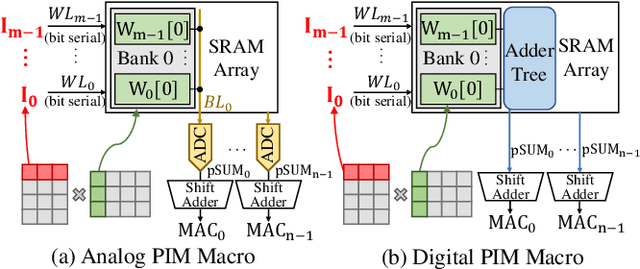
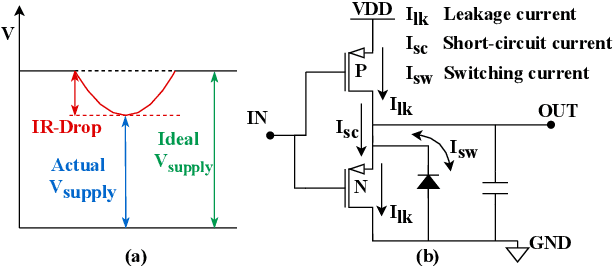
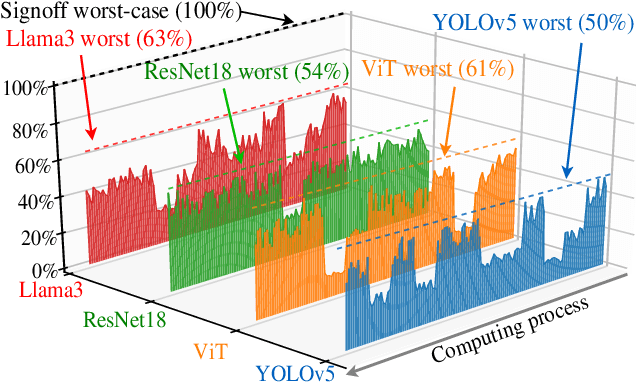
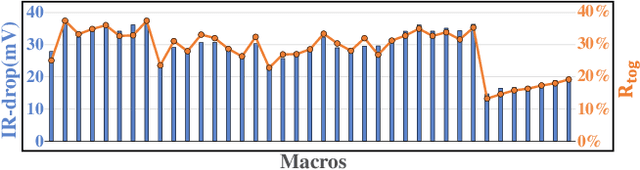
SRAM Processing-in-Memory (PIM) has emerged as the most promising implementation for high-performance PIM, delivering superior computing density, energy efficiency, and computational precision. However, the pursuit of higher performance necessitates more complex circuit designs and increased operating frequencies, which exacerbate IR-drop issues. Severe IR-drop can significantly degrade chip performance and even threaten reliability. Conventional circuit-level IR-drop mitigation methods, such as back-end optimizations, are resource-intensive and often compromise power, performance, and area (PPA). To address these challenges, we propose AIM, comprehensive software and hardware co-design for architecture-level IR-drop mitigation in high-performance PIM. Initially, leveraging the bit-serial and in-situ dataflow processing properties of PIM, we introduce Rtog and HR, which establish a direct correlation between PIM workloads and IR-drop. Building on this foundation, we propose LHR and WDS, enabling extensive exploration of architecture-level IR-drop mitigation while maintaining computational accuracy through software optimization. Subsequently, we develop IR-Booster, a dynamic adjustment mechanism that integrates software-level HR information with hardware-based IR-drop monitoring to adapt the V-f pairs of the PIM macro, achieving enhanced energy efficiency and performance. Finally, we propose the HR-aware task mapping method, bridging software and hardware designs to achieve optimal improvement. Post-layout simulation results on a 7nm 256-TOPS PIM chip demonstrate that AIM achieves up to 69.2% IR-drop mitigation, resulting in 2.29x energy efficiency improvement and 1.152x speedup.