 Add to Chrome
 Add to Firefox
 Add to Edge
A neuromorphic vision system for open-world visual intelligence
Jul 11, 2026
Time-efficient and robust visual intelligence remains a critical challenge in unstructured open-world environments, yet current approaches often rely on computationally intensive neural architectures or task-specific sensors with limited versatility. Inspired by biological vision and information bottleneck theory, we report a neuromorphic vision system that performs task-oriented visual intelligence through an information distillation strategy (named as task traction mechanism) implemented on hardware. The system integrates a polarization-sensitive imager with a resistive random-access memory (RRAM) array to progressively distill task-relevant information via light field selection, region of interest extraction, and target anticipation. The neuromorphic vision system conducts visual tasks within an execution time of 193 μs. Evaluation across eight challenging open-world scenarios shows accuracy improvements of 25.54%, 37.73%, and 36.10% for object tracking, object segmentation, and trajectory prediction, respectively, together with an average 30.6-fold reduction in latency relative to state-of-the-art solutions.

Do Not Break the Vessels: Structure-Preserving Mean Flow for Vascular Image Translation
Jun 30, 2026Reconstructing anatomically faithful vascular structures from clinically accessible imaging modalities is of substantial clinical significance. However, existing cross-modal translation methods mainly emphasize pixel-level fidelity or visual realism and treat structure preservation as a property of the final output rather than an invariant of the generative process. This limitation often leads to structural discontinuities and artifacts, compromising anatomical coherence and clinical reliability. In this work, we propose a Structure-Preserving Mean Flow (SPMF) framework that formulates vascular image translation as a topology-invariant transport process. Based on a structural invariance principle, we derive an orthogonality constraint on the flow velocity field that formally separates appearance transport from topological distortion. We implement this constraint as a time-weighted surrogate objective within a Brownian bridge diffusion model to preserve topology at every diffusion step. Moreover, we propose a Prototype-Guided Structural Refinement (PGSR) module to align degraded inference-time structures with reliable training-time structures. Experiments on paired NIRII-to-2PF and fundus datasets demonstrate consistent improvements over state-of-the-art methods, achieving peak PSNR values of 24.96 dB and 24.83 dB, respectively.
TRUST: Efficient Abdominal Trauma Recognition via Image-to-Ultrasound-Video Transfer Learning
Jun 26, 2026Abdominal ultrasound is indispensable for rapid, noninvasive trauma triage. However, interpreting the subtle dynamic cues embedded in continuous scanning is time-intensive and operator-dependent. Parameter-Efficient Image-to-Video Transfer Learning (PEIVTL), which efficiently adapts pre-trained image models to the video domain, notably through visual-textual alignment, offers a promising paradigm for ultrasound video analysis. Nevertheless, substantial spatiotemporal and semantic variations arising from physician-dependent scanning practices continue to limit the effectiveness and generalizability of this framework. We propose TRUST, a scan-aware PEIVTL framework that explicitly models fine-grained spatiotemporal variations to enable reliable ultrasound video understanding. First, we introduce a Cross-Frequency Collaborative Adapter (CFCA) that establishes mutual constraints between low- and high-frequency components, enhancing discriminative spatial feature extraction under heavy speckle corruption. Second, we design a Multi-Granularity Motion-Aware (MGMA) module that integrates local temporal convolutions with motion-prior-guided global self-attention, jointly capturing stable intra-view patterns and abrupt inter-view transitions to characterize complex scanning dynamics. Third, a Visual Query Semantic Aggregation (VQSA) module dynamically generates text prototypes conditioned on visual features, enabling adaptive visual-textual alignment robust to intra-class variability under diverse scanning conditions. Experiments on in-house ultrasound trauma datasets demonstrate that TRUST outperforms state-of-the-art methods by 9.63% with superior computational efficiency.
A data-physics hybrid generative model for patient-specific post-stroke motor rehabilitation using wearable sensor data
Dec 16, 2025Dynamic prediction of locomotor capacity after stroke is crucial for tailoring rehabilitation, yet current assessments provide only static impairment scores and do not indicate whether patients can safely perform specific tasks such as slope walking or stair climbing. Here, we develop a data-physics hybrid generative framework that reconstructs an individual stroke survivor's neuromuscular control from a single 20 m level-ground walking trial and predicts task-conditioned locomotion across rehabilitation scenarios. The system combines wearable-sensor kinematics, a proportional-derivative physics controller, a population Healthy Motion Atlas, and goal-conditioned deep reinforcement learning with behaviour cloning and generative adversarial imitation learning to generate physically plausible, patient-specific gait simulations for slopes and stairs. In 11 stroke survivors, the personalized controllers preserved idiosyncratic gait patterns while improving joint-angle and endpoint fidelity by 4.73% and 12.10%, respectively, and reducing training time to 25.56% relative to a physics-only baseline. In a multicentre pilot involving 21 inpatients, clinicians who used our locomotion predictions to guide task selection and difficulty obtained larger gains in Fugl-Meyer lower-extremity scores over 28 days of standard rehabilitation than control clinicians (mean change 6.0 versus 3.7 points). These findings indicate that our generative, task-predictive framework can augment clinical decision-making in post-stroke gait rehabilitation and provide a template for dynamically personalized motor recovery strategies.
SID: Multi-LLM Debate Driven by Self Signals
Oct 08, 2025Large Language Models (LLMs) have exhibited impressive capabilities across diverse application domains. Recent work has explored Multi-LLM Agent Debate (MAD) as a way to enhance performance by enabling multiple LLMs to discuss and refine responses iteratively. Nevertheless, existing MAD methods predominantly focus on utilizing external structures, such as debate graphs, using LLM-as-a-Judge, while neglecting the application of self signals, such as token logits and attention, that arise during generation. This omission leads to redundant computation and potential performance degradation. In this paper, we shift the focus to the self signals of multi-LLM debate and introduce a Self-Signals Driven Multi-LLM Debate (SID), which leverages two types of self-signals: model-level confidence and token-level semantic focus, to adaptively guide the debate process. Our approach enables high-confidence agents to exit early at the model level and compress the redundant debate contents based on the attention mechanism. We evaluate our method on various LLMs and Multimodal LLMs across multiple challenging benchmarks. Experimental results demonstrate that our method not only outperforms existing MAD techniques in accuracy but also reduces token consumption, highlighting the effectiveness of utilizing self signals in enhancing both the performance and efficiency of multi-agent debate systems. Our code will be available at~\href{https://github.com/xuhang2019/SID}{\texttt{https://github.com/xuhang2019/SID}}.
CECT-Mamba: a Hierarchical Contrast-enhanced-aware Model for Pancreatic Tumor Subtyping from Multi-phase CECT
Sep 16, 2025Contrast-enhanced computed tomography (CECT) is the primary imaging technique that provides valuable spatial-temporal information about lesions, enabling the accurate diagnosis and subclassification of pancreatic tumors. However, the high heterogeneity and variability of pancreatic tumors still pose substantial challenges for precise subtyping diagnosis. Previous methods fail to effectively explore the contextual information across multiple CECT phases commonly used in radiologists' diagnostic workflows, thereby limiting their performance. In this paper, we introduce, for the first time, an automatic way to combine the multi-phase CECT data to discriminate between pancreatic tumor subtypes, among which the key is using Mamba with promising learnability and simplicity to encourage both temporal and spatial modeling from multi-phase CECT. Specifically, we propose a dual hierarchical contrast-enhanced-aware Mamba module incorporating two novel spatial and temporal sampling sequences to explore intra and inter-phase contrast variations of lesions. A similarity-guided refinement module is also imposed into the temporal scanning modeling to emphasize the learning on local tumor regions with more obvious temporal variations. Moreover, we design the space complementary integrator and multi-granularity fusion module to encode and aggregate the semantics across different scales, achieving more efficient learning for subtyping pancreatic tumors. The experimental results on an in-house dataset of 270 clinical cases achieve an accuracy of 97.4% and an AUC of 98.6% in distinguishing between pancreatic ductal adenocarcinoma (PDAC) and pancreatic neuroendocrine tumors (PNETs), demonstrating its potential as a more accurate and efficient tool.
Generalised Label-free Artefact Cleaning for Real-time Medical Pulsatile Time Series
Apr 29, 2025Artefacts compromise clinical decision-making in the use of medical time series. Pulsatile waveforms offer probabilities for accurate artefact detection, yet most approaches rely on supervised manners and overlook patient-level distribution shifts. To address these issues, we introduce a generalised label-free framework, GenClean, for real-time artefact cleaning and leverage an in-house dataset of 180,000 ten-second arterial blood pressure (ABP) samples for training. We first investigate patient-level generalisation, demonstrating robust performances under both intra- and inter-patient distribution shifts. We further validate its effectiveness through challenging cross-disease cohort experiments on the MIMIC-III database. Additionally, we extend our method to photoplethysmography (PPG), highlighting its applicability to diverse medical pulsatile signals. Finally, its integration into ICM+, a clinical research monitoring software, confirms the real-time feasibility of our framework, emphasising its practical utility in continuous physiological monitoring. This work provides a foundational step toward precision medicine in improving the reliability of high-resolution medical time series analysis
A Causality-Inspired Model for Intima-Media Thickening Assessment in Ultrasound Videos
Mar 16, 2025Carotid atherosclerosis represents a significant health risk, with its early diagnosis primarily dependent on ultrasound-based assessments of carotid intima-media thickening. However, during carotid ultrasound screening, significant view variations cause style shifts, impairing content cues related to thickening, such as lumen anatomy, which introduces spurious correlations that hinder assessment. Therefore, we propose a novel causal-inspired method for assessing carotid intima-media thickening in frame-wise ultrasound videos, which focuses on two aspects: eliminating spurious correlations caused by style and enhancing causal content correlations. Specifically, we introduce a novel Spurious Correlation Elimination (SCE) module to remove non-causal style effects by enforcing prediction invariance with style perturbations. Simultaneously, we propose a Causal Equivalence Consolidation (CEC) module to strengthen causal content correlation through adversarial optimization during content randomization. Simultaneously, we design a Causal Transition Augmentation (CTA) module to ensure smooth causal flow by integrating an auxiliary pathway with text prompts and connecting it through contrastive learning. The experimental results on our in-house carotid ultrasound video dataset achieved an accuracy of 86.93\%, demonstrating the superior performance of the proposed method. Code is available at \href{https://github.com/xielaobanyy/causal-imt}{https://github.com/xielaobanyy/causal-imt}.
A Unified Platform for At-Home Post-Stroke Rehabilitation Enabled by Wearable Technologies and Artificial Intelligence
Nov 28, 2024
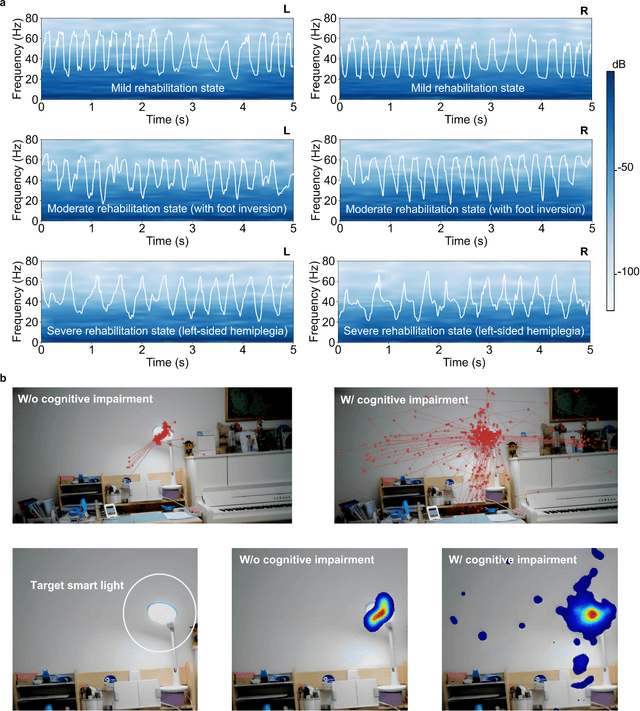


At-home rehabilitation for post-stroke patients presents significant challenges, as continuous, personalized care is often limited outside clinical settings. Additionally, the absence of comprehensive solutions addressing diverse rehabilitation needs in home environments complicates recovery efforts. Here, we introduce a smart home platform that integrates wearable sensors, ambient monitoring, and large language model (LLM)-powered assistance to provide seamless health monitoring and intelligent support. The system leverages machine learning enabled plantar pressure arrays for motor recovery assessment (94% classification accuracy), a wearable eye-tracking module for cognitive evaluation, and ambient sensors for precise smart home control (100% operational success, <1 s latency). Additionally, the LLM-powered agent, Auto-Care, offers real-time interventions, such as health reminders and environmental adjustments, enhancing user satisfaction by 29%. This work establishes a fully integrated platform for long-term, personalized rehabilitation, offering new possibilities for managing chronic conditions and supporting aging populations.
Wearable intelligent throat enables natural speech in stroke patients with dysarthria
Nov 28, 2024


Wearable silent speech systems hold significant potential for restoring communication in patients with speech impairments. However, seamless, coherent speech remains elusive, and clinical efficacy is still unproven. Here, we present an AI-driven intelligent throat (IT) system that integrates throat muscle vibrations and carotid pulse signal sensors with large language model (LLM) processing to enable fluent, emotionally expressive communication. The system utilizes ultrasensitive textile strain sensors to capture high-quality signals from the neck area and supports token-level processing for real-time, continuous speech decoding, enabling seamless, delay-free communication. In tests with five stroke patients with dysarthria, IT's LLM agents intelligently corrected token errors and enriched sentence-level emotional and logical coherence, achieving low error rates (4.2% word error rate, 2.9% sentence error rate) and a 55% increase in user satisfaction. This work establishes a portable, intuitive communication platform for patients with dysarthria with the potential to be applied broadly across different neurological conditions and in multi-language support systems.