 Add to Chrome
 Add to Firefox
 Add to Edge
CheckVLA: Execution-Time Verification with Action-Conditioned World Model for Long-Horizon Mobile Manipulation
Jul 29, 2026
Vision-language-action (VLA) policies commonly execute long-horizon mobile manipulation through open-loop action chunks, issuing multiple actions without receiving new high-level visual input. A committed chunk therefore implies how observations should evolve, but accidental deviations can violate this expectation while the remaining actions continue to propagate the error: commit-time policy confidence cannot react to a deviation that occurs after dispatch, and observation-only anomaly scores lack an action-conditioned reference for separating expected effects from unexplained changes. We propose CheckVLA, which verifies execution with a separately trained, frozen action-conditioned world model. A conformally calibrated risk threshold bounds the episode-level probability of an unnecessary first intervention and determines when to intervene, its exceedance controls how strongly the rewritten suffix retains the superseded chunk, latency-aware hard prefixing restricts replacement to actions that remain deployable, and an event-driven keyframe bank preserves evidence of prior progress across repairs. On RoboCasa365, under a common training recipe and a matched invocation budget, CheckVLA attains a 36.1% average success rate against 27.6% for periodic replanning (+8.5 points). At a matched 5% episode-level false-alarm target, action conditioning raises timely recall to 77.9%, against 48.6% for an observation-only control and 37.9% for an action-shuffled control. These simulation results support action-conditioned verification as a way to restore feedback during chunked execution while keeping the repair consistent with inference latency.

A data-physics hybrid generative model for patient-specific post-stroke motor rehabilitation using wearable sensor data
Dec 16, 2025Dynamic prediction of locomotor capacity after stroke is crucial for tailoring rehabilitation, yet current assessments provide only static impairment scores and do not indicate whether patients can safely perform specific tasks such as slope walking or stair climbing. Here, we develop a data-physics hybrid generative framework that reconstructs an individual stroke survivor's neuromuscular control from a single 20 m level-ground walking trial and predicts task-conditioned locomotion across rehabilitation scenarios. The system combines wearable-sensor kinematics, a proportional-derivative physics controller, a population Healthy Motion Atlas, and goal-conditioned deep reinforcement learning with behaviour cloning and generative adversarial imitation learning to generate physically plausible, patient-specific gait simulations for slopes and stairs. In 11 stroke survivors, the personalized controllers preserved idiosyncratic gait patterns while improving joint-angle and endpoint fidelity by 4.73% and 12.10%, respectively, and reducing training time to 25.56% relative to a physics-only baseline. In a multicentre pilot involving 21 inpatients, clinicians who used our locomotion predictions to guide task selection and difficulty obtained larger gains in Fugl-Meyer lower-extremity scores over 28 days of standard rehabilitation than control clinicians (mean change 6.0 versus 3.7 points). These findings indicate that our generative, task-predictive framework can augment clinical decision-making in post-stroke gait rehabilitation and provide a template for dynamically personalized motor recovery strategies.
Generalised Label-free Artefact Cleaning for Real-time Medical Pulsatile Time Series
Apr 29, 2025Artefacts compromise clinical decision-making in the use of medical time series. Pulsatile waveforms offer probabilities for accurate artefact detection, yet most approaches rely on supervised manners and overlook patient-level distribution shifts. To address these issues, we introduce a generalised label-free framework, GenClean, for real-time artefact cleaning and leverage an in-house dataset of 180,000 ten-second arterial blood pressure (ABP) samples for training. We first investigate patient-level generalisation, demonstrating robust performances under both intra- and inter-patient distribution shifts. We further validate its effectiveness through challenging cross-disease cohort experiments on the MIMIC-III database. Additionally, we extend our method to photoplethysmography (PPG), highlighting its applicability to diverse medical pulsatile signals. Finally, its integration into ICM+, a clinical research monitoring software, confirms the real-time feasibility of our framework, emphasising its practical utility in continuous physiological monitoring. This work provides a foundational step toward precision medicine in improving the reliability of high-resolution medical time series analysis
AI-Driven Smart Sportswear for Real-Time Fitness Monitoring Using Textile Strain Sensors
Apr 11, 2025Wearable biosensors have revolutionized human performance monitoring by enabling real-time assessment of physiological and biomechanical parameters. However, existing solutions lack the ability to simultaneously capture breath-force coordination and muscle activation symmetry in a seamless and non-invasive manner, limiting their applicability in strength training and rehabilitation. This work presents a wearable smart sportswear system that integrates screen-printed graphene-based strain sensors with a wireless deep learning framework for real-time classification of exercise execution quality. By leveraging 1D ResNet-18 for feature extraction, the system achieves 92.3% classification accuracy across six exercise conditions, distinguishing between breathing irregularities and asymmetric muscle exertion. Additionally, t-SNE analysis and Grad-CAM-based explainability visualization confirm that the network accurately captures biomechanically relevant features, ensuring robust interpretability. The proposed system establishes a foundation for next-generation AI-powered sportswear, with applications in fitness optimization, injury prevention, and adaptive rehabilitation training.
Wireless Silent Speech Interface Using Multi-Channel Textile EMG Sensors Integrated into Headphones
Apr 11, 2025This paper presents a novel wireless silent speech interface (SSI) integrating multi-channel textile-based EMG electrodes into headphone earmuff for real-time, hands-free communication. Unlike conventional patch-based EMG systems, which require large-area electrodes on the face or neck, our approach ensures comfort, discretion, and wearability while maintaining robust silent speech decoding. The system utilizes four graphene/PEDOT:PSS-coated textile electrodes to capture speech-related neuromuscular activity, with signals processed via a compact ESP32-S3-based wireless readout module. To address the challenge of variable skin-electrode coupling, we propose a 1D SE-ResNet architecture incorporating squeeze-and-excitation (SE) blocks to dynamically adjust per-channel attention weights, enhancing robustness against motion-induced impedance variations. The proposed system achieves 96% accuracy on 10 commonly used voice-free control words, outperforming conventional single-channel and non-adaptive baselines. Experimental validation, including XAI-based attention analysis and t-SNE feature visualization, confirms the adaptive channel selection capability and effective feature extraction of the model. This work advances wearable EMG-based SSIs, demonstrating a scalable, low-power, and user-friendly platform for silent communication, assistive technologies, and human-computer interaction.
Wearable intelligent throat enables natural speech in stroke patients with dysarthria
Nov 28, 2024


Wearable silent speech systems hold significant potential for restoring communication in patients with speech impairments. However, seamless, coherent speech remains elusive, and clinical efficacy is still unproven. Here, we present an AI-driven intelligent throat (IT) system that integrates throat muscle vibrations and carotid pulse signal sensors with large language model (LLM) processing to enable fluent, emotionally expressive communication. The system utilizes ultrasensitive textile strain sensors to capture high-quality signals from the neck area and supports token-level processing for real-time, continuous speech decoding, enabling seamless, delay-free communication. In tests with five stroke patients with dysarthria, IT's LLM agents intelligently corrected token errors and enriched sentence-level emotional and logical coherence, achieving low error rates (4.2% word error rate, 2.9% sentence error rate) and a 55% increase in user satisfaction. This work establishes a portable, intuitive communication platform for patients with dysarthria with the potential to be applied broadly across different neurological conditions and in multi-language support systems.
A Unified Platform for At-Home Post-Stroke Rehabilitation Enabled by Wearable Technologies and Artificial Intelligence
Nov 28, 2024
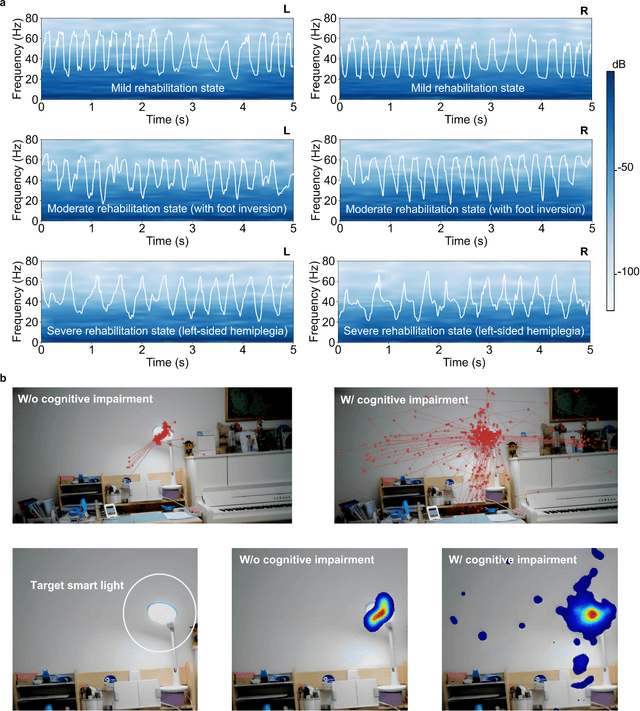


At-home rehabilitation for post-stroke patients presents significant challenges, as continuous, personalized care is often limited outside clinical settings. Additionally, the absence of comprehensive solutions addressing diverse rehabilitation needs in home environments complicates recovery efforts. Here, we introduce a smart home platform that integrates wearable sensors, ambient monitoring, and large language model (LLM)-powered assistance to provide seamless health monitoring and intelligent support. The system leverages machine learning enabled plantar pressure arrays for motor recovery assessment (94% classification accuracy), a wearable eye-tracking module for cognitive evaluation, and ambient sensors for precise smart home control (100% operational success, <1 s latency). Additionally, the LLM-powered agent, Auto-Care, offers real-time interventions, such as health reminders and environmental adjustments, enhancing user satisfaction by 29%. This work establishes a fully integrated platform for long-term, personalized rehabilitation, offering new possibilities for managing chronic conditions and supporting aging populations.
Deep Learning for Motion Classification in Ankle Exoskeletons Using Surface EMG and IMU Signals
Nov 25, 2024Ankle exoskeletons have garnered considerable interest for their potential to enhance mobility and reduce fall risks, particularly among the aging population. The efficacy of these devices relies on accurate real-time prediction of the user's intended movements through sensor-based inputs. This paper presents a novel motion prediction framework that integrates three Inertial Measurement Units (IMUs) and eight surface Electromyography (sEMG) sensors to capture both kinematic and muscular activity data. A comprehensive set of activities, representative of everyday movements in barrier-free environments, was recorded for the purpose. Our findings reveal that Convolutional Neural Networks (CNNs) slightly outperform Long Short-Term Memory (LSTM) networks on a dataset of five motion tasks, achieving classification accuracies of $96.5 \pm 0.8 \%$ and $87.5 \pm 2.9 \%$, respectively. Furthermore, we demonstrate the system's proficiency in transfer learning, enabling accurate motion classification for new subjects using just ten samples per class for finetuning. The robustness of the model is demonstrated by its resilience to sensor failures resulting in absent signals, maintaining reliable performance in real-world scenarios. These results underscore the potential of deep learning algorithms to enhance the functionality and safety of ankle exoskeletons, ultimately improving their usability in daily life.
A deep learning-enabled smart garment for versatile sleep behaviour monitoring
Aug 01, 2024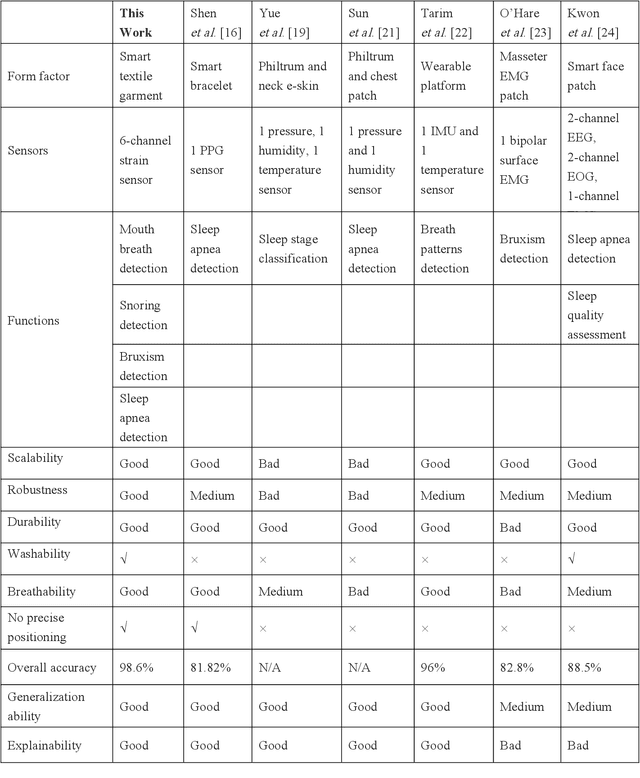
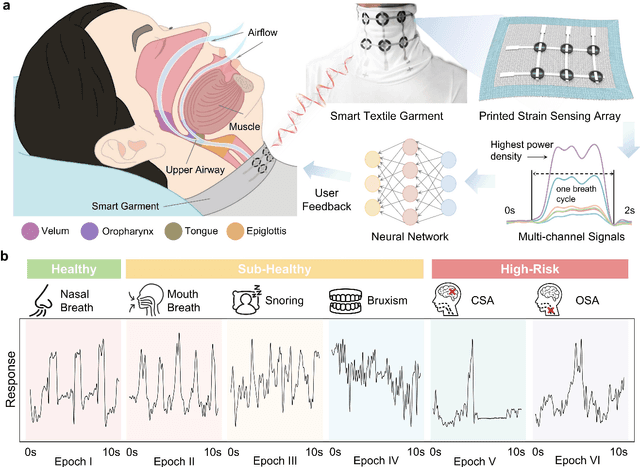
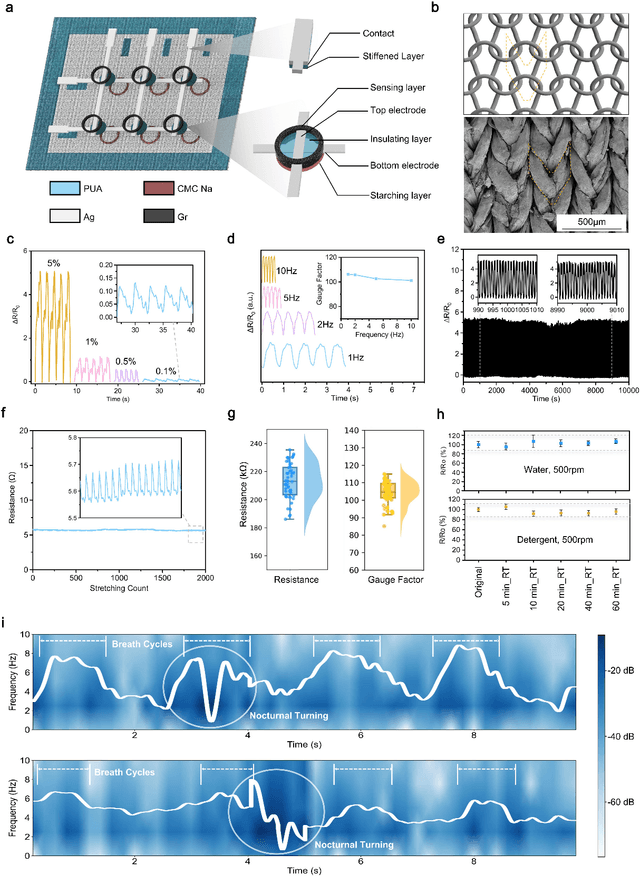
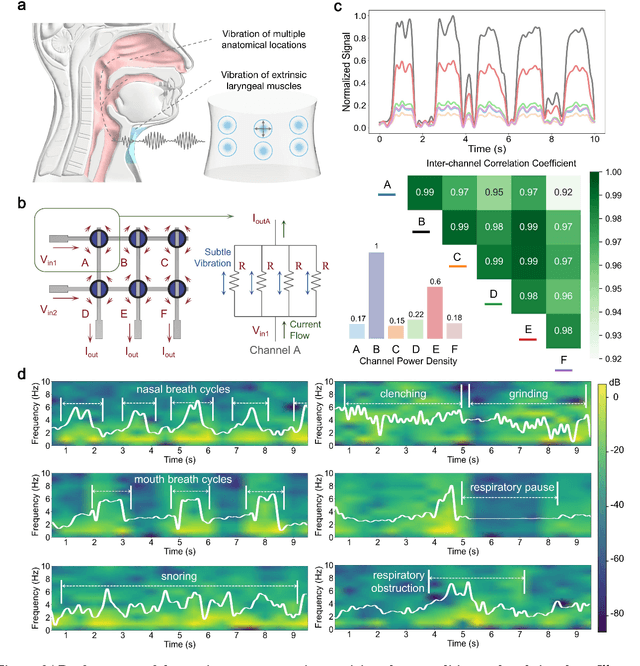
Continuous monitoring and accurate detection of complex sleep patterns associated to different sleep-related conditions is essential, not only for enhancing sleep quality but also for preventing the risk of developing chronic illnesses associated to unhealthy sleep. Despite significant advances in research, achieving versatile recognition of various unhealthy and sub-healthy sleep patterns with simple wearable devices at home remains a significant challenge. Here, we report a robust and durable ultrasensitive strain sensor array printed on a smart garment, in its collar region. This solution allows detecting subtle vibrations associated with multiple sleep patterns at the extrinsic laryngeal muscles. Equipped with a deep learning neural network, it can precisely identify six sleep states-nasal breathing, mouth breathing, snoring, bruxism, central sleep apnea (CSA), and obstructive sleep apnea (OSA)-with an impressive accuracy of 98.6%, all without requiring specific positioning. We further demonstrate its explainability and generalization capabilities in practical applications. Explainable artificial intelligence (XAI) visualizations reflect comprehensive signal pattern analysis with low bias. Transfer learning tests show that the system can achieve high accuracy (overall accuracy of 95%) on new users with very few-shot learning (less than 15 samples per class). The scalable manufacturing process, robustness, high accuracy, and excellent generalization of the smart garment make it a promising tool for next-generation continuous sleep monitoring.
Dissociation of Faithful and Unfaithful Reasoning in LLMs
May 23, 2024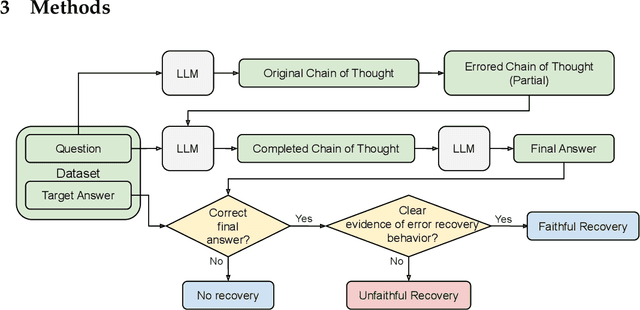
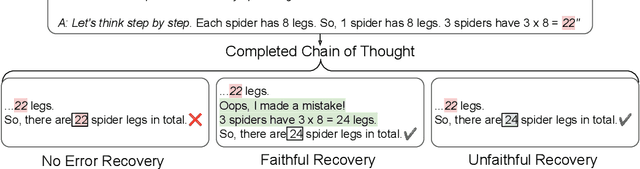

Large language models (LLMs) improve their performance in downstream tasks when they generate Chain of Thought reasoning text before producing an answer. Our research investigates how LLMs recover from errors in Chain of Thought, reaching the correct final answer despite mistakes in the reasoning text. Through analysis of these error recovery behaviors, we find evidence for unfaithfulness in Chain of Thought, but we also identify many clear examples of faithful error recovery behaviors. We identify factors that shift LLM recovery behavior: LLMs recover more frequently from obvious errors and in contexts that provide more evidence for the correct answer. However, unfaithful recoveries show the opposite behavior, occurring more frequently for more difficult error positions. Our results indicate that there are distinct mechanisms driving faithful and unfaithful error recoveries. Our results challenge the view that LLM reasoning is a uniform, coherent process.