 Add to Chrome
 Add to Firefox
 Add to Edge
CIGTSurv: Clinical Information Guided Tri-modal Survival Prediction with Local Prototype Association and Global Feature Alignment
Aug 04, 2026
Multimodal learning has significantly advanced survival prediction by integrating pathology images with genomic data. However, clinical information, despite its critical role in reflecting a patient' s overall health, remains underutilized due to its discrete, sparse, and low-dimensional nature. Furthermore, the inherent heterogeneity across these modalities pose significant challenges in modeling cross-modal interactions. In this paper, we propose CIGTSurv, a Clinical Information Guided Tri-modal framework for Survival prediction. Specifically, we first design a holistic text template and use pretrained foundation models to transform clinical tabular data into high-dimensional tokenized embeddings. Using clinical information as an anchor, we then introduce a dual-level interaction mechanism: 1) a local prototype association (LPA) module based on cross-attention to explicitly learn token-level correspondences between different modalities, and 2) a global feature alignment (GFA) loss based on Maximum Mean Discrepancy (MMD) to implicitly enhance cross-modal distribution consistency. Extensive experiments on five TCGA cancer cohorts demonstrate that CIGTSurv achieves state-of-the-art (SOTA) survival prediction performance. Our source code is publicly available at https://github.com/Daijing-ai/CIGT-Surv.git.

Ptolemy's Equant Equates to a Universal Dynamical Clock via Machine Learning
Jul 16, 2026Oscillatory dynamics arise ubiquitously in nonlinear systems, yet identifying a physically interpretable phase and phase dynamics in nonlinear, high-dimensional oscillations remains a central unresolved problem. Here we establish the principle of a universal dynamical clock, a physical perspective in which oscillations of arbitrary dimensionality and geometry are equivalently represented as uniform rotation through an equant-induced nonlinear viewing coordinate, inspired by Ptolemy's equant and formalised through an areal-uniformity principle reminiscent of Kepler's second law. Using a machine-learning framework, we demonstrate the existence of such an equant for a broad class of oscillatory dynamics and construct the associated dynamical clock and phase dynamics under additive forces, including noise, periodic perturbations, and coupling. Its value in uncovering new physical rules and phenomena is demonstrated by four findings: (i) collective oscillations in Escherichia coli populations obey a previously unexplained superlinear scaling law, resolving a long-standing open problem posed in 2004; (ii) the response mechanisms of engineered genetic circuits to changes in gene expression and environmental conditions; (iii) a classical-mechanics counterpart of the Berry geometric phase emerges naturally from the phase of the dynamical clock; and (iv) optimal equant non-uniformity provides a geometric early-warning signal for critical transitions and enables prediction of critical parameters. By providing operational and system-agnostic phase dynamics that can be constructed directly from data, the dynamical clock enables principled classification, comparison, and control of oscillatory systems, and offers a new route to understanding how specific dynamical regimes support distinct functional behaviours in networked systems.
Lyapunov Guidance: A Unified Framework for Stabilizing Generative Flows
Jul 15, 2026Flow matching has emerged as an effective framework for learning complex data distributions, but adapting pretrained flow models to new tasks often requires computationally expensive retraining. Post-training guidance provides a more efficient alternative, but existing methods are largely heuristic and offer no explicit stability guarantees. We address this limitation by proposing LyaGuide, a unified Lyapunov-guided framework that formulates flow guidance as a Lyapunov control problem. Our main theoretical result establishes an equivalence between guided flow matching and Lyapunov control, thereby unifying common guidance strategies, such as classifier guidance, reward guidance, and energy-based guidance, within a single control-theoretic framework. To enforce the Lyapunov condition, we introduce a pseudo-projection operator with a closed-form expression that endows learned or heuristic guidance terms with explicit stability guarantees. LyaGuide supports two practical settings: a model-driven setting, where the target guidance distribution is specified through a known Lyapunov function, and a data-driven setting, where the guidance is adapted from task-specific downstream data. LyaGuide is compatible with existing guidance methods, introduces minimal additional computational overhead, and is straightforward to integrate in practice. Extensive experiments on synthetic benchmarks, image inverse problems, reinforcement learning planning, and energy-based modeling demonstrate consistent improvements in sample quality, guidance fidelity, and robustness, while maintaining computational efficiency.
Beyond Thinking: Imagining in 360$^\circ$ for Humanoid Visual Search
May 09, 2026Humanoid Visual Search (HVS) requires agents to actively explore immersive 360$^\circ$ environments. While prior methods treat this as a monolithic task relying on cumulative, multi-turn Chain-of-Thought (CoT) reasoning, they impose heavy cognitive burdens and require expensive trajectory-level annotations. In this paper, we propose Imagining in 360$^\circ$, a novel framework that decouples the exploration process into a specialized Imaginator and an Actor. The Imaginator functions as a probabilistic predictor of spatial priors; instead of maintaining a cumulative reasoning chain, it infers the semantic layout of both observed and unobserved regions in a single step. By sampling multiple hypotheses within this semantic space, we provide the Actor with a distribution of effective spatial information, offering robust guidance that hedges against uncertainty during active search. This decoupled architecture significantly lowers data engineering costs by eliminating the need for full-trajectory CoT annotations, enabling the generation of over 1.96 million curated training samples. Extensive experiments demonstrate that explicitly modeling semantic spatial priors drastically improves search efficiency and success rates in complex, in-the-wild environments.
HGP-Mamba: Integrating Histology and Generated Protein Features for Mamba-based Multimodal Survival Risk Prediction
Mar 17, 2026Recent advances in multimodal learning have significantly improved cancer survival risk prediction. However, the joint prognostic potential of protein markers and histopathology images remains underexplored, largely due to the high cost and limited availability of protein expression profiling. To address this challenge, we propose HGP-Mamba, a Mamba-based multimodal framework that efficiently integrates histological with generated protein features for survival risk prediction. Specifically, we introduce a protein feature extractor (PFE) that leverages pretrained foundation models to derive high-throughput protein embeddings directly from Whole Slide Images (WSIs), enabling data-efficient incorporation of molecular information. Together with histology embeddings that capture morphological patterns, we further introduce the Local Interaction-aware Mamba (LiAM) for fine-grained feature interaction and the Global Interaction-enhanced Mamba (GiEM) to promote holistic modality fusion at the slide level, thus capture complex cross-modal dependencies. Experiments on four public cancer datasets demonstrate that HGP-Mamba achieves state-of-the-art performance while maintaining superior computational efficiency compared with existing methods. Our source code is publicly available at <a href="https://github.com/Daijing-ai/HGP-Mamba.git">this https URL</a>.
MTPano: Multi-Task Panoramic Scene Understanding via Label-Free Integration of Dense Prediction Priors
Feb 05, 2026Comprehensive panoramic scene understanding is critical for immersive applications, yet it remains challenging due to the scarcity of high-resolution, multi-task annotations. While perspective foundation models have achieved success through data scaling, directly adapting them to the panoramic domain often fails due to severe geometric distortions and coordinate system discrepancies. Furthermore, the underlying relations between diverse dense prediction tasks in spherical spaces are underexplored. To address these challenges, we propose MTPano, a robust multi-task panoramic foundation model established by a label-free training pipeline. First, to circumvent data scarcity, we leverage powerful perspective dense priors. We project panoramic images into perspective patches to generate accurate, domain-gap-free pseudo-labels using off-the-shelf foundation models, which are then re-projected to serve as patch-wise supervision. Second, to tackle the interference between task types, we categorize tasks into rotation-invariant (e.g., depth, segmentation) and rotation-variant (e.g., surface normals) groups. We introduce the Panoramic Dual BridgeNet, which disentangles these feature streams via geometry-aware modulation layers that inject absolute position and ray direction priors. To handle the distortion from equirectangular projections (ERP), we incorporate ERP token mixers followed by a dual-branch BridgeNet for interactions with gradient truncation, facilitating beneficial cross-task information sharing while blocking conflicting gradients from incompatible task attributes. Additionally, we introduce auxiliary tasks (image gradient, point map, etc.) to fertilize the cross-task learning process. Extensive experiments demonstrate that MTPano achieves state-of-the-art performance on multiple benchmarks and delivers competitive results against task-specific panoramic specialist foundation models.
UniSER: A Foundation Model for Unified Soft Effects Removal
Nov 18, 2025Digital images are often degraded by soft effects such as lens flare, haze, shadows, and reflections, which reduce aesthetics even though the underlying pixels remain partially visible. The prevailing works address these degradations in isolation, developing highly specialized, specialist models that lack scalability and fail to exploit the shared underlying essences of these restoration problems. While specialist models are limited, recent large-scale pretrained generalist models offer powerful, text-driven image editing capabilities. while recent general-purpose systems (e.g., GPT-4o, Flux Kontext, Nano Banana) require detailed prompts and often fail to achieve robust removal on these fine-grained tasks or preserve identity of the scene. Leveraging the common essence of soft effects, i.e., semi-transparent occlusions, we introduce a foundational versatile model UniSER, capable of addressing diverse degradations caused by soft effects within a single framework. Our methodology centers on curating a massive 3.8M-pair dataset to ensure robustness and generalization, which includes novel, physically-plausible data to fill critical gaps in public benchmarks, and a tailored training pipeline that fine-tunes a Diffusion Transformer to learn robust restoration priors from this diverse data, integrating fine-grained mask and strength controls. This synergistic approach allows UniSER to significantly outperform both specialist and generalist models, achieving robust, high-fidelity restoration in the wild.
SPGen: Spherical Projection as Consistent and Flexible Representation for Single Image 3D Shape Generation
Sep 16, 2025


Existing single-view 3D generative models typically adopt multiview diffusion priors to reconstruct object surfaces, yet they remain prone to inter-view inconsistencies and are unable to faithfully represent complex internal structure or nontrivial topologies. In particular, we encode geometry information by projecting it onto a bounding sphere and unwrapping it into a compact and structural multi-layer 2D Spherical Projection (SP) representation. Operating solely in the image domain, SPGen offers three key advantages simultaneously: (1) Consistency. The injective SP mapping encodes surface geometry with a single viewpoint which naturally eliminates view inconsistency and ambiguity; (2) Flexibility. Multi-layer SP maps represent nested internal structures and support direct lifting to watertight or open 3D surfaces; (3) Efficiency. The image-domain formulation allows the direct inheritance of powerful 2D diffusion priors and enables efficient finetuning with limited computational resources. Extensive experiments demonstrate that SPGen significantly outperforms existing baselines in geometric quality and computational efficiency.
3R-GS: Best Practice in Optimizing Camera Poses Along with 3DGS
Apr 05, 20253D Gaussian Splatting (3DGS) has revolutionized neural rendering with its efficiency and quality, but like many novel view synthesis methods, it heavily depends on accurate camera poses from Structure-from-Motion (SfM) systems. Although recent SfM pipelines have made impressive progress, questions remain about how to further improve both their robust performance in challenging conditions (e.g., textureless scenes) and the precision of camera parameter estimation simultaneously. We present 3R-GS, a 3D Gaussian Splatting framework that bridges this gap by jointly optimizing 3D Gaussians and camera parameters from large reconstruction priors MASt3R-SfM. We note that naively performing joint 3D Gaussian and camera optimization faces two challenges: the sensitivity to the quality of SfM initialization, and its limited capacity for global optimization, leading to suboptimal reconstruction results. Our 3R-GS, overcomes these issues by incorporating optimized practices, enabling robust scene reconstruction even with imperfect camera registration. Extensive experiments demonstrate that 3R-GS delivers high-quality novel view synthesis and precise camera pose estimation while remaining computationally efficient. Project page: https://zsh523.github.io/3R-GS/
SolidGS: Consolidating Gaussian Surfel Splatting for Sparse-View Surface Reconstruction
Dec 19, 2024

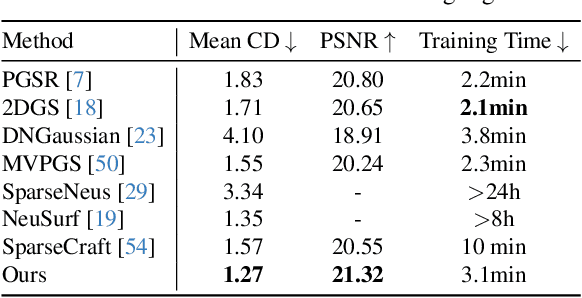
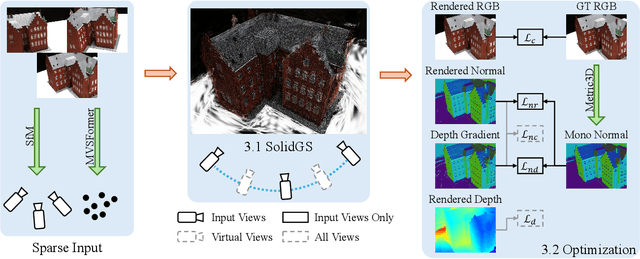
Gaussian splatting has achieved impressive improvements for both novel-view synthesis and surface reconstruction from multi-view images. However, current methods still struggle to reconstruct high-quality surfaces from only sparse view input images using Gaussian splatting. In this paper, we propose a novel method called SolidGS to address this problem. We observed that the reconstructed geometry can be severely inconsistent across multi-views, due to the property of Gaussian function in geometry rendering. This motivates us to consolidate all Gaussians by adopting a more solid kernel function, which effectively improves the surface reconstruction quality. With the additional help of geometrical regularization and monocular normal estimation, our method achieves superior performance on the sparse view surface reconstruction than all the Gaussian splatting methods and neural field methods on the widely used DTU, Tanks-and-Temples, and LLFF datasets.