 Add to Chrome
 Add to Firefox
 Add to Edge
ParaTool: Shifting Tool Representations from Context to Parameters
May 28, 2026
Tool calling extends large language models (LLMs) by enabling grounded interaction with external executable interfaces, thereby supporting environment-coupled problem solving. However, mainstream in-context learning (ICL) approaches typically incorporate detailed tool documentation and usage examples directly into the context. This results in substantial inference overhead and heightened risks of hallucination as the context length grows. Conversely, while tuning-based methods improve general tool-calling capabilities, they often fail to effectively internalize the specific details of previously seen tools, thereby retaining a dependency on in-context documentation. To address these limitations, we propose ParaTool, a framework that projects each tool into a dedicated, loadable set of parameters. By equipping a dynamic integration of these parameterized tools, the LLM can perform tool calling without relying on in-context documents or examples. Specifically, our approach consists of three stages: (1) parametric tool pre-training encapsulates the knowledge of different tools into independent parameter modules; (2) soft tool selection employs a gating network to dynamically weigh and aggregate relevant tool parameters; and (3) parametric tool fine-tuning jointly updates tool parameters to align the training and inference processes. Experiments on Stable ToolBench and BFCL demonstrate that ParaTool significantly outperforms strong ICL-based baselines, achieving superior performance while reducing computational complexity.

GraphTeam: Facilitating Large Language Model-based Graph Analysis via Multi-Agent Collaboration
Oct 23, 2024

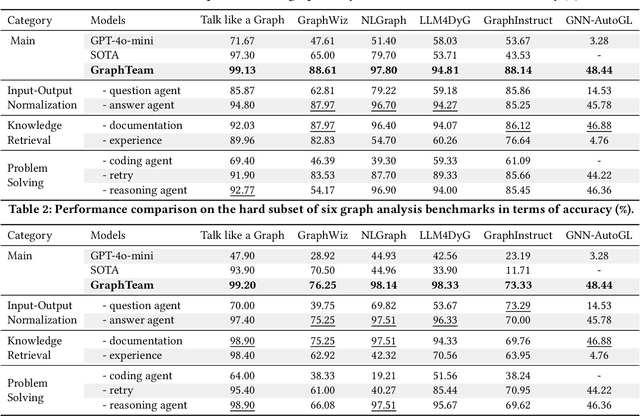

Graphs are widely used for modeling relational data in real-world scenarios, such as social networks and urban computing. Existing LLM-based graph analysis approaches either integrate graph neural networks (GNNs) for specific machine learning tasks, limiting their transferability, or rely solely on LLMs' internal reasoning ability, resulting in suboptimal performance. To address these limitations, we take advantage of recent advances in LLM-based agents, which have shown capabilities of utilizing external knowledge or tools for problem solving. By simulating human problem-solving strategies such as analogy and collaboration, we propose a multi-agent system based on LLMs named GraphTeam, for graph analysis. GraphTeam consists of five LLM-based agents from three modules, and the agents with different specialities can collaborate with each other to address complex problems. Specifically, (1) input-output normalization module: the question agent extracts and refines four key arguments from the original question, facilitating the problem understanding, and the answer agent organizes the results to meet the output requirement; (2) external knowledge retrieval module: we first build a knowledge base consisting of relevant documentation and experience information, and then the search agent retrieves the most relevant entries for each question. (3) problem-solving module: given the retrieved information from search agent, the coding agent uses established algorithms via programming to generate solutions, and in case the coding agent does not work, the reasoning agent will directly compute the results without programming. Extensive experiments on six graph analysis benchmarks demonstrate that GraphTeam achieves state-of-the-art performance with an average 25.85% improvement over the best baseline in terms of accuracy. The code and data are available at https://github.com/BUPT-GAMMA/GraphTeam.
Can Large Language Models Analyze Graphs like Professionals? A Benchmark, Datasets and Models
Sep 29, 2024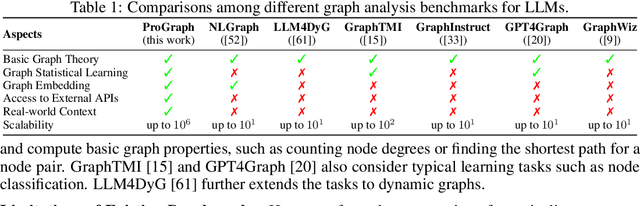

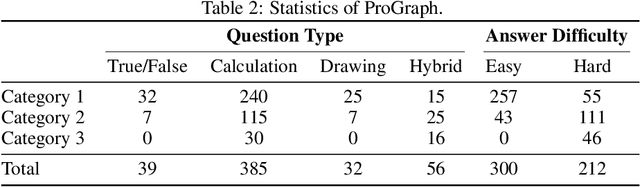

The need to analyze graphs is ubiquitous across various fields, from social networks to biological research and recommendation systems. Therefore, enabling the ability of large language models (LLMs) to process graphs is an important step toward more advanced general intelligence. However, current LLM benchmarks on graph analysis require models to directly reason over the prompts describing graph topology, and are thus limited to small graphs with only a few dozens of nodes. In contrast, human experts typically write programs based on popular libraries for task solving, and can thus handle graphs with different scales. To this end, a question naturally arises: can LLMs analyze graphs like professionals? In this paper, we introduce ProGraph, a manually crafted benchmark containing 3 categories of graph tasks. The benchmark expects solutions based on programming instead of directly reasoning over raw inputs. Our findings reveal that the performance of current LLMs is unsatisfactory, with the best model achieving only 36% accuracy. To bridge this gap, we propose LLM4Graph datasets, which include crawled documents and auto-generated codes based on 6 widely used graph libraries. By augmenting closed-source LLMs with document retrieval and fine-tuning open-source ones on the codes, we show 11-32% absolute improvements in their accuracies. Our results underscore that the capabilities of LLMs in handling structured data are still under-explored, and show the effectiveness of LLM4Graph in enhancing LLMs' proficiency of graph analysis. The benchmark, datasets and enhanced open-source models are available at https://github.com/BUPT-GAMMA/ProGraph.