 Add to Chrome
 Add to Firefox
 Add to Edge
MMOE: Modernizing Diffusion Transformers with Efficient Expert Design
Jul 27, 2026
Modern large language models scale successfully by pairing capacity growth with efficiency, keeping per-token and deployment costs under control as capacity grows. AIGC Foundation Models (AFMs), especially diffusion-transformer backbones, have begun to adopt sparse experts, but recent efforts mostly enlarge total parameter counts and sparsity ratios without importing the efficiency mechanisms that made LLM scaling practical, so generation quality is seldom balanced against training and deployment cost. This raises a natural question: can the architectural principles behind efficient LLM scaling be adapted to AFMs in a more balanced way? We introduce ModernMOE (MMOE), a modernization of SiT-style diffusion transformers that systematically adapts routed experts, shared and lightweight experts, gate-residual routing, and attention-residual information reuse to AIGC generation. Rather than treating MoE as a single plug-in replacement, MMOE studies how different modern expert components affect convergence, efficiency, and generation quality when composed inside a diffusion transformer. Every experiment in this paper is trained on a single eight-GPU H100 node with batch size 256 for 400k steps, an accessible single-machine budget. Under matched training and sampling protocols and at this budget, MMOE reaches lower FID at every recorded checkpoint, that is, it converges faster per training step, than dense and intermediate sparse-expert baselines, and among the sparse variants it attains the best quality-cost balance. Routing analysis further shows stable expert specialization across depth, substantial use of lightweight routes, and modest step-to-step routing changes during denoising. These results suggest that AFMs can follow the balanced scaling path of LLMs by importing proven efficiency designs, rather than by simply increasing total parameters and sparsity ratios.

ShotPlan: Cinematic Video Generation with Learnable Planning Token
Jul 20, 2026Current video generation models achieve impressive results in single-shot generation, yet remain limited in cinematic video generation, where coherent narratives and effective multi-shot composition require explicit shot planning. To address this challenge, we propose ShotPlan, a framework for explicit multi-shot cinematic video generation built upon a video diffusion foundation model. Our method introduces learnable planning tokens that capture shot-level transition cues and can be seamlessly integrated with the original video generation tokens to control transition timestamps. Unlike standard video generation tokens, the proposed planning tokens are equipped with Fractional Temporal Rotary Position Embedding (FRoPE), enabling shot transitions to be modeled at the frame level. Experiments demonstrate that ShotPlan significantly outperforms existing cinematic video generation methods, offering more flexible shot management and stronger inter-shot consistency.
SIFT: Self-Imagination Fine-Tuning for Physically Plausible Motion in Video Diffusion Models
Jun 26, 2026Recent advances in video diffusion models have greatly improved visual fidelity, yet their generated motions often violate physical plausibility. We observe a common kinematic failure, "motion entanglement", the unintended coupling of independent motion sources, such as camera movement and object motion. We identify that this issue stems from data bias and the reconstruction-based training design of diffusion models. Training on noisy videos that still retain coarse motion cues inadvertently encourages the model to replicate existing motion without an incentive to learn how to model kinematically-grounded motions. To address this, we propose a Self-Imagination Fine-Tuning (SIFT) paradigm, which enables the model to learn from its own generated videos rather than directly reconstructing real ones, breaking the reconstruction shortcut. We further employ motion-aware discriminative supervision and a progressive hard-case replay strategy to stabilize and accelerate learning. By leveraging freely-generated text prompts, our method can densely cover a broad motion space, including rare or finely-disentangled scenarios that would be costly to collect as video data. Extensive experiments demonstrate that our approach substantially improves the physical realism, motion disentanglement, and controllability of generated videos.
TeleWorld: Towards Dynamic Multimodal Synthesis with a 4D World Model
Dec 31, 2025World models aim to endow AI systems with the ability to represent, generate, and interact with dynamic environments in a coherent and temporally consistent manner. While recent video generation models have demonstrated impressive visual quality, they remain limited in real-time interaction, long-horizon consistency, and persistent memory of dynamic scenes, hindering their evolution into practical world models. In this report, we present TeleWorld, a real-time multimodal 4D world modeling framework that unifies video generation, dynamic scene reconstruction, and long-term world memory within a closed-loop system. TeleWorld introduces a novel generation-reconstruction-guidance paradigm, where generated video streams are continuously reconstructed into a dynamic 4D spatio-temporal representation, which in turn guides subsequent generation to maintain spatial, temporal, and physical consistency. To support long-horizon generation with low latency, we employ an autoregressive diffusion-based video model enhanced with Macro-from-Micro Planning (MMPL)--a hierarchical planning method that reduces error accumulation from frame-level to segment-level-alongside efficient Distribution Matching Distillation (DMD), enabling real-time synthesis under practical computational budgets. Our approach achieves seamless integration of dynamic object modeling and static scene representation within a unified 4D framework, advancing world models toward practical, interactive, and computationally accessible systems. Extensive experiments demonstrate that TeleWorld achieves strong performance in both static and dynamic world understanding, long-term consistency, and real-time generation efficiency, positioning it as a practical step toward interactive, memory-enabled world models for multimodal generation and embodied intelligence.
Uni-Inter: Unifying 3D Human Motion Synthesis Across Diverse Interaction Contexts
Nov 17, 2025We present Uni-Inter, a unified framework for human motion generation that supports a wide range of interaction scenarios: including human-human, human-object, and human-scene-within a single, task-agnostic architecture. In contrast to existing methods that rely on task-specific designs and exhibit limited generalization, Uni-Inter introduces the Unified Interactive Volume (UIV), a volumetric representation that encodes heterogeneous interactive entities into a shared spatial field. This enables consistent relational reasoning and compound interaction modeling. Motion generation is formulated as joint-wise probabilistic prediction over the UIV, allowing the model to capture fine-grained spatial dependencies and produce coherent, context-aware behaviors. Experiments across three representative interaction tasks demonstrate that Uni-Inter achieves competitive performance and generalizes well to novel combinations of entities. These results suggest that unified modeling of compound interactions offers a promising direction for scalable motion synthesis in complex environments.
Towards a Generalizable Bimanual Foundation Policy via Flow-based Video Prediction
May 30, 2025Learning a generalizable bimanual manipulation policy is extremely challenging for embodied agents due to the large action space and the need for coordinated arm movements. Existing approaches rely on Vision-Language-Action (VLA) models to acquire bimanual policies. However, transferring knowledge from single-arm datasets or pre-trained VLA models often fails to generalize effectively, primarily due to the scarcity of bimanual data and the fundamental differences between single-arm and bimanual manipulation. In this paper, we propose a novel bimanual foundation policy by fine-tuning the leading text-to-video models to predict robot trajectories and training a lightweight diffusion policy for action generation. Given the lack of embodied knowledge in text-to-video models, we introduce a two-stage paradigm that fine-tunes independent text-to-flow and flow-to-video models derived from a pre-trained text-to-video model. Specifically, optical flow serves as an intermediate variable, providing a concise representation of subtle movements between images. The text-to-flow model predicts optical flow to concretize the intent of language instructions, and the flow-to-video model leverages this flow for fine-grained video prediction. Our method mitigates the ambiguity of language in single-stage text-to-video prediction and significantly reduces the robot-data requirement by avoiding direct use of low-level actions. In experiments, we collect high-quality manipulation data for real dual-arm robot, and the results of simulation and real-world experiments demonstrate the effectiveness of our method.
Metric-Solver: Sliding Anchored Metric Depth Estimation from a Single Image
Apr 16, 2025Accurate and generalizable metric depth estimation is crucial for various computer vision applications but remains challenging due to the diverse depth scales encountered in indoor and outdoor environments. In this paper, we introduce Metric-Solver, a novel sliding anchor-based metric depth estimation method that dynamically adapts to varying scene scales. Our approach leverages an anchor-based representation, where a reference depth serves as an anchor to separate and normalize the scene depth into two components: scaled near-field depth and tapered far-field depth. The anchor acts as a normalization factor, enabling the near-field depth to be normalized within a consistent range while mapping far-field depth smoothly toward zero. Through this approach, any depth from zero to infinity in the scene can be represented within a unified representation, effectively eliminating the need to manually account for scene scale variations. More importantly, for the same scene, the anchor can slide along the depth axis, dynamically adjusting to different depth scales. A smaller anchor provides higher resolution in the near-field, improving depth precision for closer objects while a larger anchor improves depth estimation in far regions. This adaptability enables the model to handle depth predictions at varying distances and ensure strong generalization across datasets. Our design enables a unified and adaptive depth representation across diverse environments. Extensive experiments demonstrate that Metric-Solver outperforms existing methods in both accuracy and cross-dataset generalization.
OmniVDiff: Omni Controllable Video Diffusion for Generation and Understanding
Apr 15, 2025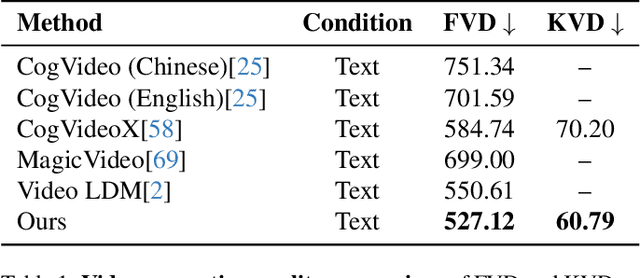
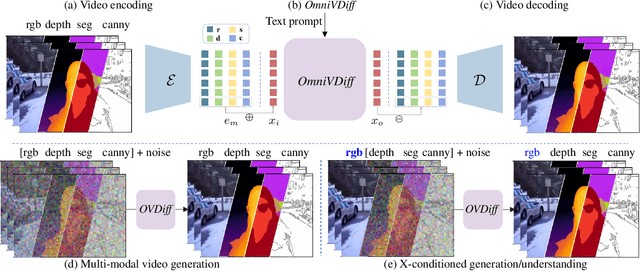
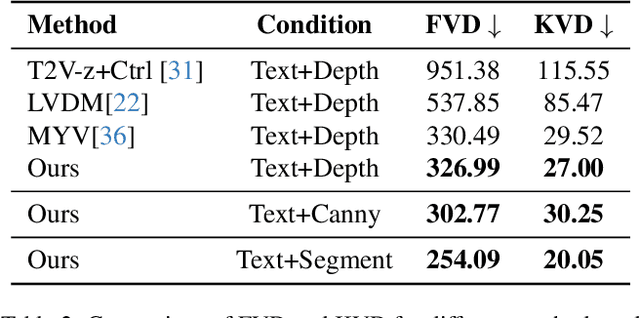
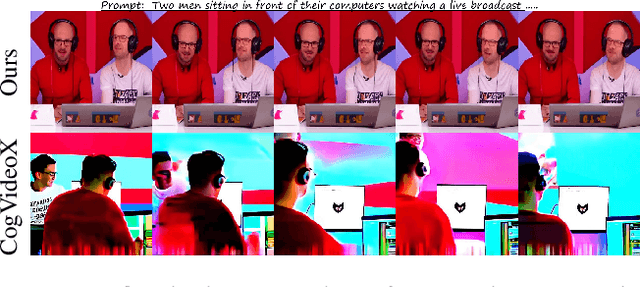
In this paper, we propose a novel framework for controllable video diffusion, OmniVDiff, aiming to synthesize and comprehend multiple video visual content in a single diffusion model. To achieve this, OmniVDiff treats all video visual modalities in the color space to learn a joint distribution, while employing an adaptive control strategy that dynamically adjusts the role of each visual modality during the diffusion process, either as a generation modality or a conditioning modality. This allows flexible manipulation of each modality's role, enabling support for a wide range of tasks. Consequently, our model supports three key functionalities: (1) Text-conditioned video generation: multi-modal visual video sequences (i.e., rgb, depth, canny, segmentaion) are generated based on the text conditions in one diffusion process; (2) Video understanding: OmniVDiff can estimate the depth, canny map, and semantic segmentation across the input rgb frames while ensuring coherence with the rgb input; and (3) X-conditioned video generation: OmniVDiff generates videos conditioned on fine-grained attributes (e.g., depth maps or segmentation maps). By integrating these diverse tasks into a unified video diffusion framework, OmniVDiff enhances the flexibility and scalability for controllable video diffusion, making it an effective tool for a variety of downstream applications, such as video-to-video translation. Extensive experiments demonstrate the effectiveness of our approach, highlighting its potential for various video-related applications.
MMGen: Unified Multi-modal Image Generation and Understanding in One Go
Mar 26, 2025A unified diffusion framework for multi-modal generation and understanding has the transformative potential to achieve seamless and controllable image diffusion and other cross-modal tasks. In this paper, we introduce MMGen, a unified framework that integrates multiple generative tasks into a single diffusion model. This includes: (1) multi-modal category-conditioned generation, where multi-modal outputs are generated simultaneously through a single inference process, given category information; (2) multi-modal visual understanding, which accurately predicts depth, surface normals, and segmentation maps from RGB images; and (3) multi-modal conditioned generation, which produces corresponding RGB images based on specific modality conditions and other aligned modalities. Our approach develops a novel diffusion transformer that flexibly supports multi-modal output, along with a simple modality-decoupling strategy to unify various tasks. Extensive experiments and applications demonstrate the effectiveness and superiority of MMGen across diverse tasks and conditions, highlighting its potential for applications that require simultaneous generation and understanding.
MVTokenFlow: High-quality 4D Content Generation using Multiview Token Flow
Feb 17, 2025In this paper, we present MVTokenFlow for high-quality 4D content creation from monocular videos. Recent advancements in generative models such as video diffusion models and multiview diffusion models enable us to create videos or 3D models. However, extending these generative models for dynamic 4D content creation is still a challenging task that requires the generated content to be consistent spatially and temporally. To address this challenge, MVTokenFlow utilizes the multiview diffusion model to generate multiview images on different timesteps, which attains spatial consistency across different viewpoints and allows us to reconstruct a reasonable coarse 4D field. Then, MVTokenFlow further regenerates all the multiview images using the rendered 2D flows as guidance. The 2D flows effectively associate pixels from different timesteps and improve the temporal consistency by reusing tokens in the regeneration process. Finally, the regenerated images are spatiotemporally consistent and utilized to refine the coarse 4D field to get a high-quality 4D field. Experiments demonstrate the effectiveness of our design and show significantly improved quality than baseline methods.