 Add to Chrome
 Add to Firefox
 Add to Edge
IPT-V2: Efficient Image Processing Transformer using Hierarchical Attentions
Mar 31, 2024


Recent advances have demonstrated the powerful capability of transformer architecture in image restoration. However, our analysis indicates that existing transformerbased methods can not establish both exact global and local dependencies simultaneously, which are much critical to restore the details and missing content of degraded images. To this end, we present an efficient image processing transformer architecture with hierarchical attentions, called IPTV2, adopting a focal context self-attention (FCSA) and a global grid self-attention (GGSA) to obtain adequate token interactions in local and global receptive fields. Specifically, FCSA applies the shifted window mechanism into the channel self-attention, helps capture the local context and mutual interaction across channels. And GGSA constructs long-range dependencies in the cross-window grid, aggregates global information in spatial dimension. Moreover, we introduce structural re-parameterization technique to feed-forward network to further improve the model capability. Extensive experiments demonstrate that our proposed IPT-V2 achieves state-of-the-art results on various image processing tasks, covering denoising, deblurring, deraining and obtains much better trade-off for performance and computational complexity than previous methods. Besides, we extend our method to image generation as latent diffusion backbone, and significantly outperforms DiTs.

InternLM2 Technical Report
Mar 26, 2024


The evolution of Large Language Models (LLMs) like ChatGPT and GPT-4 has sparked discussions on the advent of Artificial General Intelligence (AGI). However, replicating such advancements in open-source models has been challenging. This paper introduces InternLM2, an open-source LLM that outperforms its predecessors in comprehensive evaluations across 6 dimensions and 30 benchmarks, long-context modeling, and open-ended subjective evaluations through innovative pre-training and optimization techniques. The pre-training process of InternLM2 is meticulously detailed, highlighting the preparation of diverse data types including text, code, and long-context data. InternLM2 efficiently captures long-term dependencies, initially trained on 4k tokens before advancing to 32k tokens in pre-training and fine-tuning stages, exhibiting remarkable performance on the 200k ``Needle-in-a-Haystack" test. InternLM2 is further aligned using Supervised Fine-Tuning (SFT) and a novel Conditional Online Reinforcement Learning from Human Feedback (COOL RLHF) strategy that addresses conflicting human preferences and reward hacking. By releasing InternLM2 models in different training stages and model sizes, we provide the community with insights into the model's evolution.
CodeS: Natural Language to Code Repository via Multi-Layer Sketch
Mar 25, 2024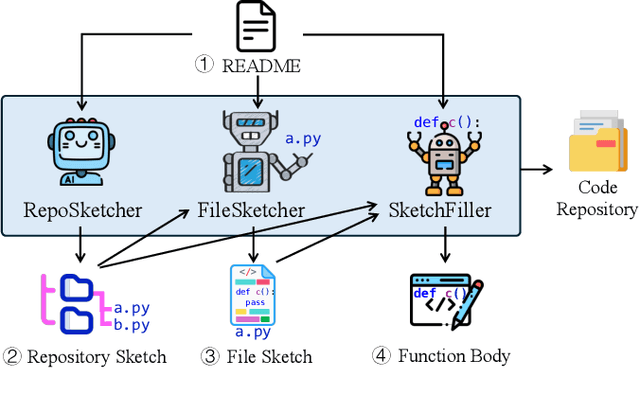
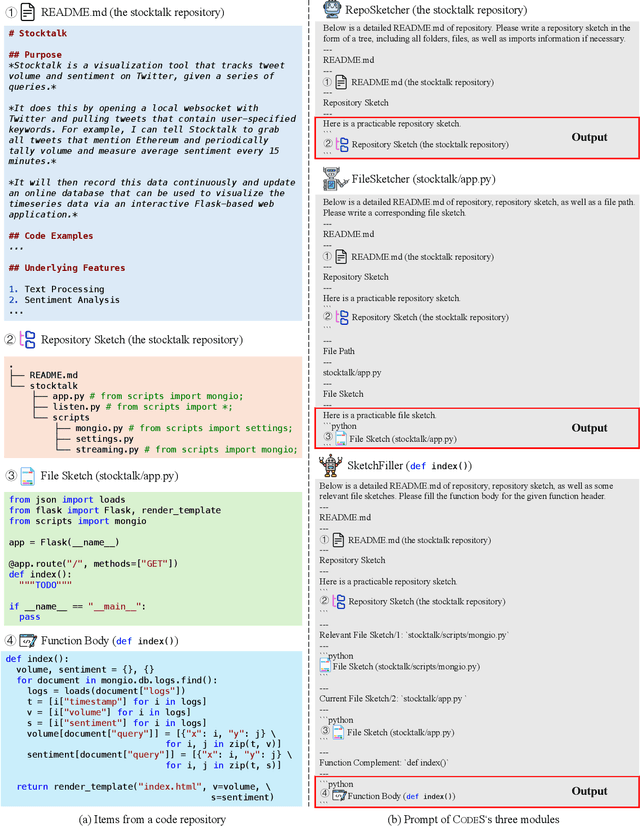

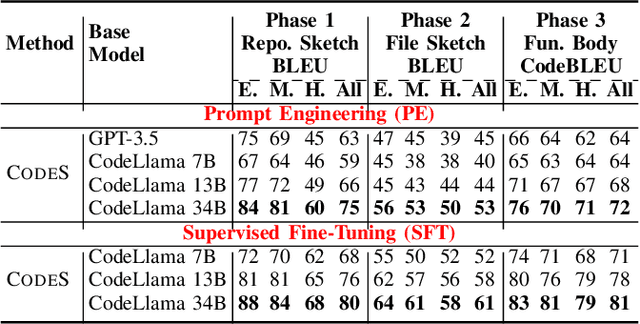
The impressive performance of large language models (LLMs) on code-related tasks has shown the potential of fully automated software development. In light of this, we introduce a new software engineering task, namely Natural Language to code Repository (NL2Repo). This task aims to generate an entire code repository from its natural language requirements. To address this task, we propose a simple yet effective framework CodeS, which decomposes NL2Repo into multiple sub-tasks by a multi-layer sketch. Specifically, CodeS includes three modules: RepoSketcher, FileSketcher, and SketchFiller. RepoSketcher first generates a repository's directory structure for given requirements; FileSketcher then generates a file sketch for each file in the generated structure; SketchFiller finally fills in the details for each function in the generated file sketch. To rigorously assess CodeS on the NL2Repo task, we carry out evaluations through both automated benchmarking and manual feedback analysis. For benchmark-based evaluation, we craft a repository-oriented benchmark, SketchEval, and design an evaluation metric, SketchBLEU. For feedback-based evaluation, we develop a VSCode plugin for CodeS and engage 30 participants in conducting empirical studies. Extensive experiments prove the effectiveness and practicality of CodeS on the NL2Repo task.
IS-Fusion: Instance-Scene Collaborative Fusion for Multimodal 3D Object Detection
Mar 22, 2024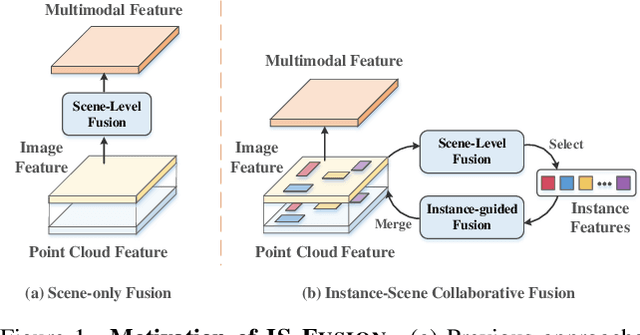
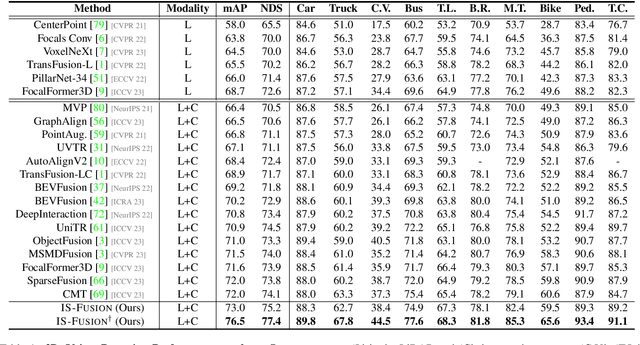
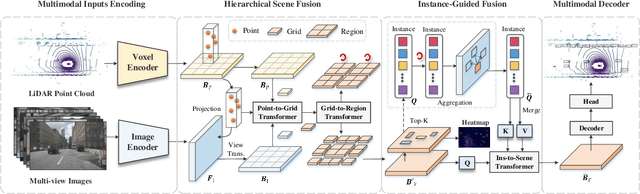
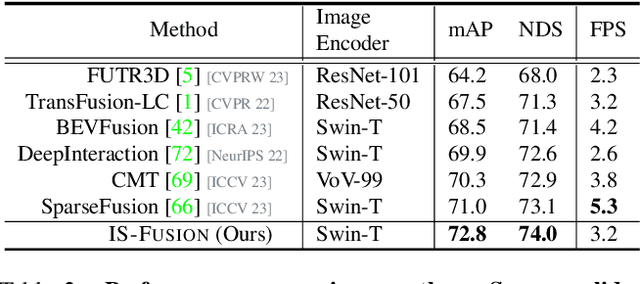
Bird's eye view (BEV) representation has emerged as a dominant solution for describing 3D space in autonomous driving scenarios. However, objects in the BEV representation typically exhibit small sizes, and the associated point cloud context is inherently sparse, which leads to great challenges for reliable 3D perception. In this paper, we propose IS-Fusion, an innovative multimodal fusion framework that jointly captures the Instance- and Scene-level contextual information. IS-Fusion essentially differs from existing approaches that only focus on the BEV scene-level fusion by explicitly incorporating instance-level multimodal information, thus facilitating the instance-centric tasks like 3D object detection. It comprises a Hierarchical Scene Fusion (HSF) module and an Instance-Guided Fusion (IGF) module. HSF applies Point-to-Grid and Grid-to-Region transformers to capture the multimodal scene context at different granularities. IGF mines instance candidates, explores their relationships, and aggregates the local multimodal context for each instance. These instances then serve as guidance to enhance the scene feature and yield an instance-aware BEV representation. On the challenging nuScenes benchmark, IS-Fusion outperforms all the published multimodal works to date. Code is available at: https://github.com/yinjunbo/IS-Fusion.
Benchmarking Chinese Commonsense Reasoning of LLMs: From Chinese-Specifics to Reasoning-Memorization Correlations
Mar 21, 2024We introduce CHARM, the first benchmark for comprehensively and in-depth evaluating the commonsense reasoning ability of large language models (LLMs) in Chinese, which covers both globally known and Chinese-specific commonsense. We evaluated 7 English and 12 Chinese-oriented LLMs on CHARM, employing 5 representative prompt strategies for improving LLMs' reasoning ability, such as Chain-of-Thought. Our findings indicate that the LLM's language orientation and the task's domain influence the effectiveness of the prompt strategy, which enriches previous research findings. We built closely-interconnected reasoning and memorization tasks, and found that some LLMs struggle with memorizing Chinese commonsense, affecting their reasoning ability, while others show differences in reasoning despite similar memorization performance. We also evaluated the LLMs' memorization-independent reasoning abilities and analyzed the typical errors. Our study precisely identified the LLMs' strengths and weaknesses, providing the clear direction for optimization. It can also serve as a reference for studies in other fields. We will release CHARM at https://github.com/opendatalab/CHARM .
RAR: Retrieving And Ranking Augmented MLLMs for Visual Recognition
Mar 20, 2024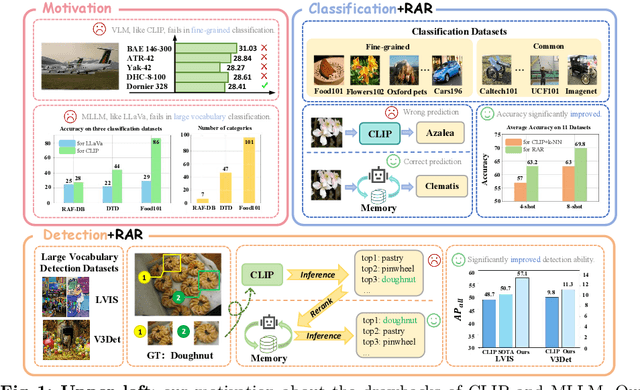
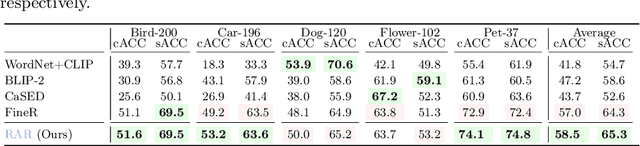
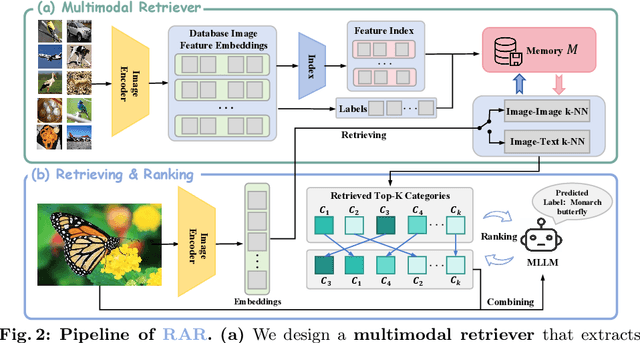
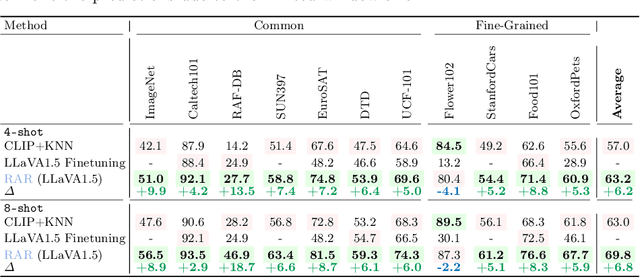
CLIP (Contrastive Language-Image Pre-training) uses contrastive learning from noise image-text pairs to excel at recognizing a wide array of candidates, yet its focus on broad associations hinders the precision in distinguishing subtle differences among fine-grained items. Conversely, Multimodal Large Language Models (MLLMs) excel at classifying fine-grained categories, thanks to their substantial knowledge from pre-training on web-level corpora. However, the performance of MLLMs declines with an increase in category numbers, primarily due to growing complexity and constraints of limited context window size. To synergize the strengths of both approaches and enhance the few-shot/zero-shot recognition abilities for datasets characterized by extensive and fine-grained vocabularies, this paper introduces RAR, a Retrieving And Ranking augmented method for MLLMs. We initially establish a multi-modal retriever based on CLIP to create and store explicit memory for different categories beyond the immediate context window. During inference, RAR retrieves the top-k similar results from the memory and uses MLLMs to rank and make the final predictions. Our proposed approach not only addresses the inherent limitations in fine-grained recognition but also preserves the model's comprehensive knowledge base, significantly boosting accuracy across a range of vision-language recognition tasks. Notably, our approach demonstrates a significant improvement in performance on 5 fine-grained visual recognition benchmarks, 11 few-shot image recognition datasets, and the 2 object detection datasets under the zero-shot recognition setting.
HeR-DRL:Heterogeneous Relational Deep Reinforcement Learning for Decentralized Multi-Robot Crowd Navigation
Mar 15, 2024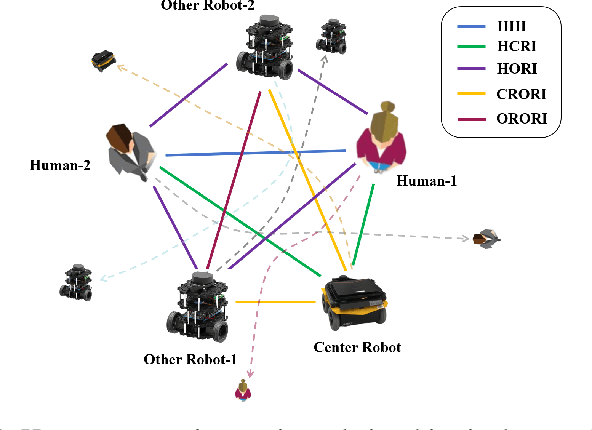
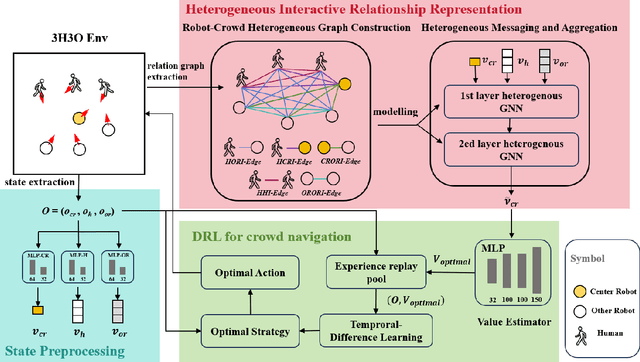
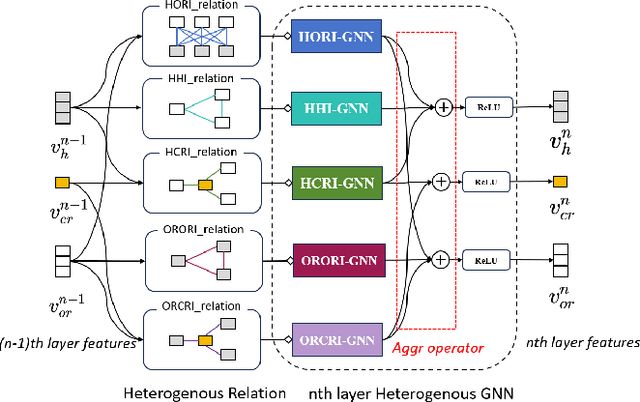
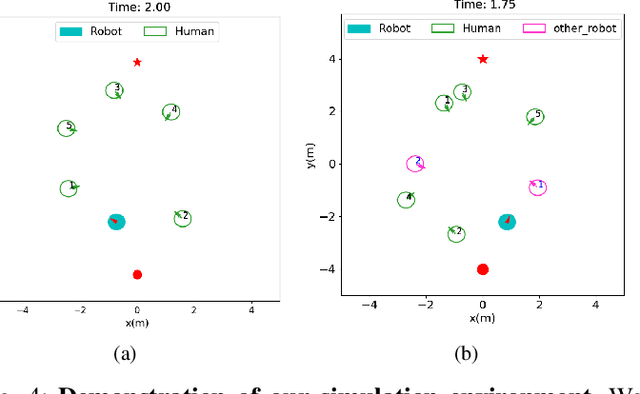
Crowd navigation has received significant research attention in recent years, especially DRL-based methods. While single-robot crowd scenarios have dominated research, they offer limited applicability to real-world complexities. The heterogeneity of interaction among multiple agent categories, like in decentralized multi-robot pedestrian scenarios, are frequently disregarded. This "interaction blind spot" hinders generalizability and restricts progress towards robust navigation algorithms. In this paper, we propose a heterogeneous relational deep reinforcement learning(HeR-DRL), based on customised heterogeneous GNN, in order to improve navigation strategies in decentralized multi-robot crowd navigation. Firstly, we devised a method for constructing robot-crowd heterogenous relation graph that effectively simulates the heterogeneous pair-wise interaction relationships. We proposed a new heterogeneous graph neural network for transferring and aggregating the heterogeneous state information. Finally, we incorporate the encoded information into deep reinforcement learning to explore the optimal policy. HeR-DRL are rigorously evaluated through comparing it to state-of-the-art algorithms in both single-robot and multi-robot circle crowssing scenario. The experimental results demonstrate that HeR-DRL surpasses the state-of-the-art approaches in overall performance, particularly excelling in safety and comfort metrics. This underscores the significance of interaction heterogeneity for crowd navigation. The source code will be publicly released in https://github.com/Zhouxy-Debugging-Den/HeR-DRL.
PERL: Parameter Efficient Reinforcement Learning from Human Feedback
Mar 15, 2024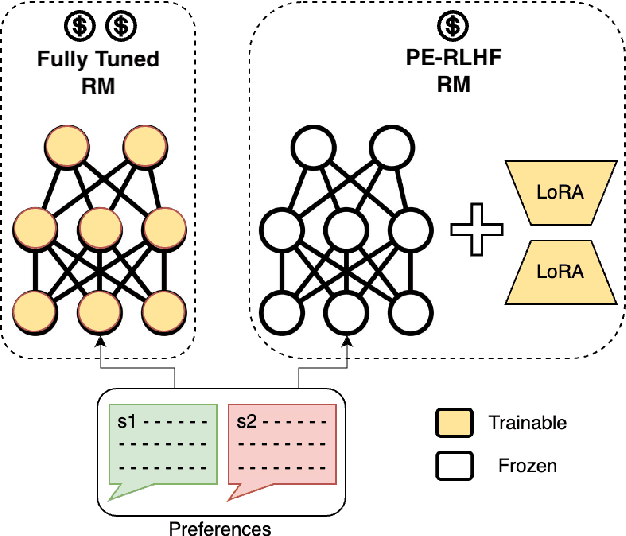
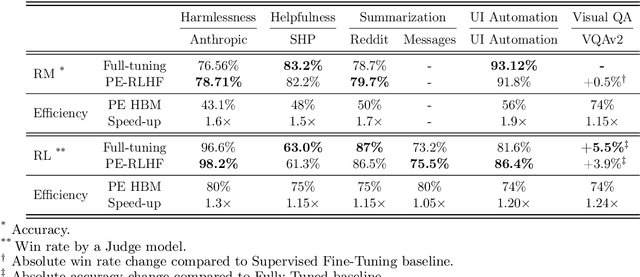
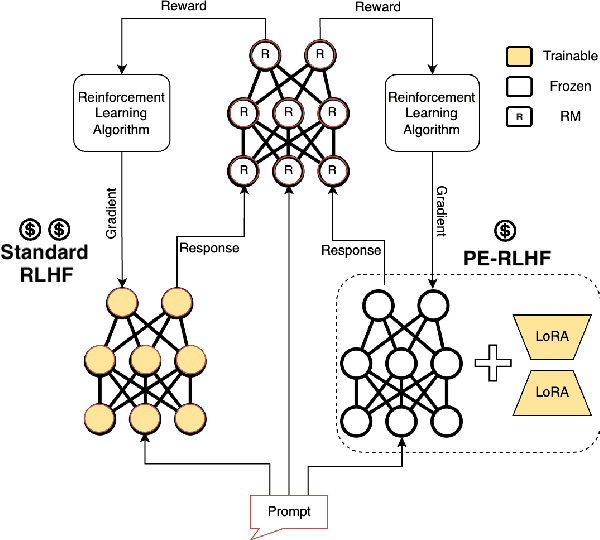
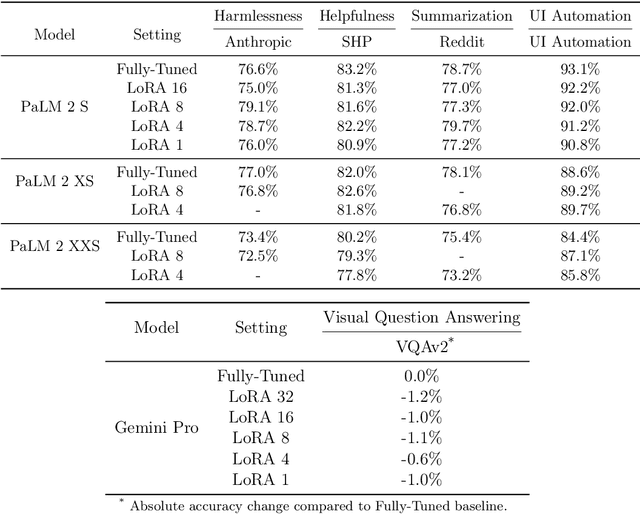
Reinforcement Learning from Human Feedback (RLHF) has proven to be a strong method to align Pretrained Large Language Models (LLMs) with human preferences. But training models with RLHF is computationally expensive, and an overall complex process. In this work, we study RLHF where the underlying models are trained using the parameter efficient method of Low-Rank Adaptation (LoRA) introduced by Hu et al. [2021]. We investigate the setup of "Parameter Efficient Reinforcement Learning" (PERL), in which we perform reward model training and reinforcement learning using LoRA. We compare PERL to conventional fine-tuning (full-tuning) across various configurations for 7 benchmarks, including 2 novel datasets, of reward modeling and reinforcement learning. We find that PERL performs on par with the conventional RLHF setting, while training faster, and with less memory. This enables the high performance of RLHF, while reducing the computational burden that limits its adoption as an alignment technique for Large Language Models. We also release 2 novel thumbs up/down preference datasets: "Taskmaster Coffee", and "Taskmaster Ticketing" to promote research around RLHF.
Low-Complexity Beam Training for Multi-RIS-Assisted Multi-User Communications
Mar 14, 2024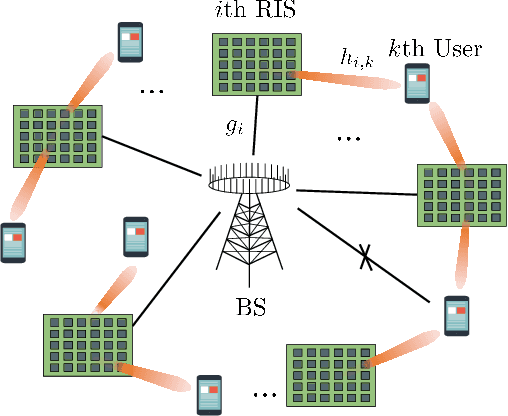
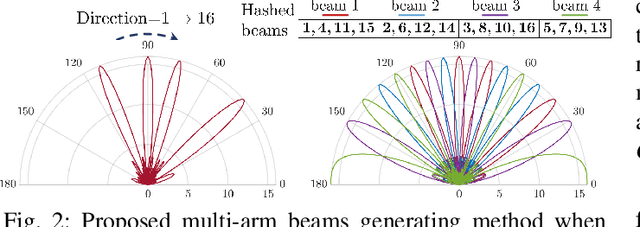
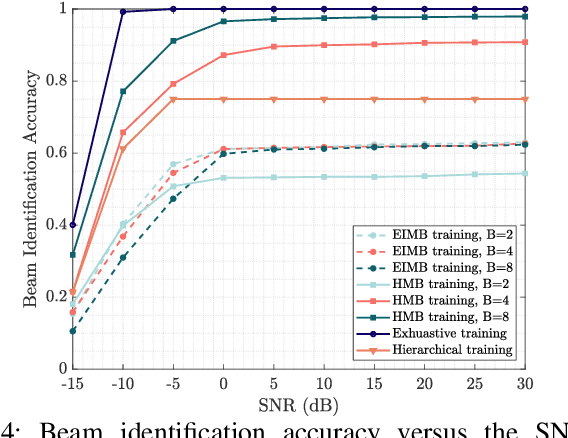
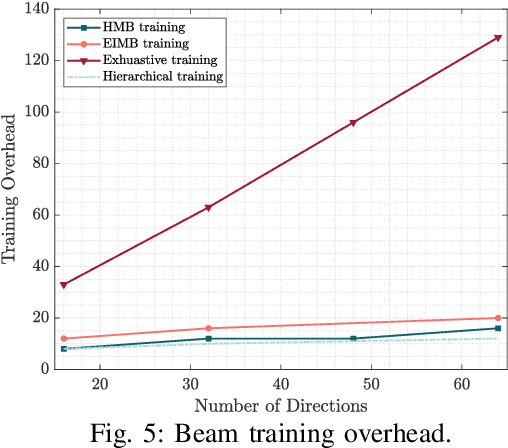
In this paper, we investigate the beam training problem in the multi-user millimeter wave (mmWave) communication system, where multiple reconfigurable intelligent surfaces (RISs) are deployed to improve the coverage and the achievable rate. However, existing beam training techniques in mmWave systems suffer from the high complexity (i.e., exponential order) and low identification accuracy. To address these problems, we propose a novel hashing multi-arm beam (HMB) training scheme that reduces the training complexity to the logarithmic order with the high accuracy. Specifically, we first design a generation mechanism for HMB codebooks. Then, we propose a demultiplexing algorithm based on the soft decision to distinguish signals from different RIS reflective links. Finally, we utilize a multi-round voting mechanism to align the beams. Simulation results show that the proposed HMB training scheme enables simultaneous training for multiple RISs and multiple users, and reduces the beam training overhead to the logarithmic level. Moreover, it also shows that our proposed scheme can significantly improve the identification accuracy by at least 20% compared to existing beam training techniques.
KnowCoder: Coding Structured Knowledge into LLMs for Universal Information Extraction
Mar 14, 2024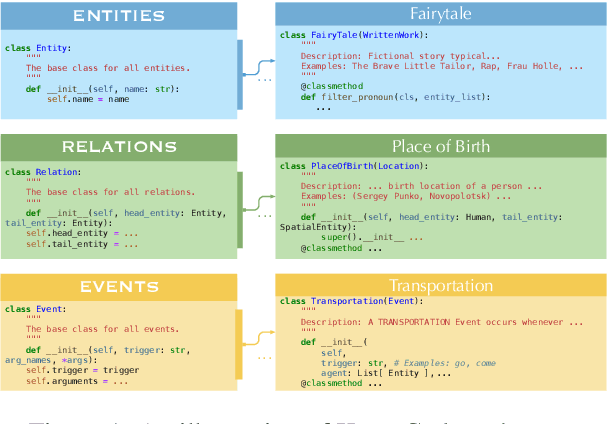
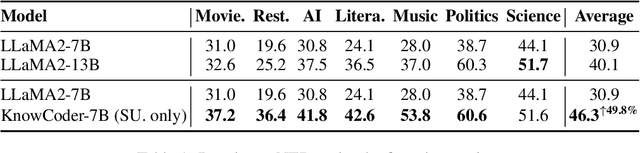
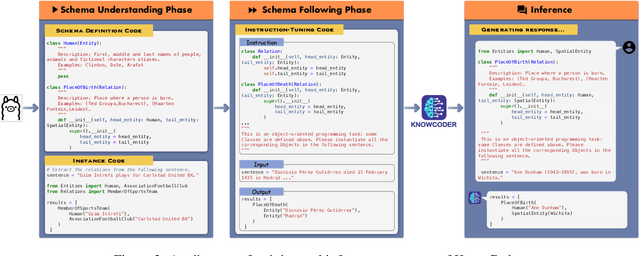
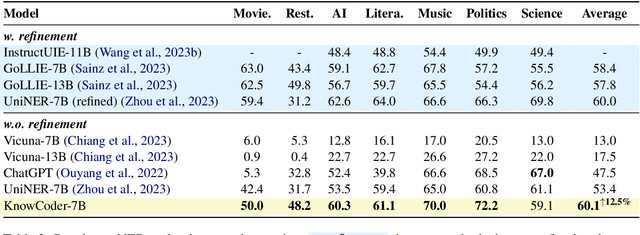
In this paper, we propose KnowCoder, a Large Language Model (LLM) to conduct Universal Information Extraction (UIE) via code generation. KnowCoder aims to develop a kind of unified schema representation that LLMs can easily understand and an effective learning framework that encourages LLMs to follow schemas and extract structured knowledge accurately. To achieve these, KnowCoder introduces a code-style schema representation method to uniformly transform different schemas into Python classes, with which complex schema information, such as constraints among tasks in UIE, can be captured in an LLM-friendly manner. We further construct a code-style schema library covering over $\textbf{30,000}$ types of knowledge, which is the largest one for UIE, to the best of our knowledge. To ease the learning process of LLMs, KnowCoder contains a two-phase learning framework that enhances its schema understanding ability via code pretraining and its schema following ability via instruction tuning. After code pretraining on around $1.5$B automatically constructed data, KnowCoder already attains remarkable generalization ability and achieves relative improvements by $\textbf{49.8%}$ F1, compared to LLaMA2, under the few-shot setting. After instruction tuning, KnowCoder further exhibits strong generalization ability on unseen schemas and achieves up to $\textbf{12.5%}$ and $\textbf{21.9%}$, compared to sota baselines, under the zero-shot setting and the low resource setting, respectively. Additionally, based on our unified schema representations, various human-annotated datasets can simultaneously be utilized to refine KnowCoder, which achieves significant improvements up to $\textbf{7.5%}$ under the supervised setting.