 Add to Chrome
 Add to Firefox
 Add to Edge
Event Ontology Expansion via LLM-Based Conceptualization
Jun 19, 2026
Event ontology expansion aims to discover emerging event types from data and extend them to appropriate positions in the existing event ontology.. Existing methods typically cluster contextualized trigger representations and attach induced clusters to the ontology based on instance-level similarity. However, ontology expansion requires concept-level semantics that characterize event types, whereas contextualized trigger representations often conflate these semantics with surface contextual variation, leading to unstable clustering and unreliable hierarchy expansion. To address this issue, we propose ConceptE, a conceptualization-enhanced framework for event ontology expansion. ConceptE first derives concept-level semantics by prompting an LLM with the sentence and event trigger, producing a concise concept name and a natural-language description. It then jointly encodes these semantics with trigger information to build concept-enhanced representations aligned with ontology-level reasoning. This representation design supports more coherent event clustering, more reliable hierarchy expansion, and ontology-consistent type naming. Experiments on ACE, ERE, and MAVEN demonstrate that ConceptE consistently outperforms state-of-the-art approaches across all subtasks of event ontology expansion. In particular, it achieves improvements of up to 12.37\% in BCubed-F1 for event clustering and 6.48\% in Taxo\_F1 for hierarchy expansion, demonstrating the effectiveness of the proposed ConceptE method.

KnowCoder: Coding Structured Knowledge into LLMs for Universal Information Extraction
Mar 14, 2024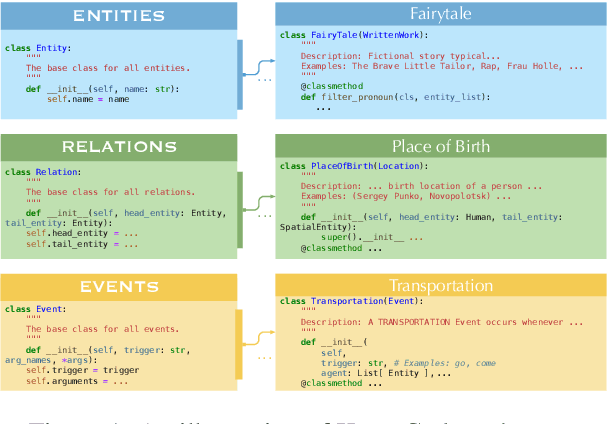
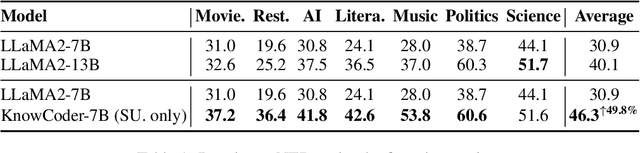
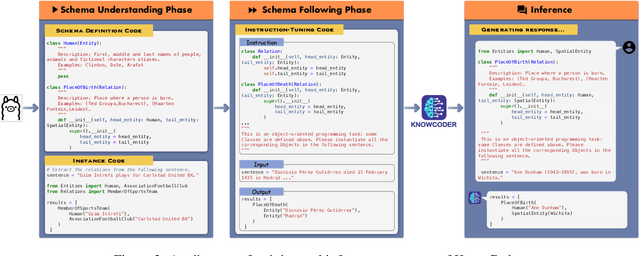
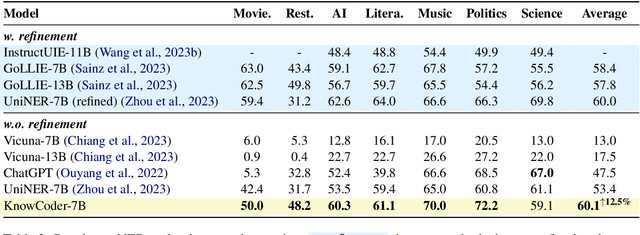
In this paper, we propose KnowCoder, a Large Language Model (LLM) to conduct Universal Information Extraction (UIE) via code generation. KnowCoder aims to develop a kind of unified schema representation that LLMs can easily understand and an effective learning framework that encourages LLMs to follow schemas and extract structured knowledge accurately. To achieve these, KnowCoder introduces a code-style schema representation method to uniformly transform different schemas into Python classes, with which complex schema information, such as constraints among tasks in UIE, can be captured in an LLM-friendly manner. We further construct a code-style schema library covering over $\textbf{30,000}$ types of knowledge, which is the largest one for UIE, to the best of our knowledge. To ease the learning process of LLMs, KnowCoder contains a two-phase learning framework that enhances its schema understanding ability via code pretraining and its schema following ability via instruction tuning. After code pretraining on around $1.5$B automatically constructed data, KnowCoder already attains remarkable generalization ability and achieves relative improvements by $\textbf{49.8%}$ F1, compared to LLaMA2, under the few-shot setting. After instruction tuning, KnowCoder further exhibits strong generalization ability on unseen schemas and achieves up to $\textbf{12.5%}$ and $\textbf{21.9%}$, compared to sota baselines, under the zero-shot setting and the low resource setting, respectively. Additionally, based on our unified schema representations, various human-annotated datasets can simultaneously be utilized to refine KnowCoder, which achieves significant improvements up to $\textbf{7.5%}$ under the supervised setting.
Nested Event Extraction upon Pivot Element Recogniton
Sep 22, 2023


Nested Event Extraction (NEE) aims to extract complex event structures where an event contains other events as its arguments recursively. Nested events involve a kind of Pivot Elements (PEs) that simultaneously act as arguments of outer events and as triggers of inner events, and thus connect them into nested structures. This special characteristic of PEs brings challenges to existing NEE methods, as they cannot well cope with the dual identities of PEs. Therefore, this paper proposes a new model, called PerNee, which extracts nested events mainly based on recognizing PEs. Specifically, PerNee first recognizes the triggers of both inner and outer events and further recognizes the PEs via classifying the relation type between trigger pairs. In order to obtain better representations of triggers and arguments to further improve NEE performance, it incorporates the information of both event types and argument roles into PerNee through prompt learning. Since existing NEE datasets (e.g., Genia11) are limited to specific domains and contain a narrow range of event types with nested structures, we systematically categorize nested events in generic domain and construct a new NEE dataset, namely ACE2005-Nest. Experimental results demonstrate that PerNee consistently achieves state-of-the-art performance on ACE2005-Nest, Genia11 and Genia13.