 Add to Chrome
 Add to Firefox
 Add to Edge
SagnacAssisted Enhanced OTDR for Distributed Acoustic Sensing: A Standardized Benchmark and Engineering Evaluation Framework
Jun 04, 2026
Phase-sensitive optical time-domain reflectometry ($φ$-OTDR) is widely used in large-scale distributed acoustic sensing (DAS) because it provides distributed spatiotemporal monitoring over long sensing distances. Its field performance can still deteriorate because of polarization-induced fading (PIF), local signal degradation, and strong environmental interference. This study develops a Sagnac-assisted enhanced $φ$-OTDR sensing architecture and a standardized benchmark framework for engineering-oriented DAS event recognition. The Sagnac interferometer provides a continuous phase response that supplements fading-prone observations in the $φ$-OTDR channel, and heterogeneous signal alignment is achieved using a cross-correlation procedure implemented on an FPGA platform. The benchmark protocol compares conventional feature-engineering methods, probabilistic shallow classifiers, single-branch deep models, and dual-branch fusion models under consistent data partitioning, preprocessing, and metric definitions. Experiments on a 10-km sensing fiber with six representative acoustic event classes show that the dual-branch fusion model provides the most favorable trade-off among the evaluated methods, reaching 89.79\% accuracy, 89.83\% macro-F1, and a nuisance alarm rate of 5.00\% on the balanced test set. The results also show that channel grouping strongly affects dual-branch evaluation, indicating that deployment-oriented conclusions should be based on accuracy, macro-F1, nuisance alarm rate, false negative rate, and latency rather than accuracy alone. This work provides a physically motivated enhancement strategy for $φ$-OTDR-based DAS and a reproducible benchmark protocol for future fusion-oriented sensing research. The implementation and scripts for reproducing the DAS event-recognition experiments are publicly available at https://github.com/wawa-abc/das.

MUSE: A Unified Agentic Harness for MLLMs
Jun 02, 2026Despite rapid progress, multimodal large language models (MLLMs) still fail on tasks that humans solve effortlessly, such as navigating a grid maze from a screenshot or selecting the correct puzzle piece. Rather than retraining the model, we ask a complementary question: how much capability can be elicited from a frozen MLLM purely by improving the execution scaffold around it? We introduce MUSE, a multimodal unified structured execution harness that wraps any off-the-shelf MLLM with composable modules for task representation, visual processing, perception tool use, structured parsing, deterministic verification, and verifier-guided repair, without any model retraining. We evaluate MUSE across diverse benchmarks spanning visual spatial planning, visual perception, multimodal reasoning, and fine-grained visual discrimination, using multiple state-of-the-art MLLMs. MUSE delivers consistent gains over the bare model in all settings, with the largest jumps on challenging instances. Further analysis reveals that many MLLM failures arise from harness-level shortcomings rather than fundamental model deficits, and can be addressed through verifier-guided repair without touching the model. These findings highlight the agentic multimodal harness as a critical yet underexplored design dimension, offering an orthogonal avenue for improving MLLMs beyond model-centric optimization.
The Indra Representation Hypothesis for Multimodal Alignment
Apr 06, 2026Recent studies have uncovered an interesting phenomenon: unimodal foundation models tend to learn convergent representations, regardless of differences in architecture, training objectives, or data modalities. However, these representations are essentially internal abstractions of samples that characterize samples independently, leading to limited expressiveness. In this paper, we propose The Indra Representation Hypothesis, inspired by the philosophical metaphor of Indra's Net. We argue that representations from unimodal foundation models are converging to implicitly reflect a shared relational structure underlying reality, akin to the relational ontology of Indra's Net. We formalize this hypothesis using the V-enriched Yoneda embedding from category theory, defining the Indra representation as a relational profile of each sample with respect to others. This formulation is shown to be unique, complete, and structure-preserving under a given cost function. We instantiate the Indra representation using angular distance and evaluate it in cross-model and cross-modal scenarios involving vision, language, and audio. Extensive experiments demonstrate that Indra representations consistently enhance robustness and alignment across architectures and modalities, providing a theoretically grounded and practical framework for training-free alignment of unimodal foundation models. Our code is available at https://github.com/Jianglin954/Indra.
Physically Inspired Gaussian Splatting for HDR Novel View Synthesis
Mar 30, 2026High dynamic range novel view synthesis (HDR-NVS) reconstructs scenes with dynamic details by fusing multi-exposure low dynamic range (LDR) views, yet it struggles to capture ambient illumination-dependent appearance. Implicitly supervising HDR content by constraining tone-mapped results fails in correcting abnormal HDR values, and results in limited gradients for Gaussians in under/over-exposed regions. To this end, we introduce PhysHDR-GS, a physically inspired HDR-NVS framework that models scene appearance via intrinsic reflectance and adjustable ambient illumination. PhysHDR-GS employs a complementary image-exposure (IE) branch and Gaussian-illumination (GI) branch to faithfully reproduce standard camera observations and capture illumination-dependent appearance changes, respectively. During training, the proposed cross-branch HDR consistency loss provides explicit supervision for HDR content, while an illumination-guided gradient scaling strategy mitigates exposure-biased gradient starvation and reduces under-densified representations. Experimental results across realistic and synthetic datasets demonstrate our superiority in reconstructing HDR details (e.g., a PSNR gain of 2.04 dB over HDR-GS), while maintaining real-time rendering speed (up to 76 FPS). Code and models are available at https://huimin-zeng.github.io/PhysHDR-GS/.
CompSRT: Quantization and Pruning for Image Super Resolution Transformers
Jan 28, 2026Model compression has become an important tool for making image super resolution models more efficient. However, the gap between the best compressed models and the full precision model still remains large and a need for deeper understanding of compression theory on more performant models remains. Prior research on quantization of LLMs has shown that Hadamard transformations lead to weights and activations with reduced outliers, which leads to improved performance. We argue that while the Hadamard transform does reduce the effect of outliers, an empirical analysis on how the transform functions remains needed. By studying the distributions of weights and activations of SwinIR-light, we show with statistical analysis that lower errors is caused by the Hadamard transforms ability to reduce the ranges, and increase the proportion of values around $0$. Based on these findings, we introduce CompSRT, a more performant way to compress the image super resolution transformer network SwinIR-light. We perform Hadamard-based quantization, and we also perform scalar decomposition to introduce two additional trainable parameters. Our quantization performance statistically significantly surpasses the SOTA in metrics with gains as large as 1.53 dB, and visibly improves visual quality by reducing blurriness at all bitwidths. At $3$-$4$ bits, to show our method is compatible with pruning for increased compression, we also prune $40\%$ of weights and show that we can achieve $6.67$-$15\%$ reduction in bits per parameter with comparable performance to SOTA.
TexLiverNet: Leveraging Medical Knowledge and Spatial-Frequency Perception for Enhanced Liver Tumor Segmentation
Nov 07, 2024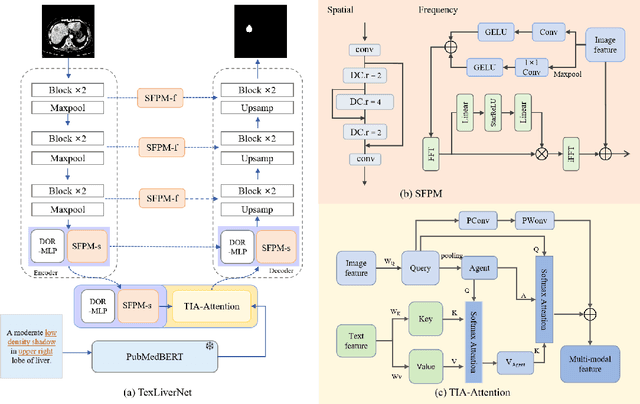
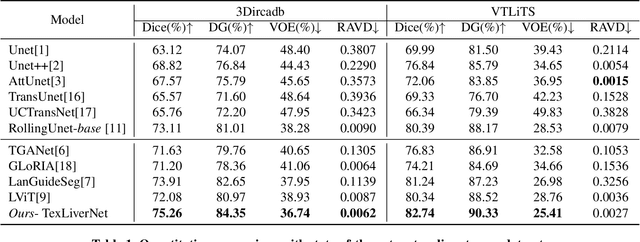
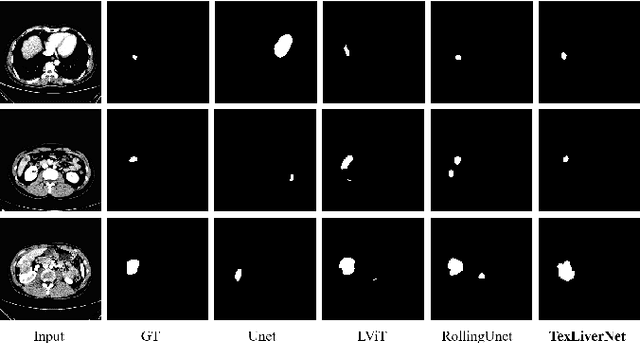
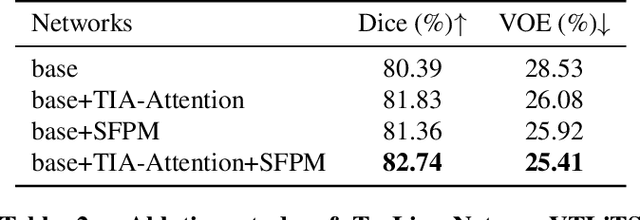
Integrating textual data with imaging in liver tumor segmentation is essential for enhancing diagnostic accuracy. However, current multi-modal medical datasets offer only general text annotations, lacking lesion-specific details critical for extracting nuanced features, especially for fine-grained segmentation of tumor boundaries and small lesions. To address these limitations, we developed datasets with lesion-specific text annotations for liver tumors and introduced the TexLiverNet model. TexLiverNet employs an agent-based cross-attention module that integrates text features efficiently with visual features, significantly reducing computational costs. Additionally, enhanced spatial and adaptive frequency domain perception is proposed to precisely delineate lesion boundaries, reduce background interference, and recover fine details in small lesions. Comprehensive evaluations on public and private datasets demonstrate that TexLiverNet achieves superior performance compared to current state-of-the-art methods.
IPT-V2: Efficient Image Processing Transformer using Hierarchical Attentions
Mar 31, 2024


Recent advances have demonstrated the powerful capability of transformer architecture in image restoration. However, our analysis indicates that existing transformerbased methods can not establish both exact global and local dependencies simultaneously, which are much critical to restore the details and missing content of degraded images. To this end, we present an efficient image processing transformer architecture with hierarchical attentions, called IPTV2, adopting a focal context self-attention (FCSA) and a global grid self-attention (GGSA) to obtain adequate token interactions in local and global receptive fields. Specifically, FCSA applies the shifted window mechanism into the channel self-attention, helps capture the local context and mutual interaction across channels. And GGSA constructs long-range dependencies in the cross-window grid, aggregates global information in spatial dimension. Moreover, we introduce structural re-parameterization technique to feed-forward network to further improve the model capability. Extensive experiments demonstrate that our proposed IPT-V2 achieves state-of-the-art results on various image processing tasks, covering denoising, deblurring, deraining and obtains much better trade-off for performance and computational complexity than previous methods. Besides, we extend our method to image generation as latent diffusion backbone, and significantly outperforms DiTs.
HyperEditor: Achieving Both Authenticity and Cross-Domain Capability in Image Editing via Hypernetworks
Dec 21, 2023Editing real images authentically while also achieving cross-domain editing remains a challenge. Recent studies have focused on converting real images into latent codes and accomplishing image editing by manipulating these codes. However, merely manipulating the latent codes would constrain the edited images to the generator's image domain, hindering the attainment of diverse editing goals. In response, we propose an innovative image editing method called HyperEditor, which utilizes weight factors generated by hypernetworks to reassign the weights of the pre-trained StyleGAN2's generator. Guided by CLIP's cross-modal image-text semantic alignment, this innovative approach enables us to simultaneously accomplish authentic attribute editing and cross-domain style transfer, a capability not realized in previous methods. Additionally, we ascertain that modifying only the weights of specific layers in the generator can yield an equivalent editing result. Therefore, we introduce an adaptive layer selector, enabling our hypernetworks to autonomously identify the layers requiring output weight factors, which can further improve our hypernetworks' efficiency. Extensive experiments on abundant challenging datasets demonstrate the effectiveness of our method.
IFT: Image Fusion Transformer for Ghost-free High Dynamic Range Imaging
Sep 26, 2023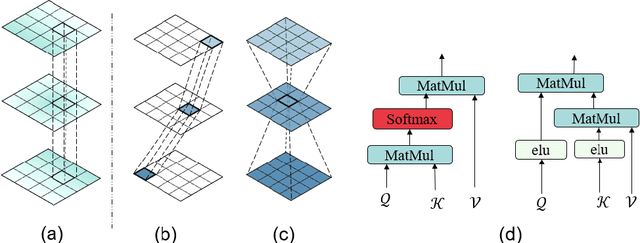
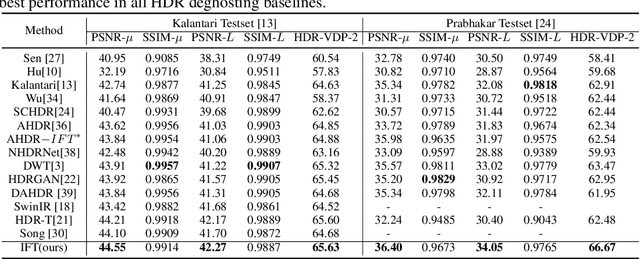
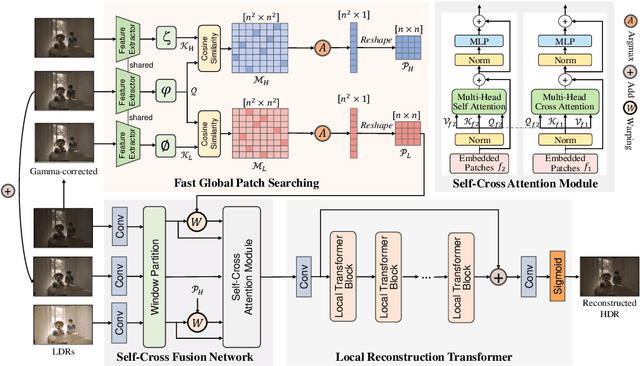
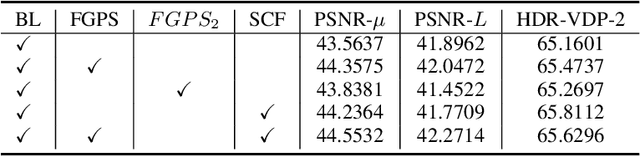
Multi-frame high dynamic range (HDR) imaging aims to reconstruct ghost-free images with photo-realistic details from content-complementary but spatially misaligned low dynamic range (LDR) images. Existing HDR algorithms are prone to producing ghosting artifacts as their methods fail to capture long-range dependencies between LDR frames with large motion in dynamic scenes. To address this issue, we propose a novel image fusion transformer, referred to as IFT, which presents a fast global patch searching (FGPS) module followed by a self-cross fusion module (SCF) for ghost-free HDR imaging. The FGPS searches the patches from supporting frames that have the closest dependency to each patch of the reference frame for long-range dependency modeling, while the SCF conducts intra-frame and inter-frame feature fusion on the patches obtained by the FGPS with linear complexity to input resolution. By matching similar patches between frames, objects with large motion ranges in dynamic scenes can be aligned, which can effectively alleviate the generation of artifacts. In addition, the proposed FGPS and SCF can be integrated into various deep HDR methods as efficient plug-in modules. Extensive experiments on multiple benchmarks show that our method achieves state-of-the-art performance both quantitatively and qualitatively.
Data Upcycling Knowledge Distillation for Image Super-Resolution
Sep 25, 2023Knowledge distillation (KD) emerges as a challenging yet promising technique for compressing deep learning models, characterized by the transmission of extensive learning representations from proficient and computationally intensive teacher models to compact student models. However, only a handful of studies have endeavored to compress the models for single image super-resolution (SISR) through KD, with their effects on student model enhancement remaining marginal. In this paper, we put forth an approach from the perspective of efficient data utilization, namely, the Data Upcycling Knowledge Distillation (DUKD) which facilitates the student model by the prior knowledge teacher provided via upcycled in-domain data derived from their inputs. This upcycling process is realized through two efficient image zooming operations and invertible data augmentations which introduce the label consistency regularization to the field of KD for SISR and substantially boosts student model's generalization. The DUKD, due to its versatility, can be applied across a broad spectrum of teacher-student architectures. Comprehensive experiments across diverse benchmarks demonstrate that our proposed DUKD method significantly outperforms previous art, exemplified by an increase of up to 0.5dB in PSNR over baselines methods, and a 67% parameters reduced RCAN model's performance remaining on par with that of the RCAN teacher model.