 Add to Chrome
 Add to Firefox
 Add to Edge
Beyond Dialogue Time: Temporal Semantic Memory for Personalized LLM Agents
Jan 12, 2026
Memory enables Large Language Model (LLM) agents to perceive, store, and use information from past dialogues, which is essential for personalization. However, existing methods fail to properly model the temporal dimension of memory in two aspects: 1) Temporal inaccuracy: memories are organized by dialogue time rather than their actual occurrence time; 2) Temporal fragmentation: existing methods focus on point-wise memory, losing durative information that captures persistent states and evolving patterns. To address these limitations, we propose Temporal Semantic Memory (TSM), a memory framework that models semantic time for point-wise memory and supports the construction and utilization of durative memory. During memory construction, it first builds a semantic timeline rather than a dialogue one. Then, it consolidates temporally continuous and semantically related information into a durative memory. During memory utilization, it incorporates the query's temporal intent on the semantic timeline, enabling the retrieval of temporally appropriate durative memories and providing time-valid, duration-consistent context to support response generation. Experiments on LongMemEval and LoCoMo show that TSM consistently outperforms existing methods and achieves up to 12.2% absolute improvement in accuracy, demonstrating the effectiveness of the proposed method.

StruProKGR: A Structural and Probabilistic Framework for Sparse Knowledge Graph Reasoning
Dec 14, 2025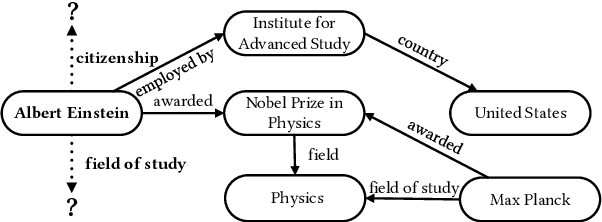
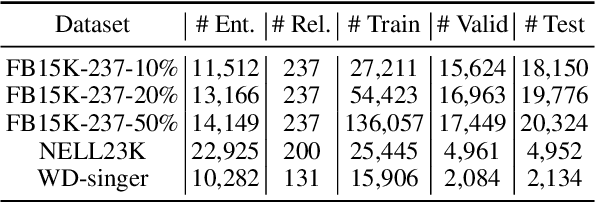

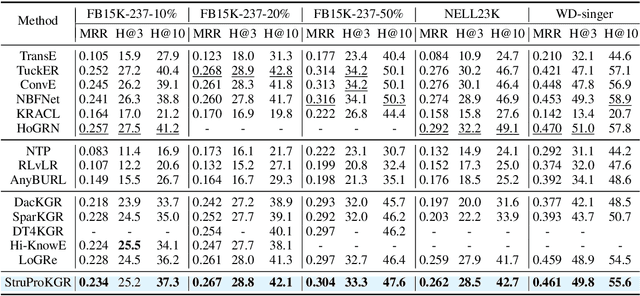
Sparse Knowledge Graphs (KGs) are commonly encountered in real-world applications, where knowledge is often incomplete or limited. Sparse KG reasoning, the task of inferring missing knowledge over sparse KGs, is inherently challenging due to the scarcity of knowledge and the difficulty of capturing relational patterns in sparse scenarios. Among all sparse KG reasoning methods, path-based ones have attracted plenty of attention due to their interpretability. Existing path-based methods typically rely on computationally intensive random walks to collect paths, producing paths of variable quality. Additionally, these methods fail to leverage the structured nature of graphs by treating paths independently. To address these shortcomings, we propose a Structural and Probabilistic framework named StruProKGR, tailored for efficient and interpretable reasoning on sparse KGs. StruProKGR utilizes a distance-guided path collection mechanism to significantly reduce computational costs while exploring more relevant paths. It further enhances the reasoning process by incorporating structural information through probabilistic path aggregation, which prioritizes paths that reinforce each other. Extensive experiments on five sparse KG reasoning benchmarks reveal that StruProKGR surpasses existing path-based methods in both effectiveness and efficiency, providing an effective, efficient, and interpretable solution for sparse KG reasoning.
RouteRAG: Efficient Retrieval-Augmented Generation from Text and Graph via Reinforcement Learning
Dec 10, 2025Retrieval-Augmented Generation (RAG) integrates non-parametric knowledge into Large Language Models (LLMs), typically from unstructured texts and structured graphs. While recent progress has advanced text-based RAG to multi-turn reasoning through Reinforcement Learning (RL), extending these advances to hybrid retrieval introduces additional challenges. Existing graph-based or hybrid systems typically depend on fixed or handcrafted retrieval pipelines, lacking the ability to integrate supplementary evidence as reasoning unfolds. Besides, while graph evidence provides relational structures crucial for multi-hop reasoning, it is substantially more expensive to retrieve. To address these limitations, we introduce \model{}, an RL-based framework that enables LLMs to perform multi-turn and adaptive graph-text hybrid RAG. \model{} jointly optimizes the entire generation process via RL, allowing the model to learn when to reason, what to retrieve from either texts or graphs, and when to produce final answers, all within a unified generation policy. To guide this learning process, we design a two-stage training framework that accounts for both task outcome and retrieval efficiency, enabling the model to exploit hybrid evidence while avoiding unnecessary retrieval overhead. Experimental results across five question answering benchmarks demonstrate that \model{} significantly outperforms existing RAG baselines, highlighting the benefits of end-to-end RL in supporting adaptive and efficient retrieval for complex reasoning.
KnowCoder: Coding Structured Knowledge into LLMs for Universal Information Extraction
Mar 14, 2024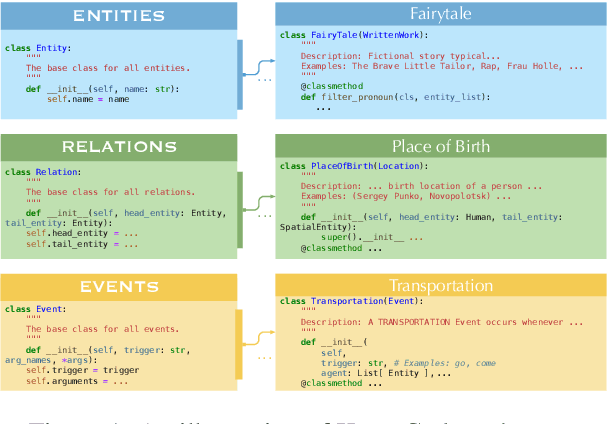
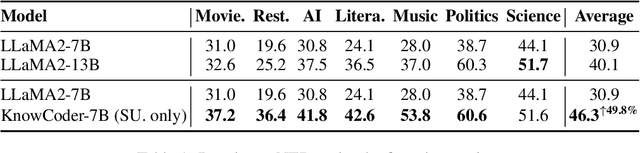
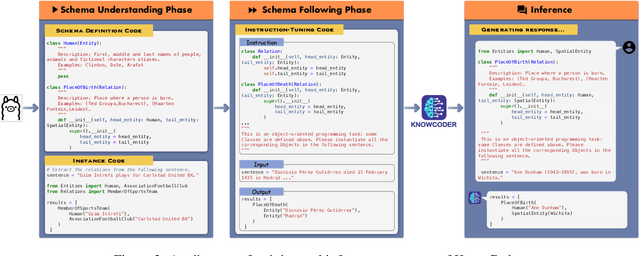
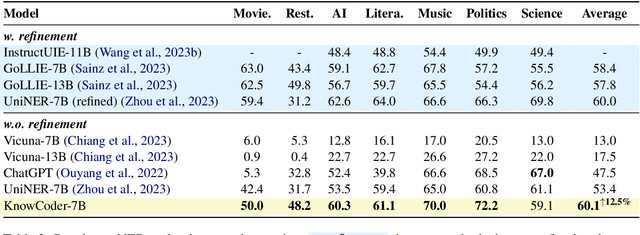
In this paper, we propose KnowCoder, a Large Language Model (LLM) to conduct Universal Information Extraction (UIE) via code generation. KnowCoder aims to develop a kind of unified schema representation that LLMs can easily understand and an effective learning framework that encourages LLMs to follow schemas and extract structured knowledge accurately. To achieve these, KnowCoder introduces a code-style schema representation method to uniformly transform different schemas into Python classes, with which complex schema information, such as constraints among tasks in UIE, can be captured in an LLM-friendly manner. We further construct a code-style schema library covering over $\textbf{30,000}$ types of knowledge, which is the largest one for UIE, to the best of our knowledge. To ease the learning process of LLMs, KnowCoder contains a two-phase learning framework that enhances its schema understanding ability via code pretraining and its schema following ability via instruction tuning. After code pretraining on around $1.5$B automatically constructed data, KnowCoder already attains remarkable generalization ability and achieves relative improvements by $\textbf{49.8%}$ F1, compared to LLaMA2, under the few-shot setting. After instruction tuning, KnowCoder further exhibits strong generalization ability on unseen schemas and achieves up to $\textbf{12.5%}$ and $\textbf{21.9%}$, compared to sota baselines, under the zero-shot setting and the low resource setting, respectively. Additionally, based on our unified schema representations, various human-annotated datasets can simultaneously be utilized to refine KnowCoder, which achieves significant improvements up to $\textbf{7.5%}$ under the supervised setting.
Retrieval-Augmented Code Generation for Universal Information Extraction
Nov 06, 2023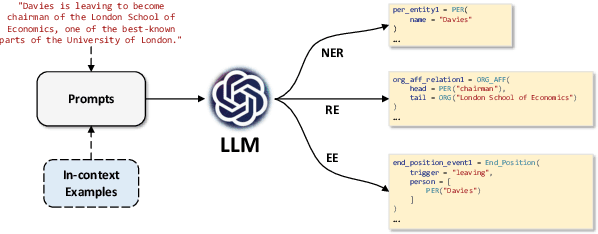
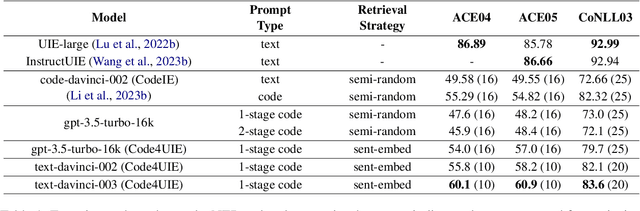
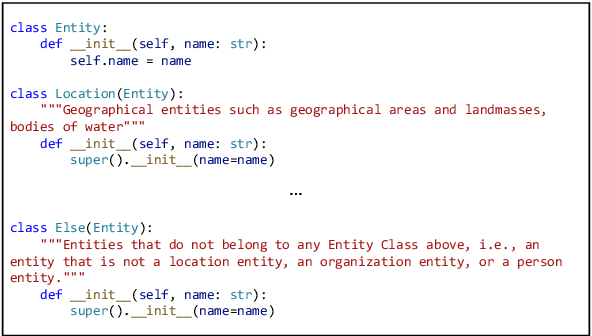
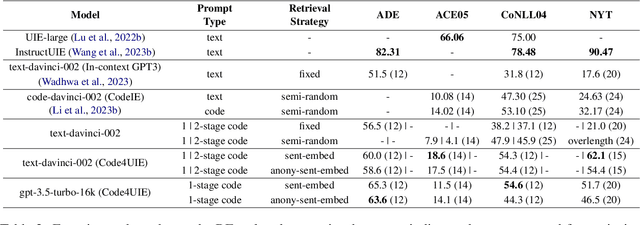
Information Extraction (IE) aims to extract structural knowledge (e.g., entities, relations, events) from natural language texts, which brings challenges to existing methods due to task-specific schemas and complex text expressions. Code, as a typical kind of formalized language, is capable of describing structural knowledge under various schemas in a universal way. On the other hand, Large Language Models (LLMs) trained on both codes and texts have demonstrated powerful capabilities of transforming texts into codes, which provides a feasible solution to IE tasks. Therefore, in this paper, we propose a universal retrieval-augmented code generation framework based on LLMs, called Code4UIE, for IE tasks. Specifically, Code4UIE adopts Python classes to define task-specific schemas of various structural knowledge in a universal way. By so doing, extracting knowledge under these schemas can be transformed into generating codes that instantiate the predefined Python classes with the information in texts. To generate these codes more precisely, Code4UIE adopts the in-context learning mechanism to instruct LLMs with examples. In order to obtain appropriate examples for different tasks, Code4UIE explores several example retrieval strategies, which can retrieve examples semantically similar to the given texts. Extensive experiments on five representative IE tasks across nine datasets demonstrate the effectiveness of the Code4UIE framework.