 Add to Chrome
 Add to Firefox
 Add to Edge
Learning When to Trust via Selective Context Preference Optimization
Aug 06, 2026
Language models increasingly condition their answers on external signals, and a single misleading one can turn a correct answer wrong. The obvious remedy, training models to resist such signals, hides a failure mode: a model that ignores all context looks robust yet is useless when the context is worth trusting. We recast the problem as selective trust and introduce MIST, a human-annotated benchmark that renders each reasoning item under four matched conditions (clean, misleading, correct-context, and irrelevant-context), together with SC2W, a paired metric counting how often a misleading signal flips a clean-correct answer to wrong. Across a comprehensive benchmark study, we observe that such a susceptibility is universal. We then propose SCOPE, which mines clean-correct/misleading-wrong failures and optimizes a standard Direct Preference Optimization (DPO) objective over matched preference pairs balanced equally across all four conditions, rather than over misleading items alone. Our approach substantially reduces SC2W on popular open-sourced models while preserving accuracy when the added context is clean, correct, or irrelevant. With this work, we argue that models should be judged on selective trust, not on resistance alone.

Quo Vadis, World Modeling?
Aug 03, 2026Continually improving agents require dynamic interaction feedback beyond static supervision, yet direct real-environment interaction is costly, slow, unsafe, and hard to parallelize. World modeling offers a natural intermediate proxy that allows agents to query lower-cost, more controllable feedback before committing to real actions. Classical world models instantiate this proxy primarily through future physical-state prediction, a formulation useful yet narrow for agents that require actionable feedback beyond raw state transitions. In this work, we conceptualize Agent-Centric Interactive World Proxies, shifting the fundamental paradigm from physical state transitions to agent-usable information transitions, such as execution outcomes, retrieved experiences or skills, and verification signals, broadening the scope of world modeling to provide versatile feedback for continually improving agents. To systematically map this design space, we organize world proxies into six functional forms based on their feedback modalities: dynamics, spatial, execution, memory/experience, skill, and reward/verification proxies, which together characterize the primary ways world modeling serves agent improvement. We further analyze how these proxies empower agents across three progressive levels: L.1 Inference-Time Guidance, where proxy outputs enrich in-context information for superior decisions; L.2 Training-Time Optimization, where proxy outputs yield rewards, critiques, or synthetic rollouts for policy learning; and L.3 Agent-Proxy Co-Evolution, where real-environment evidence continuously updates both the proxy and the agent for co-evolution. Ultimately, this work recasts world modeling into an agent-centric paradigm, establishing a roadmap for building world proxies that empower agents to plan better, learn faster, and evolve continually.
Data Pyramid for Embodied Manipulation
Jul 27, 2026Multimodal foundation models learned to see and to speak by consuming the whole internet. Embodied agents admit no such shortcut, since they require data that couple observations with physical states and actions. These signals can be provided, to varying degrees, by multiple data sources. In this work, we organize the embodied data ecosystem as a "pyramid" spanning five complementary sources: real-robot data, UMI-style data, egocentric and exocentric data, simulation data, and general vision-language data. We organize the pyramid around the tension between scalability and robot alignment, and further characterize each source in terms of data quality, diversity, reusability, and physical fidelity. We then analyze recent embodied foundation models through the lens of their data recipes, examining how different sources are selected, aligned, and mixed during pretraining. For embodied brain models, vision-language-action models, and world-action models alike, we relate data composition to capabilities in perception, reasoning, planning, action generation, and world prediction. We close by discussing six open challenges: building large-scale tactile datasets, collecting failure and recovery data, developing scalable data-collection pipelines, aligning actions across embodiments, leveraging egocentric data for dexterous manipulation, and designing principled data recipes for robot learning. We hope this work paves the foundation for the design of next-generation embodied systems.
AI for Auto-Research: Roadmap & User Guide
May 18, 2026AI-assisted research is crossing a threshold: fully automated systems can now generate research papers for as little as $15, while long-horizon agents can execute experiments, draft manuscripts, and simulate critique with minimal human input. Yet this productivity frontier exposes a deeper integrity problem: under scientific pressure, even frontier LLMs still fabricate results, miss hidden errors, and fail to judge novelty reliably. Studying developments through April 2026, we present an end-to-end analysis of AI across the complete research lifecycle, organized into four epistemological phases: Creation (idea generation, literature review, coding & experiments, tables & figures), Writing (paper writing), Validation (peer review, rebuttal & revision), and Dissemination (posters, slides, videos, social media, project pages, and interactive agents). We identify a sharp, stage-dependent boundary between reliable assistance and unreliable autonomy: AI excels at structured, retrieval-grounded, and tool-mediated tasks, but remains fragile for genuinely novel ideas, research-level experiments, and scientific judgment. Generated ideas often degrade after implementation, research code lags far behind pattern-matching benchmarks, and end-to-end autonomous systems have not yet consistently reached major-venue acceptance standards. We further show that greater automation can obscure rather than eliminate failure modes, making human-governed collaboration the most credible deployment paradigm. Finally, we provide a structured taxonomy, benchmark suite, and tool inventory, cross-stage design principles, and a practitioner-oriented playbook, with resources maintained at our project page.
Masked Generative Transformer Is What You Need for Image Editing
May 11, 2026Diffusion models dominate image editing, yet their global denoising mechanism entangles edited regions with surrounding context, causing modifications to propagate into areas that should remain intact. We propose a fundamentally different approach by leveraging Masked Generative Transformers (MGTs), whose localized token-prediction paradigm naturally confines changes to intended regions. We present EditMGT, an MGT-based editing framework that is the first of its kind. Our approach employs multi-layer attention consolidation to aggregate cross-attention maps into precise edit localization signals, and region-hold sampling to explicitly prevent token flipping in non-target areas. To support training, we construct CrispEdit-2M, a 2M-sample high-resolution (>1024) editing dataset spanning seven categories. With only 960M parameters, EditMGT achieves state-of-the-art image similarity on multiple benchmarks while delivering 6x faster editing, demonstrating that MGTs offer a compelling alternative to diffusion-based editing.
Agentic World Modeling: Foundations, Capabilities, Laws, and Beyond
Apr 24, 2026As AI systems move from generating text to accomplishing goals through sustained interaction, the ability to model environment dynamics becomes a central bottleneck. Agents that manipulate objects, navigate software, coordinate with others, or design experiments require predictive environment models, yet the term world model carries different meanings across research communities. We introduce a "levels x laws" taxonomy organized along two axes. The first defines three capability levels: L1 Predictor, which learns one-step local transition operators; L2 Simulator, which composes them into multi-step, action-conditioned rollouts that respect domain laws; and L3 Evolver, which autonomously revises its own model when predictions fail against new evidence. The second identifies four governing-law regimes: physical, digital, social, and scientific. These regimes determine what constraints a world model must satisfy and where it is most likely to fail. Using this framework, we synthesize over 400 works and summarize more than 100 representative systems spanning model-based reinforcement learning, video generation, web and GUI agents, multi-agent social simulation, and AI-driven scientific discovery. We analyze methods, failure modes, and evaluation practices across level-regime pairs, propose decision-centric evaluation principles and a minimal reproducible evaluation package, and outline architectural guidance, open problems, and governance challenges. The resulting roadmap connects previously isolated communities and charts a path from passive next-step prediction toward world models that can simulate, and ultimately reshape, the environments in which agents operate.
EditMGT: Unleashing Potentials of Masked Generative Transformers in Image Editing
Dec 12, 2025Recent advances in diffusion models (DMs) have achieved exceptional visual quality in image editing tasks. However, the global denoising dynamics of DMs inherently conflate local editing targets with the full-image context, leading to unintended modifications in non-target regions. In this paper, we shift our attention beyond DMs and turn to Masked Generative Transformers (MGTs) as an alternative approach to tackle this challenge. By predicting multiple masked tokens rather than holistic refinement, MGTs exhibit a localized decoding paradigm that endows them with the inherent capacity to explicitly preserve non-relevant regions during the editing process. Building upon this insight, we introduce the first MGT-based image editing framework, termed EditMGT. We first demonstrate that MGT's cross-attention maps provide informative localization signals for localizing edit-relevant regions and devise a multi-layer attention consolidation scheme that refines these maps to achieve fine-grained and precise localization. On top of these adaptive localization results, we introduce region-hold sampling, which restricts token flipping within low-attention areas to suppress spurious edits, thereby confining modifications to the intended target regions and preserving the integrity of surrounding non-target areas. To train EditMGT, we construct CrispEdit-2M, a high-resolution dataset spanning seven diverse editing categories. Without introducing additional parameters, we adapt a pre-trained text-to-image MGT into an image editing model through attention injection. Extensive experiments across four standard benchmarks demonstrate that, with fewer than 1B parameters, our model achieves similarity performance while enabling 6 times faster editing. Moreover, it delivers comparable or superior editing quality, with improvements of 3.6% and 17.6% on style change and style transfer tasks, respectively.
WEAVE: Unleashing and Benchmarking the In-context Interleaved Comprehension and Generation
Nov 14, 2025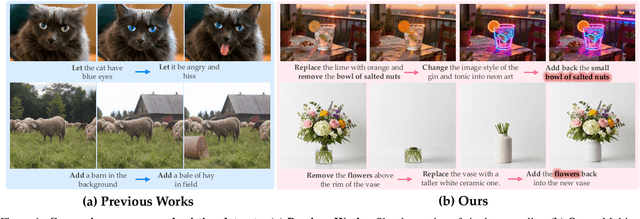
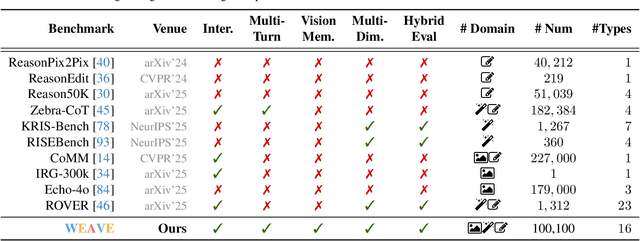
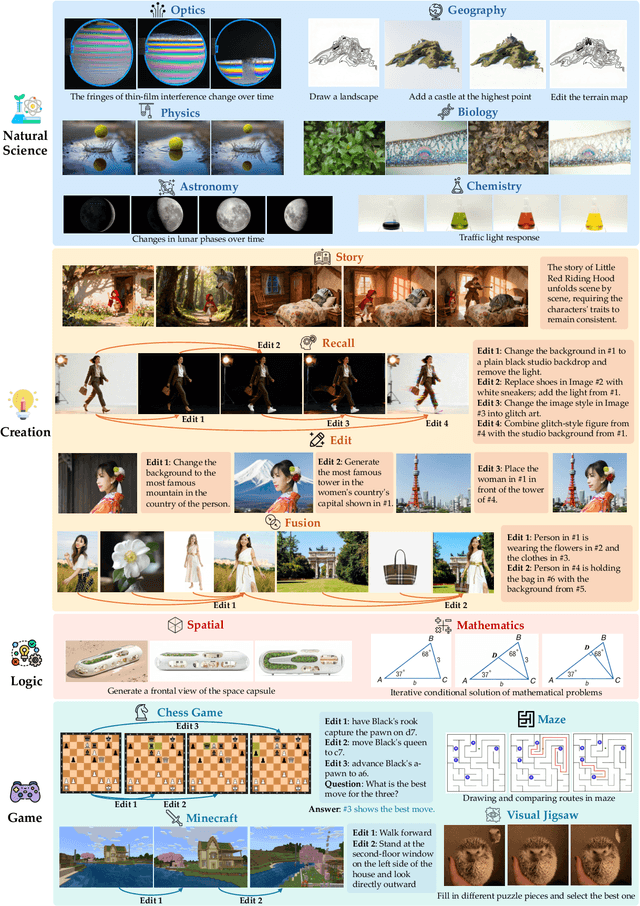
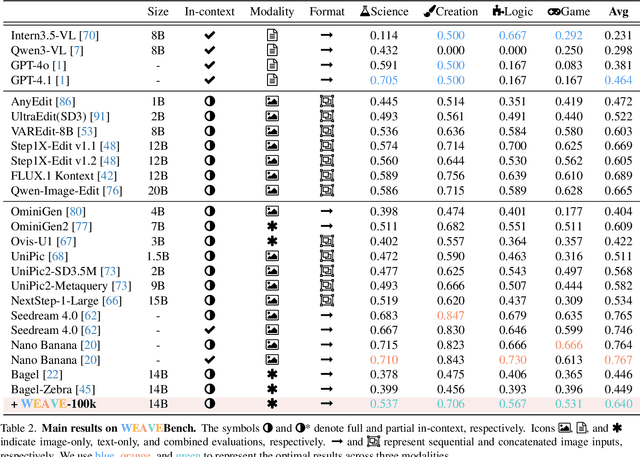
Recent advances in unified multimodal models (UMMs) have enabled impressive progress in visual comprehension and generation. However, existing datasets and benchmarks focus primarily on single-turn interactions, failing to capture the multi-turn, context-dependent nature of real-world image creation and editing. To address this gap, we present WEAVE, the first suite for in-context interleaved cross-modality comprehension and generation. Our suite consists of two complementary parts. WEAVE-100k is a large-scale dataset of 100K interleaved samples spanning over 370K dialogue turns and 500K images, covering comprehension, editing, and generation tasks that require reasoning over historical context. WEAVEBench is a human-annotated benchmark with 100 tasks based on 480 images, featuring a hybrid VLM judger evaluation framework based on both the reference image and the combination of the original image with editing instructions that assesses models' abilities in multi-turn generation, visual memory, and world-knowledge reasoning across diverse domains. Experiments demonstrate that training on WEAVE-100k enables vision comprehension, image editing, and comprehension-generation collaboration capabilities. Furthermore, it facilitates UMMs to develop emergent visual-memory capabilities, while extensive evaluations on WEAVEBench expose the persistent limitations and challenges of current approaches in multi-turn, context-aware image generation and editing. We believe WEAVE provides a view and foundation for studying in-context interleaved comprehension and generation for multi-modal community.
Mixed-R1: Unified Reward Perspective For Reasoning Capability in Multimodal Large Language Models
May 30, 2025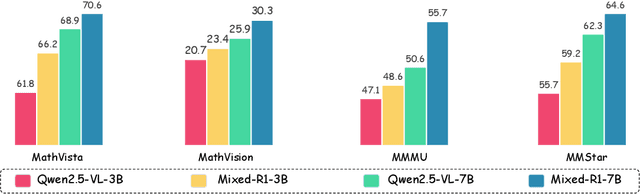
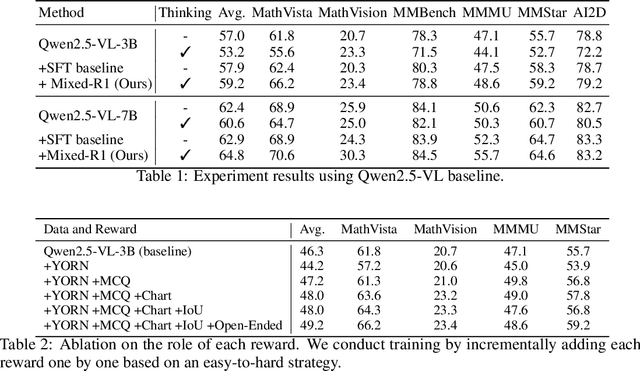
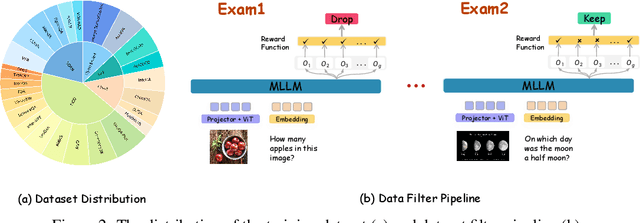

Recent works on large language models (LLMs) have successfully demonstrated the emergence of reasoning capabilities via reinforcement learning (RL). Although recent efforts leverage group relative policy optimization (GRPO) for MLLMs post-training, they constantly explore one specific aspect, such as grounding tasks, math problems, or chart analysis. There are no works that can leverage multi-source MLLM tasks for stable reinforcement learning. In this work, we present a unified perspective to solve this problem. We present Mixed-R1, a unified yet straightforward framework that contains a mixed reward function design (Mixed-Reward) and a mixed post-training dataset (Mixed-45K). We first design a data engine to select high-quality examples to build the Mixed-45K post-training dataset. Then, we present a Mixed-Reward design, which contains various reward functions for various MLLM tasks. In particular, it has four different reward functions: matching reward for binary answer or multiple-choice problems, chart reward for chart-aware datasets, IoU reward for grounding problems, and open-ended reward for long-form text responses such as caption datasets. To handle the various long-form text content, we propose a new open-ended reward named Bidirectional Max-Average Similarity (BMAS) by leveraging tokenizer embedding matching between the generated response and the ground truth. Extensive experiments show the effectiveness of our proposed method on various MLLMs, including Qwen2.5-VL and Intern-VL on various sizes. Our dataset and model are available at https://github.com/xushilin1/mixed-r1.
An Empirical Study of GPT-4o Image Generation Capabilities
Apr 08, 2025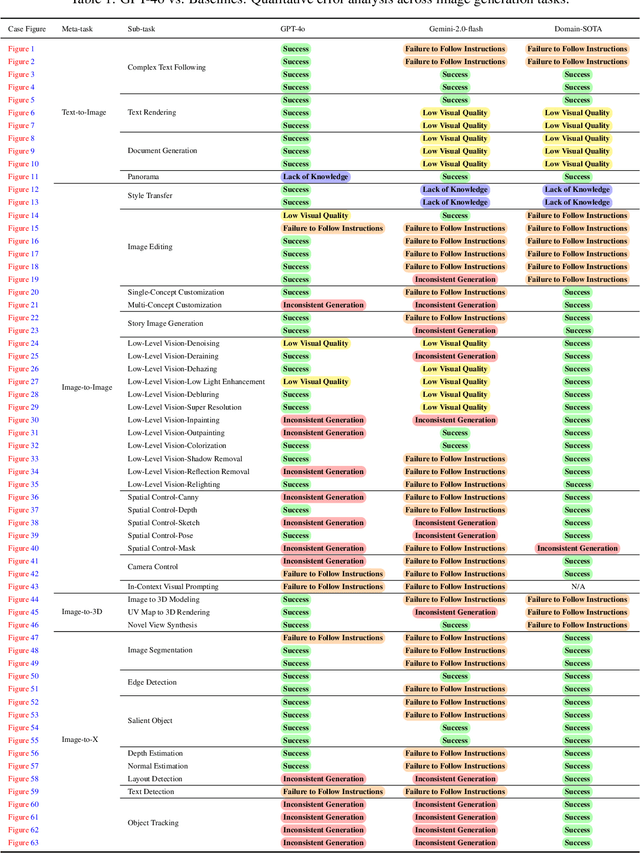


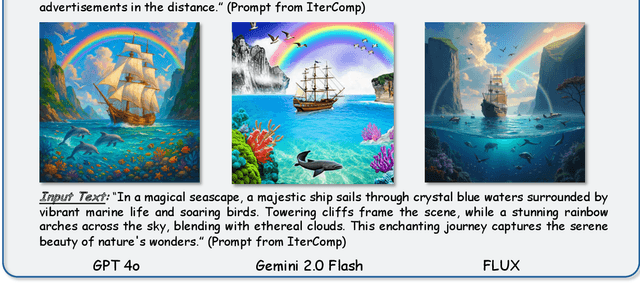
The landscape of image generation has rapidly evolved, from early GAN-based approaches to diffusion models and, most recently, to unified generative architectures that seek to bridge understanding and generation tasks. Recent advances, especially the GPT-4o, have demonstrated the feasibility of high-fidelity multimodal generation, their architectural design remains mysterious and unpublished. This prompts the question of whether image and text generation have already been successfully integrated into a unified framework for those methods. In this work, we conduct an empirical study of GPT-4o's image generation capabilities, benchmarking it against leading open-source and commercial models. Our evaluation covers four main categories, including text-to-image, image-to-image, image-to-3D, and image-to-X generation, with more than 20 tasks. Our analysis highlights the strengths and limitations of GPT-4o under various settings, and situates it within the broader evolution of generative modeling. Through this investigation, we identify promising directions for future unified generative models, emphasizing the role of architectural design and data scaling.