 Add to Chrome
 Add to Firefox
 Add to Edge
PerceptionDLM: Parallel Region Perception with Multimodal Diffusion Language Models
Jun 17, 2026
Multimodal large language models (MLLMs) have achieved remarkable progress in visual understanding tasks. However, most existing MLLMs rely on autoregressive generation, which limits their efficiency for perception tasks that require captioning multiple regions. In this work, we propose PerceptionDLM, a multimodal diffusion language model optimized for efficient parallel region perception. Built upon PerceptionDLM-Base, a strong foundational baseline that achieves state-of-the-art performance among open-source diffusion MLLMs, our architecture fully leverages the parallel decoding nature of DLMs. Specifically, we introduce efficient prompting and structured attention masking to enable simultaneous perception of multiple masked regions, allowing the model to generate region descriptions in parallel at both the sequence and token levels. This design significantly improves inference efficiency compared with existing approaches that process regions sequentially. To systematically evaluate the parallelism property of visual perception capability for DLMs, we construct a new Parallel Detailed Localized Captioning Benchmark (ParaDLC-Bench) by scaling the DLC-Bench to include multiple region masks per image, enabling joint evaluation of both caption quality and inference efficiency. Experiments demonstrate that PerceptionDLM maintains competitive performance in region captioning while achieving substantial speed improvements for multi-region perception tasks. Our results highlight the potential of multimodal diffusion language models for efficient, parallel visual perception. To the best of our knowledge, we are the first to achieve parallel region caption and perception by leveraging the advantages of diffusion language models. Code, models, and datasets are released.

Mixed-R1: Unified Reward Perspective For Reasoning Capability in Multimodal Large Language Models
May 30, 2025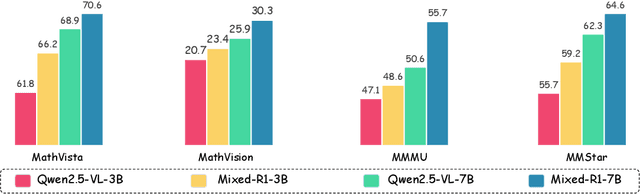
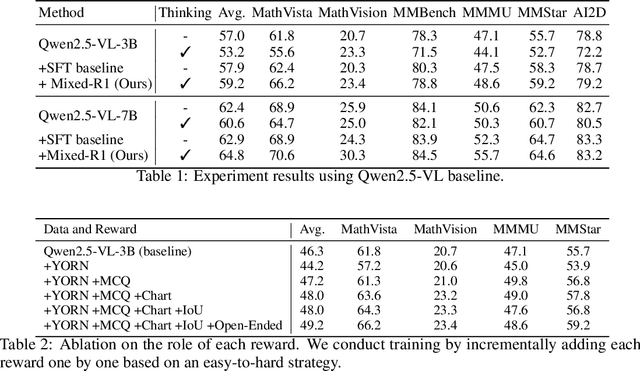
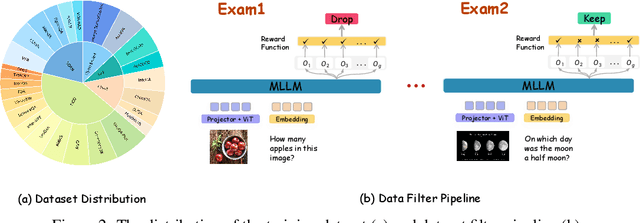
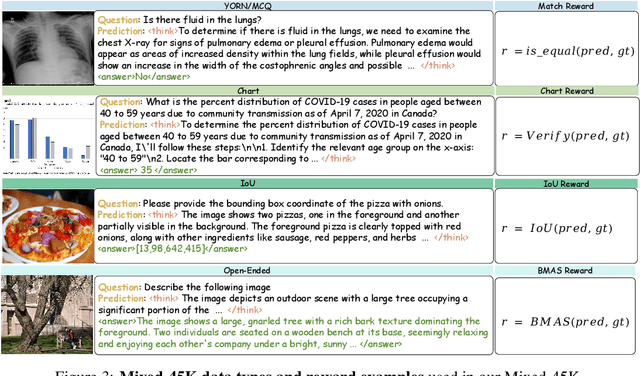
Recent works on large language models (LLMs) have successfully demonstrated the emergence of reasoning capabilities via reinforcement learning (RL). Although recent efforts leverage group relative policy optimization (GRPO) for MLLMs post-training, they constantly explore one specific aspect, such as grounding tasks, math problems, or chart analysis. There are no works that can leverage multi-source MLLM tasks for stable reinforcement learning. In this work, we present a unified perspective to solve this problem. We present Mixed-R1, a unified yet straightforward framework that contains a mixed reward function design (Mixed-Reward) and a mixed post-training dataset (Mixed-45K). We first design a data engine to select high-quality examples to build the Mixed-45K post-training dataset. Then, we present a Mixed-Reward design, which contains various reward functions for various MLLM tasks. In particular, it has four different reward functions: matching reward for binary answer or multiple-choice problems, chart reward for chart-aware datasets, IoU reward for grounding problems, and open-ended reward for long-form text responses such as caption datasets. To handle the various long-form text content, we propose a new open-ended reward named Bidirectional Max-Average Similarity (BMAS) by leveraging tokenizer embedding matching between the generated response and the ground truth. Extensive experiments show the effectiveness of our proposed method on various MLLMs, including Qwen2.5-VL and Intern-VL on various sizes. Our dataset and model are available at https://github.com/xushilin1/mixed-r1.