 Add to Chrome
 Add to Firefox
 Add to Edge
DynamicWAM: Dual-Path Motion Conditioning for World-Action Models in Dynamic Manipulation
Aug 01, 2026
Dynamic manipulation requires robots to infer target motion and respond promptly, yet existing World-Action Models (WAMs) typically condition only on the current frame and execute large backbones synchronously, limiting motion awareness and responsive control in dynamic scenes. We propose DynamicWAM, a compact WAM for dynamic object manipulation with dual-path motion conditioning. DynamicWAM introduces history-flow conditioning, encoding temporally aligned optical-flow frames alongside the current observation through a frozen pretrained video VAE to preserve spatial motion structure, while injecting kinematic descriptors of displacement, duration, velocity, and acceleration into the action expert to provide motion magnitude and timing. The two complementary paths are fused through joint world-action attention. A distilled compact backbone and real-time chunking (RTC)-based asynchronous execution further enable responsive control. On DOMINO, DynamicWAM achieves a 38.2% success rate and a 53.2 manipulation score, outperforming all evaluated baselines. Across 12 real-world tasks spanning linear, circular, and compound target motion, it achieves a 46.7% average success rate, exceeding the strongest baseline by 22.9 percentage points.

Data Pyramid for Embodied Manipulation
Jul 27, 2026Multimodal foundation models learned to see and to speak by consuming the whole internet. Embodied agents admit no such shortcut, since they require data that couple observations with physical states and actions. These signals can be provided, to varying degrees, by multiple data sources. In this work, we organize the embodied data ecosystem as a "pyramid" spanning five complementary sources: real-robot data, UMI-style data, egocentric and exocentric data, simulation data, and general vision-language data. We organize the pyramid around the tension between scalability and robot alignment, and further characterize each source in terms of data quality, diversity, reusability, and physical fidelity. We then analyze recent embodied foundation models through the lens of their data recipes, examining how different sources are selected, aligned, and mixed during pretraining. For embodied brain models, vision-language-action models, and world-action models alike, we relate data composition to capabilities in perception, reasoning, planning, action generation, and world prediction. We close by discussing six open challenges: building large-scale tactile datasets, collecting failure and recovery data, developing scalable data-collection pipelines, aligning actions across embodiments, leveraging egocentric data for dexterous manipulation, and designing principled data recipes for robot learning. We hope this work paves the foundation for the design of next-generation embodied systems.
Efficient-WAM: A 1B-Parameter World-Action Model with Low-Cost Future Imagination
Jun 08, 2026World-Action Models (WAMs) have emerged as a promising paradigm for embodied control by coupling future visual prediction with action generation. However, most existing WAMs rely on photorealistic future prediction, which incurs high inference latency and makes real-time robot deployment difficult. This motivates a more efficient WAM design that preserves the control benefits of future visual prediction while reducing its inference cost. We introduce Efficient-WAM, a World-Action Model that reduces the cost of future imagination while preserving its control benefit. Efficient-WAM improves inference efficiency via a compact video expert transferred from WAN-2.2-5B, token-sparse video latents, and asymmetric video-action denoising that allocates fewer sampling steps to video than to actions. Instead of optimizing the future branch for visual fidelity, Efficient-WAM treats future video prediction as a compact guidance signal for action generation. Comprehensive experiments on RoboTwin 2.0 and real-world manipulation tasks show that Efficient-WAM maintains strong action performance despite visibly coarse future predictions. While maintaining competitive control capabilities, our 1B-parameter model can reduce per-chunk latency to around 100 ms during physical deployment, achieving a 30x speedup over existing WAMs.
Dream-Tac: A Unified Tactile World Action Model for Contact-Rich Robot Manipulation
Jun 07, 2026World action models inherit the predictive capability of world models, enabling action generation to be guided by anticipated future observations. However, they rely primarily on vision and often fail in contact-rich manipulation, where critical cues arise from physical interaction. In this paper, we propose Dream-Tac, a unified Tactile-World Action Model that jointly models actions, future visual observations, and tactile dynamics. Specifically, Dream-Tac introduces (i) contact-gated visuotactile fusion to selectively integrate tactile signals and (ii) a contact-aware attention bias to better regulate cross-modal interactions during manipulation. To support real-time deployment, we further design a dual-level acceleration strategy, reformulating the contact-aware bias to preserve the fused attention path during training and introducing cache-based diffusion acceleration at inference, achieving up to 2.9$\times$ faster training and 1.8$\times$ faster inference. Across six contact-rich manipulation tasks, Dream-Tac improves action accuracy by 31.7\% on average, demonstrating the effectiveness of unified visuotactile world modeling.Code is available at https://github.com/LYFCLOUDFAN/Dream-Tac.
Token Expand-Merge: Training-Free Token Compression for Vision-Language-Action Models
Dec 10, 2025Vision-Language-Action (VLA) models pretrained on large-scale multimodal datasets have emerged as powerful foundations for robotic perception and control. However, their massive scale, often billions of parameters, poses significant challenges for real-time deployment, as inference becomes computationally expensive and latency-sensitive in dynamic environments. To address this, we propose Token Expand-and-Merge-VLA (TEAM-VLA), a training-free token compression framework that accelerates VLA inference while preserving task performance. TEAM-VLA introduces a dynamic token expansion mechanism that identifies and samples additional informative tokens in the spatial vicinity of attention-highlighted regions, enhancing contextual completeness. These expanded tokens are then selectively merged in deeper layers under action-aware guidance, effectively reducing redundancy while maintaining semantic coherence. By coupling expansion and merging within a single feed-forward pass, TEAM-VLA achieves a balanced trade-off between efficiency and effectiveness, without any retraining or parameter updates. Extensive experiments on LIBERO benchmark demonstrate that TEAM-VLA consistently improves inference speed while maintaining or even surpassing the task success rate of full VLA models. The code is public available on \href{https://github.com/Jasper-aaa/TEAM-VLA}{https://github.com/Jasper-aaa/TEAM-VLA}
NeuralHDHair: Automatic High-fidelity Hair Modeling from a Single Image Using Implicit Neural Representations
May 09, 2022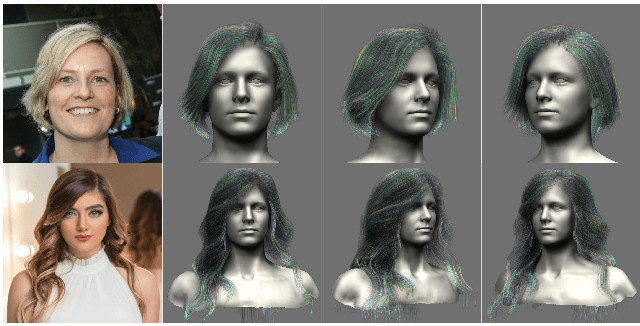
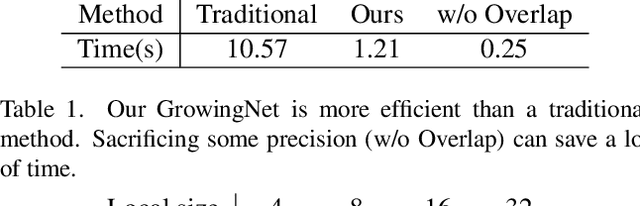
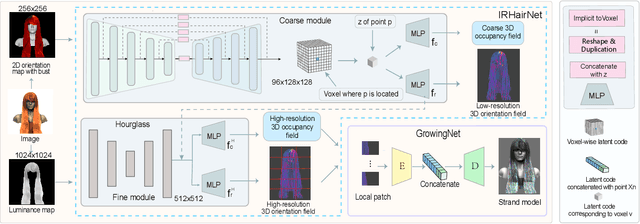
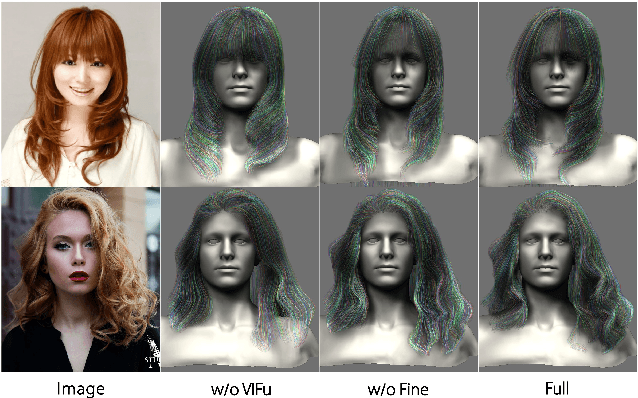
Undoubtedly, high-fidelity 3D hair plays an indispensable role in digital humans. However, existing monocular hair modeling methods are either tricky to deploy in digital systems (e.g., due to their dependence on complex user interactions or large databases) or can produce only a coarse geometry. In this paper, we introduce NeuralHDHair, a flexible, fully automatic system for modeling high-fidelity hair from a single image. The key enablers of our system are two carefully designed neural networks: an IRHairNet (Implicit representation for hair using neural network) for inferring high-fidelity 3D hair geometric features (3D orientation field and 3D occupancy field) hierarchically and a GrowingNet(Growing hair strands using neural network) to efficiently generate 3D hair strands in parallel. Specifically, we perform a coarse-to-fine manner and propose a novel voxel-aligned implicit function (VIFu) to represent the global hair feature, which is further enhanced by the local details extracted from a hair luminance map. To improve the efficiency of a traditional hair growth algorithm, we adopt a local neural implicit function to grow strands based on the estimated 3D hair geometric features. Extensive experiments show that our method is capable of constructing a high-fidelity 3D hair model from a single image, both efficiently and effectively, and achieves the-state-of-the-art performance.