 Add to Chrome
 Add to Firefox
 Add to Edge
Masked Generative Transformer Is What You Need for Image Editing
May 11, 2026
Diffusion models dominate image editing, yet their global denoising mechanism entangles edited regions with surrounding context, causing modifications to propagate into areas that should remain intact. We propose a fundamentally different approach by leveraging Masked Generative Transformers (MGTs), whose localized token-prediction paradigm naturally confines changes to intended regions. We present EditMGT, an MGT-based editing framework that is the first of its kind. Our approach employs multi-layer attention consolidation to aggregate cross-attention maps into precise edit localization signals, and region-hold sampling to explicitly prevent token flipping in non-target areas. To support training, we construct CrispEdit-2M, a 2M-sample high-resolution (>1024) editing dataset spanning seven categories. With only 960M parameters, EditMGT achieves state-of-the-art image similarity on multiple benchmarks while delivering 6x faster editing, demonstrating that MGTs offer a compelling alternative to diffusion-based editing.

NTIRE 2026 Challenge on Short-form UGC Video Restoration in the Wild with Generative Models: Datasets, Methods and Results
Apr 12, 2026This paper presents an overview of the NTIRE 2026 Challenge on Short-form UGC Video Restoration in the Wild with Generative Models. This challenge utilizes a new short-form UGC (S-UGC) video restoration benchmark, termed KwaiVIR, which is contributed by USTC and Kuaishou Technology. It contains both synthetically distorted videos and real-world short-form UGC videos in the wild. For this edition, the released data include 200 synthetic training videos, 48 wild training videos, 11 validation videos, and 20 testing videos. The primary goal of this challenge is to establish a strong and practical benchmark for restoring short-form UGC videos under complex real-world degradations, especially in the emerging paradigm of generative-model-based S-UGC video restoration. This challenge has two tracks: (i) the primary track is a subjective track, where the evaluation is based on a user study; (ii) the second track is an objective track. These two tracks enable a comprehensive assessment of restoration quality. In total, 95 teams have registered for this competition. And 12 teams submitted valid final solutions and fact sheets for the testing phase. The submitted methods achieved strong performance on the KwaiVIR benchmark, demonstrating encouraging progress in short-form UGC video restoration in the wild.
Hybrid Physical and Geometrical Optics Method for Modeling Subsurface Imaging Using mmWave FMCW Radar
Apr 11, 2026A hybrid physical and geometrical optics method is proposed to model the subsurface imaging using mmWave FMCW radar. Modeling of the wave propagation for subsurface imaging can improve the interpretation of acquired data and imaging results. Full-wave simulation is common in simulating wave propagation. However, when the frequency is high such as mmWave frequency, it is difficult to implement since it costs large computation resource and time. In this paper, the physical and geometrical optics are hybridized to simulate the wave propagation in subsurface imaging scenarios. In the proposed method, physical optics method is utilized to calculate the reflection from the object and geometrical optics method is utilized to calculate the transmission of the wave through object. By combining the results from physical and geometrical optics, the wave propagation in the subsurface imaging scenarios is simulated. The synthetic-aperture radar imaging is applied to the simulated data and the image is successfully reconstructed. Further, the experiment setup is developed and the comparison between simulation and experiment is carried out. The results demonstrated that the proposed simulation method can model the subsurface imaging with mmWave FMCW radar.
NTIRE 2026 3D Restoration and Reconstruction in Real-world Adverse Conditions: RealX3D Challenge Results
Apr 05, 2026This paper presents a comprehensive review of the NTIRE 2026 3D Restoration and Reconstruction (3DRR) Challenge, detailing the proposed methods and results. The challenge seeks to identify robust reconstruction pipelines that are robust under real-world adverse conditions, specifically extreme low-light and smoke-degraded environments, as captured by our RealX3D benchmark. A total of 279 participants registered for the competition, of whom 33 teams submitted valid results. We thoroughly evaluate the submitted approaches against state-of-the-art baselines, revealing significant progress in 3D reconstruction under adverse conditions. Our analysis highlights shared design principles among top-performing methods and provides insights into effective strategies for handling 3D scene degradation.
The RoboSense Challenge: Sense Anything, Navigate Anywhere, Adapt Across Platforms
Jan 08, 2026Autonomous systems are increasingly deployed in open and dynamic environments -- from city streets to aerial and indoor spaces -- where perception models must remain reliable under sensor noise, environmental variation, and platform shifts. However, even state-of-the-art methods often degrade under unseen conditions, highlighting the need for robust and generalizable robot sensing. The RoboSense 2025 Challenge is designed to advance robustness and adaptability in robot perception across diverse sensing scenarios. It unifies five complementary research tracks spanning language-grounded decision making, socially compliant navigation, sensor configuration generalization, cross-view and cross-modal correspondence, and cross-platform 3D perception. Together, these tasks form a comprehensive benchmark for evaluating real-world sensing reliability under domain shifts, sensor failures, and platform discrepancies. RoboSense 2025 provides standardized datasets, baseline models, and unified evaluation protocols, enabling large-scale and reproducible comparison of robust perception methods. The challenge attracted 143 teams from 85 institutions across 16 countries, reflecting broad community engagement. By consolidating insights from 23 winning solutions, this report highlights emerging methodological trends, shared design principles, and open challenges across all tracks, marking a step toward building robots that can sense reliably, act robustly, and adapt across platforms in real-world environments.
Vision-Language-Action Models for Autonomous Driving: Past, Present, and Future
Dec 18, 2025Autonomous driving has long relied on modular "Perception-Decision-Action" pipelines, where hand-crafted interfaces and rule-based components often break down in complex or long-tailed scenarios. Their cascaded design further propagates perception errors, degrading downstream planning and control. Vision-Action (VA) models address some limitations by learning direct mappings from visual inputs to actions, but they remain opaque, sensitive to distribution shifts, and lack structured reasoning or instruction-following capabilities. Recent progress in Large Language Models (LLMs) and multimodal learning has motivated the emergence of Vision-Language-Action (VLA) frameworks, which integrate perception with language-grounded decision making. By unifying visual understanding, linguistic reasoning, and actionable outputs, VLAs offer a pathway toward more interpretable, generalizable, and human-aligned driving policies. This work provides a structured characterization of the emerging VLA landscape for autonomous driving. We trace the evolution from early VA approaches to modern VLA frameworks and organize existing methods into two principal paradigms: End-to-End VLA, which integrates perception, reasoning, and planning within a single model, and Dual-System VLA, which separates slow deliberation (via VLMs) from fast, safety-critical execution (via planners). Within these paradigms, we further distinguish subclasses such as textual vs. numerical action generators and explicit vs. implicit guidance mechanisms. We also summarize representative datasets and benchmarks for evaluating VLA-based driving systems and highlight key challenges and open directions, including robustness, interpretability, and instruction fidelity. Overall, this work aims to establish a coherent foundation for advancing human-compatible autonomous driving systems.
EditMGT: Unleashing Potentials of Masked Generative Transformers in Image Editing
Dec 12, 2025Recent advances in diffusion models (DMs) have achieved exceptional visual quality in image editing tasks. However, the global denoising dynamics of DMs inherently conflate local editing targets with the full-image context, leading to unintended modifications in non-target regions. In this paper, we shift our attention beyond DMs and turn to Masked Generative Transformers (MGTs) as an alternative approach to tackle this challenge. By predicting multiple masked tokens rather than holistic refinement, MGTs exhibit a localized decoding paradigm that endows them with the inherent capacity to explicitly preserve non-relevant regions during the editing process. Building upon this insight, we introduce the first MGT-based image editing framework, termed EditMGT. We first demonstrate that MGT's cross-attention maps provide informative localization signals for localizing edit-relevant regions and devise a multi-layer attention consolidation scheme that refines these maps to achieve fine-grained and precise localization. On top of these adaptive localization results, we introduce region-hold sampling, which restricts token flipping within low-attention areas to suppress spurious edits, thereby confining modifications to the intended target regions and preserving the integrity of surrounding non-target areas. To train EditMGT, we construct CrispEdit-2M, a high-resolution dataset spanning seven diverse editing categories. Without introducing additional parameters, we adapt a pre-trained text-to-image MGT into an image editing model through attention injection. Extensive experiments across four standard benchmarks demonstrate that, with fewer than 1B parameters, our model achieves similarity performance while enabling 6 times faster editing. Moreover, it delivers comparable or superior editing quality, with improvements of 3.6% and 17.6% on style change and style transfer tasks, respectively.
Astra: A Multi-Agent System for GPU Kernel Performance Optimization
Sep 09, 2025GPU kernel optimization has long been a central challenge at the intersection of high-performance computing and machine learning. Efficient kernels are crucial for accelerating large language model (LLM) training and serving, yet attaining high performance typically requires extensive manual tuning. Compiler-based systems reduce some of this burden, but still demand substantial manual design and engineering effort. Recently, researchers have explored using LLMs for GPU kernel generation, though prior work has largely focused on translating high-level PyTorch modules into CUDA code. In this work, we introduce Astra, the first LLM-based multi-agent system for GPU kernel optimization. Unlike previous approaches, Astra starts from existing CUDA implementations extracted from SGLang, a widely deployed framework for serving LLMs, rather than treating PyTorch modules as the specification. Within Astra, specialized LLM agents collaborate through iterative code generation, testing, profiling, and planning to produce kernels that are both correct and high-performance. On kernels from SGLang, Astra achieves an average speedup of 1.32x using zero-shot prompting with OpenAI o4-mini. A detailed case study further demonstrates that LLMs can autonomously apply loop transformations, optimize memory access patterns, exploit CUDA intrinsics, and leverage fast math operations to yield substantial performance gains. Our work highlights multi-agent LLM systems as a promising new paradigm for GPU kernel optimization.
Mixed-R1: Unified Reward Perspective For Reasoning Capability in Multimodal Large Language Models
May 30, 2025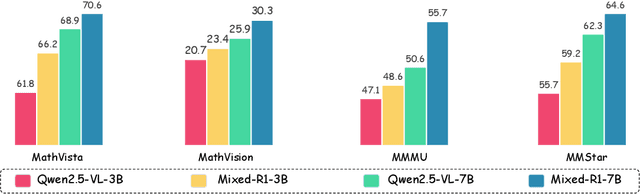
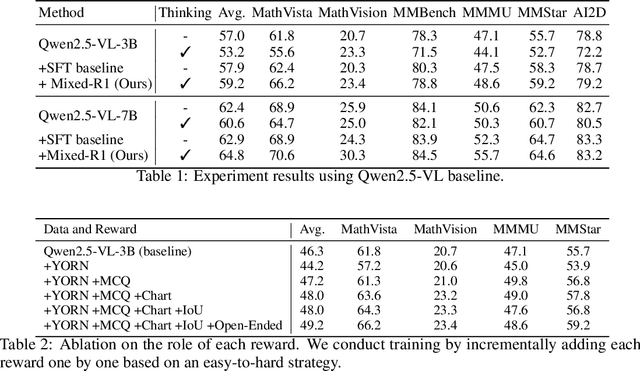
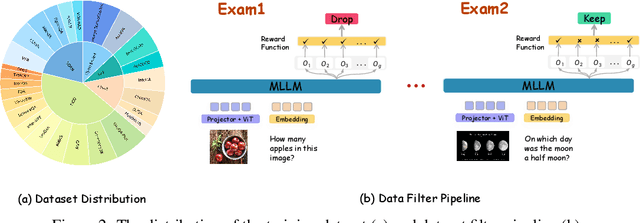
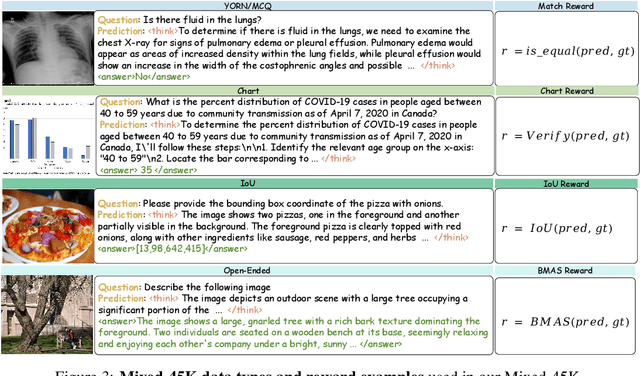
Recent works on large language models (LLMs) have successfully demonstrated the emergence of reasoning capabilities via reinforcement learning (RL). Although recent efforts leverage group relative policy optimization (GRPO) for MLLMs post-training, they constantly explore one specific aspect, such as grounding tasks, math problems, or chart analysis. There are no works that can leverage multi-source MLLM tasks for stable reinforcement learning. In this work, we present a unified perspective to solve this problem. We present Mixed-R1, a unified yet straightforward framework that contains a mixed reward function design (Mixed-Reward) and a mixed post-training dataset (Mixed-45K). We first design a data engine to select high-quality examples to build the Mixed-45K post-training dataset. Then, we present a Mixed-Reward design, which contains various reward functions for various MLLM tasks. In particular, it has four different reward functions: matching reward for binary answer or multiple-choice problems, chart reward for chart-aware datasets, IoU reward for grounding problems, and open-ended reward for long-form text responses such as caption datasets. To handle the various long-form text content, we propose a new open-ended reward named Bidirectional Max-Average Similarity (BMAS) by leveraging tokenizer embedding matching between the generated response and the ground truth. Extensive experiments show the effectiveness of our proposed method on various MLLMs, including Qwen2.5-VL and Intern-VL on various sizes. Our dataset and model are available at https://github.com/xushilin1/mixed-r1.
Advancing Fine-Grained Visual Understanding with Multi-Scale Alignment in Multi-Modal Models
Nov 14, 2024


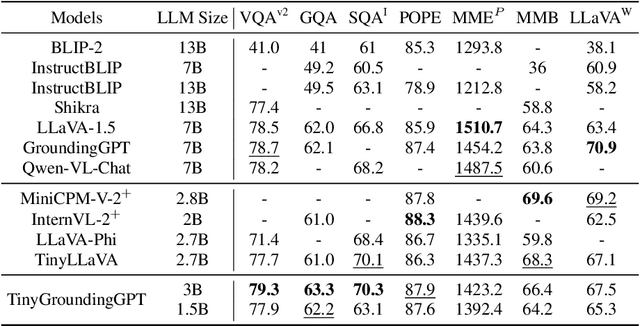
Multi-modal large language models (MLLMs) have achieved remarkable success in fine-grained visual understanding across a range of tasks. However, they often encounter significant challenges due to inadequate alignment for fine-grained knowledge, which restricts their ability to accurately capture local details and attain a comprehensive global perception. While recent advancements have focused on aligning object expressions with grounding information, they typically lack explicit integration of object images, which contain affluent information beyond mere texts or coordinates. To bridge this gap, we introduce a novel fine-grained visual knowledge alignment method that effectively aligns and integrates multi-scale knowledge of objects, including texts, coordinates, and images. This innovative method is underpinned by our multi-scale fine-grained enhancement data synthesis pipeline, which provides over 300K essential training data to enhance alignment and improve overall performance. Furthermore, we present TinyGroundingGPT, a series of compact models optimized for high-level alignments. With a scale of approximately 3B parameters, TinyGroundingGPT achieves outstanding results in grounding tasks while delivering performance comparable to larger MLLMs in complex visual scenarios.